
Market Report · July 20, 2026

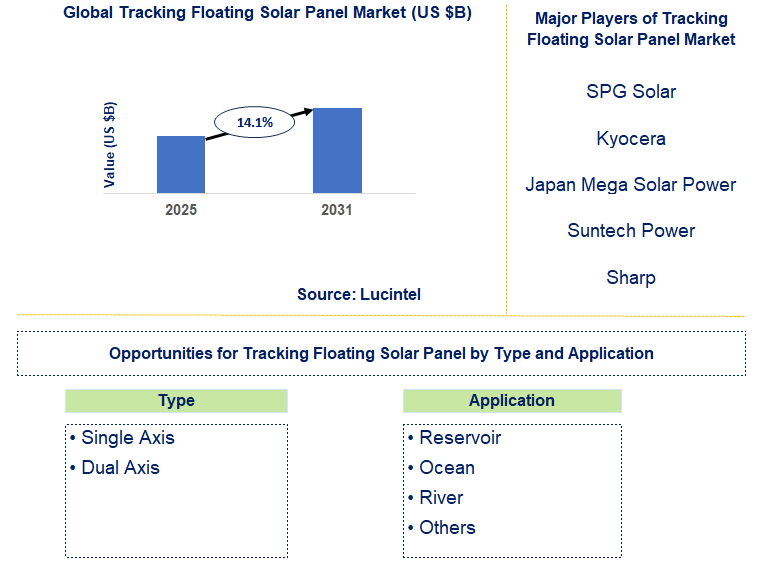
Key data points: The growth forecast = 14.1% annually for the next 7 years. Scroll below to get more insights. This market report covers Trends, opportunities and forecasts in tracking floating solar panel market to 2031 by type (single axis and dual axis), application (reservoir, ocean, river, and others), and region (North America, Europe, Asia Pacific, and the Rest of the World)
We'll send your sample report shortly.
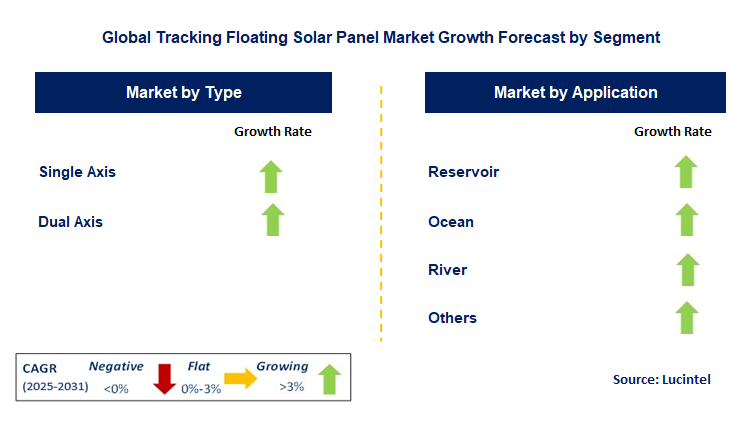
• Lucintel forecasts that, within the type category, single axis is expected to witness higher growth over the forecast period.
• Within the application category, reservoir is expected to witness the highest growth.
• In terms of region, APAC is expected to witness the highest growth over the forecast period due to increasing investments in renewable energy.
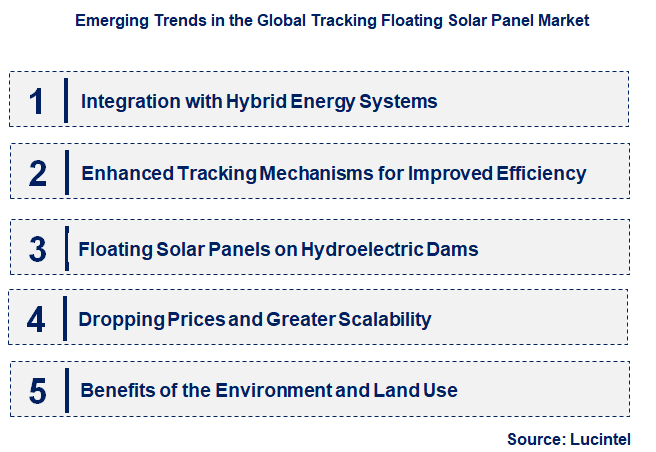
• Integration with Hybrid Energy Systems: There has been and continues to be a rise in adoption of tracking floating solar panels in hybrid energy systems that comprise of solar, wind, and energy storage components. The need to produce reliable energy throughout the year, irrespective of the availability of sunshine, explains this trend. The hybrid systems are vital for off-grid communities and island due to their stable power supply.
• Enhanced Tracking Mechanisms for Improved Efficiency: Improvement toward the tracking mechanisms of floating solar panels has become a common focus. Newer tracking systems allow the solar panels to follow the sun’s movement meticulously for maximum energy production. This is an improvement that economically sustains floating solar energy power which makes it feasible for widespread utilization.
• Floating Solar Panels on Hydroelectric Dams: Installing floating solar panels on top of the surfaces of solar power hydroelectric reservoirs is becoming a common practice. These solar panels can be useful in conjunction with hydroelectric energy since they can produce energy during the day while water energy production can occur at nighttime. This balance aids to maximize the energy benefit from power generation sources without incurring extra land costs.
• Dropping Prices and Greater Scalability: With the advancements made in the technology of floating solar panels, the production cost of both the tracking systems and the panels is reducing with an increase in production volume. This change is economically enabling and encourages widespread adoption of floating solar power systems in places with scarce land resources. The ability to build floating solar systems economically increases their attractiveness for large-scale energy projects worldwide.
• Benefits of the Environment and Land Use: Utilizing floating solar panels can go a long way in resolving many land-use problems posed by traditional and ground-mounted solar systems. Their installation over water bodies eliminates the need for land, which is a valuable resource, especially in densely populated areas or regions with intense agricultural activity. This environmental advantage makes floating solar panels a cost-effective solution in countries where land for renewable solar projects is scarce. These trends focus on the increased prospects of tracking floating solar panels, which will lead to the global energy transition. With the developments in tracking technology, the market is anticipated to witness high adoption and further innovation in solar power generation.
• Critical Changes: Enhanced Tracking Systems: Solar energy available today can go up substantially with the implementation of new tracking technology in floating solar panels. These systems track the sun, changing the angle of the solar cells to optimize energy capture. This improvement has been critical in resolving the competitive disadvantage of floating solar panels against land-mounted systems.
• Deployment in Hybrid Power Systems: Hybrid systems which utilize the integration of solar, wind and storage batteries are increasingly incorporating tracking floating solar panels. This rests my case that these systems enhance the reliability and stability of solar energy. These systems are increasingly useful in off grid zones or regions with cyclical energy requirements.
• Cost Reduction and Increased Accessibility: The reduced price of materials and components, better production technology, lower manufacturing costs, as well as increased demand for cost effective solar solutions have made tracking floaters more affordable for commercial and government initiatives. These changes are accelerating the shift to using floating solar technologies, especially in developing economies.
• Integration with Existing Infrastructure: Tracking floating solar panels are being adopted into pre-existing systems like hydroelectric dams and reservoirs. This improvement ensures that water bodies which are not being optimally utilized can be put to use for energy generation, integrating two semi separated aspects of infrastructure. The implementation of these systems aids in reducing land use and simultaneously increasing renewable energy resources.
• Environmental Benefits and Land Use Optimization: Floating solar panels tackle the land use problems of conventional solar systems that are mounted on the ground. These panels can be placed on water bodies which allow for the generation of solar energy without the need to utilize too much scarce land. This makes these types of solar panels appealing to nations suffering with low land availability, enabling floating solar panels to be an optimal choice for sustainable energy harnessing. The mentioned developments have drastically improved the functionality and practicality of tracking floating solar panels. With the advancement of technology and innovation, it is believed that the systems will be critical to global initiatives that strive to increase the use of renewable energy while reducing land use.
• Adoption Within Hybrid Energy Systems: The integration of wind energy, solar energy, and energy storage into one single energy source is called hybrid energy systems. These systems tackle the intermittency of energy by using floating solar panels as a solution. In addition, these panels are ideally suited for hybrid systems in regions where water bodies abound but there is limited land area to develop solar power stations.
• Floating Solar Panels in Less Economically Developed Countries: Among less economically developed countries, floating solar panels installed on power generating reservoirs and lakes are becoming increasingly popular. To improve production levels for these countries, the automated floating solar panels with adjustable direction can multiply the energy produced and increase the effectiveness of the projects.
• Combining Hydroelectric Dams with Renewable Energy Sources: Floating solar panels continue to prove themselves as a viable solution for the mounting renewable energy problem. The combination of panels with solar energy could be beneficial for both parties. As the day progresses, floating solar panels can make good use of available reservoir space to generate power as the hydroelectric plants run during the night. This not only greatly improves the productivity of the already existing plants, but also ensures maximum energy demand is met.
• Policy Support and Government Subsidies: Governmental intervention along with policy support for the proj3cts makes it easier to get solar power using renewable sources. Taxed to harness water bodies and transform them into energy sources, renewable energy gets a boost in popularity for the floating solar panel model. The adoption of the panels are set to meet a number of renewable energy goals due to the multiple subsidies and tax incentives being put into place.
• Deployment of Floating Solar Panels in Remote and Off-grid Locations: Floating solar panels provide an opportunity for deployment in clean and remote solar sources. Communities on rural islands with little-to-no land can now be provided electricity through the use water bodies combined with panels. Addable tracking systems can be further installed to increase the amount of energy captured optimally. Sustainable spatial energy solutions are highly sought after due to the tracking floating solar panel market expansion opportunities. The global emphasis on using renewable energy sources is likely to aid in substantial market growth.
• SPG Solar
• Kyocera
• Japan Mega Solar Power
• Suntech Power
• Sharp
• Ciel & Terre
• First Solar
• Trina Solar
• Yingli Solar
• JA Solar
• Single Axis
• Dual Axis
• Reservoir
• Ocean
• River
• Others
• North America
• Europe
• Asia Pacific
• The Rest of the World
• United States: Alongside the floating solar panels that are being developed and used on the surface of water bodies across the United Sates, these solar systems are being integrated into larger renewable energy projects. Solar energy floating farms are being constructed in solar rich states like California and Arizona. New technological breakthroughs have also come in the form of new and precise trackers that capture more power while lessening the costs associated with installation. The systems have also enjoyed faster adoption due to regulatory and federal financial support. As renewable energy goals are set by the government, these systems are positioned to provide sustainable energy solutions while aiding in fulfilling the objectives.
• China: With the rapid pace at which China is erecting large scale floating solar projects, the country is fast emerging as a leading definer of the tracking floating solar panel market. The government of China has immense floating solar technology support as part of the overall renewable energy strategy. Providing these trackers is paid back by the power generated from their usage, greatly contributing to the energy efficiency of the country. Floating solar systems are becoming a major component of the transition China is making towards renewable energy, especially in regions with scarce land resources. The low cost of deploying these systems makes China’s mass production capability highly desirable.
• Germany: To help meet its carbon reduction goals, Germany is working on incorporating tracking floating solar panels within its renewable energy framework. The country has already undertaken a few pilot projects that prove floating solar power is possible. With more and more water bodies available for use, especially in hydroelectric power stations, floating solar panels are being looked at as a means to maximize real estate value. The development of tracking technology is vital to make these systems operate with higher efficiencies as compared to the automatically mounted ground solar panels. Germany still plays an important role in the advocacy for clean energy practices.
• India: Floating solar panels are now being used in India as a potential solution to lift the energy burden in a country that is already struggling with land. Several floating solar projects have already been initiated in the states of Kerala and Telangana, which have adequate water bodies. Some other recent initiatives include the use of new advanced trackers which capture more energy from the sun in regions that are not particularly sunny. As India aims to enhance the renewable energy generation limits, it considers these driving systems as an important factor when the projects are supported by the government.
• Japan: Japan's increasing adoption of floating solar panels is being witnessed in parts of the country that have little land, like coastal areas and even some reservoirs. Japan has made huge strides in using floating solar systems with tracking technology as it boosts productivity and energy efficiency. The need for Japan to become self-serving with energy, owing to the diversification from nuclear power, has created new innovative floating solar energy solutions. There are high expectations that further progress will come in the tracking systems for floating solar panels as the county strives to meet its renewable energy targets.


• SPG Solar
• Kyocera
• Japan Mega Solar Power
• Suntech Power
• Sharp
• Ciel & Terre
• First Solar
• Trina Solar
• Yingli Solar
• JA Solar Q5. Which tracking floating solar panel market segment will be the largest in future? Answer: Lucintel forecasts that, within the type category, single axis is expected to witness higher growth over the forecast period. Q6. In tracking floating solar panel market, which region is expected to be the largest in next 5 years? Answer: In terms of region, APAC is expected to witness the highest growth over the forecast period due to increasing investments in renewable energy. Q7. Do we receive customization in this report? Answer: Yes, Lucintel provides 10% customization without any additional cost.


Choose a license that fits your team. Instant PDF delivery.
Prices exclude taxes. Instant delivery. Custom licensing available on request.
Market Report · July 20, 2026
Market Report · July 20, 2026
Market Report · July 20, 2026
Trusted partner for strategic intelligence and business growth


Receive a complimentary market analysis tailored to your industry. Our analysts will identify key growth opportunities and competitive dynamics specific to your business.

Market size, growth rate, and key trend analysis for your specific sector.

Top competitor positioning and market share analysis.

Strategic recommendations backed by data-driven insights.
Get curated market intelligence and competitive moves straight to your inbox.
By subscribing, you agree to receive our monthly insights. Unsubscribe anytime.
Receive a complimentary market analysis tailored to your industry. Our analysts will identify key growth opportunities and competitive dynamics specific to your business.
Market size, growth rate, and key trend analysis for your specific sector.
Top competitor positioning and market share analysis.
Strategic recommendations backed by data-driven insights.
Get curated market intelligence, emerging trends, and competitive moves straight to your inbox each month.
By subscribing, you agree to receive our monthly insights. Unsubscribe anytime.
We'll send your sample report shortly.