
Market Report · July 22, 2026

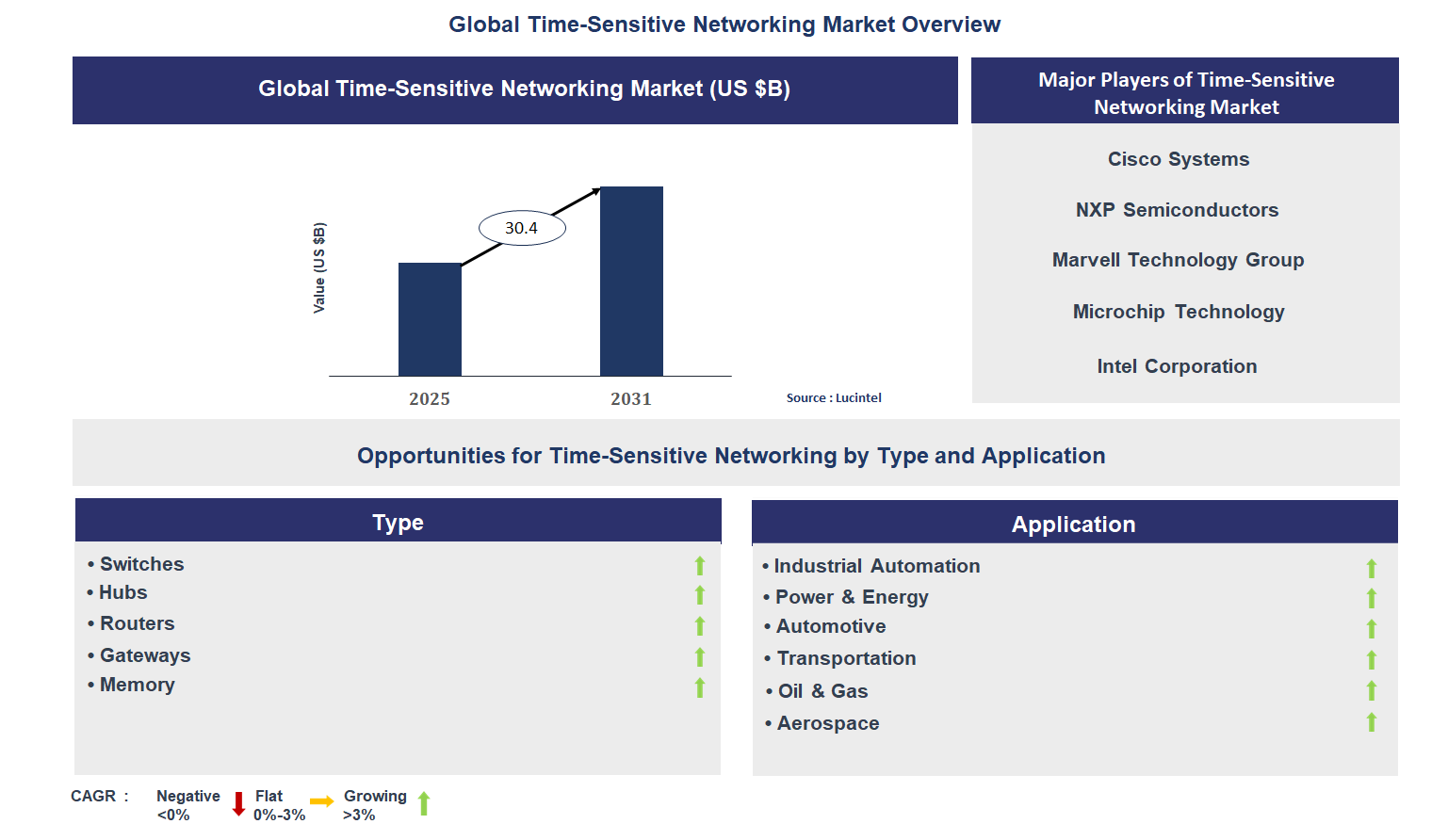
Key data points: The growth forecast = 30.4% annually for the next 7 years. Scroll below to get more insights. This market report covers trends, opportunities and forecasts in time-sensitive networking market to 2031 by type (switches, hubs, routers, gateways, and memory), application (industrial automation, power & energy, automotive, transportation, oil & gas, and aerospace), and region (North America, Europe, Asia Pacific, and the Rest of the World)
We'll send your sample report shortly.
• Lucintel forecasts that, within the type category, router is expected to witness the highest growth over the forecast period.
• Within the application category, industrial automation is expected to witness the highest growth.
• In terms of region, APAC is expected to witness the highest growth over the forecast period. Gain valuable insights for your business decisions with our comprehensive 150+ page report. Sample figures with some insights are shown below.
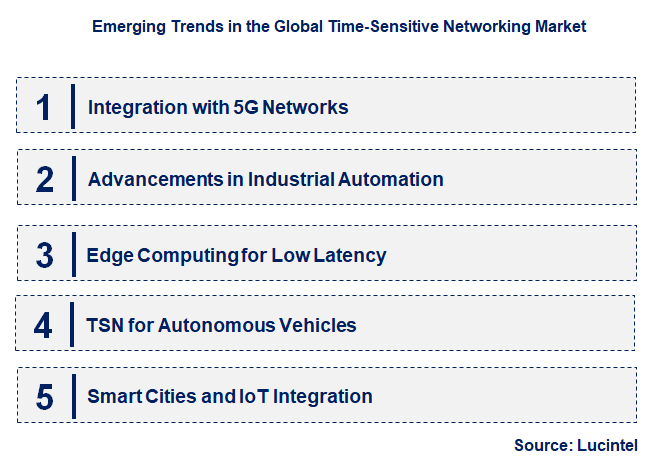
• Integration with 5G Networks: TSN is being increasingly integrated with 5G networks to support ultra-reliable, low-latency communications (URLLC). This synergy is expected to revolutionize industries like automotive and telecommunications, enabling real-time data transfer for autonomous vehicles, IoT devices, and remote control systems. The combination of TSN and 5G is seen as a critical enabler for next-generation industrial applications.
• Advancements in Industrial Automation: As part of Industry 4.0, TSN is becoming essential for industrial automation, allowing seamless communication between machines and devices in real time. With the increasing use of IoT and robotics in manufacturing, TSN provides the necessary precision timing and network synchronization for automated production lines, improving productivity and reducing downtime.
• Edge Computing for Low Latency: The rise of edge computing is playing a pivotal role in the TSN market. By processing data closer to the source, edge computing reduces latency, which is essential for real-time applications. The integration of TSN with edge computing allows for faster decision-making and enables applications in smart cities, autonomous driving, and industrial automation.
• TSN for Autonomous Vehicles: TSN is being increasingly deployed in autonomous vehicles for real-time communication between sensors, cameras, and control systems. The need for high precision and low latency in autonomous driving systems makes TSN an ideal solution. As the automotive industry moves toward fully autonomous vehicles, TSN will play a central role in vehicle-to-vehicle (V2V) and vehicle-to-infrastructure (V2I) communication.
• Smart Cities and IoT Integration: TSN is being adopted in smart city projects to ensure reliable, synchronized communication between sensors, IoT devices, and network infrastructure. This enables real-time monitoring of traffic, environmental conditions, and public safety. TSNs ability to provide deterministic data transmission is key to optimizing the operation of smart city applications. These emerging trends, including the integration of TSN with 5G, advancements in industrial automation, edge computing, autonomous vehicles, and smart cities, are reshaping the Time-Sensitive Networking market. As industries increasingly adopt TSN to meet the demands of real-time, low-latency communication, the technology’s role in shaping the future of connected systems is becoming more prominent.
• Standards Development for TSN: Standardization efforts, led by organizations like IEEE, are crucial for the growth of the TSN market. The development of TSN standards ensures interoperability between devices and networks across industries, which is crucial for global adoption. The ongoing work in defining these standards is paving the way for widespread deployment of TSN in mission-critical applications like automotive and industrial automation.
• TSN Integration with Industrial Ethernet: The integration of TSN with Industrial Ethernet protocols is enabling higher-performance networking in industrial environments. This development allows manufacturers to leverage existing Ethernet infrastructure while benefiting from TSNs low-latency, time-synchronized capabilities. As industries adopt more IoT devices, this integration will provide a seamless, cost-effective solution for real-time data communication.
• Increased Investment in 5G and TSN: The convergence of TSN with 5G networks is being actively explored, with major telecom operators investing in TSN technology to support ultra-reliable, low-latency communications. This development is crucial for applications requiring real-time data transmission, such as autonomous vehicles and industrial automation. 5G’s ability to handle massive data transfer, combined with TSN’s precision, is a game-changer.
• Real-Time Data Processing in Edge Computing: The adoption of edge computing technologies is complementing TSNs capabilities, allowing for faster data processing and lower latency in real-time systems. Edge computing reduces the strain on centralized data centers and supports applications like autonomous vehicles and industrial robots, which require immediate decision-making based on real-time data.
• Automotive Industry Adoption of TSN: The automotive industry is increasingly incorporating TSN to ensure real-time communication between sensors, control units, and cameras in autonomous vehicles. TSN ensures low-latency, high-priority data transmission, critical for the safety and efficiency of autonomous systems. As vehicles become more connected and automated, TSN technology will be a vital component of next-generation automotive systems. The ongoing development of TSN standards, integration with industrial Ethernet, investment in 5G, real-time data processing with edge computing, and adoption in the automotive industry are key drivers shaping the Time-Sensitive Networking market. As these developments continue to unfold, TSNs role in enabling real-time communication across industries will become even more pivotal.
• Industrial Automation: TSN presents a growth opportunity in industrial automation by providing precise synchronization and low-latency communication for machines and robots on the factory floor. As industries move toward fully automated systems, TSN will be essential for improving efficiency, reducing downtime, and ensuring high levels of reliability in production environments.
• Automotive Industry: The automotive industry’s shift toward connected vehicles and autonomous driving systems presents a major growth opportunity for TSN. With its ability to enable real-time communication between sensors, cameras, and control units, TSN will play a critical role in the development of autonomous vehicles, ensuring safety and smooth operation.
• Smart Cities and IoT: TSN offers significant growth potential in the development of smart cities. By providing deterministic data transmission, TSN ensures reliable communication between IoT devices and network infrastructure, making it a key enabler for smart grids, traffic management, environmental monitoring, and public safety systems.
• Telecommunications Networks: With the rollout of 5G, TSN is poised to play a critical role in enabling ultra-reliable, low-latency communication for telecom networks. The integration of TSN with 5G will support next-generation applications like remote surgery, autonomous driving, and industrial IoT, driving growth in the telecommunications sector.
• Edge Computing: The rise of edge computing presents a growth opportunity for TSN as it allows for real-time data processing closer to the source. TSNs low-latency capabilities, combined with edge computing, will enhance applications in industrial automation, healthcare, and transportation, driving the adoption of TSN in these sectors. The growing demand for TSN in industrial automation, automotive systems, smart cities, telecommunications, and edge computing presents substantial growth opportunities. As these applications expand, the adoption of TSN will continue to rise, enabling faster, more reliable, and real-time data communication across industries.
• Cisco Systems
• NXP Semiconductors
• Marvell Technology Group
• Microchip Technology
• Intel Corporation
• National Instruments Corporation
• Analog Devices
• Broadcom Limited
• Belden
• Renesas Electronics Corporation
• Switches
• Hubs
• Routers
• Gateways
• Memory
• Industrial Automation
• Power & Energy
• Automotive
• Transportation
• Oil & Gas
• Aerospace
• North America
• Europe
• Asia Pacific
• The Rest of the World
• United States: The U.S. has become a leader in TSN adoption, particularly in industrial automation and telecommunications. Companies like Cisco and Intel have made significant strides by integrating TSN into their networking solutions, enhancing real-time communication for connected devices. Moreover, the U.S. is pushing for TSN standards in 5G networks, further expanding its use in IoT and autonomous systems.
• China: China has increasingly focused on TSN as part of its broader “Made in China 2025” initiative, which seeks to advance its capabilities in high-tech manufacturing. Chinese companies like Huawei are integrating TSN into their networking products, especially for 5G and smart city applications. The governments push for smart infrastructure is driving significant investments in TSN technology.
• Germany: Germany, with its strong industrial base, is leveraging TSN for Industry 4.0 applications. Companies like Siemens and Bosch are incorporating TSN into their manufacturing processes for synchronized control of robots, automated systems, and IoT devices. TSN plays a key role in Germany’s vision for digital factories and smart manufacturing, ensuring reliability and precise timing.
• India: India is gradually adopting TSN technologies, particularly in the industrial and automotive sectors. Startups and established tech companies are beginning to implement TSN for real-time data transmission in connected vehicles and industrial automation. Indias focus on digital transformation and smart infrastructure projects is expected to accelerate TSN adoption in the coming years.
• Japan: Japan is investing heavily in TSN for its automotive and robotics industries. Major automotive manufacturers like Toyota are exploring TSN to enable real-time data communication for autonomous vehicles. Additionally, Japan’s robotics sector uses TSN to ensure precision timing in automated manufacturing processes, contributing to Japans leadership in automation and smart manufacturing.


• Cisco Systems
• NXP Semiconductors
• Marvell Technology Group
• Microchip Technology
• Intel Corporation
• National Instruments Corporation
• Analog Devices
• Broadcom Limited
• Belden
• Renesas Electronics Corporation Q5. Which time-sensitive networking market segment will be the largest in future? Answer: Lucintel forecasts that, within the type category, router is expected to witness the highest growth over the forecast period. Q6. In time-sensitive networking market, which region is expected to be the largest in next 5 years? Answer: In terms of region, APAC is expected to witness the highest growth over the forecast period. Q7. Do we receive customization in this report? Answer: Yes, Lucintel provides 10% customization without any additional cost.


Choose a license that fits your team. Instant PDF delivery.
Prices exclude taxes. Instant delivery. Custom licensing available on request.
Market Report · July 22, 2026
Market Report · July 17, 2026
Market Report · July 17, 2026
Trusted partner for strategic intelligence and business growth


Receive a complimentary market analysis tailored to your industry. Our analysts will identify key growth opportunities and competitive dynamics specific to your business.

Market size, growth rate, and key trend analysis for your specific sector.

Top competitor positioning and market share analysis.

Strategic recommendations backed by data-driven insights.
Get curated market intelligence and competitive moves straight to your inbox.
By subscribing, you agree to receive our monthly insights. Unsubscribe anytime.
Receive a complimentary market analysis tailored to your industry. Our analysts will identify key growth opportunities and competitive dynamics specific to your business.
Market size, growth rate, and key trend analysis for your specific sector.
Top competitor positioning and market share analysis.
Strategic recommendations backed by data-driven insights.
Get curated market intelligence, emerging trends, and competitive moves straight to your inbox each month.
By subscribing, you agree to receive our monthly insights. Unsubscribe anytime.
We'll send your sample report shortly.