Thin Film And Printed Battery Market Report: Trends, Forecast and Competitive Analysis to 2035

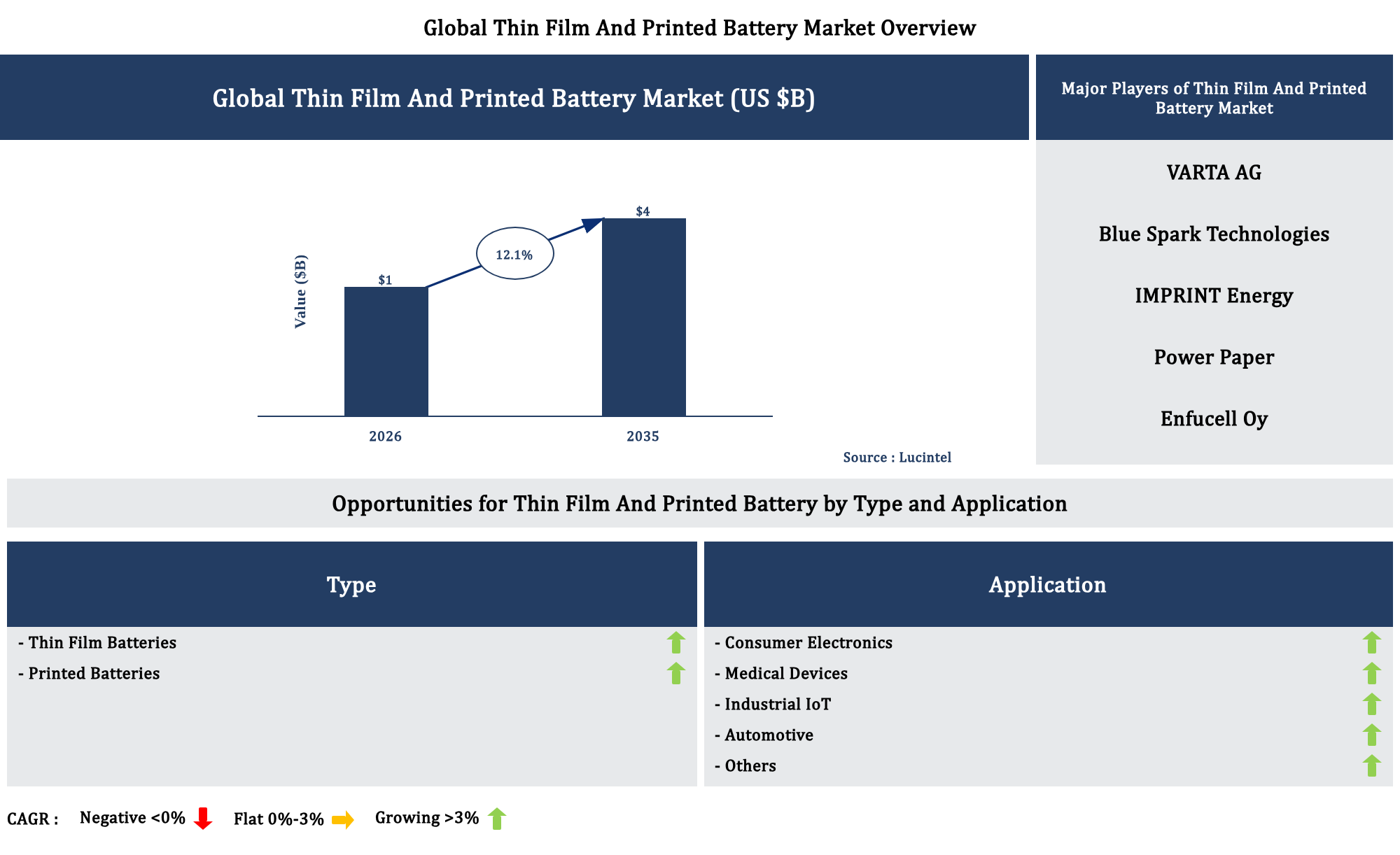
Key data points: The market size in 2035 = $4 billion, growth forecast = 12.1% annually for the next 9 years. Scroll below to get more insights. This market report covers trends, opportunities and forecasts in thin film and printed battery market to 2035 by type (thin film batteries and printed batteries), application (consumer electronics, medical devices, industrial IoT, automotive, and others), and region (North America, Europe, Asia Pacific, and the Rest of the World)

Publisher: Lucintel Last Updated: July 2026
See Pricing

Download Sample Report

| ✨ New Download Sample report — Get instant insights! | ✨ New Download Sample report — Get instant insights!

Thin Film And Printed Battery Market Report: Trends, Forecast and Competitive Analysis to 2035

Thin Film And Printed Battery Market

The future of the global thin film and printed battery market looks promising with opportunities in the consumer electronics, medical devices, industrial IoT, and automotive markets. The global thin film and printed battery market is expected to reach an estimated $4 billion by 2035 with a CAGR of 12.1% from 2026 to 2035. The major drivers for this market are the increasing demand for flexible energy storage solutions, the rising adoption of wearable electronic devices, and the growing need for compact rechargeable batteries.

  • Lucintel forecasts that, within the type category, printed battery is expected to witness higher growth over the forecast period due to the increasing demand for flexible power solutions.
  • Within the application category, consumer electronics is expected to witness the highest growth due to the rising consumer electronics device adoption.
  • In terms of regions, APAC is expected to witness the highest growth over the forecast period due to the growing electronics manufacturing investments.

Gain valuable insights for your business decisions with our comprehensive 150+ page report. Sample figures with some insights are shown below.
Thin Film And Printed Battery Market

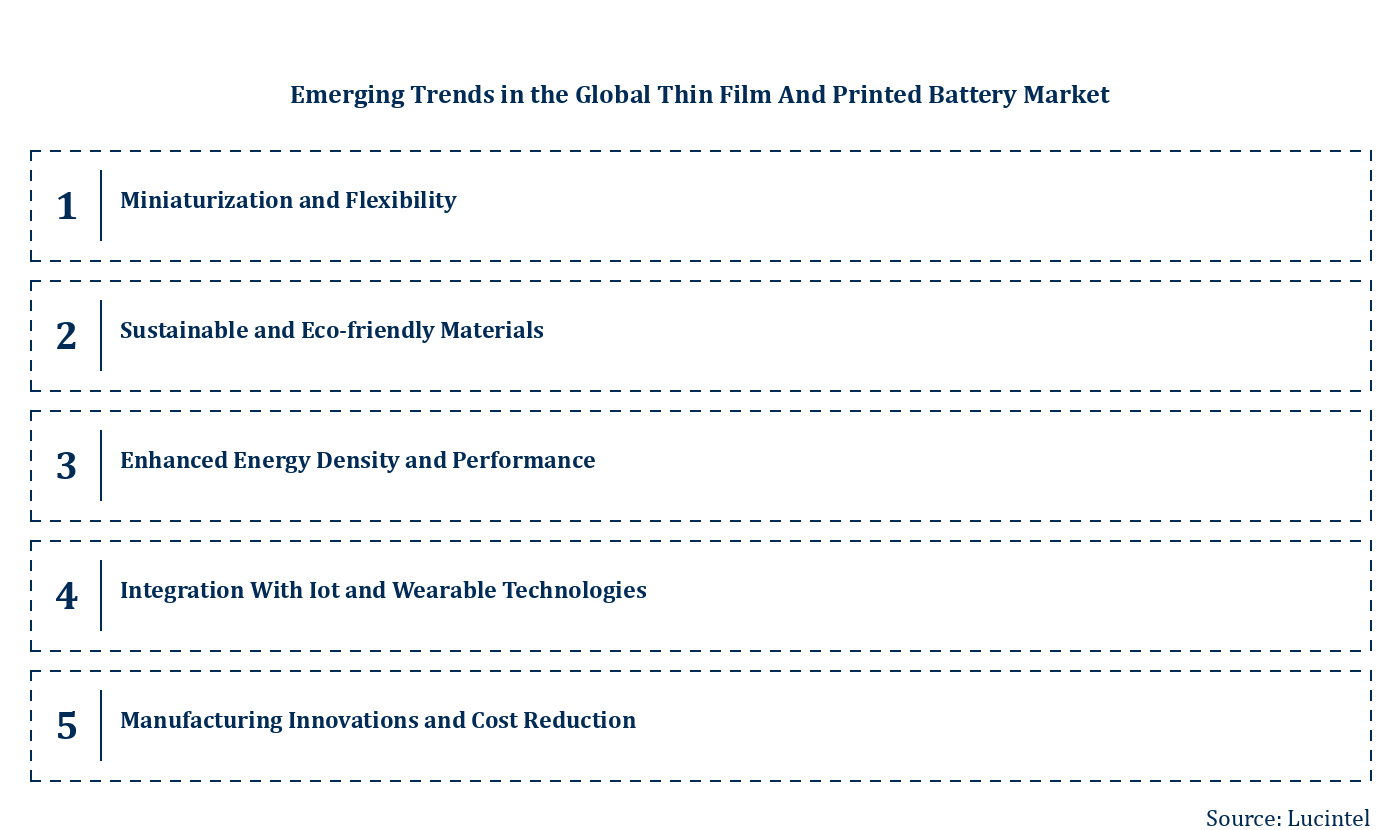
Emerging Trends in the Thin Film And Printed Battery Market

The thin film and printed battery market is experiencing rapid growth driven by technological advancements and increasing demand for compact, flexible, and sustainable energy solutions. As industries such as consumer electronics, healthcare, and IoT expand, the market is evolving with innovative materials and manufacturing processes. These developments are not only enhancing battery performance but also enabling new applications that were previously unfeasible. The market's trajectory indicates a shift towards more integrated, lightweight, and environmentally friendly power sources, which are transforming product design and functionality across various sectors. Understanding these emerging trends is crucial for stakeholders aiming to capitalize on future opportunities.

  • Miniaturization and Flexibility: The demand for ultra-thin, flexible batteries is rising to meet the needs of wearable devices, flexible electronics, and smart packaging. These batteries can be integrated into curved or foldable surfaces, offering design versatility and improved user experience. Advances in materials like printed electrodes and encapsulation techniques are enabling these innovations, making devices more portable and unobtrusive. This trend is expanding the application scope of printed batteries, especially in consumer electronics and medical devices, where space and form factor are critical.
  • Sustainable and Eco-Friendly Materials: Growing environmental concerns are pushing manufacturers to adopt biodegradable, recyclable, and non-toxic materials in battery production. Innovations include using eco-friendly substrates and electrode materials that reduce hazardous waste and improve lifecycle management. This shift not only aligns with regulatory standards but also appeals to environmentally conscious consumers. The adoption of sustainable materials is expected to enhance the market's reputation and open new opportunities in green electronics, ultimately contributing to a circular economy in energy storage solutions.
  • Enhanced Energy Density and Performance: Researchers are focusing on increasing the energy density of printed and thin film batteries to extend device operation times. Techniques such as nanostructuring electrodes and optimizing electrolyte compositions are leading to higher capacity and faster charging capabilities. Improved performance metrics are critical for applications in medical implants, IoT sensors, and autonomous systems, where reliability and longevity are paramount. These advancements are making printed batteries more competitive with traditional lithium-ion counterparts, broadening their adoption across high-performance sectors.
  • Integration with IoT and Wearable Technologies: The proliferation of IoT devices and wearable gadgets is driving demand for integrated power sources that are lightweight, flexible, and easy to manufacture. Printed batteries can be seamlessly embedded into devices, enabling continuous operation without bulky power packs. This integration facilitates smarter, more connected products, from health monitors to smart textiles. The trend is fostering innovation in product design, reducing manufacturing costs, and enabling new functionalities, thereby accelerating the growth of connected ecosystems.
  • Manufacturing Innovations and Cost Reduction: Advances in printing techniques such as inkjet, screen, and roll-to-roll printing are making battery production more scalable and cost-effective. These innovations reduce material waste and enable high-throughput manufacturing, which is essential for mass-market adoption. Additionally, the development of printable electrode inks and encapsulation materials is improving battery stability and lifespan. Cost reductions and manufacturing efficiencies are making printed batteries more accessible for a wide range of applications, from consumer electronics to large-scale energy storage, thus expanding market reach.

These emerging trends are collectively reshaping the thin film and printed battery market by enhancing performance, sustainability, and integration capabilities. They are enabling new applications, reducing costs, and fostering innovation, which will likely lead to increased adoption across diverse industries. As these developments continue, the market is poised for significant growth, driven by the demand for smarter, more sustainable, and versatile energy solutions.
Thin Film And Printed Battery Market by country

Recent Developments in the Thin Film And Printed Battery Market

The thin film and printed battery market is experiencing rapid growth driven by advancements in flexible electronics, wearable devices, and IoT applications. Innovations in materials and manufacturing processes are enabling more efficient, durable, and environmentally friendly batteries. As demand for miniaturized, lightweight power sources increases across various industries, market players are investing heavily in research and development. These developments are shaping a competitive landscape, offering new opportunities for technological integration and sustainable energy solutions.

  • Growing Demand for Flexible Electronics: The increasing adoption of flexible smartphones, wearables, and foldable devices is boosting the need for thin film and printed batteries. These batteries offer lightweight, bendable, and space-efficient power solutions, enabling innovative product designs. The market benefits from enhanced user experience and new form factors, expanding applications in healthcare, consumer electronics, and automotive sectors. This trend is expected to drive significant revenue growth and technological advancements in flexible power sources.
  • Advancements in Material Technologies: New materials such as printable electrodes, solid electrolytes, and eco-friendly substrates are improving battery performance and safety. These innovations lead to higher energy densities, longer lifespans, and better environmental compatibility. The development of biodegradable and recyclable batteries aligns with sustainability goals, attracting environmentally conscious consumers and manufacturers. Material innovations are also reducing manufacturing costs, making printed batteries more accessible for mass-market applications.
  • Integration with Internet of Things (IoT): The proliferation of IoT devices requires compact, reliable, and long-lasting power sources. Printed and thin film batteries are ideal for powering sensors, smart tags, and connected devices due to their small size and flexibility. Enhanced energy management and wireless charging capabilities are further improving device efficiency. This integration is expanding the market, enabling smarter, more connected environments across industrial, healthcare, and home automation sectors.
  • Focus on Sustainability and Eco-Friendly Solutions: Increasing environmental awareness is prompting manufacturers to develop sustainable batteries with reduced toxic materials and improved recyclability. Innovations in biodegradable substrates and non-toxic electrolytes are reducing ecological footprints. These eco-friendly batteries are gaining traction in consumer electronics and medical devices, where safety and sustainability are critical. The push for green energy solutions is fostering collaborations and investments in sustainable battery technologies, shaping a more environmentally responsible market landscape.
  • Expansion Into Automotive and Aerospace Sectors: The automotive industry’s shift towards electric vehicles (EVs) and aerospace applications demands lightweight, high-performance power sources. Thin film and printed batteries offer advantages such as reduced weight, flexible form factors, and rapid charging capabilities. These batteries are suitable for embedded systems, sensors, and auxiliary power units. Their adoption is expected to accelerate as industries seek innovative energy solutions that enhance vehicle efficiency, safety, and performance, opening new revenue streams and technological opportunities.

The overall impact of these developments is transforming the thin film and printed battery market into a dynamic, innovative sector. Enhanced performance, sustainability, and integration with emerging technologies are driving market expansion. As industries adopt these advanced batteries, the market is poised for significant growth, fostering new applications and competitive advantages for manufacturers worldwide.

Strategic Growth Opportunities in the Thin Film And Printed Battery Market

The thin film and printed battery market is experiencing rapid growth driven by advancements in flexible electronics, wearable devices, and IoT applications. As demand for lightweight, compact, and efficient power sources increases, innovative manufacturing techniques and new application sectors are emerging. This expansion offers significant opportunities for market players to develop specialized solutions, enhance performance, and capture emerging markets. Strategic investments and technological innovations are crucial to capitalize on these expanding opportunities and meet evolving consumer and industrial needs.

  • Expanding Wearable Device Market: The increasing adoption of wearable health monitors, fitness trackers, and smart accessories drives demand for thin film and printed batteries. These batteries offer flexibility, lightweight design, and safety advantages, making them ideal for compact, portable devices. As wearable technology becomes more integrated into daily life, the need for reliable, long-lasting power sources will accelerate growth in this segment, encouraging innovation in battery chemistry and form factors.
  • Growth in IoT and Smart Sensors: The proliferation of IoT devices and smart sensors across industries such as healthcare, agriculture, and manufacturing creates a significant opportunity for printed batteries. These batteries enable miniaturization and flexible integration into various surfaces and objects. Their ability to be printed on different substrates reduces manufacturing costs and allows for customized shapes, supporting widespread deployment of IoT solutions and enhancing device autonomy.
  • Advancements in Flexible Electronics: The development of flexible, foldable, and rollable electronic devices is fueling demand for thin film and printed batteries. These batteries can be integrated seamlessly into flexible displays, wearable tech, and smart packaging, providing reliable power without compromising device flexibility. Innovations in materials and printing techniques are improving energy density and cycle life, making them suitable for next-generation flexible electronic products.
  • Increasing Use in Medical Devices: The medical sector benefits from thin film and printed batteries due to their biocompatibility, safety, and ability to conform to complex shapes. Applications include implantable devices, smart bandages, and diagnostic sensors. The demand for miniaturized, safe power sources that can operate reliably over extended periods is driving research and development, opening new markets for personalized and remote healthcare solutions.
  • Rising Demand in Consumer Electronics: Consumer electronics such as smart cards, wireless sensors, and portable gadgets are increasingly adopting printed batteries for their compactness and design flexibility. These batteries support innovative product designs and enable thinner, lighter devices. As consumer preferences shift towards sleek, integrated electronics, manufacturers are investing in printed battery technologies to meet aesthetic and functional demands, expanding market reach and product diversity.

The overall market landscape is poised for substantial growth as these opportunities converge, fostering innovation and expanding application horizons. Companies that strategically invest in R&D and diversify their product offerings will be well-positioned to capitalize on the expanding demand across multiple sectors, ultimately driving the evolution of the thin film and printed battery market.

Thin Film And Printed Battery Market Drivers and Challenges

The thin film and printed battery market is influenced by a variety of technological, economic, and regulatory factors. Rapid advancements in flexible electronics, wearable devices, and IoT applications are driving demand for innovative power solutions. Economic factors such as decreasing manufacturing costs and increasing consumer spending on portable devices further propel market growth. Regulatory standards related to safety, environmental impact, and recycling also shape industry development. However, the market faces challenges including technological limitations, high production costs, and stringent regulatory compliance. Understanding these drivers and challenges is essential for stakeholders to navigate the evolving landscape and capitalize on emerging opportunities.

The factors responsible for driving the thin film and printed battery market include:

  • Technological Innovation: The development of flexible, lightweight, and high-capacity batteries has revolutionized portable electronics. Advances in materials like printable electrodes and solid electrolytes enable batteries to be integrated into diverse devices, expanding their application scope. These innovations improve device performance, durability, and form factor, making them attractive for wearable tech, medical devices, and IoT sensors. As research progresses, the potential for even more efficient and environmentally friendly batteries continues to grow, fueling market expansion and attracting investments.
  • Growing Adoption in Wearable Devices: The surge in wearable technology such as smartwatches, fitness trackers, and medical monitoring devices is a significant driver. These devices require compact, lightweight, and flexible power sources, which thin film and printed batteries can provide. The increasing consumer demand for health monitoring and personalized gadgets further accelerates this trend. Manufacturers are increasingly integrating these batteries to enhance device portability, comfort, and aesthetics, thereby expanding the market and encouraging innovation in battery design.
  • Expansion in IoT and Smart Devices: The proliferation of IoT devices across industries like healthcare, automotive, and smart homes is boosting demand for reliable, miniaturized power sources. Printed batteries offer the advantage of being easily integrated into various surfaces and objects, enabling seamless device design. As IoT networks grow, the need for sustainable, long-lasting, and scalable energy solutions becomes critical. This trend is expected to continue, with printed batteries playing a vital role in powering the next generation of interconnected devices.
  • Environmental Regulations and Sustainability Initiatives: Increasing emphasis on eco-friendly and sustainable energy solutions is driving the development of environmentally safe batteries. Regulatory frameworks aimed at reducing hazardous waste and promoting recycling are encouraging manufacturers to innovate with biodegradable and non-toxic materials. These initiatives not only help companies comply with legal standards but also appeal to environmentally conscious consumers, thereby expanding market opportunities. The push for greener batteries is expected to shape future product development and industry standards.
  • Cost Reduction and Manufacturing Advancements: Technological improvements in printing techniques and material processing are lowering production costs. Economies of scale and automation are making printed batteries more affordable, facilitating wider adoption across various sectors. Cost-effective manufacturing enables rapid deployment in consumer electronics, automotive, and industrial applications. As production becomes more efficient, the market is poised for accelerated growth, with increased accessibility and competitive pricing attracting a broader customer base.

The challenges facing the thin film and printed battery market include:

  • Technological Limitations: Despite significant progress, current printed batteries face issues such as limited energy density, shorter lifespan, and lower charge/discharge efficiency compared to traditional batteries. These limitations hinder their application in high-power or long-duration devices. Overcoming these technical barriers requires extensive research and development, which can be time-consuming and costly. Without significant breakthroughs, market penetration may remain constrained, especially in demanding sectors like automotive and aerospace.
  • High Production Costs: Although manufacturing costs are decreasing, the production of thin film and printed batteries still involves complex processes and expensive materials. Scaling up production while maintaining quality and consistency remains a challenge. High initial investments in specialized equipment and materials can deter new entrants and limit mass-market adoption. Cost competitiveness with conventional batteries is crucial for widespread acceptance, and current expenses may slow market growth.
  • Regulatory and Safety Concerns: The adoption of printed batteries is subject to strict safety and environmental regulations. Ensuring compliance with standards related to flammability, toxicity, and recyclability is complex and costly. Any safety incidents or regulatory changes can impact market confidence and lead to product recalls or redesigns. Additionally, the lack of standardized testing protocols for emerging battery technologies complicates certification processes, potentially delaying product launches and market expansion.

The thin film and printed battery market is driven by technological innovation, increasing adoption in wearable and IoT devices, environmental sustainability efforts, and manufacturing advancements. However, technological limitations, high production costs, and regulatory challenges pose significant hurdles. These factors collectively influence the market's growth trajectory, requiring stakeholders to focus on innovation, cost management, and compliance to capitalize on emerging opportunities and mitigate risks. The overall impact suggests a promising yet cautious outlook, with ongoing developments shaping the future landscape of this innovative energy sector.

List of Thin Film And Printed Battery Market Companies

Companies in the market compete on the basis of product quality offered. Major players in this market focus on expanding their manufacturing facilities, R&D investments, infrastructural development, and leverage integration opportunities across the value chain. Through these strategies thin film and printed battery market companies cater increasing demand, ensure competitive effectiveness, develop innovative products & technologies, reduce production costs, and expand their customer base. Some of the thin film and printed battery market companies profiled in this report include-

  • VARTA AG
  • Blue Spark Technologies
  • IMPRINT Energy
  • Power Paper
  • Enfucell Oy
  • Excellatron
  • Solarprint

Thin Film And Printed Battery Market by Segment

The study includes a forecast for the global thin film and printed battery market by type, application, and region.

  • Thin Film and Printed Battery Market by Type [Value from 2019 to 2035]:
    • Thin Film Batteries
    • Printed Batteries
  • Thin Film and Printed Battery Market by Application [Value from 2019 to 2035]:
    • Consumer Electronics
    • Medical Devices
    • Industrial IoT
    • Automotive
    • Others
  • Thin Film And Printed Battery Market by Region [Value ($B) from 2019 to 2035]:
    • North America
    • Europe
    • Asia Pacific
    • The Rest of the World

Country Wise Outlook for the Thin Film And Printed Battery Market

The thin film and printed battery market has experienced significant growth driven by advancements in flexible electronics, wearable devices, and IoT applications. As technology evolves, countries are investing heavily in research and development to enhance battery performance, reduce costs, and expand application areas. The market's expansion is also influenced by increasing demand for sustainable and lightweight energy storage solutions. Each country’s strategic initiatives and technological innovations are shaping the global landscape, reflecting diverse approaches to meet the rising energy storage needs across various sectors.

  • United States: The US leads in innovation with major investments in R&D, focusing on flexible, high-capacity thin film batteries for consumer electronics and medical devices. Companies are collaborating with universities to develop eco-friendly materials, and government agencies are supporting sustainable energy initiatives. The market is also driven by the growth of wearable tech and IoT devices, fostering new product development and commercialization.
  • China: China has rapidly advanced in manufacturing capabilities and scale, becoming a key player in printed and thin film batteries. The country emphasizes integrating these batteries into electric vehicles and smart gadgets, supported by government policies promoting green energy. Chinese firms are also investing in improving battery longevity and safety, aiming to dominate both domestic and international markets through cost-effective solutions.
  • Germany: Germany focuses on high-quality, durable thin film batteries for industrial applications and automotive sectors, emphasizing sustainability and efficiency. The country’s strong automotive industry is adopting printed batteries for electric vehicles, while research institutions are exploring innovative materials. Germany’s emphasis on environmental standards and technological excellence positions it as a leader in premium energy storage solutions.
  • India: India is witnessing a growing demand for lightweight, portable batteries driven by expanding consumer electronics and renewable energy sectors. The government’s push for clean energy and local manufacturing is encouraging startups and established firms to develop affordable thin film and printed batteries. Focus areas include rural electrification, wearable devices, and energy storage for solar applications, fostering domestic innovation.
  • Japan: Japan maintains a strong presence in advanced battery technology, emphasizing miniaturization, safety, and high performance. Japanese companies are pioneering in flexible and printed batteries for medical devices, wearables, and aerospace applications. The country’s focus on sustainable materials and cutting-edge research continues to position it as a leader in high-tech energy storage solutions.

Features of the Thin Film And Printed Battery Market

  • Market Size Estimates: Thin film and printed battery market size estimation in terms of value ($B).
  • Trend and Forecast Analysis: Market trends (2019 to 2025) and forecast (2026 to 2035) by various segments and regions.
  • Segmentation Analysis: Thin film and printed battery market size by type, application, and region in terms of value ($B).
  • Regional Analysis: Thin film and printed battery market breakdown by North America, Europe, Asia Pacific, and Rest of the World.
  • Growth Opportunities: Analysis of growth opportunities in different types, applications, and regions for the thin film and printed battery market.
  • Strategic Analysis: This includes M&A, new product development, and competitive landscape of the thin film and printed battery market.
  • Analysis of competitive intensity of the industry based on Porter’s Five Forces model.

Top 5 Companies

  • VARTA AG
  • Blue Spark Technologies
  • IMPRINT Energy
  • Power Paper
  • Enfucell Oy

Table of Contents

1. Executive Summary
13.1 Competitive Analysis Overview

List of Figures

List of Tables

Methodology

Lucintel has been in the business of market research and management consulting since 2000 and has published over 1000 market intelligence reports in various markets / applications and served over 1,000 clients worldwide. This study is a culmination of four months of full-time effort performed by Lucintel's analyst team. The analysts used the following sources for the creation and completion of this valuable report:

  • In-depth interviews of the major players in this market
  • Detailed secondary research from competitors' financial statements and published data
  • Extensive searches of published works, market, and database information pertaining to industry news, company press releases, and customer intentions
  • A compilation of the experiences, judgments, and insights of Lucintel's professionals, who have analyzed and tracked this market over the years.

Extensive research and interviews are conducted across the supply chain of this market to estimate market share, market size, trends, drivers, challenges, and forecasts. Below is a brief summary of the primary interviews that were conducted by job function for this report.

Lucintel's methodology for market research

Thus, Lucintel compiles vast amounts of data from numerous sources, validates the integrity of that data, and performs a comprehensive analysis. Lucintel then organizes the data, its findings, and insights into a concise report designed to support the strategic decision-making process. The figure below is a graphical representation of Lucintel's research process.

Primary interviews by job function

Buy Now

Choose a license that fits your team. Instant PDF delivery.

Market Report

1 User PDF

$4,850
Buy Now

Market Report

2-5 Users PDF

$6,700
Buy Now

Market Report

Corporate PDF

$8,850
Buy Now

Market Report

Global PDF

$10,000
Buy Now

Prices exclude taxes. Instant delivery. Custom licensing available on request.

Frequently Asked Questions

What is the thin film and printed battery market size?
The global thin film and printed battery market is expected to reach an estimated $4 billion by 2035.
What is the growth forecast for thin film and printed battery market?
The global thin film and printed battery market is expected to grow with a CAGR of 12.1% from 2026 to 2035.
What are the major drivers influencing the growth of the thin film and printed battery market?
The major drivers for this market are the increasing demand for flexible energy storage solutions, the rising adoption of wearable electronic devices, and the growing need for compact rechargeable batteries.
What are the major segments for thin film and printed battery market?
The future of the thin film and printed battery market looks promising with opportunities in the consumer electronics, medical devices, industrial IoT, and automotive markets.
Who are the key thin film and printed battery market companies?

Some of the key thin film and printed battery companies are as follows:

  • VARTA AG
  • Blue Spark Technologies
  • IMPRINT Energy
  • Power Paper
  • Enfucell Oy
  • Excellatron
  • Solarprint
Which thin film and printed battery market segment will be the largest in future?
Lucintel forecasts that, within the type category, printed battery is expected to witness higher growth over the forecast period.
In thin film and printed battery market, which region is expected to be the largest in next 9 years?
In terms of region, APAC is expected to witness the highest growth over the forecast period.
Do we receive customization in this report?
Yes, Lucintel provides 10% customization without any additional cost.

Key Questions

  • What are some of the most promising, high-growth opportunities for the thin film and printed battery market by type (thin film batteries and printed batteries), application (consumer electronics, medical devices, industrial IoT, automotive, and others), and region (North America, Europe, Asia Pacific, and the Rest of the World)?
  • Which segments will grow at a faster pace and why?
  • Which region will grow at a faster pace and why?
  • What are the key factors affecting market dynamics? What are the key challenges and business risks in this market?
  • What are the business risks and competitive threats in this market?
  • What are the emerging trends in this market and the reasons behind them?
  • What are some of the changing demands of customers in the market?
  • What are the new developments in the market? Which companies are leading these developments?
  • Who are the major players in this market? What strategic initiatives are key players pursuing for business growth?
  • What are some of the competing products in this market and how big of a threat do they pose for loss of market share by material or product substitution?
  • What M&A activity has occurred in the last 6 years and what has its impact been on the industry?
Why Choose Us

The Lucintel Advantage

Trusted partner for strategic intelligence and business growth

25+ Years Excellence

25+ Years Excellence

Quarter century of proven expertise in management consulting and market research across global markets.
Game-Changer Ideas

Game-Changer Ideas

Innovative strategies and actionable insights that help clients become the smartest in their industry.
Global Reach

Global Reach

Extensive coverage across 50+ industries and markets worldwide with localized expertise.
Start Your Growth Journey

Get Your Free
Market Intelligence
Briefing

Receive a complimentary market analysis tailored to your industry. Our analysts will identify key growth opportunities and competitive dynamics specific to your business.

Custom Market Snapshot

Market size, growth rate, and key trend analysis for your specific sector.

Competitive Landscape Overview

Top competitor positioning and market share analysis.

Growth Opportunity Identification

Strategic recommendations backed by data-driven insights.

Subscribe

Subscribe to our Newsletter

Get curated market intelligence and competitive moves straight to your inbox.

By subscribing, you agree to receive our monthly insights. Unsubscribe anytime.

Industry Trends Market Signals Opportunities Competitor Moves