
Market Report · July 20, 2026

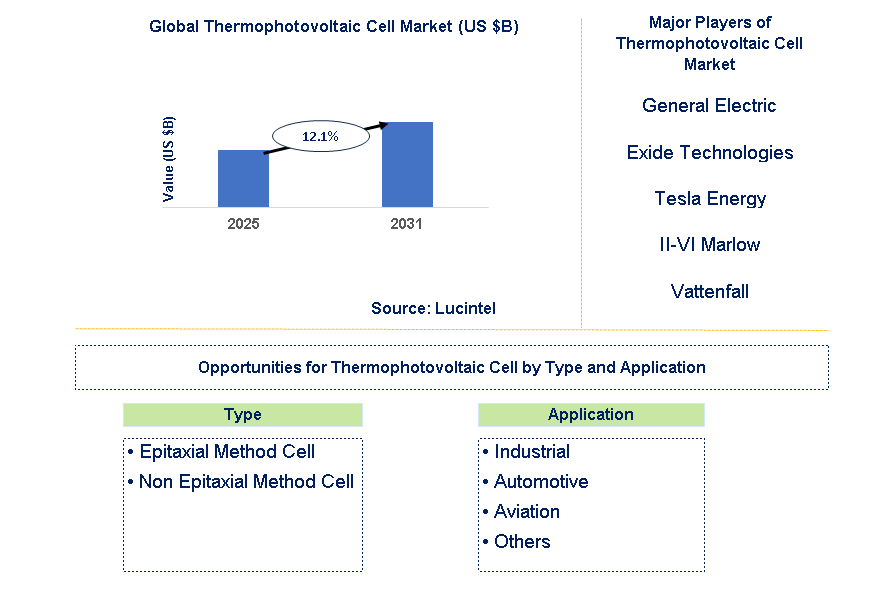
Key data points: The growth forecast = 12.1% annually for the next 7 years. Scroll below to get more insights. This market report covers Trends, opportunities and forecasts in thermophotovoltaic cell market to 2031 by type (epitaxial method cell and non epitaxial method cell), application (industrial, automotive, aviation, and others), and region (North America, Europe, Asia Pacific, and the Rest of the World)
We'll send your sample report shortly.
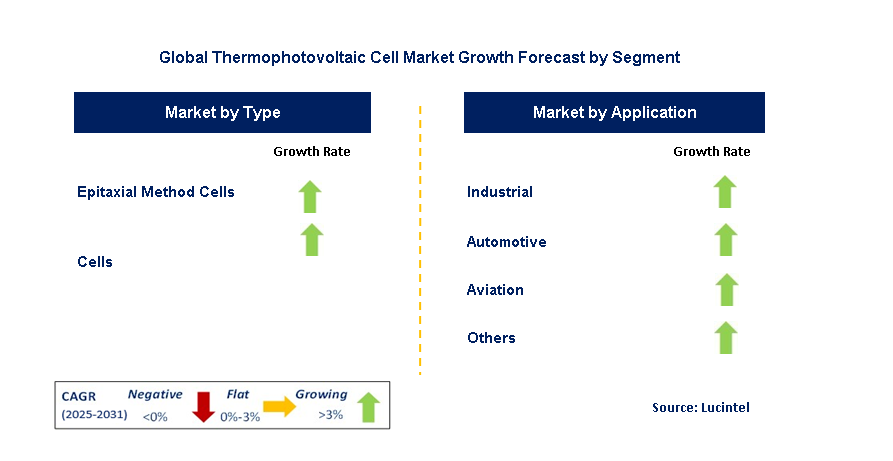
• Lucintel forecasts that, within the type category, epitaxial method cell is expected to witness higher growth over the forecast period due to its superior efficiency and performance.
• Within the application category, automotive is expected to witness the highest growth due to growing use of lead-acid batteries in cars.
• In terms of region, North America is expected to witness the highest growth over the forecast period due to increasing research and development activities.
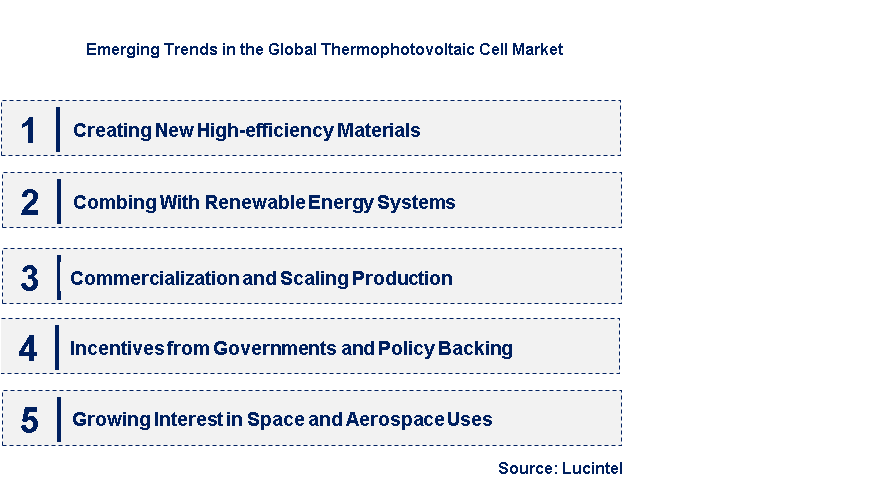
• Creating New High-efficiency Materials: Undoubtedly, one of the most important trends is the invention of different materials that are incorporated into the fabrication of thermophotovoltaic cells. TPV cells are using uniquely new materials such as Infrared emitters, quantum dots, and gallium antimonide. These new materials enable TPV cells to operate at higher temperature levels, resulting in more energy being absorbed. With the competition within the industry becoming incredibly fierce, these materials are bound to increase the cost efficiency of generating energy with TPV systems.
• Combing With Renewable Energy Systems: TPV is now being combined with solar, wind, and other renewable sources of energy to form hybrid systems that serve other forms of energy. These hybrid systems are capable of consistently generating power even when there is no direct sunlight or wind by utilizing TPV cells to harness thermal energy from industrial processes or concentrated solar power systems. This helps resolve intermittency issues associated with conventional renewable energy systems.
• Commercialization and Scaling Production: The TPV system is on the brink of commercialization due to advancements in increased production capacities accompanied with reduced manufacturing costs. This shift is further propelled by the rising TPV market and increases in supply capacity in countries such as China, and US. Increased production will enable lower costs for the TPV systems while improving their availability in the industrial, residential, and transportation markets.
• Incentives from Governments and Policy Backing: Support from the government is crucial in the adoption of TPV technology since countries all over the world are trying to accomplish their climate and carbon emission goals. In the U.S. and most European countries, governments are proffering subsidies, grants, and tax breaks to promote clean energy technologies TPV systems in particular. These policies are amplifying research efforts, encouraging investment, and boosting market growth.
• Growing Interest in Space and Aerospace Uses: Another development is the use of Thermophotovoltaic (TPV) technology in space and other aerospace applications. TPV cells have an advantage in the ability to operate in power remote or harsh conditions of space missions or deep-sea expeditions. As NASA and other space agencies look for new energy sources for satellites and space probes, TPV systems are quickly becoming the focus of more research and funding. The new trending opportunities within the TPV Cell Market are transforming the industry by factors increasing productivity, decreasing the expenditures, and widening the scope of applications. From developing high-efficiency materials to connecting them with renewable energy system, these activities are making TPV technology more feasible. During commercialization, the ability to scale production and government funding will lead to wider acceptance in different industries. In addition, the use of space and aerospace TPV systems shows the potential of the technology in more extreme environments. In summation, these factors make TPV cells quite competitive in providing sustainable energy solutions.
• Breakthrough in Materials Science: In the recent years, materials science has progressed in such a way that boosts the performance of TPV cells. The invention of multi-junction cells as well as new semiconductor materials such as quantum dots, and nanostructured materials have resulted in increase in cell efficiency and the cell’s thermal conversion rates. With these quantum dots, it is anticipated that the cost of TPV cells will substantially decline, allowing them to be competitive with other sources of renewable energy.
• Improved Heat Conversion Efficiency: Reasonable endeavors have been made towards increasing the heat conversion efficiency of TPV cells. By employing high temperature emitter materials together with improved designs, the ability to convert thermal energy to electric energy has increased tremendously. These developments create possibilities in industrial waste helium recovery and procurement of electricity from concentrated solar power, which makes it more attractive in different fields of industry TPV cells.
• Integration with Industrial Processes: At the moment, thermophotovoltaic cells are being integrated into different industrial processes for recovery of industrial waste heat. The TPV systems are capable of concentrating and utilizing waste heat from steel, cement, and chemical industries for power generation. This technology represents a unique opportunity for the reduction of energy consumption and carbon emissions to be used in an industrial area, encouraging the use of greener practices.
• Progress in The Methods of Construction: Partially constructed TPV cells are much cheaper and easier to manufacture than before thanks to the new methods of construction in the industry. The use of additive manufacturing such as advanced 3D Printing as well as advanced semiconductor processing is leading to the creation of new complex and more efficient TPV cell designs. These shifts should lower the manufacturing costs associated with TPV technology and encourage more people to use the technology.
• Cross-Industry Collaboration” The integration of research centers, private firms, and government agencies have helped with advancing TPV technology. These partnerships are enabled by the mutual exchange of information, resources, and finances which expedite technology development. These collaborative initiatives are particularly beneficial with regard to the high speed loading of TPV systems into the markets for aerospace and industrial manufacturing. With all the major advancements made in the TPV Cell Market, the technology, efficiency and commercial viability is greatly increasing. Innovations in methods of material science, heat conversion, and fabrication processes are propelling growth inTPV systems. Furthermore, the incorporation of TPV cells in industrial processes and increasing partnerships between research institutes and companies as well as other market stakeholders are fastering market growth TPV Technology is able to broaden its scope and be put into wider use, providing cheaper and eco-friendly energy solutions, which fulfills these explorations. With all these advancements, TPV cells are going to be vital in addressing global energy needs which is the ultimate goal.
• **Waste Heat Recovery in Industry: Using TPV cells in the recovery of industrial waste heat is one of the most advanced modern techniques that can bring substantial growth in many sectors. Most industries usually have a lot of waste heat, and these cells have the best capability to collect this heat and convert it into electricity. As businesses try to lower their energy costs and increase their sustainability, this application is expected to continue expanding. In the steel, cement, and petrochemical industries, TPV systems are a great way to recover waste heat without spending too much.
• **Off-Grid Power Solutions: Another field where TPV technology is beneficial is power generation in remote regions and other areas where power grids do not reach. In the absence of a conventional power grid, TPV systems are suitable for rural and remote region power generation. With the help of biomass, solar concentrators, and even industrial processes, TPV systems are able to generate thermal energy and supply it to communities in need as a sustainable energy option.
• Aerospace and Space Exploration: The aerospace industry offers an important growth market for TPV cells, particularly in space power applications. TPV systems are exceedingly good at transforming heat into electricity, which provides a solution for the energy needs of satellites and spacecraft. As additional space long term missions are planned, especially for deep space exploration, the contribution of TPV technology will be crucial for the energy supply in these harsh conditions.
• Integration with Solar and Concentrated Solar Power: Another blooming opportunity will lie in the combination of TPV systems and Cascade Solar Power (CSP) systems. It is possible to use solar collectors integrated with TPV cells to produce electricity even without direct sunlight. This approach guarantees power supply throughout the day, which is vital to areas where sunlight is erratic. The growth of market activities for CSP and the demand for energy storage will contribute to the market penetration of TPV cells.
• Applications in Transportation: In the EV industry, there is a lot of promise with the use of thermophotovoltaic cells. They can certainly be used in TPV technology to power the onboard systems using heat recovery systems. Moreover, as the car industry keeps pouring money into clean energy solutions, it is highly likely that the TPV cells will help lessen dependency on batteries as they create a novel methodology for energy storage and power generation in automobiles. There is overwhelming development in the TPV cell market, especially in parts of the business which are less developed. These changes are being fueled by technology, government policies, and the need for renewable sources of energy. Thus, as TPV technology develops, it will transform energy generation by making it easier, cheaper, and cleaner for industries and consumers.
• General Electric
• Exide Technologies
• Tesla Energy
• II-VI Marlow
• Vattenfall
• American Elements
• COMSOL
• Epitaxial Method Cell
• Non Epitaxial Method Cell
• Industrial
• Automotive
• Aviation
• Others
• North America
• Europe
• Asia Pacific
• The Rest of the World
• United States: The United States is notable for TPV cell technology with a focus on investment-driven research and development. Companies and universities are concentrating on improving TPV cell efficiency through the use of new materials, gallium antimonide (GaSb), and modern infrared emitter technologies. An increase in government support for renewable energy in the form of tax incentives and grants made blue ocean strategies more attractive. The U.S. is also applying these funds towards TPV space applications, since high efficiency thermophotovoltaic cells are ideal power sources for space exploration because of their reliability in harsh conditions.
• China: With its huge manufacturing potential and green energy programs, China is now a world leader in thermophotovoltaic cells production. Enjoying an advantage in TPV cell research, the country has invested in increasing cell efficiency while decreasing manufacturing expenses. Quantum dots and other new semiconductor materials which can enhance the TPV cell performance are being developed collaboratively by some Chinese companies with universities. China is also working on implementing TPV systems in the industrial waste heat recovery systems to cut carbon emissions.
• Germany: Germany is already investing in achieving goals based on renewable energy resources by considering TPV technologies for residential and commercial use. Research in Germany concentrates on improving the long-term stability and performance of TPV cells. To develop more efficient and cost effective TPV systems, private companies are working in collaboration with Germany’s research institutions. Aside from these, Germany is also looking for TPV cells application for smart grids or other decentralised energy systems for a more sustainable energy future.
• India : India is applying TPV technology to meet its energy requirements and offer cleaner options for its developing economy. Work in India has been directed towards the manufacture of inexpensive and efficient thermophotovoltaic cells using indigenous materials. These cells are considered useful for rural off-grid applications. India remains one of the fastest growing countries in renewable energy and, along with favorable policies on solar energy, is ideally placed for the advancement of TPV systems in many industries.
• Japan : Japan remains on the forefront of advanced TPV cells research and development along with several other companies that are studying the application of thermophotovoltaics in high efficiency power systems. Japan’s efforts aim at the integration of TPV technology with other renewable resources such as solar and wind energy into hybrid systems for optimum energy utilization. There is also more of interest in the employment of TPV cells in aerospace, as institutions are searching for ways to incorporate these cells into satellite power systems. Japan’s advanced research is aiding in the development of TPV technology globally.


• General Electric
• Exide Technologies
• Tesla Energy
• II-VI Marlow
• Vattenfall
• American Elements
• COMSOL Q5. Which thermophotovoltaic cell market segment will be the largest in future? Answer: Lucintel forecasts that, within the type category, epitaxial method cell is expected to witness higher growth over the forecast period due to its superior efficiency and performance. Q6. In thermophotovoltaic cell market, which region is expected to be the largest in next 5 years? Answer: In terms of region, North America is expected to witness the highest growth over the forecast period due to increasing research and development activities. Q7. Do we receive customization in this report? Answer: Yes, Lucintel provides 10% customization without any additional cost.


Choose a license that fits your team. Instant PDF delivery.
Prices exclude taxes. Instant delivery. Custom licensing available on request.
Market Report · July 20, 2026
Market Report · July 20, 2026
Market Report · July 20, 2026
Trusted partner for strategic intelligence and business growth


Receive a complimentary market analysis tailored to your industry. Our analysts will identify key growth opportunities and competitive dynamics specific to your business.

Market size, growth rate, and key trend analysis for your specific sector.

Top competitor positioning and market share analysis.

Strategic recommendations backed by data-driven insights.
Get curated market intelligence and competitive moves straight to your inbox.
By subscribing, you agree to receive our monthly insights. Unsubscribe anytime.
Receive a complimentary market analysis tailored to your industry. Our analysts will identify key growth opportunities and competitive dynamics specific to your business.
Market size, growth rate, and key trend analysis for your specific sector.
Top competitor positioning and market share analysis.
Strategic recommendations backed by data-driven insights.
Get curated market intelligence, emerging trends, and competitive moves straight to your inbox each month.
By subscribing, you agree to receive our monthly insights. Unsubscribe anytime.
We'll send your sample report shortly.