
Market Report · July 29, 2026

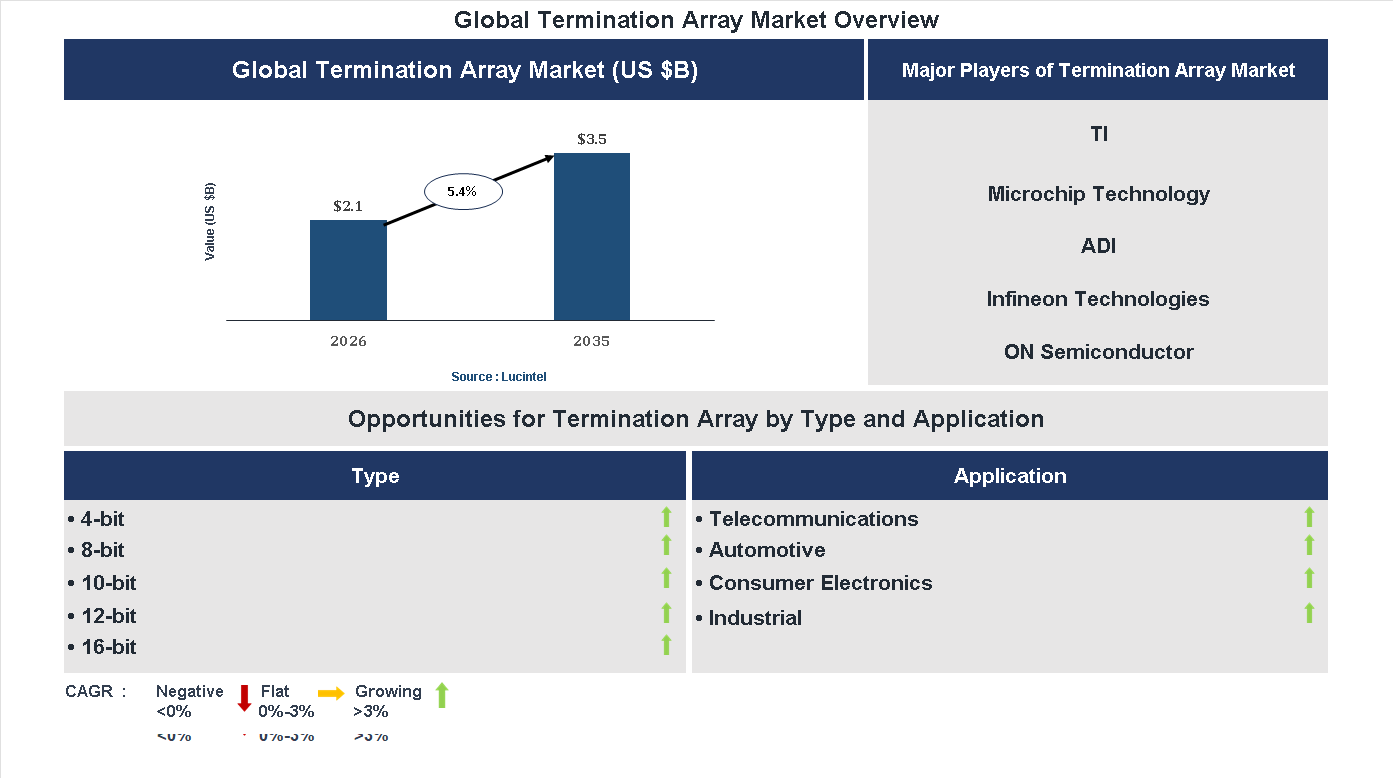
Key data points: The market size in 2035 = $3.5 billion, growth forecast = 5.4% annually for the next 8 years. Scroll below to get more insights. This market report covers trends, opportunities and forecasts in termination array market to 2035 by type (4-bit, 8-bit, 10-bit, 12-bit, and 16-bit), application (telecommunications, automotive, consumer electronics, and industrial), and region (North America, Europe, Asia Pacific, and the Rest of the World)
We'll send your sample report shortly.
• Lucintel forecasts that, within the type category, 16-bit is expected to witness the highest growth over the forecast period.
• Within the application category, telecommunication is expected to witness the highest growth.
• In terms of region, APAC is expected to witness the highest growth over the forecast period. Gain valuable insights for your business decisions with our comprehensive 150+ page report. Sample figures with some insights are shown below.
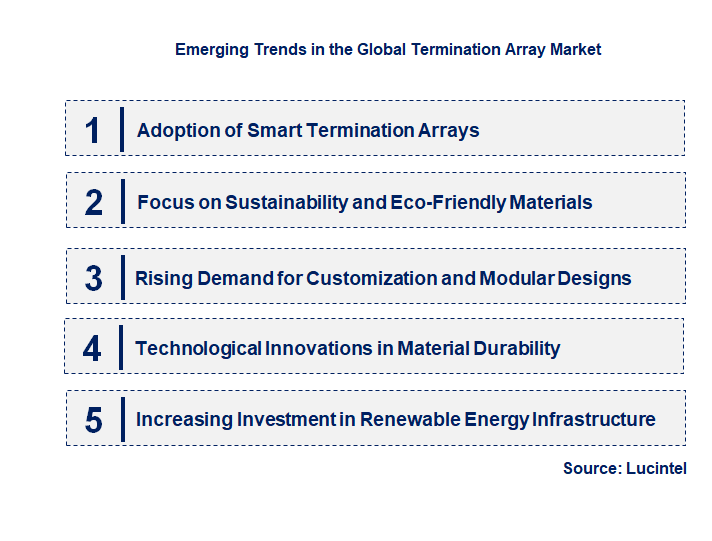
• Adoption of Smart Termination Arrays: The integration of smart technology into termination arrays is revolutionizing the market. These arrays incorporate sensors and IoT connectivity, enabling real-time monitoring, predictive maintenance, and enhanced safety. This trend improves system reliability, reduces downtime, and lowers operational costs. As energy systems become more complex, smart termination arrays offer a scalable solution that enhances overall efficiency and performance, making them highly attractive for large-scale renewable projects and grid integration.
• Focus on Sustainability and Eco-Friendly Materials: Increasing environmental concerns are driving the adoption of sustainable materials in termination arrays. Manufacturers are developing eco-friendly, recyclable, and biodegradable components to reduce the carbon footprint. This trend aligns with global sustainability goals and regulatory requirements, appealing to environmentally conscious consumers and investors. The use of sustainable materials not only minimizes environmental impact but also enhances the marketability of products, fostering a shift towards greener energy infrastructure.
• Rising Demand for Customization and Modular Designs: The market is witnessing a growing preference for customizable and modular termination arrays. These designs offer flexibility to adapt to various project sizes, configurations, and environmental conditions. Modular arrays facilitate easier installation, maintenance, and upgrades, reducing project timelines and costs. This trend caters to diverse customer needs, from small-scale solar farms to large utility projects, and supports the rapid deployment of renewable energy infrastructure across different regions.
• Technological Innovations in Material Durability: Advances in materials science are leading to the development of more durable and weather-resistant termination arrays. Innovations include the use of high-performance polymers, corrosion-resistant metals, and advanced insulation techniques. These improvements extend the lifespan of termination arrays, reduce maintenance requirements, and ensure reliable operation in harsh environments. Such technological progress is critical for expanding the applicability of termination arrays in remote or extreme conditions, thereby broadening market reach.
• Increasing Investment in Renewable Energy Infrastructure: Governments and the private sector are significantly investing in renewable energy projects, fueling the demand for advanced termination arrays. This trend is driven by commitments to reduce carbon emissions and transition to sustainable energy sources. Increased funding supports research and development, infrastructure expansion, and technological upgrades, accelerating market growth. The surge in investments is also fostering competitive innovation, leading to better product offerings and cost reductions, which further stimulate market expansion and adoption. These trends are collectively reshaping the termination array market by promoting smarter, more sustainable, customizable, durable, and well-funded solutions. They are enabling the industry to meet the evolving demands of renewable energy integration, environmental standards, and technological innovation, ultimately driving growth and transforming the energy infrastructure landscape.
• Growing Adoption of 5G Technology: Expansion of 5G networks is fueling demand for advanced termination arrays. These arrays are essential for signal integrity and high-frequency performance in 5G infrastructure. The need for compact, high-performance solutions is driving innovation, leading to increased market opportunities. As 5G deployment accelerates globally, the market for termination arrays is expected to grow substantially, supporting the development of next-generation communication systems and expanding the scope of applications.
• Advancements in Material Technologies: New materials such as ceramics and composites are enhancing termination array performance. These materials offer better thermal management, durability, and electrical properties, enabling more reliable and efficient devices. The adoption of innovative materials is reducing manufacturing costs and improving product lifespan. This development is attracting new customers and expanding applications in aerospace, defense, and telecommunications, thereby boosting market growth and competitiveness.
• Integration of Smart Technologies: Incorporating IoT and AI into termination arrays is improving their functionality and performance. Smart arrays enable real-time monitoring, predictive maintenance, and adaptive signal processing, which enhances system reliability. This integration is opening new avenues in automation, defense, and industrial applications. As smart technology adoption increases, the market is poised for significant expansion, driven by the demand for intelligent, high-performance termination solutions.
• Increasing Focus on Miniaturization: The demand for smaller, more efficient termination arrays is rising across industries. Miniaturization allows for compact device design, essential in mobile, aerospace, and medical applications. Innovations in fabrication techniques are enabling high-density arrays with improved performance. This trend is creating new market segments and opportunities for manufacturers to develop innovative, space-saving solutions, thereby fueling overall market growth and diversification.
• Rising Investment in R&D and Strategic Collaborations: Companies are investing heavily in research and development to innovate and improve termination array technologies. Strategic partnerships and collaborations are facilitating access to new markets and advanced manufacturing techniques. These efforts are accelerating product development, reducing time-to-market, and expanding application scopes. Increased R&D investment is strengthening market competitiveness and fostering a dynamic environment for technological breakthroughs and market expansion. The overall impact of these developments is a robust growth trajectory for the termination array market, characterized by technological innovation, expanded application areas, and increased competitiveness. These opportunities are driving market expansion, attracting new entrants, and fostering a more dynamic and resilient industry landscape. As a result, stakeholders are positioned to benefit from emerging trends and evolving customer demands, ensuring sustained growth and innovation.
• Increasing Adoption of 5G Technology Drives Market Expansion: The rollout of 5G networks necessitates advanced termination arrays capable of supporting higher frequencies and bandwidths. Telecom operators seek reliable, high-capacity solutions to meet the demands of faster data transmission and low latency. This surge in 5G deployment fuels demand for innovative termination array products, fostering market growth. Vendors investing in 5G-compatible technologies and strategic partnerships are positioned to capitalize on this expanding opportunity, ensuring their solutions meet evolving network requirements.
• Growing Data Center Infrastructure Boosts Demand for Termination Arrays: The rapid expansion of data centers worldwide to support cloud services, IoT, and big data analytics increases the need for efficient termination solutions. Data centers require scalable, high-density termination arrays to manage increasing fiber optic connections and ensure optimal performance. This trend drives innovation in compact, high-capacity termination products. Market players focusing on developing robust, easy-to-install solutions tailored for data center environments will benefit from this growth, strengthening their market presence.
• Technological Innovations Enhance Product Capabilities and Market Competitiveness: Advances in materials, manufacturing processes, and design techniques enable the development of more efficient, durable, and cost-effective termination arrays. Innovations such as integrated cooling, modular designs, and improved signal integrity enhance product performance. Companies investing in R&D to incorporate these technologies can differentiate themselves and meet the complex needs of modern networks. This continuous innovation cycle sustains market growth and encourages competitive differentiation among vendors.
• Strategic Collaborations and Partnerships Accelerate Market Penetration: Collaborations between component manufacturers, telecom providers, and technology integrators facilitate the development and deployment of advanced termination solutions. Partnerships enable the sharing of expertise, resources, and market access, accelerating product development cycles. Such strategic alliances help vendors expand their reach into emerging markets and diversify their offerings. This collaborative approach fosters innovation, reduces time-to-market, and enhances overall market competitiveness, supporting sustained growth.
• Increasing Focus on Customization and Modular Solutions Meets Diverse Customer Needs: As network architectures become more complex, there is a rising demand for tailored, modular termination array solutions. Customization allows clients to optimize performance, scalability, and maintenance. Modular designs facilitate easy upgrades and replacements, reducing downtime and operational costs. Vendors offering flexible, adaptable products can better serve diverse industry requirements, from telecom to enterprise networks. This focus on personalized solutions positions companies to capture niche markets and strengthen customer loyalty. The overall market outlook remains positive, with these growth opportunities collectively driving innovation, expanding applications, and increasing demand for termination array solutions. As technological and infrastructural developments continue, market players that adapt to these trends will secure competitive advantages. The evolving landscape promises sustained growth, driven by the need for high-performance, scalable, and customizable termination solutions across various industries and applications.
• Technological Advancements: The rapid evolution of fiber optic technology enhances data transmission capabilities, enabling higher bandwidth and improved performance. This drives demand for advanced termination arrays that support these high-speed networks. Innovations such as multi-fiber connectors and improved manufacturing processes reduce costs and increase efficiency, making termination arrays more accessible across various sectors. As industries seek faster, more reliable connectivity, the market benefits from continuous technological progress, fostering growth and new application opportunities.
• Growing Data Center and Telecom Infrastructure: The expansion of data centers and telecom networks worldwide significantly boosts the need for efficient termination solutions. As data traffic surges due to cloud computing, IoT, and 5G deployment, the demand for reliable, scalable termination arrays increases. These components are critical for ensuring seamless connectivity and optimal network performance. Investments by major telecom providers and data center operators in upgrading infrastructure directly contribute to market expansion, supporting the deployment of next-generation communication systems.
• Increasing Adoption of 5G Technology: The rollout of 5G networks is a major driver, requiring advanced termination arrays capable of handling higher frequencies and data rates. The need for dense, high-capacity connections in urban areas and industrial settings accelerates demand for specialized termination solutions. This technological shift not only enhances network performance but also opens new avenues for applications such as autonomous vehicles, smart cities, and industrial automation, thereby fueling market growth.
• Rising Investment in Fiber Optic Networks: Governments and private enterprises are investing heavily in expanding fiber optic networks to meet the increasing demand for high-speed internet. These investments necessitate sophisticated termination arrays to connect fiber segments efficiently. The focus on rural connectivity and broadband expansion further amplifies this trend, creating a robust market environment. As fiber optic infrastructure becomes more widespread, the demand for reliable termination solutions continues to grow, supporting overall market development.
• Increasing Focus on Network Security and Reliability: As networks become more complex and critical, ensuring security and reliability is paramount. Termination arrays play a vital role in maintaining signal integrity and preventing data breaches. The emphasis on secure, high-performance network components drives innovation in termination technology, including enhanced shielding and protective features. This focus encourages adoption across sensitive sectors such as finance, healthcare, and government, contributing to sustained market growth. The challenges facing the Market include:-
• Regulatory and Compliance Issues: Stringent regulations related to data security, privacy, and environmental standards can complicate product development and deployment. Compliance costs and delays may hinder market expansion, especially in regions with strict policies. Navigating diverse regulatory landscapes requires significant effort and adaptation, potentially limiting rapid growth and innovation within the industry.
• Technological Limitations and Compatibility Issues: Despite advancements, certain technological constraints persist, such as limited compatibility between different fiber types and connector standards. These issues can lead to increased costs and complexity in installation and maintenance. Overcoming these limitations requires ongoing research and development, which may slow down market progress and increase barriers for new entrants.
• High Capital Investment and Cost Constraints: The deployment of advanced termination arrays involves substantial capital expenditure, which can be a barrier for smaller companies and emerging markets. The high costs associated with manufacturing, installation, and maintenance may restrict widespread adoption, especially in price-sensitive regions. This financial challenge can slow market growth and limit access to cutting-edge solutions for some stakeholders. The termination array market is shaped by significant technological innovations and increasing infrastructure investments, which drive growth and expand application possibilities. However, regulatory hurdles, technological compatibility issues, and high costs pose notable challenges that could impede progress. Overall, the market's future depends on balancing these drivers and overcoming obstacles through innovation, strategic investments, and regulatory compliance, ensuring sustained development and broader adoption of termination array solutions.
• TI
• Microchip Technology
• ADI
• Infineon Technologies
• ON Semiconductor
• STMicroelectronics
• Diodes Incorporated
• 4-bit
• 8-bit
• 10-bit
• 12-bit
• 16-bit
• Telecommunications
• Automotive
• Consumer Electronics
• Industrial
• North America
• Europe
• Asia Pacific
• The Rest of the World
• United States: The US market has seen rapid adoption of advanced termination array technologies, driven by the tech sector's demand for high-speed data processing. Major companies are investing in R&D to develop more efficient, miniaturized arrays that support 5G and cloud computing infrastructure. Regulatory support for innovation and strong industry collaborations have further accelerated growth. The US also leads in integrating AI and IoT with termination arrays, enhancing automation and predictive maintenance capabilities. Market players are focusing on sustainability by developing eco-friendly materials and energy-efficient designs to meet environmental standards.
• China: China has emerged as a key player in the termination array market, fueled by government initiatives promoting digital infrastructure and smart city projects. The country is witnessing rapid manufacturing scale-up and technological innovation, with local firms investing heavily in R&D. The focus is on developing cost-effective, high-performance arrays suitable for telecom and data center applications. Strategic partnerships with global technology firms are enhancing product offerings. Additionally, China’s emphasis on 5G deployment and digital transformation has created a robust demand for advanced termination solutions, positioning it as a major growth hub in this sector.
• Germany: Germany's market development is characterized by a strong emphasis on quality, precision engineering, and sustainable practices. The country is leveraging its expertise in industrial automation and automotive manufacturing to incorporate termination arrays into smart factories and electric vehicle production. German firms are innovating in materials and design to improve durability and performance under harsh conditions. The government’s focus on Industry 4.0 initiatives and renewable energy integration is fostering new applications. Collaborations between academia and industry are driving technological advancements, ensuring Germany remains a leader in high-quality, reliable termination array solutions.
• India: India is witnessing rapid growth in the termination array market driven by expanding digital infrastructure, government initiatives like Digital India, and increasing data center investments. Local companies are focusing on developing affordable, scalable solutions to cater to the growing demand across telecom, IT, and manufacturing sectors. The market benefits from a large, skilled workforce and increasing foreign direct investment. Innovations are centered around cost reduction and customization for diverse applications. The government’s push for 5G rollout and smart city projects is expected to further boost market growth, making India a significant emerging market for termination arrays.
• Japan: Japan’s market is characterized by technological innovation and a focus on high-performance, reliable solutions. The country’s strong electronics and automotive industries are integrating advanced termination arrays to enhance product efficiency and miniaturization. Japanese firms are investing in R&D to develop arrays with superior thermal management and durability. The government’s emphasis on robotics, IoT, and smart manufacturing is creating new opportunities. Additionally, Japan’s commitment to sustainability is driving the development of eco-friendly materials and energy-efficient designs. Strategic collaborations with global technology leaders are further strengthening Japan’s position in the global termination array market.


• TI
• Microchip Technology
• ADI
• Infineon Technologies
• ON Semiconductor
• STMicroelectronics
• Diodes Incorporated Q6. Which termination array market segment will be the largest in future? Answer: Lucintel forecasts that, within the type category, 16-bit is expected to witness the highest growth over the forecast period. Q7. In termination array market, which region is expected to be the largest in next 5 years? Answer: In terms of region, APAC is expected to witness the highest growth over the forecast period. Q8. Do we receive customization in this report? Answer: Yes, Lucintel provides 10% customization without any additional cost.


Choose a license that fits your team. Instant PDF delivery.
Prices exclude taxes. Instant delivery. Custom licensing available on request.
Market Report · July 29, 2026
Market Report · July 20, 2026
Market Report · July 20, 2026
Trusted partner for strategic intelligence and business growth


Receive a complimentary market analysis tailored to your industry. Our analysts will identify key growth opportunities and competitive dynamics specific to your business.

Market size, growth rate, and key trend analysis for your specific sector.

Top competitor positioning and market share analysis.

Strategic recommendations backed by data-driven insights.
Get curated market intelligence and competitive moves straight to your inbox.
By subscribing, you agree to receive our monthly insights. Unsubscribe anytime.
Receive a complimentary market analysis tailored to your industry. Our analysts will identify key growth opportunities and competitive dynamics specific to your business.
Market size, growth rate, and key trend analysis for your specific sector.
Top competitor positioning and market share analysis.
Strategic recommendations backed by data-driven insights.
Get curated market intelligence, emerging trends, and competitive moves straight to your inbox each month.
By subscribing, you agree to receive our monthly insights. Unsubscribe anytime.
We'll send your sample report shortly.