
Market Report · July 22, 2026

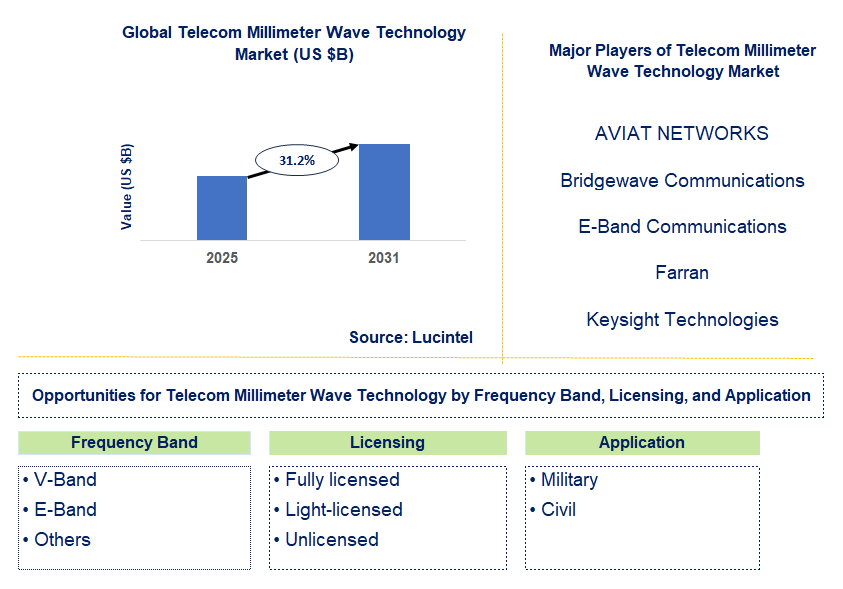
Key data points: The growth forecast = 31.2% annually for the next 7 years. Scroll below to get more insights. This market report covers trends, opportunities and forecasts in telecom millimeter wave technology market to 2031 by frequency band (V-band, E-band, and others), licensing (fully licensed, light-licensed, and unlicensed), application (military and civil), and region (North America, Europe, Asia Pacific, and the Rest of the World)
We'll send your sample report shortly.
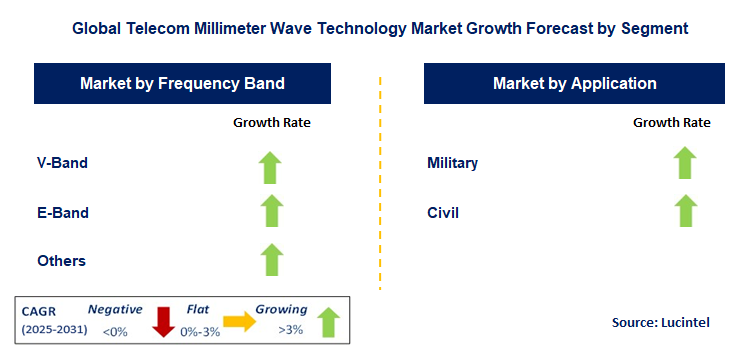
• Lucintel forecasts that, within the frequency band category, E-band is expected to witness higher growth over the forecast period.
• Within the application category, civil is expected to witness higher growth.
• In terms of region, North America is expected to witness the highest growth over the forecast period. Gain valuable insights for your business decisions with our comprehensive 150+ page report. Sample figures with some insights are shown below.
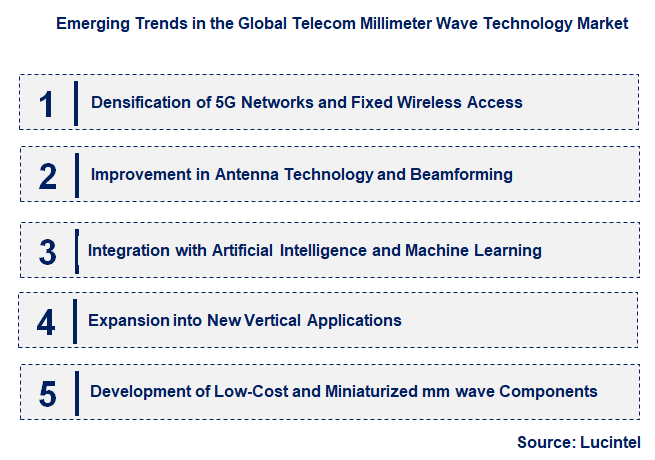
• Densification of 5G Networks and Fixed Wireless Access: This trend is about the deployment of a much larger number of small cells, especially in urban and suburban regions, to address the short distance of mm wave signals. FWA leverages mm wave to provide homes and enterprises with fiber-like broadband speeds without the necessity for extensive fiber-optic cable installation. The effect is increased network capacity in high-traffic areas, better outdoor and indoor coverage, and a feasible alternative for broadband connectivity, particularly in locations where fiber installation is cost-ineffective. This stimulates higher adoption and broad utilization of mm wave.
• Improvement in Antenna Technology and Beamforming: Antenna innovations such as massive MIMO and adaptive beamforming are essential for mm wave performance optimization. These technologies enable the accurate steering of mm wave signals to users, avoiding blockage and enhancing coverage. The effect is increased signal reliability, enhanced link stability, and larger mm wave deployment reach. This renders mm wave more usable in real-world scenarios by overcoming its natural propagation limitations.
• Integration with Artificial Intelligence and Machine Learning: AI and ML are being increasingly applied in mm wave network management to optimize in real time, anticipate failures, and dynamically allocate resources. The technologies can scan vast volumes of network data to determine best beam patterns, forecast likely signal blockages, and streamline power use. The result is more efficient network operation, lower operational expenses, and enhanced overall network efficiency, making the mm wave infrastructure more resilient and self-optimizing.
• Expansion into New Vertical Applications: In addition to classical mobile broadband, mm wave technology is now discovering new uses in multiple industries, such as industrial IoT, smart manufacturing, automotive (for self-driving cars), and healthcare. These vertical markets demand ultra-low latency, extremely high reliability, and massive connectivity, which mm wave can offer. The effect is mm wave market diversification, new revenue opportunities for telecom operators and equipment vendors, and facilitation of revolutionary technologies in these vertical industries.
• Development of Low-Cost and Miniaturized mm wave Components: Research and development are continually aimed at making mm wave components cheaper and smaller, including transceivers, antennas, and chipsets. This incorporates the use of next-generation semiconductor materials such as Gallium Nitride (Gan) and new packaging methods. The effect is decreasing the overall deployment cost of mm wave infrastructure, which allows the technology to be more attractive for more applications and devices, and enable its inclusion in smaller form factors, i.e., smartphones and IoT devices. These nascent trends are changing the telecom millimeter wave technology market by rendering mm wave more resilient, efficient, and affordable. They are transforming the technology from a niche solution to a core driver of next-generation connectivity across various applications, stimulating impressive growth and innovation in the world of telecommunications.
• Accelerated 5G mm wave Rollouts: Mobile network operators around the world are increasingly utilizing mm wave spectrum for their 5G networks, particularly in large cities and high-traffic areas such as stadiums and transportation hubs. This is aimed at delivering ultra-high speeds and high capacity where it matters most. The effect is a dramatic boost in data throughput for customers, lower network congestion, and the capacity to serve more connected devices at the same time, dramatically improving the 5G experience.
• Improved Fixed Wireless Access Deployments: Telecom service providers are investing heavily in mm wave-based FWA solutions as a potential alternative to fiber broadband, especially in suburban and rural locations. This means installing mm wave gear on cell towers or special poles to provide high-speed internet directly to homes and businesses. The effect is broader broadband reach, higher speeds of internet for formerly under-served areas, and a less expensive deployment method in comparison to trenching fiber optic cable, fueling market growth.
• Advancements in mm wave Component Miniaturization and Efficiency: Miniaturization of mm wave components, including antennas, transceivers, and power amplifiers, has made significant strides while enhancing their energy efficiency. This is paramount to enabling mm wave capabilities into smaller devices like smartphones and consumer electronics, as well as enabling base stations to shrink. The effect is wider use of mm wave in consumer devices, reduced power consumption for network equipment, and more compact and visually appealing deployments.
• Increasing Adoption in Enterprise and Industrial Uses: Outside of public networks, mm wave technology is being increasingly adopted for private enterprise networks, industrial automation (Industry 4.0), and specialized use cases such as smart factories and warehouses. Its high bandwidth and low latency are well-suited for real-time control and large-scale data transfer in these settings. The effect is the development of new vertical markets for mm wave, facilitating critical communications for industrial processes, and driving innovation in automated systems for multiple industries.
• Emerging Regulatory Environments and Spectrum Alignment: Global regulatory authorities are actively engaged in the allocation and harmonization of mm wave bands of spectrum to support world-wide deployment and innovation. Examples include spectrum auctions and the establishment of distinct licensing environments. The result is greater clarity and certainty for telecommunications operators and equipment vendors, stimulating greater investment and cross-border compatibility, which drives the development and roll-out of mm wave solutions. These latest advancements are collectively influencing the telecom millimeter wave technology market by broadly increasing its scope and potential. They are turning mm wave from a theoretical potential into a real-world necessity and an integral component of contemporary telecommunications infrastructure, opening new avenues for connectivity, innovation, and economic development across various industries and consumer uses.
• Fixed Wireless Access Expansion: FWA is a huge opportunity for growth, particularly in regions where there is not much fiber infrastructure. Through the utilization of mm wave to bring high-speed broadband right to residences and enterprises, operators are able to quickly establish competitive internet offerings. The effect is significant market reach in rural and underserved markets, offering an affordable alternative to traditional hardwired connections, and speeding digital inclusion by closing the broadband gap. The opportunity is strongest in nations with extensive geographies or difficult terrain for fiber installation.
• Industrial IoT and Private 5G Networks: Industrial applications hold massive potential for mm wave, especially private 5G networks in factories, warehouses, and logistics centers. Such environments require ultra-reliable low-latency communication (URLLC) and massive machine-type communication (m MTC) for industrial automation, robotics, and real-time data processing. The effect is improved operational efficiency, enhanced safety, and the facilitation of sophisticated industrial applications, resulting in noteworthy productivity improvements and spurring the use of mm wave in specialized enterprise solutions.
• Smart City Infrastructure and Public Safety: With increasing smartness in cities, mm wave can be pivotal in supporting a range of smart city applications such as intelligent traffic management, public Wi-Fi hotspots, and surveillance systems. Its huge capacity to support real-time collection and analysis of data from myriad sensors and devices. The effect is enhanced urban management, increased public safety through high-definition video feeds, and seamless connectivity for people, enabling more efficient and responsive cities.
• Automotive and Transportation: The automotive industry offers a promising business opportunity for mm wave technology, particularly in Advanced Driver-Assistance Systems (ADAS) and autonomous driving. mm wave radar sensors provide higher resolution and precision for object detection, obstacle avoidance, and adaptive cruise control. The effect is higher vehicle safety, evolution of autonomous driving capabilities, and creation of connected vehicle ecosystems, which bring about a new generation of transportation.
• Augmented Reality and Virtual Reality Experience: The spread of AR and VR apps, especially those needing real-time high-definition streaming and low latency, imposes a tremendous demand for mm wave connectivity on both consumer entertainment and professional training simulations. The effect is the provision of very immersive and interactive AR/VR experiences, bypassing the bandwidth constraints of legacy wireless technologies, and driving innovation in these fast-paced digital spaces. These strategic growth prospects are influencing the telecom millimeter wave technology market by broadening its base of applications and fueling massive investment beyond the first deployments of 5G mobile. They underscore the technology's inherent significance in reshaping numerous industries and elements of everyday life, creating a vibrant and growing market for mm wave solutions.
• AVIAT NETWORKS
• Bridgewave Communications
• E-Band Communications
• Farran
• Keysight Technologies
• QuinStar Technology
• Eravant
• Ceragon
• Smiths Group
• NEC Corporation
• V-Band
• E-Band
• Others
• Fully licensed
• Light-licensed
• Unlicensed
• North America
• Europe
• Asia Pacific
• The Rest of the World
• United States: The US remains at the forefront of mm wave adoption, spurred on by aggressive 5G deployments by the large carriers. Large investments are being placed in cities to densify networks, leveraging mm wave for high-capacity hotspots and fixed wireless access (FWA) solutions, especially to underserved rural populations. The US market is helped by an active regulatory environment toward spectrum licensing and allocation. Research and development efforts in advanced antenna technologies and beamforming to enhance coverage and penetration are also forefront.
• China: China is building out its 5G infrastructure aggressively, with a key emphasis on sub-6 GHz and mm wave spectrum. Whereas early 5G deployments were focused on wider area coverage using sub-6 GHz, China is increasingly adding mm wave for high-priority use cases demanding ultra-high speed and low latency, including industrial IoT and smart manufacturing. Government investment and megaproject urban developments are driving mm wave rollouts, although there are difficulties in maximizing performance in dense environments.
• Germany: Germany is aggressively moving towards 5G deployment, with increased focus on mm wave for industrial use cases and enterprise private networks. The nation is concentrating on utilizing mm wave in Industry 4.0 projects, smart manufacturing, and autonomous systems, focusing on its high-throughput and ultra-reliable communication potential in large industrial environments. Though public mm wave deployments are underway, strong focus is on dedicated enterprise solutions and vertical markets.
• India: India is seeing stepped-up investments in its digital infrastructure, with 5G deployment picking up speed. India is considering using mm wave technology for improving mobile broadband experience, especially in high-density urban areas, and delivering last-mile connectivity via fixed wireless access. Policy efforts focused on bringing about digital inclusion and a fast-growing smartphone user base are creating demand for high-capacity, low-latency networks, placing mm wave at the center of India's future telecom plans.
• Japan: Japan is leading the charge for 5G innovation, with mm wave being actively embedded into its next-generation mobile networks and new use cases being investigated. mm wave is being used in Japan to transmit high-speed data in urban environments, enable applications such as AR and VR, and paving the way for future developments including autonomous vehicles. Joint initiatives between telcos and technology companies are driving efforts to overcome propagation issues and create more efficient mm wave solutions.


• AVIAT NETWORKS
• Bridgewave Communications
• E-Band Communications
• Farran
• Keysight Technologies
• QuinStar Technology
• Eravant
• Ceragon
• Smiths Group
• NEC Corporation Q5. Which telecom millimeter wave technology market segment will be the largest in future? Answer: Lucintel forecasts that, within the frequency band category, E-band is expected to witness higher growth over the forecast period. Q6. In telecom millimeter wave technology market, which region is expected to be the largest in next 5 years? Answer: In terms of region, North America is expected to witness the highest growth over the forecast period. Q7. Do we receive customization in this report? Answer: Yes, Lucintel provides 10% customization without any additional cost.


Choose a license that fits your team. Instant PDF delivery.
Prices exclude taxes. Instant delivery. Custom licensing available on request.
Market Report · July 22, 2026
Market Report · July 17, 2026
Market Report · July 17, 2026
Trusted partner for strategic intelligence and business growth


Receive a complimentary market analysis tailored to your industry. Our analysts will identify key growth opportunities and competitive dynamics specific to your business.

Market size, growth rate, and key trend analysis for your specific sector.

Top competitor positioning and market share analysis.

Strategic recommendations backed by data-driven insights.
Get curated market intelligence and competitive moves straight to your inbox.
By subscribing, you agree to receive our monthly insights. Unsubscribe anytime.
Receive a complimentary market analysis tailored to your industry. Our analysts will identify key growth opportunities and competitive dynamics specific to your business.
Market size, growth rate, and key trend analysis for your specific sector.
Top competitor positioning and market share analysis.
Strategic recommendations backed by data-driven insights.
Get curated market intelligence, emerging trends, and competitive moves straight to your inbox each month.
By subscribing, you agree to receive our monthly insights. Unsubscribe anytime.
We'll send your sample report shortly.