
Market Report · July 22, 2026

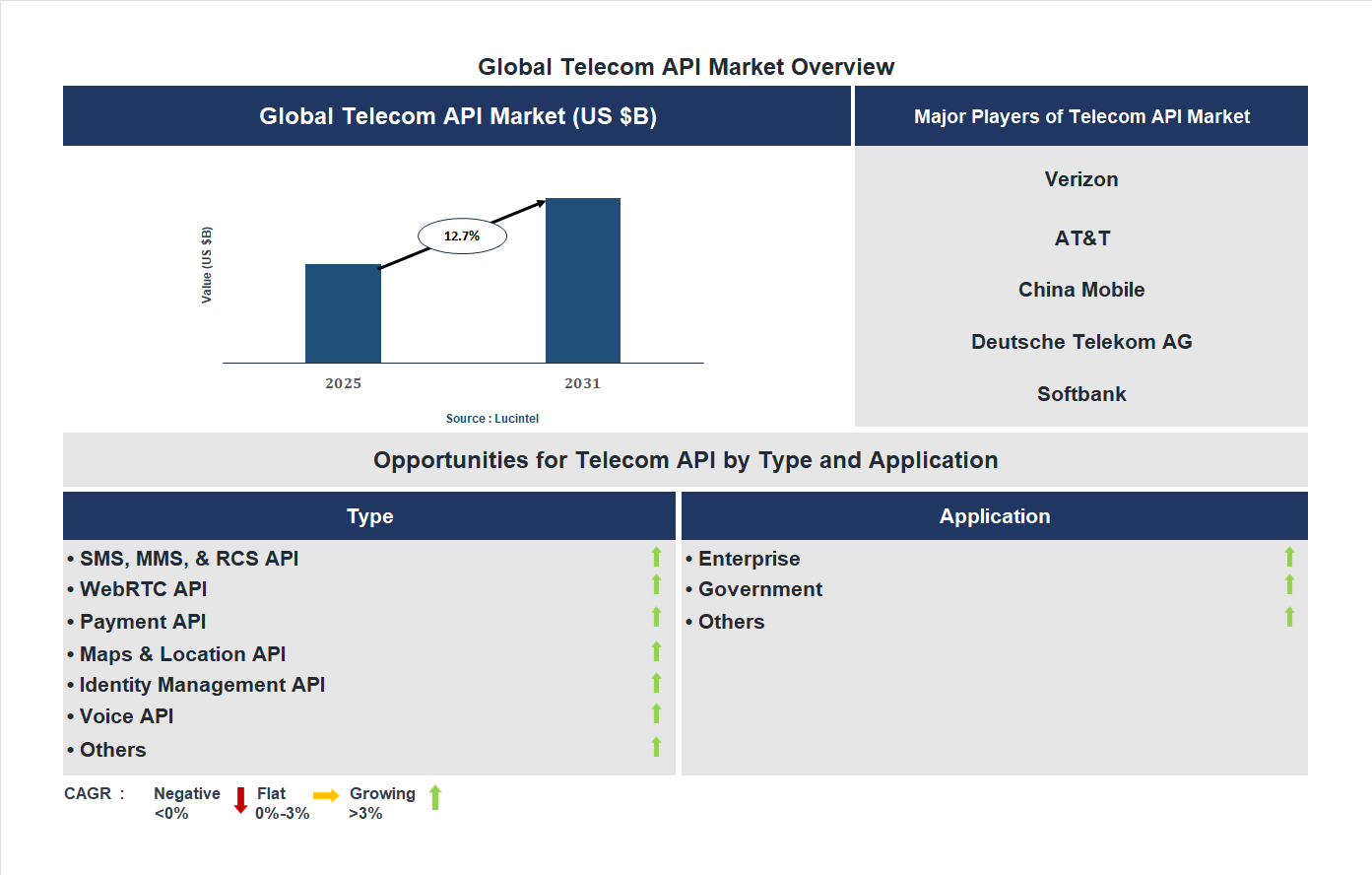
Key data points: The growth forecast = 12.7% annually for the next 7 years. Scroll below to get more insights. This market report covers trends, opportunities and forecasts in telecom API market to 2031 by type (SMS, MMS, & RCS API, WebRTC API, payment API, maps & location API, identity management API, voice API, and others), application (enterprise, government, and others), and region (North America, Europe, Asia Pacific, and the Rest of the World)
We'll send your sample report shortly.
• Lucintel forecasts that, within the type category, WebRTC API is expected to witness the highest growth over the forecast period.
• Within the application category, enterprise is expected to witness higher growth.
• In terms of region, APAC is expected to witness the highest growth over the forecast period. Gain valuable insights for your business decisions with our comprehensive 150+ page report. Sample figures with some insights are shown below.
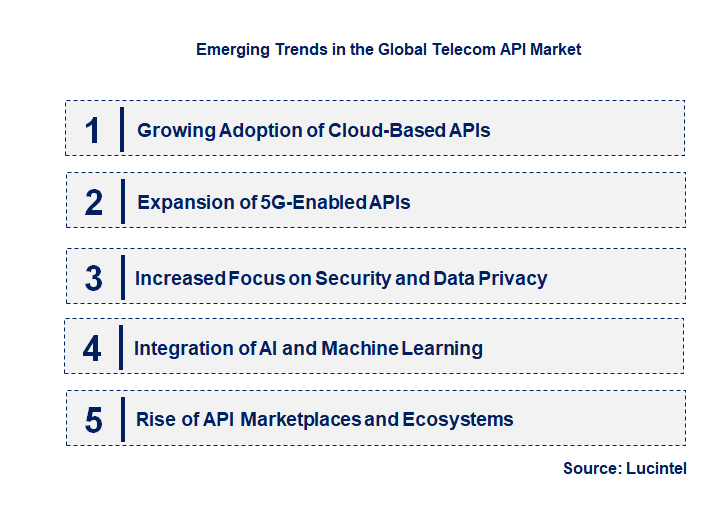
• Growing Adoption of Cloud-Based APIs: The shift to cloud infrastructure allows telecom providers to deploy APIs more rapidly and flexibly. Cloud-based APIs enable scalable, cost-effective solutions that support real-time data exchange and integration with third-party services. This trend enhances agility, reduces time-to-market for new services, and facilitates global expansion. As cloud adoption accelerates, telecom companies can better meet customer demands for personalized and innovative offerings, ultimately driving revenue growth and operational efficiency.
• Expansion of 5G-Enabled APIs: The rollout of 5G networks is fueling the development of APIs tailored for ultra-low latency, high bandwidth, and massive device connectivity. These APIs support new applications such as IoT, smart cities, and autonomous vehicles. They enable telecom providers to monetize 5G infrastructure by offering innovative services and platforms. The integration of 5G APIs is transforming the market by enabling real-time data processing and creating opportunities for new business models, thus positioning telecom companies as key players in the digital economy.
• Increased Focus on Security and Data Privacy: As APIs facilitate access to sensitive customer data and critical network functions, security has become a top priority. Telecom providers are investing in robust authentication, encryption, and monitoring solutions to prevent breaches and ensure compliance with regulations like GDPR. Enhanced security measures build customer trust and protect brand reputation. This trend underscores the importance of secure API design and management, shaping the market by driving demand for advanced security solutions and fostering a safer digital environment.
• Integration of AI and Machine Learning: AI-powered APIs are transforming telecom operations by enabling predictive analytics, automated customer support, and network optimization. These intelligent APIs facilitate personalized customer experiences and proactive service management. The integration of AI and ML enhances operational efficiency, reduces costs, and opens new revenue streams through innovative offerings. As AI adoption grows, the market is moving towards smarter, more autonomous API ecosystems that support complex, data-driven decision-making processes.
• Rise of API Marketplaces and Ecosystems: Telecom companies are creating API marketplaces to foster innovation and collaboration with third-party developers and partners. These ecosystems enable rapid deployment of new services, expand reach, and generate additional revenue streams. API marketplaces facilitate easier access to telecom capabilities, encouraging a broader ecosystem of applications and integrations. This trend is reshaping the market by promoting open innovation, increasing competition, and accelerating the development of new digital services. In summary, these trends are collectively transforming the telecom API market by fostering greater agility, security, and innovation. The shift towards cloud, 5G, AI, and open ecosystems is enabling telecom providers to deliver more personalized, efficient, and secure services. As these developments continue, the market is poised for significant growth, with new opportunities emerging for players who can adapt to the evolving technological landscape.
• Adoption of 5G Technology: The rollout of 5G networks has accelerated API development to support high-speed, low-latency applications, enabling telecoms to offer advanced services like IoT, smart cities, and autonomous vehicles. This development enhances network capabilities, attracts new customers, and opens revenue streams from innovative solutions.
• Emergence of API Marketplaces: Telecom companies are establishing API marketplaces to facilitate easier access, management, and monetization of APIs. This trend promotes ecosystem collaboration, attracts third-party developers, and accelerates service deployment, boosting overall market growth.
• Increased Focus on Security and Compliance: As APIs become more integral to telecom operations, security concerns have intensified. Market players are investing in robust security protocols, encryption, and compliance measures to protect sensitive data, build customer trust, and meet regulatory requirements.
• Integration of AI and Machine Learning: AI-driven APIs are transforming customer service, network management, and predictive analytics. This integration improves operational efficiency, personalizes customer experiences, and enables proactive maintenance, giving telecom providers a competitive edge.
• Expansion of IoT Connectivity: Telecom APIs are crucial for managing IoT devices and data streams. The expansion of IoT connectivity through APIs is driving new business models, enabling real-time data exchange, and supporting smart infrastructure development. In summary, these developments are significantly impacting the telecom API market by fostering innovation, enhancing security, and expanding service offerings. They are enabling telecom providers to stay competitive in a rapidly evolving digital landscape, attract new customers, and generate new revenue streams. The market is becoming more dynamic, integrated, and customer-centric, paving the way for sustained growth and technological advancement.
• Customer Experience Enhancement: APIs enable personalized, real-time customer interactions by integrating data across platforms, leading to improved satisfaction and loyalty. This fosters competitive differentiation and drives revenue growth through targeted marketing and service customization.
• Network Automation and Orchestration: APIs facilitate automation of network management, reducing operational costs and minimizing downtime. This enhances network reliability, accelerates deployment of new services, and supports the transition to 5G infrastructure.
• IoT Ecosystem Development: APIs are critical for connecting and managing IoT devices, enabling telecom operators to offer innovative IoT solutions for smart cities, healthcare, and industrial automation. This expands revenue streams and market reach.
• Cloud Integration and Service Delivery: APIs support seamless integration of telecom services with cloud platforms, allowing for scalable, flexible, and on-demand service provisioning. This accelerates digital transformation and opens new business models.
• Revenue Generation through Value-Added Services: APIs enable telecom providers to develop and monetize value-added services such as mobile payments, content delivery, and security solutions. This diversification enhances profitability and market competitiveness. In summary, these growth opportunities are significantly transforming the telecom API market by fostering innovation, improving operational efficiency, and expanding service offerings. As telecom companies leverage these APIs, they are better positioned to meet evolving customer demands, capitalize on emerging technologies, and sustain competitive advantage in a dynamic digital landscape.
• Technological Innovation: The continuous evolution of communication technologies, such as 5G and cloud computing, enables telecom providers to develop advanced APIs that support new services. These innovations facilitate faster, more reliable, and scalable solutions, meeting the increasing demand for digital transformation. As businesses seek seamless integration of communication services, telecom APIs become vital, driving market growth. The adoption of AI and machine learning further enhances API capabilities, enabling predictive analytics and personalized customer experiences, which are crucial for competitive advantage.
• Growing Demand for Digital Services: The surge in digital services, including messaging, voice, and video communication, propels the need for robust APIs. Enterprises across various sectors are integrating telecom APIs to automate workflows, improve customer engagement, and enable omnichannel communication. The rise of remote work and e-commerce has accelerated this trend, making telecom APIs indispensable for delivering real-time, interactive services. This demand fosters innovation and expands the market as providers develop versatile API solutions tailored to diverse industry needs.
• Regulatory and Compliance Pressures: Governments and regulatory bodies are implementing stricter data privacy and security standards, influencing the development and deployment of telecom APIs. Compliance with regulations such as GDPR and CCPA requires API providers to incorporate robust security measures, data encryption, and user consent protocols. These regulatory frameworks ensure consumer protection but also increase operational complexity and costs for providers. Navigating these regulations is critical for market participants to avoid penalties and maintain trust, thereby shaping the evolution of API offerings.
• Increasing Adoption of IoT and Smart Devices: The proliferation of IoT devices and smart technologies necessitates seamless communication between devices and platforms, driving demand for versatile telecom APIs. These APIs enable real-time data exchange, device management, and remote monitoring, essential for smart homes, connected vehicles, and industrial automation. As IoT adoption accelerates, telecom APIs become integral to enabling scalable, secure, and interoperable solutions, fueling market expansion. This trend underscores the importance of flexible API architectures capable of supporting diverse device ecosystems. The challenges facing this telecom API market include:-
• Security and Data Privacy Concerns: As telecom APIs handle sensitive customer data and facilitate critical communications, they are prime targets for cyberattacks. Ensuring API security involves implementing robust authentication, encryption, and monitoring mechanisms, which can be complex and resource-intensive. Data breaches can lead to significant financial losses and damage to reputation, making security a top concern. Balancing ease of access with stringent security measures remains a challenge, especially as cyber threats evolve rapidly, requiring continuous updates and vigilance.
• Regulatory Compliance and Legal Challenges: Navigating the complex landscape of global data protection laws and telecom regulations poses significant hurdles. Variations in regulations across regions demand adaptable API designs and compliance strategies, increasing development and operational costs. Non-compliance can result in hefty fines and legal repercussions, discouraging innovation. Additionally, evolving regulatory requirements necessitate ongoing updates to API frameworks, complicating deployment and maintenance efforts for providers.
• Integration and Interoperability Issues: Integrating telecom APIs with existing legacy systems and diverse third-party platforms presents technical challenges. Compatibility issues, data synchronization problems, and inconsistent standards can hinder seamless operation. These complexities can lead to increased development time, higher costs, and potential service disruptions. Ensuring interoperability across a broad ecosystem of devices and services requires standardized protocols and flexible API architectures, which are often difficult to implement in heterogeneous environments. In summary, the telecom API market is driven by technological advancements, increasing digital service demands, regulatory developments, and IoT proliferation. However, security concerns, compliance challenges, and integration issues pose significant hurdles. These factors collectively influence the market’s trajectory, requiring stakeholders to innovate continuously while managing risks. Successfully navigating these drivers and challenges will determine the market’s growth potential and competitive landscape, shaping the future of digital communication ecosystems.
• Verizon
• AT&T
• China Mobile
• Deutsche Telekom AG
• Softbank
• China Telecom
• Telefonica
• Vodafone
• America Movil
• Orange
• SMS, MMS, & RCS API
• WebRTC API
• Payment API
• Maps & Location API
• Identity Management API
• Voice API
• Others
• Enterprise
• Government
• Others
• North America
• Europe
• Asia Pacific
• The Rest of the World
• United States: The US market is characterized by rapid adoption of 5G APIs, with major telecom providers expanding their API ecosystems to support IoT, cloud services, and enterprise solutions. Companies like Twilio and Verizon are innovating with programmable communication APIs, enabling seamless integration of messaging, voice, and video services. The focus is on enhancing customer engagement and enabling new revenue streams through API-driven platforms. Additionally, regulatory support and investments in infrastructure are accelerating API deployment across various sectors.
• China: China’s telecom API market is driven by government initiatives and the rapid expansion of 5G networks. Major players such as China Mobile, Huawei, and Alibaba are developing APIs to support smart city projects, IoT applications, and mobile payments. The emphasis is on integrating AI and big data analytics into APIs to improve network efficiency and customer experience. The Chinese market also sees a strong push towards cloud-based APIs, facilitating digital transformation for enterprises and government agencies.
• Germany: Germany’s telecom API market is focused on enhancing network security, privacy, and interoperability within the European Union’s regulatory framework. Telecom operators like Deutsche Telekom are investing in APIs that support B2B services, smart home solutions, and industrial IoT. The country is also emphasizing the development of APIs that enable seamless integration with European digital infrastructure, fostering innovation in sectors such as automotive, manufacturing, and healthcare. The push for open APIs aligns with broader EU digital strategies.
• India: India’s telecom API market is rapidly evolving, driven by the government’s Digital India initiative and the proliferation of affordable smartphones. Telecom providers like Bharti Airtel and Reliance Jio are expanding their API offerings to support mobile payments, e-commerce, and digital banking. The focus is on creating APIs that facilitate financial inclusion, rural connectivity, and enterprise digitization. The market is also witnessing increased adoption of cloud-native APIs and AI-powered solutions to improve service delivery and operational efficiency.
• Japan: Japan’s telecom API market is characterized by advanced technological integration and a focus on smart city and IoT applications. Major telecom companies such as NTT Docomo and SoftBank are developing APIs to support autonomous vehicles, smart infrastructure, and healthcare solutions. The emphasis is on secure, high-speed connectivity enabled by 5G and edge computing. Japan is also investing in APIs that promote interoperability between different systems and support innovative digital services, aligning with its goal of maintaining technological leadership in the region.


• Verizon
• AT&T
• China Mobile
• Deutsche Telekom AG
• Softbank
• China Telecom
• Telefonica
• Vodafone
• America Movil
• Orange Q5. Which telecom API market segment will be the largest in future? Answer: Lucintel forecasts that, within the type category, WebRTC API is expected to witness the highest growth over the forecast period. Q6. In telecom API market, which region is expected to be the largest in next 5 years? Answer: In terms of region, APAC is expected to witness the highest growth over the forecast period. Q7. Do we receive customization in this report? Answer: Yes, Lucintel provides 10% customization without any additional cost.


Choose a license that fits your team. Instant PDF delivery.
Prices exclude taxes. Instant delivery. Custom licensing available on request.
Market Report · July 22, 2026
Market Report · July 17, 2026
Market Report · July 17, 2026
Trusted partner for strategic intelligence and business growth


Receive a complimentary market analysis tailored to your industry. Our analysts will identify key growth opportunities and competitive dynamics specific to your business.

Market size, growth rate, and key trend analysis for your specific sector.

Top competitor positioning and market share analysis.

Strategic recommendations backed by data-driven insights.
Get curated market intelligence and competitive moves straight to your inbox.
By subscribing, you agree to receive our monthly insights. Unsubscribe anytime.
Receive a complimentary market analysis tailored to your industry. Our analysts will identify key growth opportunities and competitive dynamics specific to your business.
Market size, growth rate, and key trend analysis for your specific sector.
Top competitor positioning and market share analysis.
Strategic recommendations backed by data-driven insights.
Get curated market intelligence, emerging trends, and competitive moves straight to your inbox each month.
By subscribing, you agree to receive our monthly insights. Unsubscribe anytime.
We'll send your sample report shortly.