
Market Report · July 15, 2026

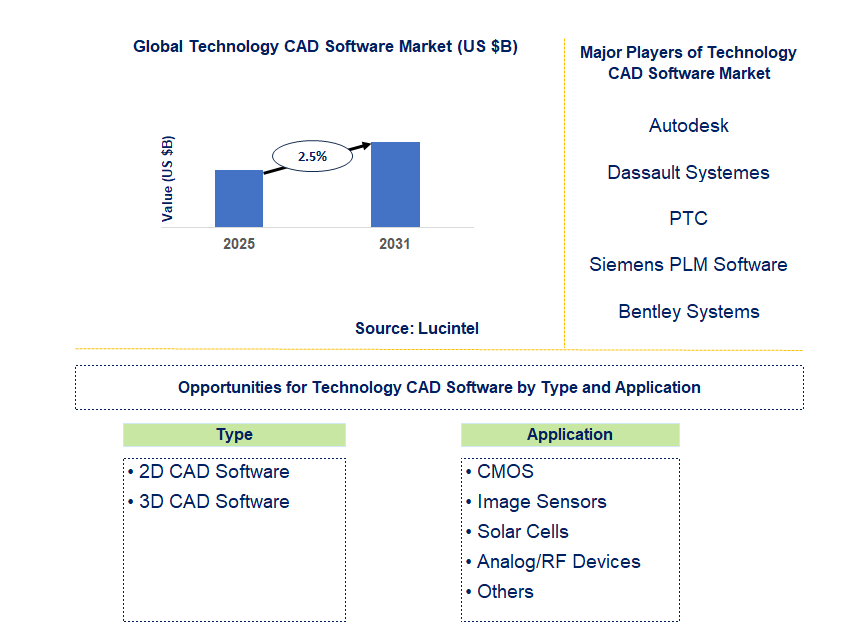
Key data points: The growth forecast = 2.5% annually for the next 7 years. Scroll below to get more insights. This market report covers trends, opportunities and forecasts in technology CAD software market to 2031 by type (2D CAD software and 3D CAD software), application (CMOS, image sensors, solar cells, analog/RF devices, and others), and region (North America, Europe, Asia Pacific, and the Rest of the World)
We'll send your sample report shortly.
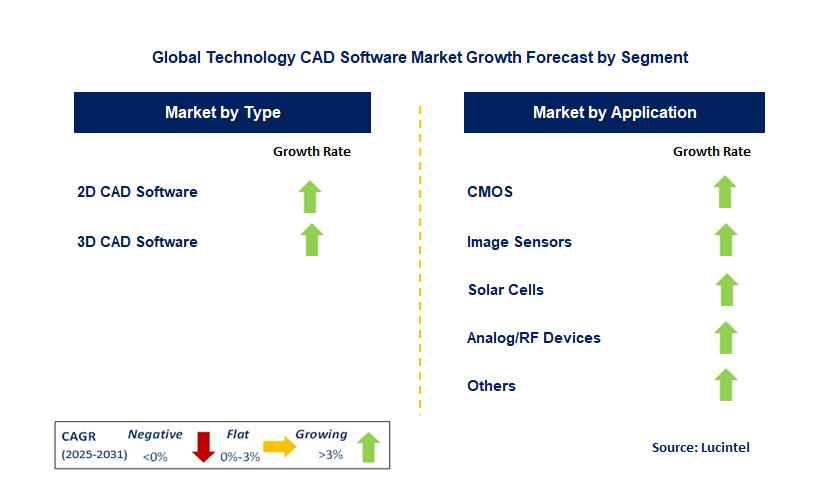
• Lucintel forecasts that, within the type category, 3D CAD software is expected to witness higher growth over the forecast period.
• Within the application category, CMOS is expected to witness the highest growth.
• In terms of region, APAC is expected to witness the highest growth over the forecast period. Gain valuable insights for your business decisions with our comprehensive 150+ page report. Sample figures with some insights are shown below.
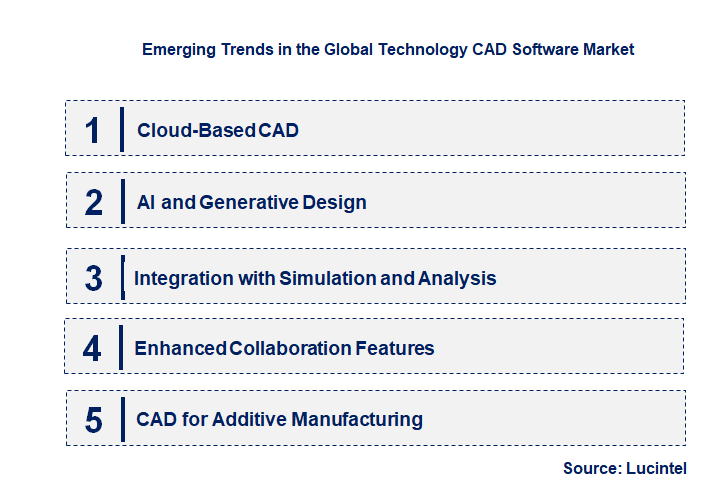
• Cloud-Based CAD: The shift towards cloud-based CAD platforms offers enhanced flexibility, accessibility, and collaboration. Teams can work on projects in real-time from anywhere with an internet connection, reducing IT overhead and enabling scalable deployment for businesses of all sizes, fostering remote work and easier data management.
• AI and Generative Design: Artificial intelligence (AI) is being integrated into CAD software to automate repetitive tasks, suggest design optimizations, and enable generative design, where algorithms create design options based on specified parameters, leading to faster innovation and more efficient designs.
• Integration with Simulation and Analysis: Modern CAD software increasingly includes advanced simulation and analysis capabilities, allowing engineers to test and optimize designs virtually before physical prototyping, reducing costs and time while improving product performance and reliability through early-stage validation.
• Enhanced Collaboration Features: Collaborative CAD tools are becoming more sophisticated, enabling seamless real-time co-design, review processes, and data sharing among multidisciplinary teams, regardless of location, improving communication and accelerating the product development lifecycle.
• CAD for Additive Manufacturing: CAD software is evolving to better support additive manufacturing processes, with features for designing complex geometries optimized for 3D printing, material optimization, and seamless integration with 3D printers, driving innovation in rapid prototyping and customized manufacturing. These emerging trends—cloud-based CAD, AI and generative design, simulation integration, enhanced collaboration, and CAD for additive manufacturing—are collectively reshaping the technology CAD software market by making design processes more efficient, innovative, and accessible. This evolution is empowering engineers and designers to create better products faster and more sustainably.
• Increased Adoption of 3D CAD: There is a growing preference for 3D CAD software over 2D due to its ability to create complex models, enhance visualization, and facilitate better simulation and prototyping, leading to more accurate designs and streamlined product development.
• Shift Towards Subscription Licensing: Many CAD vendors are moving from perpetual licenses to subscription-based models, offering more flexibility and lower upfront costs, making advanced CAD tools accessible to a wider range of users, including SMEs.
• Integration of CAD with PLM Systems: CAD software is increasingly being integrated with Product Lifecycle Management (PLM) systems to improve data management, streamline workflows from design to manufacturing, and enhance collaboration across the entire product lifecycle.
• Mobile CAD Applications: The development of mobile CAD apps allows engineers and designers to view, annotate, and even make minor modifications to designs on the go, enhancing flexibility and enabling better communication outside the traditional office environment.
• Focus on Interoperability: There’s a growing emphasis on improving the interoperability of CAD software with other engineering tools and file formats, ensuring seamless data exchange and collaboration across different software platforms, enhancing workflow efficiency. These key developments—the rise of 3D CAD, the shift to subscription licensing, PLM integration, mobile applications, and the focus on interoperability—are significantly impacting the technology CAD software market by making it more powerful, accessible, and integrated into broader product development processes.
• Architecture, Engineering, and Construction (AEC): Developing BIM (Building Information Modeling) integrated CAD solutions that enhance collaboration, visualization, and lifecycle management for building and infrastructure projects offers substantial growth in the AEC sector.
• Manufacturing and Automotive: Providing advanced 3D CAD tools with simulation and analysis capabilities for product design, tooling, and virtual prototyping in the manufacturing and automotive industries presents a significant growth area.
• Aerospace and Defense: Offering high-precision CAD software with robust simulation and analysis features critical for the complex designs in the aerospace and defense sectors provides a strategic growth opportunity.
• Healthcare and Medical Devices: Creating specialized CAD tools for designing medical devices, prosthetics, and anatomical models, often integrated with 3D printing technologies, represents a growing niche within the healthcare application.
• Electronics and Electrical Design: Developing CAD software tailored for the design and layout of electronic components and electrical systems, with features for simulation and analysis of electronic performance, offers a strategic growth path in the electronics industry. These strategic growth opportunities across AEC, manufacturing/automotive, aerospace/defense, healthcare, and electronics highlight the potential for the technology CAD software market to expand by addressing the specialized design and modeling needs of these key application areas.
• Autodesk
• Dassault Systemes
• PTC
• Siemens PLM Software
• Bentley Systems
• Altair Engineering
• IMSI Design
• Hexagon
• ANSYS
• Corel Corporation
• 2D CAD Software
• 3D CAD Software
• CMOS
• Image Sensors
• Solar Cells
• Analog/RF Devices
• Others
• North America
• Europe
• Asia Pacific
• The Rest of the World
• United States: The US market sees a strong push towards cloud-based CAD solutions and the integration of AI for generative design and automation. Key advancements include enhanced collaboration tools within platforms and a growing focus on sustainability in design, leveraging CAD for lifecycle assessments.
• China: China’s CAD market is characterized by the rise of domestic CAD software providers alongside the adoption of international solutions. Recent developments include a strong emphasis on 3D CAD for manufacturing and infrastructure projects, with increasing government support for local technology development.
• Germany: In Germany, recent developments focus on the integration of CAD with Industry 4.0 initiatives, emphasizing digital twins and simulation for optimized manufacturing processes. There’s also a notable demand for CAD software that supports complex mechanical engineering and automotive design.
• India: India’s CAD market is experiencing rapid growth, driven by increasing adoption in the automotive, construction, and manufacturing sectors. Key developments include the rising popularity of cloud-based CAD, making it accessible to SMEs, and a growing focus on 3D modeling for infrastructure development.
• Japan: Japan’s CAD market shows a steady adoption of advanced 3D CAD software, particularly in the automotive and electronics industries. Recent trends include a growing interest in cloud-based deployment for better collaboration and the integration of CAD with virtual reality for enhanced design visualization.


• Autodesk
• Dassault Systemes
• PTC
• Siemens PLM Software
• Bentley Systems
• Altair Engineering
• IMSI Design
• Hexagon
• ANSYS
• Corel Corporation Q5. Which technology CAD software market segment will be the largest in future? Answer: Lucintel forecasts that, within the type category, 3D CAD software is expected to witness higher growth over the forecast period. Q6. In technology CAD software market, which region is expected to be the largest in next 5 years? Answer: In terms of region, APAC is expected to witness the highest growth over the forecast period. Q7. Do we receive customization in this report? Answer: Yes, Lucintel provides 10% customization without any additional cost.


Choose a license that fits your team. Instant PDF delivery.
Prices exclude taxes. Instant delivery. Custom licensing available on request.
Market Report · July 15, 2026
Market Report · June 26, 2026
Market Report · June 24, 2026
Trusted partner for strategic intelligence and business growth


Receive a complimentary market analysis tailored to your industry. Our analysts will identify key growth opportunities and competitive dynamics specific to your business.

Market size, growth rate, and key trend analysis for your specific sector.

Top competitor positioning and market share analysis.

Strategic recommendations backed by data-driven insights.
Get curated market intelligence and competitive moves straight to your inbox.
By subscribing, you agree to receive our monthly insights. Unsubscribe anytime.
Receive a complimentary market analysis tailored to your industry. Our analysts will identify key growth opportunities and competitive dynamics specific to your business.
Market size, growth rate, and key trend analysis for your specific sector.
Top competitor positioning and market share analysis.
Strategic recommendations backed by data-driven insights.
Get curated market intelligence, emerging trends, and competitive moves straight to your inbox each month.
By subscribing, you agree to receive our monthly insights. Unsubscribe anytime.
We'll send your sample report shortly.