
Market Report · July 15, 2026

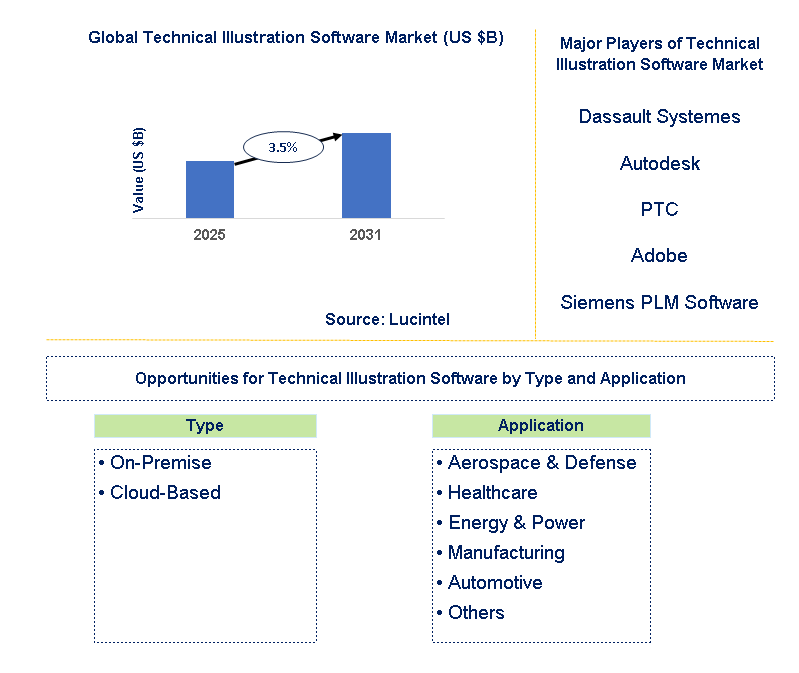
Key data points: The growth forecast = 3.5% annually for the next 7 years. Scroll below to get more insights. This market report covers trends, opportunities and forecasts in technical illustration software market to 2031 by type (on-premise and cloud-based), application (aerospace & defense, healthcare, energy & power, manufacturing, automotive, and others), and region (North America, Europe, Asia Pacific, and the Rest of the World)
We'll send your sample report shortly.
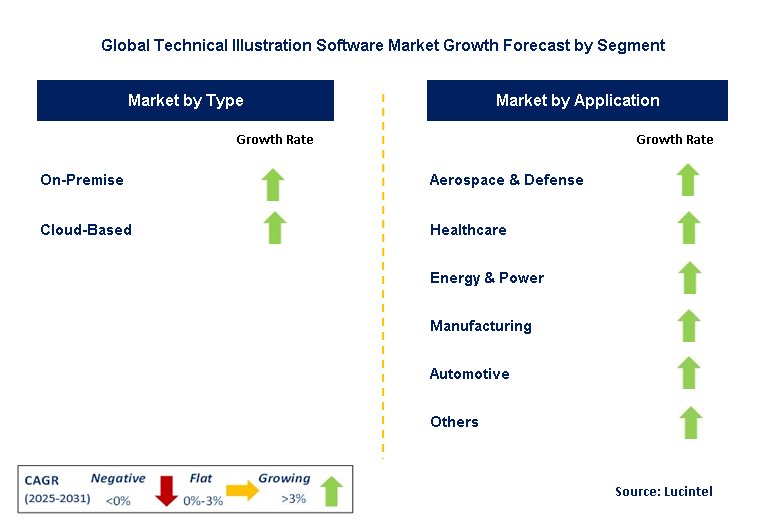
• Lucintel forecasts that, within the type category, cloud-based is expected to witness higher growth over the forecast period.
• Within the application category, automotive is expected to witness the highest growth.
• In terms of region, North America is expected to witness the highest growth over the forecast period. Gain valuable insights for your business decisions with our comprehensive 150+ page report. Sample figures with some insights are shown below.
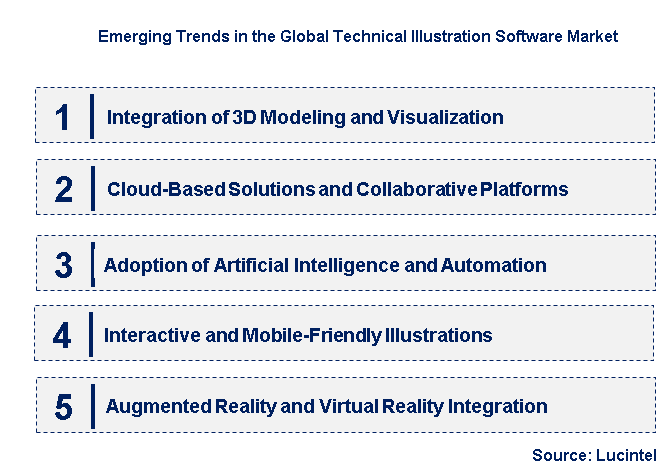
• Integration of 3D Modeling and Visualization: One of the main trends is the further integration of 3D modeling features into technical illustration software. This goes beyond the use of conventional 2D drawings to enable illustrators to directly work with 3D CAD data, generating highly precise and interactive illustrations. The effect is important: increased design visualization, better comprehension of intricate structures, and the possibility of automatically creating multiple views and exploded diagrams. This trend makes fewer demands on time and effort for manual drawing and achieves consistency with the initial design data.
• Cloud-Based Solutions and Collaborative Platforms: The transition to cloud-hosted technical illustration software and collaboration platforms is gaining momentum. They allow several stakeholders such as designers, engineers, and technical writers to view, edit, and share illustrations in real-time from any location. The result is more effective team collaboration, simplified workflows, and better version control. This movement is especially useful for distributed workforces and global teams, promoting productivity and eliminating communication constraints in intricate projects.
• Adoption of Artificial Intelligence and Automation: Artificial intelligence and machine learning are being increasingly added to technical illustration software to perform routine tasks automatically and improve design efficiency. AI driven tools can help with activities such as auto tracing, image identification, and even creating initial illustrations directly from design information. The effect is a dramatic decrease in time and effort spent manually, enabling illustrators to allocate more time on higher value tasks involving creative problem solving. This trend also holds the promise of increased accuracy and consistency in technical documentation.
• Interactive and Mobile-Friendly Illustrations: More and more, the focus is on producing technical illustrations that are mobile friendly and very interactive. What this does is ensure illustrations are optimized to be seen on different devices and offer elements such as clickable hotspots, zoom capabilities, and embedded animation. The effect is enhanced accessibility and interaction for end users like field service technicians or trainees, who can access illustrations on tablets or smartphones for fast reference and easier understanding. This also adds to the overall user experience and training success.
• Augmented Reality and Virtual Reality Integration: Integration of augmented reality and virtual reality into technical illustration software is an emerging edge trend. This enables users to place digital drawings over the real world or become immersed in virtual spaces to engage with 3D models. The effect is revolutionary for training, servicing, and product visualization, delivering immersive and intuitive knowledge of intricate machinery or processes. The trend provides record levels of clarity and participation, going beyond static images to experiential, dynamic learning. These new trends are inherently transforming the Technical Illustration Software Market into a smarter, more collaborative, and more interactive platform. They are redefining how technical data are generated and consumed, resulting in greater efficiency, better communication, and richer end-user experiences for a wide range of industries.
• Improved 3D Model Integration and Direct Manipulation: One important development is the improved capability of technical illustration software to directly import, manipulate, and use 3D CAD models. Manual recreation of parts and assemblies is no longer required, with a huge reduction in errors and time saving. Illustrators can now blow up assemblies, make cross sections, and create different views directly from the 3D source, maintaining consistency with the original design. This is important for industries with highly complex products, like aerospace and automotive, where accuracy is the top priority.
• More Focus on Cloud-Based and SaaS Deployment: There is a definite move towards cloud-based and Software as a Service deployment patterns for technical illustration software. This evolution provides more flexibility, scalability, and accessibility, allowing users to work remotely and collaborate easily. It also lowers the initial investment in software purchase and IT maintenance cost, making sophisticated tools available to small and medium sized businesses. The transformation enables remote workspaces and real time collaboration and updates on projects.
• Sophisticated Automation Features for Illustration Creation: The recent improvements involve more advanced automation capabilities in the software. These include artificial intelligence and machine learning tools that are capable of automating recurring illustration tasks, such as part callouts creation, bill of materials tables generation, or even recommending best views for a component. This improvement greatly increases productivity, reduces human error, and allows consistency in technical documentation across big projects or product ranges, leaving the illustrators to concentrate on intricate design matters.
• Interactive and Multi-Format Output Capabilities Development: Technical illustration software is now offering more powerful capabilities for interactive and multi format outputs creation. This implies that illustrations can be output not just as static graphics but also as interactive PDFs, web based animations, or even augmented reality experiences. This capability is essential for contemporary technical documentation so users can engage with diagrams, examine details at high magnification, or watch assembly process animations. This improves understanding and is extremely useful in training and field service contexts.
• Enhanced Integration with Product Lifecycle Management Systems: One of the most significant developments is the greater integration of technical illustration software and Product Lifecycle Management (PLM) systems. This means that illustrations automatically update whenever design changes are made in the PLM system, ensuring accuracy across the product lifecycle. This streamlined data flow eliminates manual rework, avoids errors, and keeps all technical documentation perpetually in sync with the newest product specifications. This integration is critical for manufacturing and engineering at large scales. These newer advances are essentially transforming the Technical Illustration Software Market by rendering solutions smarter, integrated, and user-friendly. They are leading to increased efficiency, accuracy, and versatility in producing technical documentation, eventually leading to improved communication and faster product development and maintenance cycles in various industries.
• Manufacturing and Industrial Design: The manufacturing industry presents a huge growth opportunity owing to the ever-present requirement for precise assembly instructions, maintenance guides, and quality control diagrams for intricate equipment and products. Software vendors can concentrate on creating solutions which embed flawlessly with CAD/CAM technology, provide sophisticated 3D model manipulation to create exploded views and cross sections, and enable automated bill of materials generation. Potential also exists in offering solutions to make dynamic visual work instructions for factory workers, enhancing productivity and minimizing errors.
• Aerospace and Defense Documentation: The defense and aerospace sector needs very accurate and compliant technical drawings for aircraft maintenance, training, and operating manuals. The sector poses a huge growth potential for specialized software that follows strict industry standards such as S1000D. Solutions that provide strong configuration management, version control, and functionality for integration with augmented reality for real-time maintenance support will be in demand. The complexity and extended lifecycles of aerospace products require advanced and dependable illustration tools.
• Healthcare and Medical Device Instructions: The medical industry, especially for surgery and device manufacturing, is a rapidly expanding niche market. Technical illustration software is essential in producing clear, concise assembly, usage, and maintenance instructions for devices, as well as educational content for medical staff and patients. Opportunities for growth include software that can illustrate complex anatomical structures, present interactive 3D views of devices, and follow stringent medical regulations to maintain clarity and safety in documentation.
• Automotive Service and Training: The automotive sector, with its intricate vehicle architectures and constant innovation, offers great opportunity for growth in service and training use. Technical illustration software plays a crucial role in developing highly detailed service guides, repair manuals, and training documents for mechanics. Applications capable of managing massive amounts of CAD data, creating animated sequences of diagnostic steps, and integrating augmented reality for practical training will be most appreciated. The accelerating development of electric and autonomous cars continues to fuel the demand for modernized and interactive technical documentation.
• Interactive Technical Publications and eLearning: Aside from the conventional print, a major growth area is generating interactive technical publications and eLearning modules. This usage entails building software capable of generating rich, multimedia rich content in which the users can interact with illustrations, animations, and simulations. This has strong usage in product training, online documentation, and customer support. There is opportunity for solutions that offer easy authoring of such content, cross-platform compatibility, and analytics to monitor user consumption and understanding. These strategic growth prospects are having a deep impact on the Technical Illustration Software Market by promoting specialization and innovation. They are forcing software vendors to create more focused, feature-rich, and integrated solutions that address the distinct and changing needs of various industries, ultimately growing the market size and value, as well as the overall efficiency of technical communication.
• Dassault Systemes
• Autodesk
• PTC
• Adobe
• Siemens PLM Software
• Cyient
• ACD Systems International
• Corel
• QuadriSpace
• Auto-Trol
• On-Premise
• Cloud-Based
• Aerospace & Defense
• Healthcare
• Energy & Power
• Manufacturing
• Automotive
• Others
• North America
• Europe
• Asia Pacific
• The Rest of the World
• United States: The US technical illustration software market is healthy, driven mostly by its high-industrial, aerospace and defense, and healthcare base. Recent trends involve accelerated use of sophisticated 3D visualization tools and incorporation with product lifecycle management (PLM) systems. The ongoing demand for extremely accurate and detailed illustrations for technical documentation, user guides, and training guides continues unabated. Cloud-based technologies are picking up steam, facilitating remote working and workflow optimization, especially among the large corporations that are at the forefront of embracing these innovations based on their huge budgets.
• China: The market for China's technical illustration software is rapidly growing, fueled by immense industrialization, technological innovation, and an increasing focus on digital documentation. The booming manufacturing and auto industries in China are major demand drivers. There is significant pressure to adopt Industry 4.0 concepts, which demands sophisticated technical documentation and visualization software. The market also witnesses high investment in research and development processes to bring in more advanced software, supporting the growing demand for new product development projects.
• Germany: The German technical illustration software market is increasing gradually, mirroring its healthy industrial and engineering industries. Major advancements focus on enhancing efficiency and accuracy in technical writing, with emphasis on seamless integration of software with current CAD and PLM infrastructures. Germany, as a top manufacturing location, focuses on high-fidelity 2D and 3D graphics for assembly, maintenance, and training. Demand is further driven by the implementation of smart factory solutions that necessitate smooth integration of technical illustrations with digital production and design systems.
• India: India's market for technical illustration software is changing at a fast pace, with growing usage in different sectors such as manufacturing, automotive, and IT services. Developments in recent times reflect a shift towards 3D illustration capabilities and the inclusion of artificial intelligence and machine learning tools to enable automated pattern recognition and design generation. The market is also seeing a move toward cloud-based technology to enable remote collaboration and easy accessibility. There is increasing emphasis on customization and personalization to address particular user requirements and optimize workflow efficiency.
• Japan: The market for technical illustration software in Japan is growing steadily, fueled by its sophisticated manufacturing and automotive industries. Recent trends involve emphasis on the automated creation of technical drawings and incorporation of advanced visualization capabilities. Technical illustration software is being used increasingly by Japanese companies for developing precise product designs, service guides, and assembly instructions. There is also an increasing demand to integrate augmented and virtual reality technologies into the curriculum to increase interactivity and comprehension of complicated technical information.


• Dassault Systemes
• Autodesk
• PTC
• Adobe
• Siemens PLM Software
• Cyient
• ACD Systems International
• Corel
• QuadriSpace
• Auto-Trol Q5. Which technical illustration software market segment will be the largest in future? Answer: Lucintel forecasts that, within the type category, cloud-based is expected to witness higher growth over the forecast period. Q6. In technical illustration software market, which region is expected to be the largest in next 5 years? Answer: In terms of region, North America is expected to witness the highest growth over the forecast period. Q7. Do we receive customization in this report? Answer: Yes, Lucintel provides 10% customization without any additional cost.


Choose a license that fits your team. Instant PDF delivery.
Prices exclude taxes. Instant delivery. Custom licensing available on request.
Market Report · July 15, 2026
Market Report · June 26, 2026
Market Report · June 24, 2026
Trusted partner for strategic intelligence and business growth


Receive a complimentary market analysis tailored to your industry. Our analysts will identify key growth opportunities and competitive dynamics specific to your business.

Market size, growth rate, and key trend analysis for your specific sector.

Top competitor positioning and market share analysis.

Strategic recommendations backed by data-driven insights.
Get curated market intelligence and competitive moves straight to your inbox.
By subscribing, you agree to receive our monthly insights. Unsubscribe anytime.
Receive a complimentary market analysis tailored to your industry. Our analysts will identify key growth opportunities and competitive dynamics specific to your business.
Market size, growth rate, and key trend analysis for your specific sector.
Top competitor positioning and market share analysis.
Strategic recommendations backed by data-driven insights.
Get curated market intelligence, emerging trends, and competitive moves straight to your inbox each month.
By subscribing, you agree to receive our monthly insights. Unsubscribe anytime.
We'll send your sample report shortly.