
Market Report · July 15, 2026

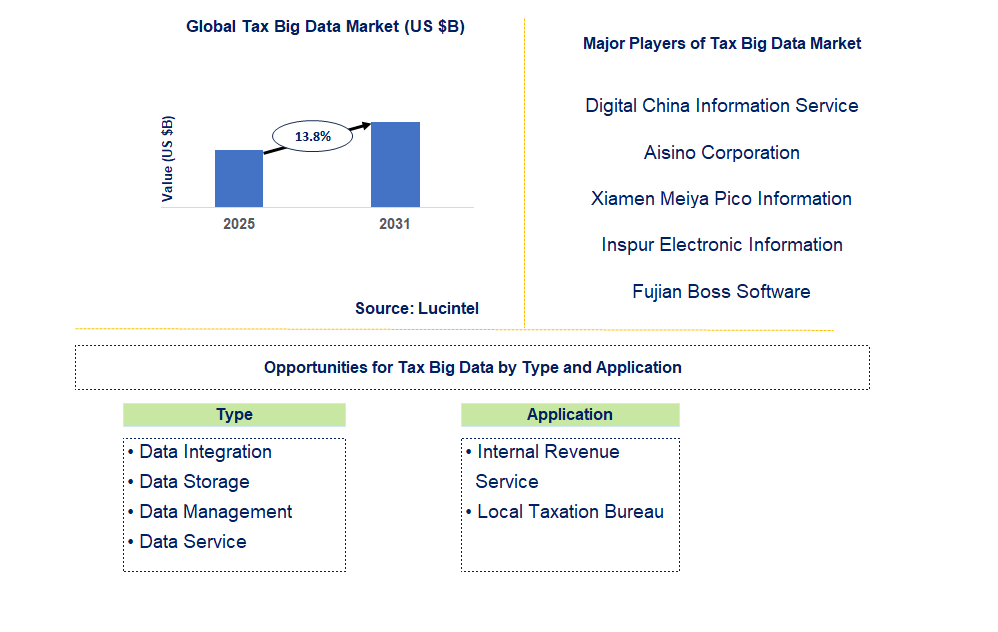
Key data points: The growth forecast = 13.8% annually for the next 7 years. Scroll below to get more insights. This market report covers Trends, opportunity and forecast in tax big data market to 2031 by type (data integration, data storage, data management, and data service), application (internal revenue service and local taxation bureau), and region (North America, Europe, Asia Pacific, and the Rest of the World)
We'll send your sample report shortly.
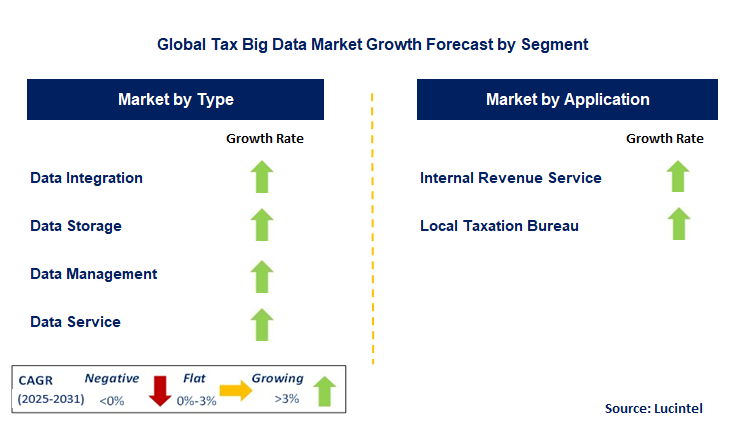
• Lucintel forecasts that, within the type category, data integration is expected to witness the highest growth over the forecast period.
• Within the application category, internal revenue service is expected to witness higher growth.
• In terms of region, APAC is expected to witness the highest growth over the forecast period. Gain valuable insights for your business decisions with our comprehensive 150+ page report. Sample figures with some insights are shown below.
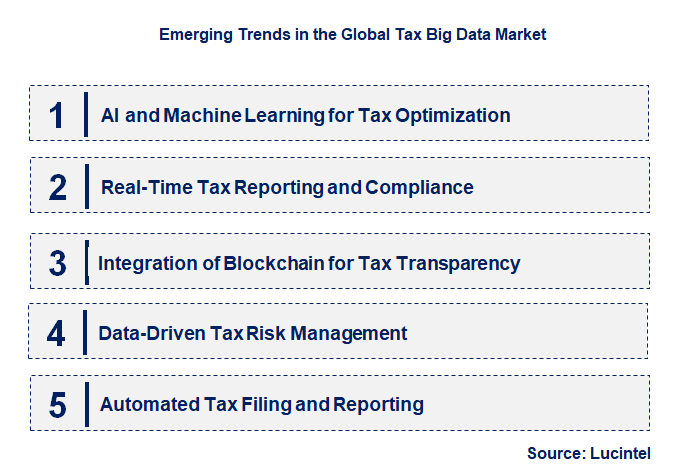
• AI and Machine Learning for Tax Optimization: AI and machine learning technologies are becoming central to tax data analytics, offering enhanced predictive capabilities. By analyzing large datasets, these tools help identify tax-saving opportunities, optimize deductions, and forecast future tax liabilities. Machine learning algorithms can also detect anomalies in tax filings, which helps identify potential errors or fraud. As tax regulations evolve, AI-powered solutions assist tax professionals in automating complex calculations and compliance checks, saving time and reducing human error. These innovations are making tax operations more efficient and reducing the risk of costly mistakes.
• Real-Time Tax Reporting and Compliance: Real-time reporting has emerged as a crucial trend driven by the need for better transparency and immediate compliance. Governments worldwide are implementing digital tax systems, requiring businesses to submit tax data in real-time. This trend is facilitated by the use of cloud-based platforms and automated tax reporting tools that enable organizations to submit tax filings quickly and accurately. By providing up-to-date tax information, businesses can avoid penalties and improve cash flow management. Real-time compliance also helps businesses make more informed decisions, ensuring that they meet regulatory requirements in a timely manner.
• Integration of Blockchain for Tax Transparency: Blockchain technology is increasingly integrated into the tax big data market to enhance transparency and security in tax transactions. By providing an immutable and transparent ledger of all transactions, blockchain enables tax authorities and businesses to track financial activities in real-time, ensuring compliance and reducing fraud. The decentralized nature of blockchain also enhances data security, preventing unauthorized access or tampering. Blockchain has the potential to simplify tax reporting, minimize administrative overhead, and improve the efficiency of audits, making it a transformative technology for both taxpayers and tax authorities.
• Data-Driven Tax Risk Management: Tax risk management is evolving with the help of Big Data analytics. Tax authorities are leveraging advanced analytics to assess potential risks in real-time, enabling them to identify discrepancies, audit patterns, or areas of non-compliance before they escalate into larger issues. Businesses are using Big Data tools to assess their own tax risk profiles, enabling them to make data-driven decisions regarding their tax strategies. With improved data analysis, tax risk management becomes more proactive, helping organizations avoid penalties and optimize tax planning strategies. This shift is reshaping how both companies and governments approach tax risk.
• Automated Tax Filing and Reporting: The automation of tax filing and reporting processes is a key trend in the tax big data market. By automating routine tasks such as data entry, document generation, and submission, tax professionals can reduce manual workloads and focus on more strategic decision-making. Automation tools powered by AI and Big Data technologies are enabling faster and more accurate tax filings. These tools can integrate with existing enterprise resource planning (ERP) systems to streamline data flow and minimize human error. This trend is not only increasing efficiency but also improving compliance, as automated systems ensure that tax filings are complete and accurate. The tax big data market is being reshaped by technological advancements such as AI, blockchain, and automation, which drive efficiency, transparency, and better decision-making. Real-time tax reporting, data-driven risk management, and AI and machine learning integration are transforming how tax professionals and authorities handle complex tax-related tasks. Blockchain technology enhances transparency, while automated tax filing systems ensure greater accuracy and compliance. Together, these emerging trends are streamlining tax processes and enabling businesses and tax authorities to adapt more effectively to evolving regulatory environments. The future of the tax big data market looks poised for greater automation and more brilliant data-driven insights.
• Integration of Artificial Intelligence (AI) and Machine Learning (ML): The adoption of AI and ML technologies in tax administration is one of the most significant developments in the tax big data market. Tax authorities are leveraging these technologies to analyze vast amounts of data quickly, improving audit processes and identifying discrepancies or fraudulent activities. AI-driven systems are now able to predict tax evasion patterns and automate routine tasks such as processing returns and audits. This increases efficiency and accuracy while reducing manual intervention, leading to a more streamlined and effective tax collection system.
• Real-Time Data Analytics for Tax Compliance: Governments are increasingly utilizing real-time data analytics to monitor tax compliance and detect irregularities in tax filings. By integrating Big Data platforms with digital tax filing systems, tax authorities can track and analyze transactions in real time, ensuring timely detection of potential tax evasion. This proactive approach allows authorities to act faster, conducting audits and applying penalties more efficiently. Real-time analytics also provides businesses with more transparent, responsive tax reporting systems, reducing the risk of errors and improving compliance rates.
• Blockchain for Secure and Transparent Tax Reporting: Blockchain technology has gained momentum in the tax big data market as it ensures secure, transparent, and immutable tax transactions. By leveraging blockchain, tax authorities can securely record tax-related data, preventing fraudulent activities such as tax evasion or manipulation of records. Blockchain’s transparent nature allows for real-time verification of transactions, promoting trust between businesses and tax authorities. This development has the potential to revolutionize global tax systems, offering an immutable and verifiable record of tax payments, which ensures greater accountability and transparency.
• Automation of Tax Audits and Risk Management: The automation of tax audits and risk management processes through Big Data tools is reshaping how tax authorities detect and address tax evasion. Automated systems powered by Big Data and AI can now analyze financial records more efficiently, flagging potential red flags and anomalies. This allows tax authorities to focus their efforts on high-risk cases and reduce the administrative burden of manual audits. Additionally, Big Data-driven risk management systems are helping tax agencies better understand emerging risks, enabling them to respond proactively and minimize revenue loss.
• Adoption of Cloud-Based Tax Solutions: The transition to cloud-based tax solutions has been another key development in the tax big data market. Cloud platforms offer greater scalability, flexibility, and cost efficiency compared to traditional on-premises systems. Tax authorities and businesses are increasingly adopting cloud solutions for data storage, processing, and analysis. Cloud-based systems enable seamless data integration and collaboration, ensuring that tax-related data is easily accessible and up-to-date. Additionally, cloud solutions facilitate the implementation of AI, machine learning, and real-time analytics, enhancing the overall efficiency and effectiveness of tax administration. Recent developments in the tax big data market are transforming tax administration through the integration of advanced technologies such as AI, machine learning, blockchain, and cloud-based solutions. These advancements are improving tax compliance, reducing fraud, and enhancing transparency and efficiency in tax processes. Real-time data analytics and the automation of tax audits are also helping authorities address emerging risks more effectively. As these technologies continue to evolve, the tax big data market is set to redefine how tax authorities and businesses interact, leading to more accurate, streamlined, and secure tax systems worldwide.
• AI-Driven Tax Audits and Compliance Monitoring: AI-driven tax audits represent a major growth opportunity in the tax big data market. By leveraging machine learning algorithms and AI tools, tax authorities can process large datasets to automatically identify discrepancies or suspicious patterns in tax filings. This reduces manual intervention, accelerates audit processes, and enhances the accuracy of compliance monitoring. With AI’s ability to analyze real-time data and predict tax evasion, tax authorities can proactively identify high-risk cases, improving compliance rates and reducing the burden on taxpayers. This application not only enhances tax efficiency but also improves the overall quality of audits and compliance monitoring.
• Real-Time Fraud Detection and Prevention: Real-time fraud detection is a key application for Big Data in the tax market. By integrating Big Data tools with AI and machine learning, tax authorities can monitor financial transactions in real time, identifying anomalies and flagging potential fraudulent activities. This proactive approach minimizes tax evasion and increases revenue collection. Big Data analytics enables tax officials to track vast amounts of transaction data across multiple sources and jurisdictions, identifying patterns of fraud that would have previously gone unnoticed. By enhancing fraud prevention in real-time, authorities can ensure a more transparent and secure tax system.
• Blockchain for Secure Tax Transactions: Blockchain technology offers a strategic growth opportunity for secure and transparent tax systems. By implementing blockchain, tax authorities can create an immutable record of tax-related transactions, reducing the risk of fraud and ensuring accurate tax collection. This technology enhances transparency, providing businesses and tax officials with verifiable records of tax payments and filings. As a decentralized and transparent system, blockchain ensures that all parties involved can trace and verify transactions, reducing administrative errors, promoting trust, and increasing overall tax compliance. Blockchain’s ability to maintain a secure, transparent, and auditable record of tax transactions has transformative potential.
• Cloud-Based Tax Data Management: The transition to cloud-based tax data management systems presents a significant growth opportunity in the tax big data market. Cloud platforms offer enhanced scalability, flexibility, and cost-efficiency compared to traditional on-premises systems. Cloud-based solutions can streamline the processing, storage, and management of large volumes of tax-related data, enabling easier integration with AI and Big Data tools. Additionally, cloud-based systems allow for real-time access to tax data across departments and jurisdictions, improving collaboration between tax authorities and businesses. With cloud solutions, tax authorities can more efficiently manage vast amounts of data, ensuring data security and regulatory compliance while lowering operational costs.
• Automated Tax Reporting and Compliance: Automated tax reporting and compliance systems are transforming how businesses interact with tax authorities. By leveraging Big Data analytics and AI, companies can automate the generation of tax reports, ensuring accuracy, reducing errors, and improving compliance. Automated systems can also analyze large volumes of financial data to assess tax liability, providing real-time insights and reducing manual processing. This growth opportunity significantly reduces administrative burdens on businesses while increasing the speed and accuracy of tax filings. For tax authorities, these automated reporting systems provide more accurate, timely information, leading to better decision-making and more efficient tax administration. The tax big data market is undergoing a transformation, with emerging growth opportunities centered around AI, machine learning, blockchain, cloud computing, and automation. AI-driven tax audits and compliance monitoring, real-time fraud detection, blockchain for secure transactions, cloud-based data management, and automated reporting are reshaping tax systems globally. These applications not only improve tax collection efficiency but also enhance transparency, compliance, and security. As tax authorities and businesses increasingly adopt these technologies, the tax big data market is poised for significant growth, providing new opportunities for innovation and more efficient tax systems worldwide.
• Digital China Information Service
• Aisino Corporation
• Xiamen Meiya Pico Information
• Inspur Electronic Information
• Fujian Boss Software
• Data Integration
• Data Storage
• Data Management
• Data Service
• Internal Revenue Service
• Local Taxation Bureau
• North America
• Europe
• Asia Pacific
• The Rest of the World
• United States: In the United States, the use of Big Data in tax operations has surged, especially with the adoption of artificial intelligence (AI) and machine learning for audit and fraud detection. The Internal Revenue Service (IRS) has invested in advanced data analytics tools to enhance tax compliance and identify high-risk tax filers. Additionally, automation and predictive analytics are being integrated into tax systems to streamline filing and reduce errors. The growing use of blockchain technology in tax reporting has also gained attention for its potential to improve transparency, security, and efficiency in tax transactions.
• China: China has been aggressively incorporating Big Data into its tax administration, particularly to improve compliance and detect tax evasion. The country’s State Administration of Taxation (SAT) is utilizing real-time data analytics to monitor tax filings and conduct audits more effectively. By leveraging AI and Big Data, China is also implementing tax incentive programs based on data-driven insights. The Chinese government has made substantial investments in integrating Big Data with its digital tax infrastructure, providing businesses with streamlined tax filing systems. The use of blockchain in China’s tax reporting system is also expanding, with an emphasis on transparency and reducing fraudulent activities.
• Germany: In Germany, the tax authority (Bundeszentralamt für Steuern, or BZSt) has begun incorporating advanced data analytics to enhance tax audits and risk management. The focus has been on automating tax assessments and using Big Data to detect anomalies in tax filings. The implementation of digital tax returns has become widespread, allowing for more accurate and efficient processing of data. Additionally, Germany has been using Big Data to improve its VAT (Value Added Tax) system by identifying discrepancies between businesses’ reported and actual sales. The government is also exploring the use of AI for more targeted tax audits and fraud detection.
• India: India is leveraging Big Data to tackle tax evasion and enhance compliance, particularly with the implementation of the Goods and Services Tax (GST) system. The GST Network (GSTN) uses real-time data analytics to monitor transactions across the country and ensure accurate tax filings. India’s Income Tax Department has incorporated Big Data tools to enhance its e-filing system, making it easier for taxpayers to submit returns and access relevant information. Additionally, AI and machine learning are being used to automate assessments, detect tax fraud, and improve the overall efficiency of tax administration, marking a significant step toward a more transparent tax system.
• Japan: Japan has embraced Big Data in its tax system to streamline administration and improve compliance monitoring. The National Tax Agency (NTA) uses Big Data tools to identify tax evasion patterns and streamline audit procedures. Real-time data analytics is being used to monitor corporate tax filings, ensuring greater transparency in the process. Japan is also investing in blockchain to enhance tax reporting accuracy and secure transactions. In addition to data-driven insights, Japan has been integrating AI and robotic process automation (RPA) to reduce human error and expedite the tax filing and auditing process, positioning the country as a leader in digital tax solutions.


• Digital China Information Service
• Aisino Corporation
• Xiamen Meiya Pico Information
• Inspur Electronic Information
• Fujian Boss Software Q5. Which tax big data market segment will be the largest in future? Answer: Lucintel forecasts that data integration is expected to witness the highest growth over the forecast period. Q6. In tax big data market, which region is expected to be the largest in next 5 years? Answer: APAC is expected to witness the highest growth over the forecast period. Q7. Do we receive customization in this report? Answer: Yes, Lucintel provides 10% customization without any additional cost.


Choose a license that fits your team. Instant PDF delivery.
Prices exclude taxes. Instant delivery. Custom licensing available on request.
Market Report · July 15, 2026
Market Report · June 26, 2026
Market Report · June 24, 2026
Trusted partner for strategic intelligence and business growth


Receive a complimentary market analysis tailored to your industry. Our analysts will identify key growth opportunities and competitive dynamics specific to your business.

Market size, growth rate, and key trend analysis for your specific sector.

Top competitor positioning and market share analysis.

Strategic recommendations backed by data-driven insights.
Get curated market intelligence and competitive moves straight to your inbox.
By subscribing, you agree to receive our monthly insights. Unsubscribe anytime.
Receive a complimentary market analysis tailored to your industry. Our analysts will identify key growth opportunities and competitive dynamics specific to your business.
Market size, growth rate, and key trend analysis for your specific sector.
Top competitor positioning and market share analysis.
Strategic recommendations backed by data-driven insights.
Get curated market intelligence, emerging trends, and competitive moves straight to your inbox each month.
By subscribing, you agree to receive our monthly insights. Unsubscribe anytime.
We'll send your sample report shortly.