
Market Report · July 22, 2026

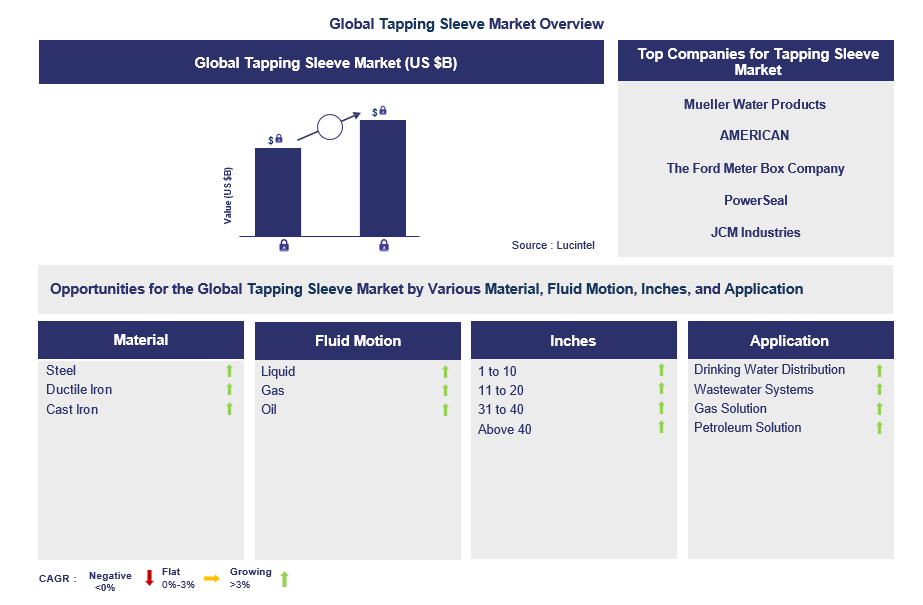
Key data points: The market size in 2030 = $3.6 billion, growth forecast = 5.6% annually for the next 6 years. Scroll below to get more insights. This market report covers trends, opportunities, and forecasts in the global tapping sleeve market to 2030 by material (steel, ductile iron, and cast iron), fluid motion (liquid, gas, and oil), inches (1 to 10, 11 to 20, 31 to 40, and above 40), application (drinking water distribution, wastewater systems, gas solution, and petroleum solution), and region (North America, Europe, Asia Pacific, and the Rest of the World)
We'll send your sample report shortly.
• Lucintel forecasts that, within the material category, steel is expected to witness the highest growth over the forecast period due to its significant usage in wider diameter pipes for better protection and can be used in challenging circumstances when the pipes need to be reinforced.
• Within the application category, wastewater will remain the largest segment due to the increasing use of water waste systems to collect waste water from residential and commercial settings and a rising number of water treatment plants across the world.
• In terms of region, North America is expected to witness the highest growth over the forecast period due to the rising need for water infrastructure replacement and substantial investment in the improvement of water and wastewater management in the region. Gain valuable insight for your business decisions with our comprehensive 150+ page report.
• Use of Advanced Materials: The tapping sleeve market is witnessing a surge in the use of superior materials such as stainless steel and ductile iron. These materials offer a good lifespan, increased corrosion resistance, and easy installation, among other benefits, making them suitable for harsh environments. The adoption of advanced materials is projected to enhance the quality of tapping sleeves, driving their growth.
• Growing Use of Wider Diameter Sleeves: Increasingly, infrastructure development projects require larger diameter tapping sleeves. For example, urban water supply systems or sewage lines often require connections to existing pipes without extensive excavation. In these cases, large diameter sleeves become essential. Consequently, these sleeves can be designed for many applications, including new connections, repairs, or maintenance.
• Focus on Trenchless Technology: Trenchless technology has been adopted by many companies in the tapping sleeves industry to minimize excavation work and surface disturbance. Driven by their cost-effectiveness and eco-friendliness, methods such as horizontal directional drilling or pipe relining have become popular trenchless technologies. It is expected that, over time, demand for tapping sleeves that can be used with these trenchless technologies will increase.
• Smart Technologies Integration: The entire structure of the tapping sleeves market has changed with the incorporation of smart technologies such as IoT (Internet of Things) and AI (Artificial Intelligence). Smart tapping sleeves provide real-time data on pressure, flow rate, and leakage, which enables improved monitoring and optimization of water, oil, or gas distribution systems. As a result, the integration of smart technology will make tapping sleeves more efficient and reliable.
• Sustainability & Environmentally Friendly Products: The tapping sleeves market is increasingly moving toward more sustainable and environmentally friendly solutions due to growing environmental concerns. Companies are manufacturing tapping sleeves with a focus on minimizing waste, reducing carbon footprints, and conserving water. Sustainability in the industry is expected to drive innovation and further growth. Consequently, emerging trends in the tapping sleeve market have resulted in advanced materials, a growing demand for larger diameter sleeves, the adoption of trenchless technologies, integration of smart technologies, and a strong emphasis on sustainability. These developments will drive market growth, improving efficiency and promoting advancements in gas, oil, and water distribution systems worldwide.

• Advanced Materials: Tapping sleeve have been enhanced with wear resistance and durability by using advanced materials such as ceramics and high-strength steels. These materials can withstand large-scale throughput demands, reducing downtime and maintenance costs.
• Precision Manufacturing Techniques: Advanced manufacturing techniques, such as laser cutting and CNC machining, have enabled the production of tapping sleeves with highly accurate dimensions and surface finishes. This level of precision ensures optimal tool performance while preventing accidents caused by tool breakage.
• Innovative Coatings: Tapping sleeves are made harder, more durable, and less slippery by using innovative coatings such as diamond-like carbon (DLC) or titanium nitride (TiN). These coatings help extend tool life and reduce friction, resulting in better-quality threading and thread-forming operations, ultimately increasing productivity.
• Intelligent Monitoring Systems: By integrating sensors and data analytics into tapping sleeves, manufacturers can enable real-time monitoring of sleeve performance during operation. This allows for proactive maintenance measures, preventing unexpected downtimes and optimizing production efficiency.
• Customization & Modular Design: Manufacturers of tapping sleeves are increasingly adopting customization and modular designs to provide bespoke solutions tailored to specific customer requirements. This flexibility enables better process optimization and improved overall performance. These changes have revolutionized the tapping sleeve market. Better materials, precision manufacturing processes, innovative coatings, intelligent monitoring, and customization have all contributed to improved performance and reliability, boosting productivity. As a result, tapping sleeves are now essential tools in achieving high-quality threaded products across various industries.
• Urban Infrastructure Upgrades: Rapid urbanization and aging infrastructure necessitate the replacement and upgrade of existing water systems. In metropolitan areas, the demand for tapping sleeves is largely driven by their ease of installation in cramped spaces.
• Industrial and Commercial Facilities: The industrial and commercial sectors require reliable pipe connection solutions that can easily scale. Tapping sleeves are capable of withstanding high pressure, providing seamless integration with existing systems. Additionally, they can accommodate a range of pipe materials and sizes, making them a preferred option during facility expansions or retrofits.
• Water Utility Projects: With leakage reduction efforts a major focus, many water utility projects now incorporate tapping sleeves due to their ability to achieve safe, leak-proof connections. This role supports infrastructure development, particularly in developing countries, and improves the efficiency of water distribution systems.
• Emergency Repairs and Maintenance: To minimize service interruptions, quick repairs and maintenance must be performed on time. Tapping sleeves are used in emergency situations, allowing for rapid installations and immediate service restoration once the issue is resolved.
• Technological Advancements: Recent developments have enhanced the performance of tapping sleeves, including corrosion-resistant coatings and improved sealing mechanisms. These innovations contribute to longer shelf lives and reduced operating costs, attracting end-users across various applications. The tapping sleeve market is growing rapidly as cities upgrade their infrastructures, factories expand, utilities improve, and quick repairs become essential. Furthermore, new technologies are making tapping sleeves more durable than ever. These opportunities are leading to increased adoption rates and improvements in the functioning of water distribution systems, as tapping sleeves remain a critical component of infrastructure.
• Many Attempts to Improve Technology in Tapping Sleeves: Continuous innovations in the design, materials, and manufacturing techniques of tapping sleeves are driving market growth. The development of performance-enhanced, corrosion-resistant, and leak-proof tapping sleeves has improved their usefulness, making them more attractive to end-users across various industries.
• Increasing Infrastructure Development Needs: The growing demand for infrastructure projects such as water supply systems, gas pipelines, and oil refineries is fueling the demand for tapping sleeves. As governments and private organizations invest in infrastructure development, there will be significant expansion in the tapping sleeve market.
• Growing Awareness of Energy Efficiency: The emphasis on energy efficiency and sustainability has led to increased use of tapping sleeves across different applications. By enabling efficient connections between pipes and equipment, these accessories help optimize energy consumption, leading to overall energy efficiency and cost savings.
• Urbanization and Population Growth: Rapid urbanization and population growth in many regions have increased the demand for basic services such as water, gas, and electricity. This surge in demand creates a need for expanded infrastructure networks that require better connections via tapping sleeves, thus driving their growth.
• Positive Regulatory Environment: Policies set by authorities greatly affect the industry due to their supportive or unsupportive approaches. Favorable government regulations that promote infrastructure development, encourage energy savings, or enforce safety measures will help accelerate the growth of the tapping sleeve market. Challenges in the tapping sleeve market include:
• Economic Volatility: Economic downturns tend to negatively impact the tapping sleeve market, as businesses may cut down on capital expenditure, including infrastructure investments. Economic fluctuations often lead to demand and pricing uncertainties, which can affect the profitability of tapping sleeve manufacturers and suppliers.
• Highly Competitive Market: The tapping sleeve market is highly competitive, with multiple suppliers striving to gain a larger market share. This intense competition can lead to price wars, reducing margins and increasing marketing costs.
• Regulatory Complexity: Various regions have different regulatory requirements governing the tapping sleeve industry, including standards and certifications. Complying with these regulations can be expensive and challenging for companies, preventing them from entering or expanding into new markets. The tapping sleeve market is influenced by a dynamic interplay between drivers and challenges. The drivers of growth include technological advancements, infrastructure development, and energy efficiency. However, challenges such as economic fluctuations, intense competition, and regulatory complexity create significant hurdles. Success in the tapping sleeve business will depend on how companies navigate these factors. Stakeholders must be aware of these drivers and challenges to make informed decisions and capitalize on emerging opportunities in the future.
• Mueller Water Products
• American
• The Ford Meter Box Company
• Powerseal
• JCM Industries
• Everett J. Prescott
• Romac Industries
• Robar Industries
• Petersen Products
• UTS Engineering
• Steel
• Ductile Iron
• Cast Iron
• Liquid
• Gas
• Oil
• 1 to 10
• 11 to 20
• 31 to 40
• Above 40
• Drinking Water Distribution
• Wastewater Systems
• Gas Solution
• Petroleum Solution
• North America
• Europe
• Asia Pacific
• The Rest of the World
• United States: The US market benefits from significant investments in smart water management systems and the replacement of aged infrastructure. Recent trends include the use of advanced materials that enhance the durability of tapping sleeves while resisting corrosion. Additionally, automation models and precision-made tapping sleeves increase installation speed and reduce operational disturbances.
• China: The tapping sleeve market is booming in China, driven by massive urbanization and industrial growth. The need for tapping sleeves in large-scale infrastructure projects requires efficient and cost-effective production. Innovations such as the use of composite materials have improved performance under diverse environmental conditions, making tapping sleeves more suitable for these large projects.
• Germany: The German tapping sleeve market focuses heavily on sustainability and energy efficiency. Recent trends involve the use of environmentally friendly materials that conform to strict environmental standards set by the government. The integration of smart technology for real-time monitoring and control has further improved the functionality and efficiency of tapping sleeves.
• India: Indian rapid urbanization and the need to replace aging water systems are driving the growth of the tapping sleeve market. Affordable tapping sleeves that withstand diverse weather conditions, including the effects of climate change, are in high demand. Local manufacturing is increasingly being considered by producers to reduce costs and enhance supply chain efficiency, helping to meet rising demand in both urban and rural areas.
• Japan: Japan is known for its technological innovation, and the tapping sleeve market in the country meets the highest quality standards. Recent advances focus on high-end engineering solutions designed to address challenges posed by seismic activities. The use of high-strength materials and precision-based manufacturing ensures that tapping sleeves are secure and safe for installation in earthquake-prone zones.


• Mueller Water Products
• AMERICAN
• The Ford Meter Box Company
• PowerSeal
• JCM Industries
• Everett J. Prescott
• Romac Industries
• Robar Industries
• Petersen Products
• UTS Engineering Q6. Which tapping sleeve market segment will be the largest in the future? Answer: Lucintel forecast that steel is expected to witness the highest growth over the forecast period due to its significant usage in wider diameter pipes for better protection and can be used in challenging circumstances when the pipes need to be reinforced. Q7. In the tapping sleeve market, which region is expected to be the largest in the next 5 years? Answer: North America is expected to witness the highest growth over the forecast period due to the rising need for water infrastructure replacement and substantial investment in the improvement of water and wastewater management in the region. Q.8 Do we receive customization in this report? Answer: Yes, Lucintel provides 10% customization without any additional cost.


Choose a license that fits your team. Instant PDF delivery.
Prices exclude taxes. Instant delivery. Custom licensing available on request.
Market Report · July 22, 2026
Market Report · July 17, 2026
Market Report · July 17, 2026
Trusted partner for strategic intelligence and business growth


Receive a complimentary market analysis tailored to your industry. Our analysts will identify key growth opportunities and competitive dynamics specific to your business.

Market size, growth rate, and key trend analysis for your specific sector.

Top competitor positioning and market share analysis.

Strategic recommendations backed by data-driven insights.
Get curated market intelligence and competitive moves straight to your inbox.
By subscribing, you agree to receive our monthly insights. Unsubscribe anytime.
Receive a complimentary market analysis tailored to your industry. Our analysts will identify key growth opportunities and competitive dynamics specific to your business.
Market size, growth rate, and key trend analysis for your specific sector.
Top competitor positioning and market share analysis.
Strategic recommendations backed by data-driven insights.
Get curated market intelligence, emerging trends, and competitive moves straight to your inbox each month.
By subscribing, you agree to receive our monthly insights. Unsubscribe anytime.
We'll send your sample report shortly.