
Market Report · July 17, 2026

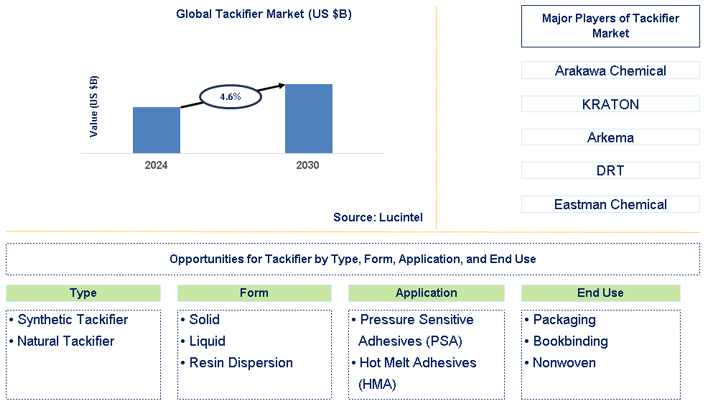
Key data points: The market size in 2030 = $4.6 billion, growth forecast = 4.6% annually for the next 6 years. Scroll below to get more insights. This market report covers trends, opportunities, and forecasts in the global tackifier market to 2030 by type (synthetic tackifier and natural tackifier), form (solid, liquid, and resin dispersion), application (pressure sensitive adhesives (PSA) and hot melt adhesives (HMA)), end use (packaging, bookbinding, nonwoven, construction, and others), and region (North America, Europe, Asia Pacific, and the Rest of the World)
We'll send your sample report shortly.
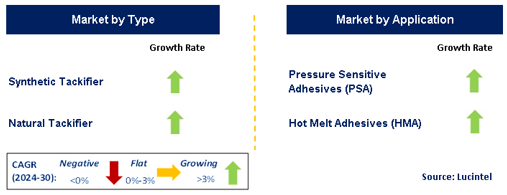
• Lucintel forecasts that, within the type category, synthetic tackifiers will remain the larger segment over the forecast period due to their unique properties of adhesion and cost-effectiveness in adhesive formulation.
• Within the end-use category, packaging will remain the largest segment due to growing consumer demand for tackifier based environmentally friendly packaging options.
• In terms of regions, APAC is expected to witness the highest growth over the forecast period due to increased construction activities and rising investments in the expansion or upgradation of manufacturing facilities in the region. Gain valuable insights for your business decisions with our comprehensive 150+ page report.
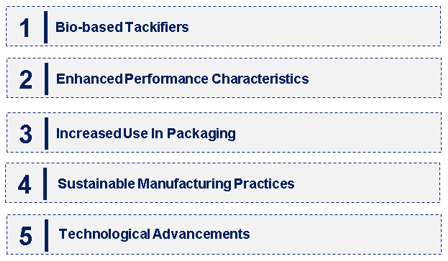
• Bio-based Tackifiers: Bio-based tackifiers are gaining popularity due to increased environmental consciousness. They are derived from renewable sources and have a lower environmental impact compared to conventional fossil-based tackifiers. Regulatory incentives and consumer demand for greener products are driving their uptake.
• Enhanced Performance Characteristics: There is an increasing trend towards tackifiers that have better performance characteristics, such as good adhesion properties and high thermal stability. Innovations in resin formulations allow for the development of products that meet the demanding requirements of various applications, including construction, automotive, etc.
• Increased Use In Packaging: The usage of tackifiers in packaging is growing as more manufacturers seek efficient adhesive solutions for different types of packaging materials. The growth of e-commerce and food packaging sectors necessitates stronger seals, which can only be achieved through the use of tackifiers, hence making them important.
• Sustainable Manufacturing Practices: Manufacturers are focusing on reducing their environmental footprints through cleaner production technologies and responsible sourcing of raw materials as part of a wider trend towards sustainability. This shift aligns with global sustainability goals and consumers’ preference for eco-friendly products.
• Technological Advancements: Advancements in manufacturing technologies enable customized tackifier properties to be produced. Certain innovations, such as advanced polymerization techniques or different blending methods, enhance the versatility and performance of tackifiers across multiple applications concurrently; this is one way through which they innovate beyond what has been done before These are the trends that are emerging in this market, and they are changing the tackifier market by driving innovation, increasing sustainability, and expanding application areas. The current market environment is dynamic and evolving rapidly because of the emphasis on bio-based materials, improved performance, and technological advancements.
• Innovation Bio-Based Tackifiers: Production of bio-based tackifiers has been driven by growing environmental awareness and support from legislation. Tackifiers made from renewable sources of energy are being investigated to reduce carbon footprints as well as capture eco-sensitive customers through sustainable consumption.
• Expansion of Production Capacity: Tackifier manufacturers continue to increase their production capacities due to high demand globally. New facilities or remodeling current ones are being built so that their output volume can be increased efficiently, whereby both domestic as well as international markets would benefit.
• Advances in Product Formulations: Improvements such as better adhesion or heat resistance have been observed with new tackifier formulations, hence responding to demands for high-performance applications, especially found in automotive and construction industries.
• Regulatory Changes and Compliance: Stricter environmental regulations have led this industry to take a different approach towards such requirements, which is aimed at meeting safety issues together with environmental concerns during product development, thus influencing its dynamics.
• Strategic Partnerships and Collaborations: Companies establish strategic partnerships and collaborate so that they can exploit synergies among themselves, leading to innovation. Advanced tackifier technologies are being promoted through these alliances, together with expanded market coverage using pooled expertise, resources, etc. The above-mentioned aspects characterize growth and transformation within the tackifier market today, including innovations, capacity expansions, or regulatory adaptations, which shape its future direction, thereby posing new opportunities and challenges to the market participants.
• Automotive Industry: Adhesives that are used in the assembly of vehicles and interiors for enhanced bonding needs create growth pockets for tackifiers in the automotive sector. Tackifiers with high performance attributes have become highly sought after due to their ability to improve the safety and longevity of vehicles.
• Construction Sector: Tackifiers refer to a class of adhesives used in flooring, roofing as well as insulation adhesives in the construction industry. The increasing urbanization rates coupled with infrastructure development projects have triggered a demand for specialized tackifiers tailored towards such changing needs within this sector.
• Packaging Industry: The packaging industry has been growing rapidly, especially considering e-commerce as well as food packaging subsectors. Packaging materials that perform better and are more reliable require tackifiers associated with them, which are essential in achieving better adhesion or sustainability across different applications.
• Medical and Healthcare Applications: Advanced medical adhesive products, including wound dressings, surgical tapes, etc., increasingly utilize tackifiers. This segment is witnessing an increased demand for advanced medical adhesives that provide safe and comfortable sticking areas, thus presenting opportunities for special tackifier products.
• Eco-friendly Solutions: There is an increased focus on sustainability with a growing market for eco-friendly tackifiers made from renewable resources. Companies that invest in developing bio-based and recyclable tackifiers are likely to benefit from increased consumer preference for sustainable products. These growth opportunities are shaping the Tackifier market, driving innovation, and expanding application areas. Corporate entities are positioning themselves strategically to harness these opportunities as well as satisfy the changing needs of various industries.
• Arakawa Chemical Industries
• KRATON
• Arkema
• DRT
• Eastman Chemical
• Exxon Mobil
• Lawter
• Neville Chemicals
• Natrochem
• Teckrez
• Synthetic Tackifier
• Natural Tackifier
• Solid
• Liquid
• Resin Dispersion
• Pressure Sensitive Adhesives (PSA)
• Hot Melt Adhesives (HMA)
• Packaging
• Bookbinding
• Nonwoven
• Construction
• Others
• North America
• Europe
• Asia Pacific
• The Rest of the World
• United States: In the USA, there has been a growing focus on bio-based sustainable tackifiers. This pressure has led to companies investing more in research and development to improve the performance of tackifiers while maintaining the low environmental impact of these products. This trend is also expected to result in increased adoption of bio-based resins.
• China: To meet the local market and overseas demand for tackifiers, China has seen exponential growth in its capacity for production. Other developments include the creation of new manufacturing facilities that have partnered with others in efforts aimed at improving production efficiency. They have also put more effort into improving the quality and performance of tackifiers for various industrial applications.
• Germany: Thermal resistance-enhanced high-performance tackifiers are among Germany’s lead innovations. Therefore, they focus on developing tackifiers that will meet both safety and performance criteria set by European stringent standards. Growth is being driven by investments made towards sustainable practices coupled with advanced manufacturing technologies within this market segment.
• India: Affordable yet high-quality tackifiers supporting the construction and automotive industry boom are increasingly sought after across India; therefore, domestic manufacturers are scaling up their productions while enhancing their formulations for increased demand under competition pressures. These facilitate market expansion alongside different government initiatives geared towards supporting industrial growth.
• Japan: Japan has progressed further than other countries when it comes to specialty tackifiers featuring unique attributes such as low environmental footprint and high-temperature stability. They are keen on the integration of cutting-edge materials and technologies because Japan wants to remain competitive globally, especially through these kinds of moves, which happen between industry players working together with institutions engaged in research.


• Arakawa Chemical Industries
• KRATON
• Arkema
• DRT
• Eastman Chemical
• Exxon Mobil
• Lawter
• Neville Chemicals
• Natrochem
• Teckrez Q6. Which tackifier market segment will be the largest in future? Answer: Lucintel forecasts that synthetic tackifier will remain the larger segment over the forecast period due to its unique properties of adhesion and cost-effectiveness in adhesive formulation. Q7. In tackifier market, which region is expected to be the largest in next 5 years? Answer: APAC is expected to witness the highest growth over the forecast period due to increased construction activities and rising investments in the expansion or upgradation of manufacturing facilities in the region. Q.8 Do we receive customization in this report? Answer: Yes, Lucintel provides 10% customization without any additional cost.


Choose a license that fits your team. Instant PDF delivery.
Prices exclude taxes. Instant delivery. Custom licensing available on request.
Market Report · July 17, 2026
Market Report · July 17, 2026
Market Report · May 18, 2026
Trusted partner for strategic intelligence and business growth


Receive a complimentary market analysis tailored to your industry. Our analysts will identify key growth opportunities and competitive dynamics specific to your business.

Market size, growth rate, and key trend analysis for your specific sector.

Top competitor positioning and market share analysis.

Strategic recommendations backed by data-driven insights.
Get curated market intelligence and competitive moves straight to your inbox.
By subscribing, you agree to receive our monthly insights. Unsubscribe anytime.
Receive a complimentary market analysis tailored to your industry. Our analysts will identify key growth opportunities and competitive dynamics specific to your business.
Market size, growth rate, and key trend analysis for your specific sector.
Top competitor positioning and market share analysis.
Strategic recommendations backed by data-driven insights.
Get curated market intelligence, emerging trends, and competitive moves straight to your inbox each month.
By subscribing, you agree to receive our monthly insights. Unsubscribe anytime.
We'll send your sample report shortly.