
Market Report · July 29, 2026

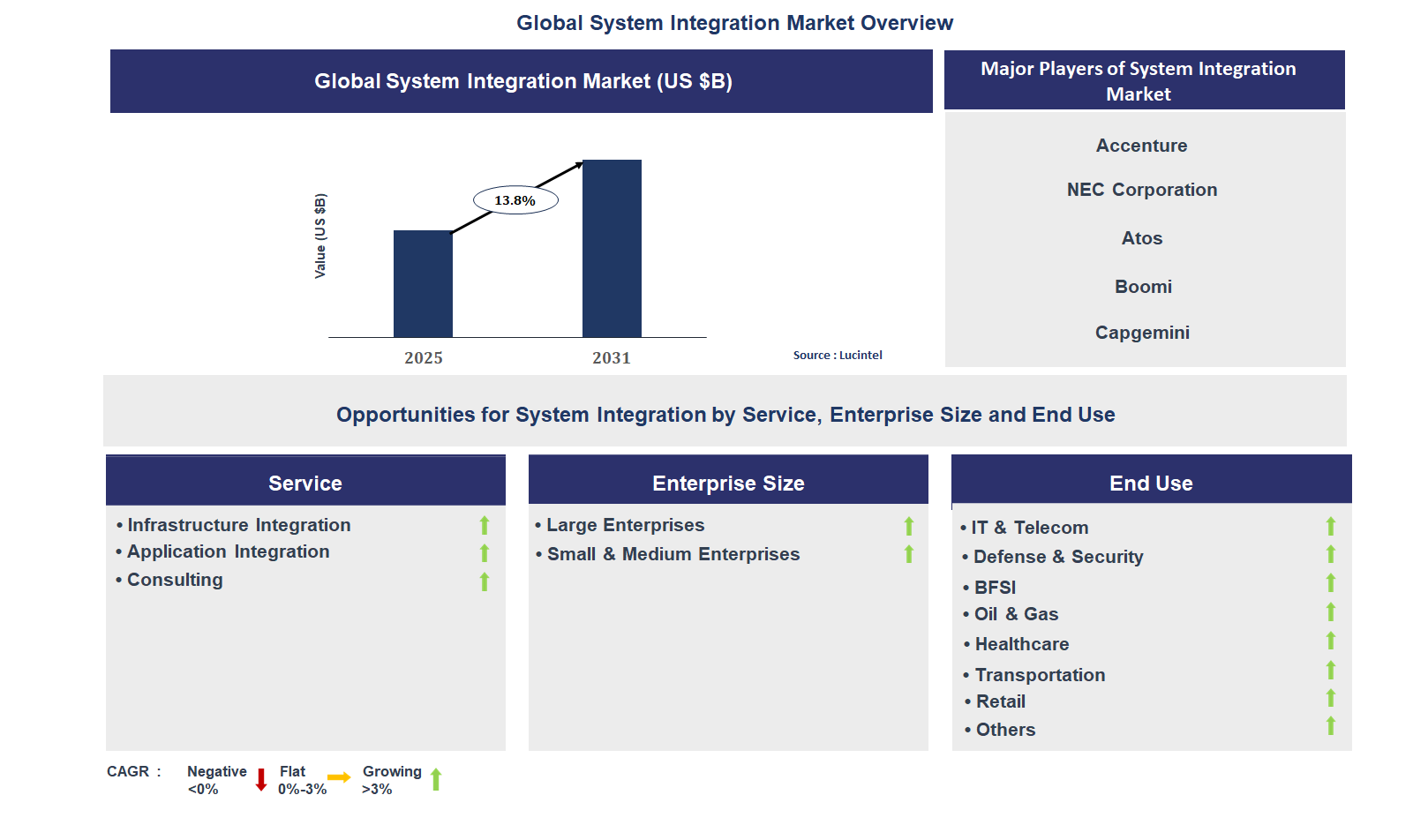
Key data points: The growth forecast = 13.8% annually for the next 7 years. Scroll below to get more insights. This market report covers trends, opportunities and forecasts in system integration market to 2031 by service (infrastructure integration, application integration, and consulting), enterprise size (large enterprises and small & medium enterprises), end use (IT & telecom, defense & security, BFSI, oil & gas, healthcare, transportation, retail, and others), and region (North America, Europe, Asia Pacific, and the Rest of the World)
We'll send your sample report shortly.
• Lucintel forecasts that, within the service category, infrastructure integration is expected to witness the highest growth over the forecast period.
• Within the end use category, BFSI is expected to witness the highest growth.
• In terms of region, North America is expected to witness the highest growth over the forecast period. Gain valuable insights for your business decisions with our comprehensive 150+ page report. Sample figures with some insights are shown below.
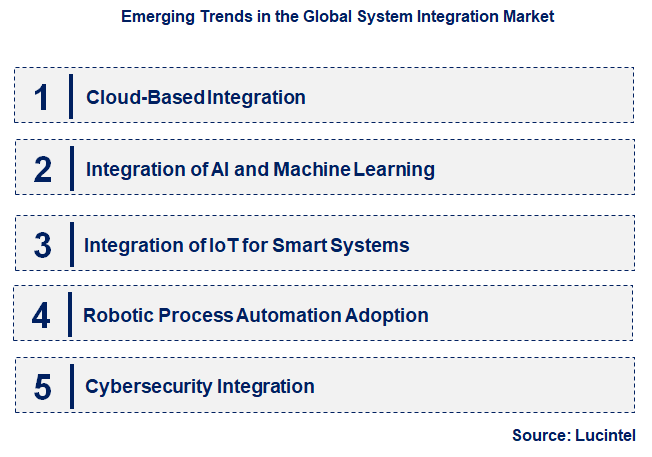
• Cloud-Based Integration: Cloud-based system integration is turning out to be one of the strongest trends in the marketplace. Organizations are increasingly turning to cloud solutions to facilitate more scalable, agile, and less expensive operations. By integrating systems into the cloud, enterprises can gain better data storage, availability, and real-time decision-making capabilities. This phenomenon is most applicable to organizations that must handle high levels of data and wish to capitalize on the capabilities of cloud computing to enhance innovation and optimize processes.
• Integration of AI and Machine Learning: The use of artificial intelligence (AI) and machine learning (ML) technologies is gaining pace at a fast rate in the system integration industry. Through the use of AI and ML, businesses can boost their automation processes, streamline workflows, and enhance predictive analysis. These technologies enable more effective operations through real-time decision-making, trend identification, and overall system improvement.
• Integration of IoT for Smart Systems: The Internet of Things (IoT) is revolutionizing businesses by networking devices and systems to develop more responsive and intelligent operations. System integrators are shifting focus towards incorporating IoT devices and sensors into industrial systems, making smart factories, buildings, and cities. This movement is facilitating improved data gathering, real-time monitoring, and predictive maintenance, resulting in lower downtime, improved efficiency, and cost savings. Increased demand for smart technologies in industries like healthcare, energy, and manufacturing is also pushing this trend further.
• Robotic Process Automation Adoption: Robotic process automation (RPA) is also one of the major trends in system integration, especially in administrative and operational processes. RPA enables companies to automate repetitive, mundane tasks using robotic software along with existing systems. This helps organizations minimize human errors, enhance speed, and maximize resource utilization. RPA is being implemented in sectors like finance, retail, and customer service, where process simplification and operational excellence are necessary.
• Cybersecurity Integration: With businesses becoming increasingly digitally interconnected, the necessity of strong cybersecurity solutions in system integration grows more paramount. System integrators currently make it a point to incorporate cybersecurity components in each phase of the process of system development and integration. Data breaches and cyber-attacks are on the increase, and companies are putting a priority on protecting sensitive information and critical infrastructure. Cybersecurity protocols integrated ensure that systems are secure and yet offer seamless interconnectivity across different platforms. The emerging trends are transforming the system integration market by promoting higher efficiency, connectivity, and innovation. Cloud-based solutions, AI, IoT, RPA, and cybersecurity are helping businesses to be smarter, faster, and more secure. As the need for integrated systems in industries remains on the rise, these trends are assisting businesses in being competitive, complying with regulatory needs, and creating better customer experiences.
• Integration of Cloud Computing: Cloud computing has emerged as the foundation for todays system integration, allowing companies to merge systems and information in a seamless way. Cloud solutions are enabling companies to expand their operations and access real-time information on various platforms. The merge of cloud computing is making systems more accessible and adaptable and lowering costs related to conventional on-premise infrastructures.
• Industry 4.0 Integration Is on the Rise: Industry 4.0 has been a game-changer for system integrators. With more manufacturers embracing IoT, AI, and robotics, system integration solutions are becoming increasingly complex and high-end. This trend is creating demands for highly specialized integrators who can integrate various technologies in order to design smart factories and automate production lines. Industry 4.0 is also fueling the implementation of predictive maintenance and real-time data analysis, further boosting operational efficiency.
• Artificial Intelligence Integration: AI is being integrated into diverse system solutions to improve automation, decision-making, and predictive analytics. From the manufacturing floor to customer service, AI is assisting companies in streamlining operations and maximizing processes. AI solution development is also resulting in the development of autonomous systems that can perform minimally with human intervention, further contributing to demand for system integration.
• Cybersecurity Solution Adoption: With growing digital transformation, businesses are incorporating strong cybersecurity into their systems. Growing cyber threats have motivated businesses to invest more in data security, thus raising the demand for system integration solutions with built-in cybersecurity protocols. This trend is assisting businesses to ensure data security and build customer and stakeholder trust.
• Smart City and Infrastructure Projects: System integration is at the core of smart city and infrastructure development. With IoT, sensors, and data analytics integration, cities are becoming smarter and more connected. System integrators have the responsibility to see that these intricate systems operate in harmony with each other, from traffic management to energy supply. Smart city initiatives are fueling the growth of the system integration market, particularly in nations such as China and India. All these developments are an indication of the increased relevance of system integration in facilitating digital transformation in various industries. With cloud computing, AI, cybersecurity, and Industry 4.0 further influencing the market, companies are embracing more complex and integrated systems. All these developments are creating a surge in demand for system integrators who will guide companies through the intricacies of emerging technology while facilitating seamless functionality.
• Automation of Manufacturing: Industry 4.0 is a major driver of system integration in manufacturing. Emerging automation technologies like AI, machine learning, and robotics are being applied on production lines to drive efficiency, minimize human error, and maximize overall output. System integrators play the key role in combining these sophisticated technologies to function in tandem, creating smart factories that can run independently and at maximum efficiency. Through this integration, productivity increases, costs are saved, and manufacturing processes become more flexible.
• Enterprise Integration via Cloud-Based Solutions: Cloud computing keeps revolutionizing the way businesses are run, and with this, cloud system integration is a significant growth prospect. With increasing businesses moving to the cloud for greater scalability, flexibility, and cost savings, system integrators become absolutely crucial in providing for uninterrupted integration of cloud platforms, on-premise systems, and data centers. This integration provides for real-time data exchange and analysis, enhanced collaboration between teams, and business continuity.
• IoT Integration for Smart Infrastructure: Smart city and smart building demand creates large opportunities for system integration providers. IoT technologies are being applied to infrastructure initiatives in order to make cities and buildings more efficient, networked spaces. By integrating sensors and networked devices into cities, system integrators make it possible to monitor and manage important infrastructure like traffic control systems, utilities, and public safety networks in real-time.
• Cybersecurity Integration in Digital Transformation: With the adoption of digital transformation by companies, the necessity of having strong cybersecurity has become increasingly vital. System integrators are now often required to integrate high-end security features into integrated systems to secure sensitive information and avoid cyber-attacks. Integrating firewalls, encryption, intrusion detection systems, and secure access processes into enterprise systems helps businesses secure their operations against vulnerabilities.
• Integration of AI and Data Analytics for Business Intelligence: Artificial intelligence and data analytics are fast changing decision-making processes within industries. System integration is fundamental in integrating AI-driven analytics tools into business processes so that companies can take advantage of big data in predictive analysis and enhanced decision-making. From optimizing supply chains to enhancing customer experience, the integration of AI and data analytics facilitates businesses to make wiser, data-based decisions. These growth prospects are driving the future of the system integration market by allowing companies to embrace innovative technologies and optimize their operations. As businesses strive to stay ahead, system integrators play an important role in facilitating smooth technology integration across industries, driving efficiency, security, and innovation.
• Accenture
• NEC Corporation
• Atos
• Boomi
• Capgemini
• Cisco Systems
• Cognizant
• Deloitte Touche Tohmatsu Limited
• HCL Technologies Limited
• IBM Corporation
• Infrastructure Integration
• Application Integration
• Consulting
• Large Enterprises
• Small & Medium Enterprises
• IT & Telecom
• Defense & Security
• BFSI
• Oil & Gas
• Healthcare
• Transportation
• Retail
• Others
• North America
• Europe
• Asia Pacific
• The Rest of the World
• United States: In the United States, the system integration sector is witnessing high demand across industries like healthcare, energy, and manufacturing. A trend that stands out is the trend towards automation in manufacturing due to Industry 4.0 technologies. System integrators in the U.S. are concentrating on combining IoT devices, AI, and robotics to automate processes and enhance manufacturing efficiency.
• China: China is increasingly positioning itself as a market leader in the system integration market, particularly in the smart cities and manufacturing spaces. The government initiatives for the digitalization of sectors, particularly manufacturing and infrastructure, have driven the need for advanced system integration solutions. Organizations are utilizing AI, IoT, and big data analytics to combine intricate systems and automate more. Chinas pursuit of the "Made in China 2025" strategy is also promoting the use of Industry 4.0 technologies.
• Germany: Germany, a country with a reputation for manufacturing prowess, has embraced system integration to maximize industrial production and logistics. Industry 4.0 and automation technology focus in the country is fueling strong market growth. German businesses are converging AI, robotics, and IoT to enhance production line effectiveness and create smart manufacturing facilities. In addition, Germanys automotive industry is a major impetus of system integration solutions, with car manufacturers embedding sophisticated technologies such as autonomous driving and connected cars in their systems.
• India: System integration solutions in India are being deployed across various industries like retail, banking, and energy increasingly. The increasing need for digital transformation in these industries is leading Indian businesses to implement cloud computing, AI, and automation as part of their processes. The emergence of fintech and e-commerce websites is fueling the need for strong system integration to create a smooth customer experience. Indian businesses are also emphasizing incorporating IoT solutions to improve operations in sectors such as manufacturing and agriculture.
• Japan: Japan is also recording robust growth within the system integration market due to advances in technology concerning robotics, automation, and artificial intelligence. The nations manufacturing sector, especially its automobile and electronics industries, is becoming more and more inclined towards system integration solutions in order to increase manufacturing efficiency and product development. The government of Japans initiative towards intelligent manufacturing and the use of Industry 4.0 technologies is also positively accelerating industry growth.


• Accenture
• NEC Corporation
• Atos
• Boomi
• Capgemini
• Cisco Systems
• Cognizant
• Deloitte Touche Tohmatsu Limited
• HCL Technologies Limited
• IBM Corporation Q5. Which system integration market segment will be the largest in future? Answer: Lucintel forecasts that, within the service category, infrastructure integration is expected to witness the highest growth over the forecast period. Q6. In system integration market, which region is expected to be the largest in next 5 years? Answer: In terms of region, North America is expected to witness the highest growth over the forecast period. Q7. Do we receive customization in this report? Answer: Yes, Lucintel provides 10% customization without any additional cost.


Choose a license that fits your team. Instant PDF delivery.
Prices exclude taxes. Instant delivery. Custom licensing available on request.
Market Report · July 29, 2026
Market Report · July 20, 2026
Market Report · July 20, 2026
Trusted partner for strategic intelligence and business growth


Receive a complimentary market analysis tailored to your industry. Our analysts will identify key growth opportunities and competitive dynamics specific to your business.

Market size, growth rate, and key trend analysis for your specific sector.

Top competitor positioning and market share analysis.

Strategic recommendations backed by data-driven insights.
Get curated market intelligence and competitive moves straight to your inbox.
By subscribing, you agree to receive our monthly insights. Unsubscribe anytime.
Receive a complimentary market analysis tailored to your industry. Our analysts will identify key growth opportunities and competitive dynamics specific to your business.
Market size, growth rate, and key trend analysis for your specific sector.
Top competitor positioning and market share analysis.
Strategic recommendations backed by data-driven insights.
Get curated market intelligence, emerging trends, and competitive moves straight to your inbox each month.
By subscribing, you agree to receive our monthly insights. Unsubscribe anytime.
We'll send your sample report shortly.