
Market Report · July 31, 2026

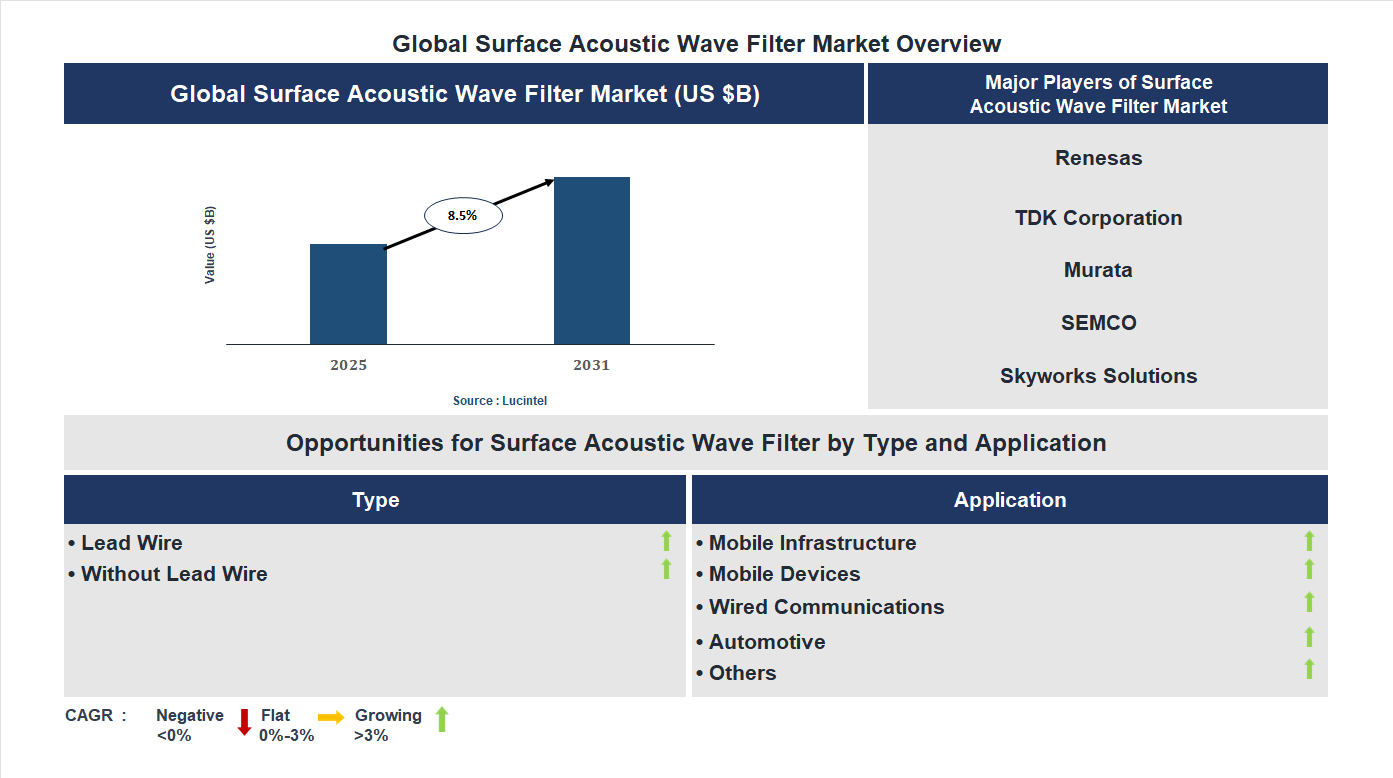
Key data points: The growth forecast = 8.5% annually for the next 7 years. Scroll below to get more insights. This market report covers trends, opportunities and forecasts in surface acoustic wave filter market to 2031 by type (lead wire and without lead wire), application (mobile infrastructure, mobile devices, wired communications, automotive, and others), and region (North America, Europe, Asia Pacific, and the Rest of the World)
We'll send your sample report shortly.
• Lucintel forecasts that, within the type category, lead wire is expected to witness higher growth over the forecast period.
• Within the application category, automotive is expected to witness the highest growth.
• In terms of region, APAC is expected to witness the highest growth over the forecast period. Gain valuable insights for your business decisions with our comprehensive 150+ page report. Sample figures with some insights are shown below.
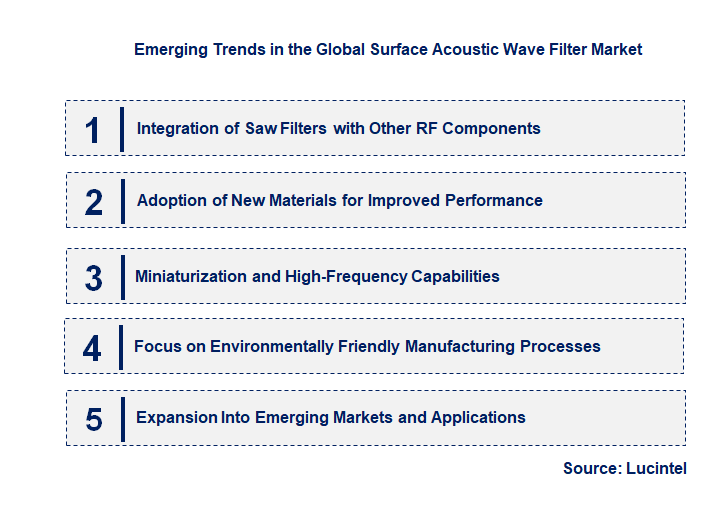
• Integration of SAW filters with other RF components: This trend involves combining SAW filters with amplifiers, switches, and other RF components into single modules. It reduces size, improves performance, and simplifies manufacturing processes. The integration enhances device reliability and reduces overall costs, making it attractive for smartphones, IoT devices, and automotive applications. Companies like broadcom and qorvo are leading this innovation, which is expected to accelerate the adoption of compact, multi-functional RF modules in various sectors.
• Adoption of new materials for improved performance: The use of advanced materials such as lithium niobate and lithium tantalate is increasing to enhance filter performance, including higher frequency operation and better temperature stability. These materials enable the development of filters with lower insertion loss and wider bandwidths, crucial for 5G and satellite communications. This trend is pushing companies like murata and taiyo yuden to invest in research and development, resulting in more robust and efficient filters that meet the stringent requirements of next-generation wireless systems.
• Miniaturization and high-frequency capabilities: As devices become smaller and more powerful, SAW filters are evolving to support higher frequencies and smaller form factors. This trend involves designing ultra-compact filters capable of operating at frequencies above 3 GHz, essential for 5G and millimeter-wave applications. The miniaturization trend allows manufacturers to produce sleeker devices with enhanced performance, giving companies like skyworks and taiwan semiconductor manufacturing company (tsmc) a competitive edge in the market.
• Focus on environmentally friendly manufacturing processes: Sustainability is becoming a key consideration, with companies adopting eco-friendly materials and manufacturing techniques. This iincludes reducing hazardous substances, minimizing waste, and improving energy efficiency during production. Such initiatives not only comply with global environmental standards but also appeal to eco-conscious consumers. Firms like qorvo and broadcom are investing in greener processes, which are expected to influence industry standards and promote sustainable growth in the SAW filter market.
• Expansion into emerging markets and applications: The market is witnessing growth beyond traditional telecommunications into sectors like automotive, aerospace, and industrial IoT. SAW filters are increasingly used in vehicle radar systems, satellite communications, and industrial sensors. This diversification opens new revenue streams and drives innovation tailored to specific industry needs. Companies such as murata and taiyo yuden are expanding their product portfolios to cater to these emerging markets, fostering broader adoption and creating new competitive dynamics. In summary, these trends are transforming the Surface Acoustic Wave Filter Market by enabling more integrated, high-performance, and sustainable solutions. The focus on miniaturization, new materials, and expanding applications is driving innovation and competition, ultimately reshaping the industry landscape and accelerating the deployment of advanced wireless technologies worldwide.
• Material Innovations: New piezoelectric materials such as lithium niobate and lithium tantalate are being developed to improve filter performance. These materials offer higher electromechanical coupling and better temperature stability, leading to enhanced signal clarity and reduced noise. This advancement allows manufacturers like broadcom and qorvo to produce more reliable and efficient filters, expanding their application in 5G and IoT devices. The improved materials also enable miniaturization, supporting the trend toward smaller, more integrated electronic devices.
• Manufacturing Process Improvements: Advanced fabrication techniques, including wafer bonding and thin-film deposition, are increasing production precision and yield. These processes reduce defects and improve filter consistency, which is crucial for high-frequency applications. Companies such as skyworks and murata are adopting these innovations to meet the rising demand for high-performance filters in smartphones and automotive systems. Enhanced manufacturing efficiency also lowers costs, making SAW filters more accessible across various market segments.
• Integration with Other Technologies: Integration of SAW filters with RF modules and other semiconductor components is gaining traction. This integration reduces overall device size and power consumption, which is vital for portable and wearable electronics. firms like taiwan semiconductor manufacturing company (tsmc) and ams are leading efforts to develop integrated solutions, enabling seamless communication systems. The trend supports the development of compact, multi-functional devices, boosting market competitiveness and innovation.
• Expansion into New Applications: SAW filters are increasingly being used in emerging sectors such as automotive radar, satellite communications, and 5G infrastructure. These applications demand high frequency and high selectivity filters, which SAW technology can provide. Companies like epcos and kyocera are investing in R&D to tailor filters for these specialized uses. This diversification broadens the market scope and opens new revenue streams, fostering industry growth.
• Strategic Collaborations and Acquisitions: Major players are forming alliances and acquiring smaller firms to enhance technological capabilities and expand product portfolios. For example, qorvo’s acquisitions of specialized filter manufacturers have strengthened its market position. Such collaborations accelerate innovation, reduce time-to-market, and enable companies to address diverse customer needs more effectively. These strategic moves are vital for maintaining competitiveness in a rapidly evolving market landscape. In summary, recent developments in the Surface Acoustic Wave Filter Market—spanning material innovations, manufacturing improvements, technological integration, application expansion, and strategic collaborations—are collectively driving growth and diversification. These advancements are leading to higher performance, reduced costs, and broader application scopes, significantly impacting the industry’s trajectory. As a result, the market is becoming more dynamic, competitive, and capable of supporting next-generation communication and electronic devices.
• Telecommunications: Enhanced 5G infrastructure : The demand for high-frequency, reliable filters in 5G networks is driving innovation, enabling faster data transmission and improved connectivity, which boosts market growth and supports the expansion of next-generation wireless services.
• Consumer Electronics: Miniaturization and integration : As smartphones, wearables, and IoT devices demand smaller, more efficient filters, companies are developing compact SAW filters that improve device performance, battery life, and user experience, expanding market penetration.
• Automotive: Advanced driver-assistance systems (ADAS) and connectivity : The automotive sectors need for robust filters for radar, V2X communication, and infotainment systems is creating opportunities for high-performance SAW filters, supporting safety and connectivity features in vehicles.
• Aerospace and Defense: High-frequency and rugged filters : The increasing reliance on satellite communication, radar, and secure communication systems in aerospace and defense sectors is driving demand for durable, high-frequency SAW filters capable of operating in harsh environments.
• Healthcare: Medical imaging and wireless devices : The rising adoption of wireless medical devices and imaging systems requires precise, reliable filters, opening avenues for innovation in SAW filter technology to improve diagnostic accuracy and device connectivity. In summary, these growth opportunities across key applications are significantly impacting the surface acoustic wave filter market by fostering innovation, expanding application scope, and enhancing product performance. Companies that strategically invest in these areas are poised to strengthen their market position and capitalize on emerging trends, ensuring sustained growth and technological leadership in this evolving industry.
• Technological Advancements: The continuous development of innovative SAW filter designs enhances performance, miniaturization, and integration capabilities, making them more suitable for advanced telecommunications and consumer electronics. These innovations enable higher frequency operation, better selectivity, and lower power consumption, which are critical for 5G networks, IoT devices, and mobile applications. As technology progresses, the demand for sophisticated filters increases, fueling market growth. Companies like broadcom and qorvo are investing heavily in R&D to develop next-generation SAW filters, thus driving the market forward.
• Growing Telecommunications Sector: The expansion of 4G, 5G, and upcoming 6G networks necessitates high-quality filters to ensure signal clarity and reduce interference. The proliferation of smartphones, wireless devices, and IoT gadgets requires reliable filtering solutions, boosting demand for SAW filters. The increasing adoption of mobile broadband and wireless communication infrastructure in emerging economies further accelerates market growth. This sectors expansion directly correlates with increased sales of SAW filters, making it a significant driver.
• Rising Adoption in Consumer Electronics: The surge in demand for smartphones, tablets, wearables, and smart home devices relies heavily on high-performance filters to ensure seamless connectivity and signal integrity. As consumer electronics become more sophisticated, the need for compact, efficient, and high-frequency SAW filters grows. Manufacturers are integrating these filters into a wide range of devices to meet consumer expectations for faster, more reliable wireless communication, thereby expanding the market. The trend toward smart and connected devices is a key growth factor.
• Increasing Focus on 5G and IoT: The deployment of 5G networks and the expansion of IoT ecosystems require advanced filtering solutions to handle higher frequencies and complex signal environments. SAW filters are essential for maintaining signal quality and reducing interference in these applications. The push toward smart cities, autonomous vehicles, and industrial automation further amplifies demand. As these technologies evolve, the need for innovative SAW filters becomes more critical, driving market expansion and technological innovation.
• Regulatory and Environmental Standards: Stringent regulations aimed at reducing electromagnetic interference and ensuring device safety are compelling manufacturers to adopt high-quality SAW filters. Compliance with standards such as RoHS and REACH influences product design and manufacturing processes. Additionally, environmental regulations promote the development of energy-efficient filters, which can operate at lower power levels. These regulatory pressures encourage innovation and higher standards within the industry, ultimately fostering market growth. The challenges facing this surface acoustic wave filter market iinclude:
• Technological Complexity: Developing high-frequency, high-performance SAW filters involves complex manufacturing processes and precise material engineering. This complexity increases R&D costs and extends product development cycles. Additionally, maintaining consistent quality and performance at scale is challenging, which can hinder market expansion. The need for specialized expertise and advanced fabrication facilities further complicates production, potentially limiting entry for smaller players and slowing overall industry growth.
• High Manufacturing Costs: The production of SAW filters requires sophisticated equipment, high-quality materials, and precise manufacturing techniques, leading to elevated costs. These costs impact the final product pricing, making it difficult for manufacturers to compete on price, especially in price-sensitive markets. The high costs also restrict the adoption of advanced SAW filters in low-cost consumer devices, limiting market penetration. Cost pressures may also hinder innovation and investment in new technologies, posing a significant barrier to growth.
• Evolving Regulatory Environment: Rapid changes in regulatory standards related to electromagnetic emissions, environmental safety, and product certifications create compliance challenges. Manufacturers must continuously adapt their processes and designs to meet new requirements, increasing costs and time-to-market. Non-compliance can result in penalties, product recalls, or bans, which threaten market stability. Navigating these regulatory complexities requires significant resources and expertise, potentially slowing innovation and market expansion. In summary, the surface acoustic wave filter market is driven by technological innovations, expanding telecommunications, consumer electronics growth, and regulatory standards. However, technological complexity, high manufacturing costs, and evolving regulations pose significant challenges. These factors collectively influence the pace and direction of market development. While opportunities for growth are substantial, stakeholders must navigate these hurdles carefully to capitalize on emerging trends. Overall, the markets future will depend on balancing innovation with cost management and regulatory compliance, shaping a dynamic landscape with considerable potential.
• Renesas
• TDK Corporation
• Murata
• SEMCO
• Skyworks Solutions
• Infineon
• Qualcomm
• Yamaha
• Changjiang Electronics
• Walmart Electronics
• Lead Wire
• Without Lead Wire
• Mobile Infrastructure
• Mobile Devices
• Wired Communications
• Automotive
• Others
• North America
• Europe
• Asia Pacific
• The Rest of the World
• United States, the market has seen increased adoption of SAW filters in 5G infrastructure and consumer electronics. companies like broadcom and qorvo are launching advanced filters with improved frequency stability and power handling. There is also a focus on integrating SAW filters with other RF components to enhance device performance. The U.S. government’s investments in 5G technology and IoT are further propelling market growth.
• China has emerged as a major manufacturing hub for SAW filters, with companies such as huawei and smic expanding their production capacities. The country is focusing on developing high-frequency and high-performance filters to support 5G networks and automotive applications. Government policies favoring domestic semiconductor and RF component development are also boosting innovation and exports in this sector.
• Germany remains a key player in the European SAW filter market, primarily driven by automotive and industrial applications. companies like infineon and ams are developing filters with enhanced durability and temperature stability for automotive radar and communication systems. Germany’s emphasis on quality and precision manufacturing continues to strengthen its position in high-end SAW filter solutions.
• India is witnessing rapid growth in the electronics manufacturing sector, with companies such as vishay and microchip manufacturing expanding their R&D efforts. The focus is on developing cost-effective, miniaturized SAW filters for mobile devices and IoT applications. Government initiatives like Make in India are encouraging local production and innovation in RF components, including SAW filters.
• Japan remains a leader in high-frequency SAW filter technology, with companies like murata and tdk investing in advanced research to improve filter performance for 5G and satellite communications. Japan’s strong emphasis on technological innovation and quality standards ensures the development of highly reliable and efficient SAW filters, supporting both domestic and global markets.


• Renesas
• TDK Corporation
• Murata
• SEMCO
• Skyworks Solutions
• Infineon
• Qualcomm
• Yamaha
• Changjiang Electronics
• Walmart Electronics Q5. Which surface acoustic wave filter market segment will be the largest in future? Answer: Lucintel forecasts that, within the type category, lead wire is expected to witness higher growth over the forecast period. Q6. In surface acoustic wave filter market, which region is expected to be the largest in next 5 years? Answer: In terms of region, APAC is expected to witness the highest growth over the forecast period. Q7. Do we receive customization in this report? Answer: Yes, Lucintel provides 10% customization without any additional cost.


Choose a license that fits your team. Instant PDF delivery.
Prices exclude taxes. Instant delivery. Custom licensing available on request.
Market Report · July 31, 2026
Market Report · July 31, 2026
Market Report · July 31, 2026
Trusted partner for strategic intelligence and business growth


Receive a complimentary market analysis tailored to your industry. Our analysts will identify key growth opportunities and competitive dynamics specific to your business.

Market size, growth rate, and key trend analysis for your specific sector.

Top competitor positioning and market share analysis.

Strategic recommendations backed by data-driven insights.
Get curated market intelligence and competitive moves straight to your inbox.
By subscribing, you agree to receive our monthly insights. Unsubscribe anytime.
Receive a complimentary market analysis tailored to your industry. Our analysts will identify key growth opportunities and competitive dynamics specific to your business.
Market size, growth rate, and key trend analysis for your specific sector.
Top competitor positioning and market share analysis.
Strategic recommendations backed by data-driven insights.
Get curated market intelligence, emerging trends, and competitive moves straight to your inbox each month.
By subscribing, you agree to receive our monthly insights. Unsubscribe anytime.
We'll send your sample report shortly.