
Market Report · July 22, 2026

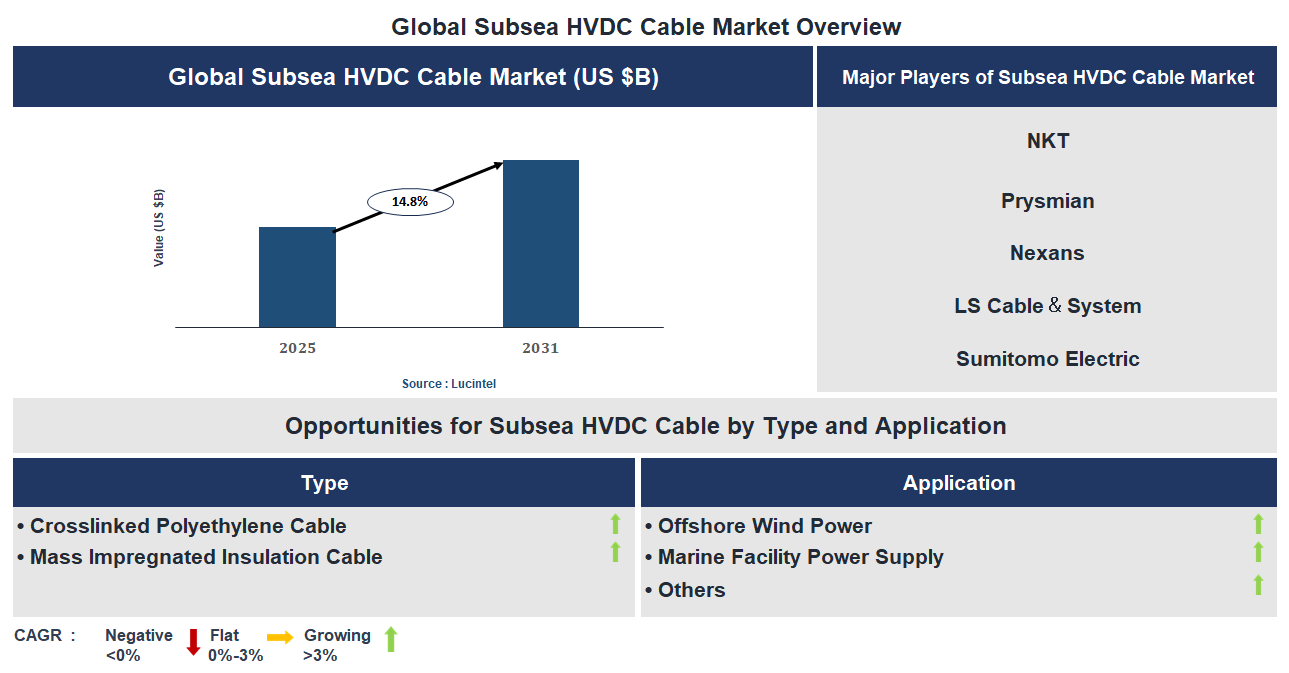
Key data points: The growth forecast = 14.8% annually for the next 7 years. Scroll below to get more insights. This market report covers trends, opportunities and forecasts in subsea HVDC cable market to 2031 by type (crosslinked polyethylene cable and mass impregnated insulation cable), application (offshore wind power, marine facility power supply, and others), and region (North America, Europe, Asia Pacific, and the Rest of the World)
We'll send your sample report shortly.
• Lucintel forecasts that, within the type category, crosslinked polyethylene cable is expected to witness higher growth over the forecast period.
• Within the application category, offshore wind power is expected to witness higher growth.
• In terms of region, APAC is expected to witness the highest growth over the forecast period. Gain valuable insights for your business decisions with our comprehensive 150+ page report. Sample figures with some insights are shown below.
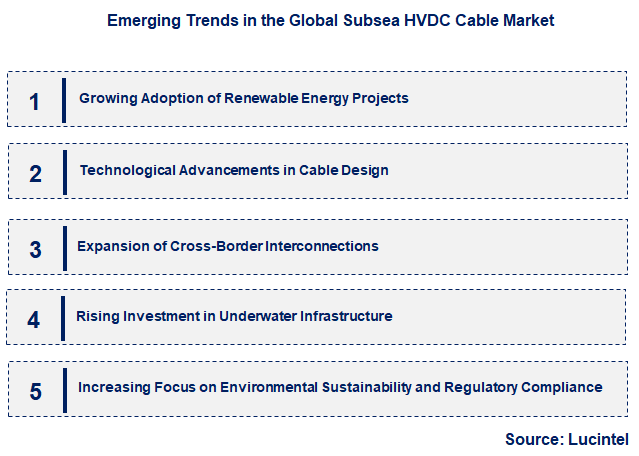
• Growing Adoption of Renewable Energy Projects: The push for renewable energy, especially offshore wind farms, is significantly boosting the demand for subsea HVDC cables. These cables enable efficient transmission of large amounts of electricity over long distances from remote renewable sites to urban centers. As governments and private entities invest heavily in offshore wind and tidal energy, the need for reliable, high-capacity subsea transmission solutions increases. This trend is expected to drive market growth, foster technological innovation, and promote sustainable energy integration across regions.
• Technological Advancements in Cable Design: Innovations in materials, insulation, and installation techniques are enhancing the performance and durability of subsea HVDC cables. Newer cables are more resistant to harsh underwater conditions, reducing maintenance costs and increasing lifespan. Developments such as XLPE insulation and improved jointing methods are making cables more efficient and easier to install. These technological improvements are critical for expanding the market, enabling longer-distance transmission, and supporting the integration of complex offshore energy projects with minimal environmental impact.
• Expansion of Cross-Border Interconnections: Countries are increasingly investing in cross-border HVDC links to facilitate energy trade, improve grid stability, and optimize resource utilization. These interconnections help balance supply and demand across regions, especially in areas with abundant renewable resources. The trend towards regional cooperation and infrastructure development is fostering a more interconnected global energy network. This expansion not only enhances energy security but also promotes market competitiveness and reduces reliance on fossil fuels, aligning with global decarbonization goals.
• Rising Investment in Underwater Infrastructure: Governments and private investors are channeling substantial funds into underwater power transmission infrastructure to support the transition to cleaner energy sources. Large-scale projects, such as intercontinental HVDC links, are being planned and executed to connect remote renewable sites with urban centers. Increased funding accelerates project timelines, encourages technological innovation, and expands market capacity. This trend underscores the strategic importance of subsea HVDC cables in achieving national and international energy targets, fostering economic growth, and ensuring reliable power supply in the face of climate change challenges.
• Increasing Focus on Environmental Sustainability and Regulatory Compliance: As environmental concerns grow, the market is witnessing a shift towards eco-friendly cable manufacturing and installation practices. Regulatory frameworks are becoming more stringent, requiring companies to adhere to sustainability standards and minimize ecological impact. Innovations in cable materials and installation methods aim to reduce seabed disturbance and carbon footprint. This trend is driving the industry to adopt greener technologies, improve stakeholder confidence, and align with global sustainability commitments. It also opens opportunities for companies that prioritize environmental responsibility, shaping a more sustainable future for subsea HVDC transmission. In summary, these trends are collectively transforming the subsea HVDC cable market by promoting technological innovation, expanding infrastructure, and emphasizing sustainability. They are enabling more efficient, reliable, and environmentally friendly power transmission solutions, which are crucial for supporting the global shift towards renewable energy and a low-carbon future. This evolution is positioning the market for sustained growth and increased strategic importance in the global energy landscape.
• Technological Innovations: New cable designs and materials have improved efficiency and durability, reducing maintenance costs and extending lifespan, which enhances overall market competitiveness.
• Expansion of Infrastructure Projects: Major offshore wind and interconnection projects are driving demand for subsea HVDC cables, boosting market growth and creating new revenue streams.
• Strategic Collaborations: Partnerships between cable manufacturers, project developers, and technology providers are fostering innovation, reducing costs, and accelerating project deployment.
• Regulatory and Policy Support: Governments are implementing supportive policies and incentives for renewable energy, encouraging investments in subsea HVDC infrastructure.
• Environmental Sustainability Initiatives: Focus on eco-friendly materials and installation practices is increasing, aligning market growth with global sustainability goals. These developments are collectively transforming the subsea HVDC cable market by enhancing technological capabilities, expanding project pipelines, and promoting sustainable practices. The market is becoming more resilient, cost-efficient, and aligned with global energy transition objectives, positioning it for sustained growth in the coming years.
• Offshore Wind Power Transmission: The increasing deployment of offshore wind farms necessitates high-capacity, reliable subsea HVDC cables to transmit electricity efficiently to onshore grids. This growth opportunity enhances renewable energy integration, reduces transmission losses, and supports national decarbonization goals, thereby expanding market reach and infrastructure resilience.
• Interconnection Projects: Cross-border and regional interconnection initiatives benefit from subsea HVDC cables by enabling stable, high-capacity power exchange between countries. This improves grid stability, enhances energy security, and facilitates the integration of diverse energy sources, fostering regional cooperation and market expansion.
• Oil & Gas Industry: The oil and gas sector utilizes subsea HVDC cables for power supply to offshore platforms and subsea equipment. This application ensures reliable, efficient power delivery, reduces operational costs, and supports the transition towards cleaner energy practices by enabling electrification of offshore operations.
• Undersea Data Transmission: The growing demand for high-speed data transfer in undersea communication networks presents an opportunity for subsea HVDC cables to support data center interconnections and submarine internet infrastructure. This enhances global connectivity, supports digital transformation, and opens new revenue streams.
• Remote and Island Power Supply: Remote communities and island nations require dependable power solutions, which subsea HVDC cables can provide by linking isolated grids to main power sources. This improves energy access, promotes sustainable development, and reduces reliance on fossil fuels, thereby expanding market penetration. In summary, these growth opportunities are significantly impacting the subsea HVDC cable market by driving technological innovation, expanding regional and application-specific deployments, and supporting global energy transition goals. As demand for efficient, high-capacity subsea power transmission increases, the market is poised for sustained growth and diversification across multiple sectors.
• Technological Innovation: The development of advanced HVDC technology enhances transmission efficiency and capacity, enabling the transfer of large amounts of electricity over long distances with minimal losses. Innovations such as multi-terminal systems and improved insulation materials reduce costs and improve reliability, making subsea HVDC solutions more attractive for cross-border interconnections and offshore renewable projects. These technological advancements support the integration of renewable energy sources like offshore wind farms, facilitating a cleaner energy mix and meeting global sustainability goals.
• Rising Renewable Energy Investments: Governments and private entities are increasing investments in renewable energy projects, particularly offshore wind and solar farms. These projects require efficient transmission solutions to deliver power to end-users, often located far from generation sites. Subsea HVDC cables are ideal for such applications due to their ability to transmit large volumes of electricity over long distances with reduced losses. This trend significantly boosts demand for subsea HVDC infrastructure, fostering market growth and supporting energy transition initiatives worldwide.
• Cross-Border Power Transmission: The globalization of energy markets and the need for regional energy security are driving the development of cross-border HVDC interconnections. Countries are investing in transnational power links to balance supply and demand, optimize resource utilization, and reduce reliance on fossil fuels. Subsea HVDC cables provide a reliable and efficient means to connect distant grids, enabling the transfer of renewable energy across borders. This interconnectedness promotes regional cooperation, enhances grid stability, and accelerates the adoption of sustainable energy sources.
• Regulatory Support and Policy Frameworks: Governments worldwide are implementing policies and regulations that favor renewable energy deployment and infrastructure development. Incentives, subsidies, and streamlined approval processes facilitate the construction of subsea HVDC projects. International agreements and regional cooperation initiatives further support cross-border interconnections. These regulatory frameworks create a conducive environment for market growth by reducing uncertainties, attracting investments, and ensuring compliance with environmental standards, thereby accelerating the deployment of subsea HVDC solutions.
• Cost Reduction and Economies of Scale: As the market matures, manufacturing processes and installation techniques for subsea HVDC cables are becoming more cost-effective. Increased competition among suppliers and technological standardization contribute to lowering project costs. Economies of scale achieved through larger project sizes and mass production of components further reduce expenses. Cost reductions make subsea HVDC projects more financially viable, encouraging wider adoption and enabling the expansion of existing networks, ultimately supporting the global transition to sustainable energy systems. The challenges facing this subsea HVDC cable market include:
• High Capital Expenditure: Subsea HVDC projects require substantial upfront investments due to complex engineering, specialized materials, and challenging installation conditions. The high capital costs can deter potential investors and slow project development, especially in regions with limited financial resources. Securing funding and managing financial risks are critical hurdles, impacting the pace of market growth and the deployment of new infrastructure.
• Technical and Environmental Challenges: Installing and maintaining subsea HVDC cables in deep-sea environments pose significant technical difficulties. Issues such as cable burial, corrosion, and marine ecosystem impacts require advanced engineering solutions and environmental assessments. Unanticipated technical problems or environmental concerns can lead to project delays, increased costs, and regulatory hurdles, affecting overall market confidence and project viability.
• Regulatory and Political Uncertainties: The market faces uncertainties stemming from changing policies, regulatory frameworks, and geopolitical tensions. Discrepancies in standards and approval processes across countries can delay project timelines and increase costs. Political instability or conflicts in certain regions may hinder infrastructure development, disrupt supply chains, and impact investor confidence, thereby constraining market expansion. In summary, the subsea HVDC cable market is driven by technological advancements, increasing renewable energy investments, regional interconnection needs, supportive policies, and cost efficiencies. However, high capital costs, technical and environmental challenges, and regulatory uncertainties pose significant hurdles. These factors collectively influence the pace and scope of market growth, requiring strategic planning and innovation to overcome obstacles. The markets future depends on balancing these drivers and challenges to foster sustainable, reliable, and cost-effective subsea HVDC solutions worldwide.
• NKT
• Prysmian
• Nexans
• LS Cable&System
• Sumitomo Electric
• ZTT Group
• Ningbo Orient Wires and Cables
• Crosslinked Polyethylene Cable
• Mass Impregnated Insulation Cable
• Offshore Wind Power
• Marine Facility Power Supply
• Others
• North America
• Europe
• Asia Pacific
• The Rest of the World
• United States: The US has seen substantial investments in offshore wind projects, which require advanced subsea HVDC cables for efficient power transmission. Regulatory support and technological innovations have accelerated the deployment of high-capacity systems, especially along the East Coast. The focus is on integrating renewable energy sources and upgrading existing grid infrastructure to improve reliability and reduce transmission losses. Public-private partnerships are playing a crucial role in expanding subsea HVDC networks, with several projects in the planning and development stages aimed at enhancing cross-border energy exchange and grid resilience.
• China: China continues to lead in the deployment of subsea HVDC cables, driven by its ambitious renewable energy targets and expanding offshore wind capacity. The country has completed several large-scale projects connecting remote renewable resources to urban centers, reducing reliance on fossil fuels. Technological advancements have enabled longer and more efficient cable systems, supporting Chinas goal of becoming a global leader in clean energy infrastructure. Government policies favoring green energy and international collaborations are further boosting market growth, with ongoing investments in cross-border interconnections to facilitate regional energy cooperation.
• Germany: Germany has focused on strengthening its North Sea offshore grid, integrating offshore wind farms with the mainland grid through subsea HVDC cables. The country aims to achieve its renewable energy targets by expanding its offshore infrastructure, supported by EU funding and regulatory frameworks. Recent developments include the commissioning of high-capacity HVDC links that improve grid stability and facilitate energy export to neighboring countries. Germanys emphasis on sustainable energy transition and cross-border cooperation has driven innovation and investment in subsea HVDC technology, positioning it as a key player in Europes renewable energy landscape.
• India: India is rapidly expanding its offshore wind and renewable energy projects, necessitating robust subsea HVDC infrastructure. The government has announced several initiatives to develop cross-border interconnections with neighboring countries like Bangladesh and Sri Lanka, aiming to enhance regional energy security. Recent advancements include the deployment of high-capacity HVDC systems capable of transmitting power over long distances with minimal losses. Policy reforms and international collaborations are fostering market growth, with a focus on reducing dependence on fossil fuels and integrating renewable sources into the national grid to meet ambitious climate goals.
• Japan: Japan has prioritized the development of subsea HVDC cables to support its renewable energy ambitions and energy diversification efforts post-Fukushima. The country is investing in offshore wind projects and cross-border interconnections with neighboring nations to enhance energy security. Recent projects involve the deployment of advanced HVDC systems capable of transmitting large amounts of renewable energy from offshore sources. Regulatory support and technological innovation are key drivers, with Japan aiming to reduce carbon emissions and transition to a more sustainable energy system. The market is also seeing increased collaboration with international partners to develop resilient and efficient subsea HVDC networks.


• NKT
• Prysmian
• Nexans
• LS Cable&System
• Sumitomo Electric
• ZTT Group
• Ningbo Orient Wires and Cables Q5. Which subsea HVDC cable market segment will be the largest in future? Answer: Lucintel forecasts that, within the type category, crosslinked polyethylene cable is expected to witness higher growth over the forecast period. Q6. In subsea HVDC cable market, which region is expected to be the largest in next 5 years? Answer: In terms of region, APAC is expected to witness the highest growth over the forecast period. Q7. Do we receive customization in this report? Answer: Yes, Lucintel provides 10% customization without any additional cost.


Choose a license that fits your team. Instant PDF delivery.
Prices exclude taxes. Instant delivery. Custom licensing available on request.
Market Report · July 22, 2026
Market Report · July 22, 2026
Market Report · July 17, 2026
Trusted partner for strategic intelligence and business growth


Receive a complimentary market analysis tailored to your industry. Our analysts will identify key growth opportunities and competitive dynamics specific to your business.

Market size, growth rate, and key trend analysis for your specific sector.

Top competitor positioning and market share analysis.

Strategic recommendations backed by data-driven insights.
Get curated market intelligence and competitive moves straight to your inbox.
By subscribing, you agree to receive our monthly insights. Unsubscribe anytime.
Receive a complimentary market analysis tailored to your industry. Our analysts will identify key growth opportunities and competitive dynamics specific to your business.
Market size, growth rate, and key trend analysis for your specific sector.
Top competitor positioning and market share analysis.
Strategic recommendations backed by data-driven insights.
Get curated market intelligence, emerging trends, and competitive moves straight to your inbox each month.
By subscribing, you agree to receive our monthly insights. Unsubscribe anytime.
We'll send your sample report shortly.