
Market Report · July 22, 2026

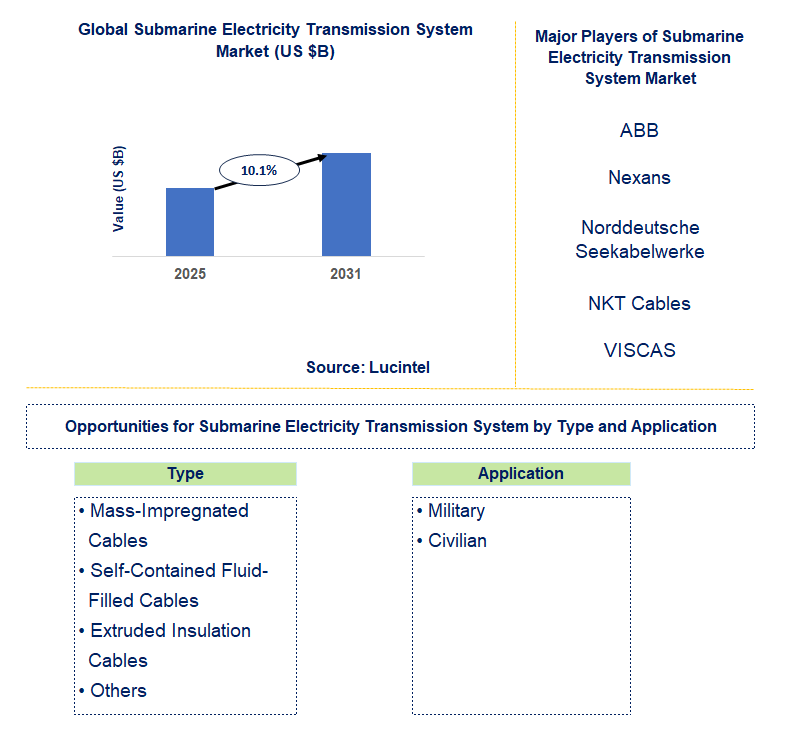
Key data points: The growth forecast = 10.1% annually for the next 7 years. Scroll below to get more insights. This market report covers Trends, opportunities and forecasts in submarine electricity transmission system market to 2031 by type (mass-impregnated cables, self-contained fluid-filled cables, extruded insulation cables, and others), application (military and civilian), and region (North America, Europe, Asia Pacific, and the Rest of the World)
We'll send your sample report shortly.
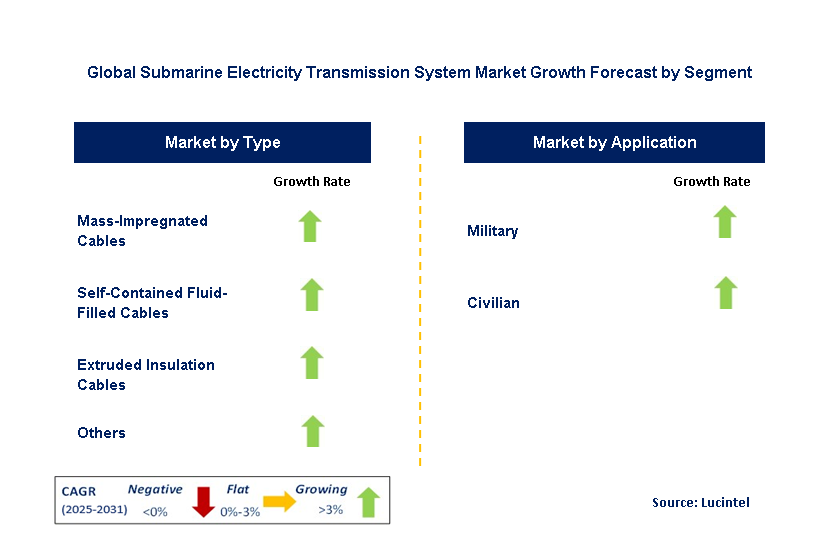
• Lucintel forecasts that, within the type category, mass-impregnated cables is expected to witness the highest growth over the forecast period due to the growing demand for high-capacity power transmission.
• Within the application category, civilian is expected to witness higher growth due to the rising demand for offshore wind energy.
• In terms of region, APAC is expected to witness the highest growth over the forecast period due to the growing offshore renewable energy projects in this region.
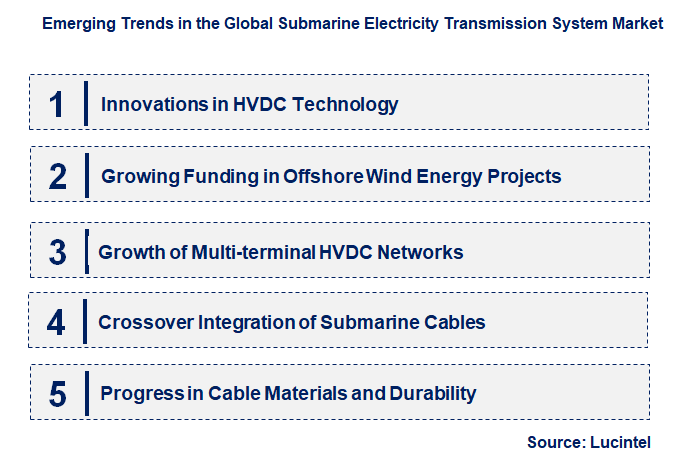
• Innovations in HVDC Technology: Submarine power transmission systems are increasingly utilizing high-voltage direct current (HVDC) technology due to its economical long-distance power transmission capability. The recent developments in HVDC technology made efficiencies and costs more favorable, meaning it is now possible to link offshore wind farms with onshore grids. Besides, undersea transmission is ideal for HVDC technology because it can transmit power across great distances with very few losses. With the growth of offshore wind energy, efficient energy transmission will continue to demand the use of HVDC systems.
• Growing Funding in Offshore Wind Energy Projects: In an effort to achieve renewable energy objectives, the world is seeing a rising demand in offshore wind energy. Undersea electricity transmission systems are critical in delivering energy produced by offshore wind farms to shore based grids. In particular, European countries, the US, and China have been spending considerable resources in offshore wind projects and increases the need for dependable submarine transmission systems. This trend will continue to grow as offshore wind energy takes an increasingly large share of the global energy production and transmission systems.
• Growth of Multi-terminal HVDC Networks: Multi-terminal HVDC networks are becoming popular in the field of submarine electricity transmission. These HVDC systems are capable of connecting different power generating sources, such as offshore wind farms, and interconnecting grids of different countries, all at the same time. Multi-terminal networks can improve the stability of energy systems and increase energy trading. This trend is likely to persist as countries search for ways to better transmit and integrate renewable energy and grid stabilizers, particularly in areas having several renewable energy sources.
• Crossover Integration of Submarine Cables: Submarine electricity transmission systems are used more and more in the context of international trade. States are building submarine cable interconnections to share renewable energy, stabilize the grid, and cut down on fossil fuel use. The Nord Link cable project between Germany and Norway or the planned UK-Netherlands interconnection highlight the role of submarine cables in trade of energy between neighboring countries. This is a trend that will continue as countries try to optimize their energy system not only to reduce emissions but also to integrate a larger share of renewables.
• Progress in Cable Materials and Durability: To ensure long-term transmission, the strength and functionality of submarine cables is most important. Developments in cable materials such as new insulating materials, coating that prevents corrosion, and super-efficient conductors are improving the reliability of submarine electricity transmission systems. These innovations contribute to the enhancement of the cable’s lifespan by lowering the maintenance procedures required while guaranteeing the seamless flow of power. These innovations will serve as infrastructure sustainability aids as the demand for submarine electricity transmission rises over time. The market in the submarine electricity transmission system is under transformation due to the emerging marketing trends of more interest and financing in offshore wind electricity, progressive investment in HVDC, and multi-terminal HVDC networks, cross-border energy trading, and cable material innovation. All these developments enhance the reliability, efficiency, and sustainability of energy transmission, which will further boost the growth of submarine electricity transmission systems in the world.
• Initiation of Key Offshore Wind Projects: Numerous key offshore wind projects have started around the world which require strong submarine electricity transmission systems that link the offshore farms to the mainland grid. The Vineyard Wind project in the U.S. and the North Sea Wind Power Hub in Europe are two of the primary projects. These projects include sophisticated submarine cable systems which are built to not only hold high capacity but also enable dependable power transmission. The success of these projects will further drive the development and adoption of submarine electricity transmission systems worldwide.
• Advancements in Submarine Cable Technology: Submarine cable technologies, especially the insulation materials and cable conductors, have improved over time in such a manner that the efficiency and the lifespan of submarine cables has vastly increased. Moreover, innovations in these technologies are allowing for longer operational periods for submarine electricity transmission systems without maintenance. These developments are critical for the successful implementation of offshore wind projects as well as incorporating renewables to the national grids.
• Expansion of Cross-Border Electricity Networks: The development of cross-border electricity networks is evolving at a quick pace with the use of submarine cables. For instance, the North Sea Wind Power Hub, alongside the interconnection between Norway and the U.K., aim to link nations together for energy trading via submarine cables. These networks will augment energy security, improve the use of renewables and strengthen the stability of the grid. The rapid progress of these interconnections is a major milestone for the market of submarine electricity transmission systems.
• Support Integration of Renewable Energy Sources: Governments as well as regulatory authorities are actively integrating renewable sources of power into the grid, including making investments in submarine electricity transmission assets. Policies that favor offshore wind initiatives and other projects like submarine cable laying are stimulating the growth of the market. For instance, the EU Green Deal together with other measures in different parts of the world is shifting investments toward renewable energy and infrastructure like submarine electricity transmission systems.
• Innovation of Technology in Power Conversion Systems: Innovation of technology in the HVDC systems or other power conversion systems is one of the backbone factors that improve the efficiency of submarine electricity transmission. Better integration of wind offshore energy into the grid is made possible with the advanced converters and grid control systems. These innovations facilitate the stability and efficiency of the transmission and motivate the further implementation of submarine electricity transmission systems. Offshore wind farm constructions, new cable technology, cross-border electricity network expansions, renewables friendly legislation, and other innovative technologies in the recent years have greatly improved the submarine electricity transmission system market. These advancements ensure better integration of renewable energy sources which makes submarine electricity transmission systems an important core in the world’s energy infrastructure.
• Integration for Offshore Wind Energy Generation: The use of offshore wind energy has been growing quickly, especially for Europe, the U.S., and China. With the increase of offshore wind farms, there is a big possibility for them to be integrated with the mainland grids through submarine electricity transmission systems. These systems facilitate the conveyance of energy from offshore wind farms to onshore substations. Submarine cables are vital in stabilizing the grid as well as transmitting energy reliably. This opportunity for growth will be more pronounced as countries adopt more radical renewable energy targets and the rest of the world continues the development of offshore wind projects.
• Cross-Border Transmission of Electricity: Submarine electricity transmission systems provide a substantial opportunity for intercontinental energy trade. Regions corresponding to these cables can trade electricity, which allows better integration of optical renewable energy resources. The Nord Link Interconnection is one of the existing interconnections that provides better grid stability and security of power for regions in Germany and Norway. It is envisioned that cross-border submarine cable systems will enhance energy security for multiple countries aiming for lowering their carbon footprint and enhancing energy efficiency.
• Deep-Sea Power Transmission: The emerging deep-sea transmission is considered a new area of growth within the deep sea electricity transmission sector as well as offshore energy generation. The development of floating offshore wind farms and deep-sea tidal energy systems requires more robust and durable submarine cables for energy collection. New technologies are being developed to support power transmission in deeper and more challenging underwater environments. These developments present opportunities for energy companies and cable manufacturers to address the demand for deep-sea renewable energy sources.
• Energy Storage Integration: As the use of renewable energy resources grows, there is an increased demand for energy storage systems, which provides new opportunities for utilizing submarine electricity transmission systems to integrate energy storage systems, such as offshore battery storage. These systems could enhance energy balance, especially for offshore wind farms where generation is sporadic. By tapping into offshore storage via submarine cables, energy, which is produced above the requirement, can be stored for later use and additionally supplied when necessary. The reliability and resilience of the modern grid could be reinforced through the combination of energy storage and Submarine electricity transmission systems.
• Progress of Technology Toward the Durability and Material Science of Cables: Innovation in aviation and space industry cable insulation and corrosion resistant materials used in submarine cables as well as the conductors used in these cables is making submarine power transmission cables cheaper and more reliable. The lifespan of submarine cables is increased with these materials. This decreases the maintenance efforts and costs of the cables, therefore, making large offshore energy projects economically practical. The greater the number of offshore wind energy projects, these materials will facilitate lower costs and higher efficiency in power transmission, thus, extending the submarine power transmission system market. Some examples of strategic opportunities in the submarine electricity transmission system market are the integration and transfer of offshore wind energy, deep sea power transmission, energy storage interconnections, and power cable transmission technology improvements. By proactively engaging in these opportunities, stakeholders can foster the transition to an environmentally friendly and fully integrated energy infrastructure. The expansion of submarine cable systems will accelerate the transition to renewable energy and facilitate efficient power transmission in different regions.
• ABB
• Nexans
• Norddeutsche Seekabelwerke
• NKT Cables
• VISCAS
• DONG Energy
• Fujikura
• Korea Electric Power Corporation
• Prysmian
• Energinet
• Mass-Impregnated Cables
• Self-Contained Fluid-Filled Cables
• Extruded Insulation Cables
• Others
• Military
• Civilian
• North America
• Europe
• Asia Pacific
• The Rest of the World
• United States: In the US, research activities in submarine electricity transmission systems are directed towards the extension of offshore wind energy development and grid integration. There are a number of initiatives which seek to connect offshore wind farms with the coast using high voltage direct current (HVDC) underwater cables. This includes the Vineyard Wind project, which proposes to build the first large-scale offshore wind farm in the U.S. These initiatives align with the U.S. federal government’s overarching plan to achieve the renewables use target and lower carbon emissions. As the offshore wind industry matures, the necessity for dependable submarine power cable systems will increasingly rise.
• China: In China, the submarine electricity transmission system market is growing rapidly due to the country’s investment in large offshore wind farms. The government has been trying to augment its renewable energy portfolio and the development of submarine cables is vital to transfer energy from offshore wind farms to the onshore power grid. The development of efficient and long distance electricity transmission by advanced HVDC technology is also being developed. Furthermore, as part of the Green Energy Transition Plan which aims to achieve carbon neutrality by 2060, there has been an increase in funding in China for the development of subsea grid infrastructure.
• Germany: Germany was one of the pioneers in the offshore wind energy industry, and submarine electricity transmission systems are vital to its energy transition strategy. The country has built large offshore wind farms in the North Sea and Baltic Sea and linked them to the onshore grid using submarine cables. One such project is Nord Link, which interconnects Germany and Norway with a high voltage direct current (HVDC) submarine cable. This not only facilitates the transfer of renewable energy between nations, but also improves the stability of the electric grid. Germany is forecasted to further extend submarine electricity transmission systems to incorporate more renewable energy into its grid.
• India: India is in the development phase of submarine electricity transmission technology, with an emphasis on boosting offshore wind power. The government has set high expectations for renewables, and offshore wind projects are set to help meet those goals. India has started working on plans for submarine cables that will connect wind power sites located offshore along the coast to the mainland. Despite the issues with infrastructure development and technology, the increasing focus on renewable energy along with the urgency for energy diversity is predicted to increase investment in submarine electricity transmission systems in the next few years.
• Japan: Japan has been proactively developing submarine electricity transmission systems as part of their expanding offshore wind energy generation initiatives. Japan already has a number of offshore wind farms and plans to expand their capacity in the near future. These offshore wind farms need submarine cables to transmit power to the land's electrical grid. Japan is also considering the use of deep sea power transmission, which could be instrumental in Japan’s move towards a low carbon energy economy. With the shift in focus to renewable energy, Japan will see a growing need for robust submarine electricity transmission systems.


• ABB
• Nexans
• Norddeutsche Seekabelwerke
• NKT Cables
• VISCAS
• DONG Energy
• Fujikura
• Korea Electric Power Corporation
• Prysmian
• Energinet Q5. Which submarine electricity transmission system market segment will be the largest in future? Answer: Lucintel forecasts that, within the type category, mass-impregnated cables is expected to witness the highest growth over the forecast period due to the growing demand for high-capacity power transmission. Q6. In submarine electricity transmission system market, which region is expected to be the largest in next 5 years? Answer: In terms of region, APAC is expected to witness the highest growth over the forecast period due to the growing offshore renewable energy projects in this region. Q7. Do we receive customization in this report? Answer: Yes, Lucintel provides 10% customization without any additional cost.


Choose a license that fits your team. Instant PDF delivery.
Prices exclude taxes. Instant delivery. Custom licensing available on request.
Market Report · July 22, 2026
Market Report · July 22, 2026
Market Report · July 17, 2026
Trusted partner for strategic intelligence and business growth


Receive a complimentary market analysis tailored to your industry. Our analysts will identify key growth opportunities and competitive dynamics specific to your business.

Market size, growth rate, and key trend analysis for your specific sector.

Top competitor positioning and market share analysis.

Strategic recommendations backed by data-driven insights.
Get curated market intelligence and competitive moves straight to your inbox.
By subscribing, you agree to receive our monthly insights. Unsubscribe anytime.
Receive a complimentary market analysis tailored to your industry. Our analysts will identify key growth opportunities and competitive dynamics specific to your business.
Market size, growth rate, and key trend analysis for your specific sector.
Top competitor positioning and market share analysis.
Strategic recommendations backed by data-driven insights.
Get curated market intelligence, emerging trends, and competitive moves straight to your inbox each month.
By subscribing, you agree to receive our monthly insights. Unsubscribe anytime.
We'll send your sample report shortly.