
Market Report · May 18, 2026

This market report covers trends, opportunities, and forecasts in the global storage battery for power supply market to 2031 by technology (lithium-ion battery, lead acid battery, flow battery, and others), application (residential, non-residencial, utility, and others), and region (North America, Europe, Asia Pacific, and the Rest of the World)
We'll send your sample report shortly.
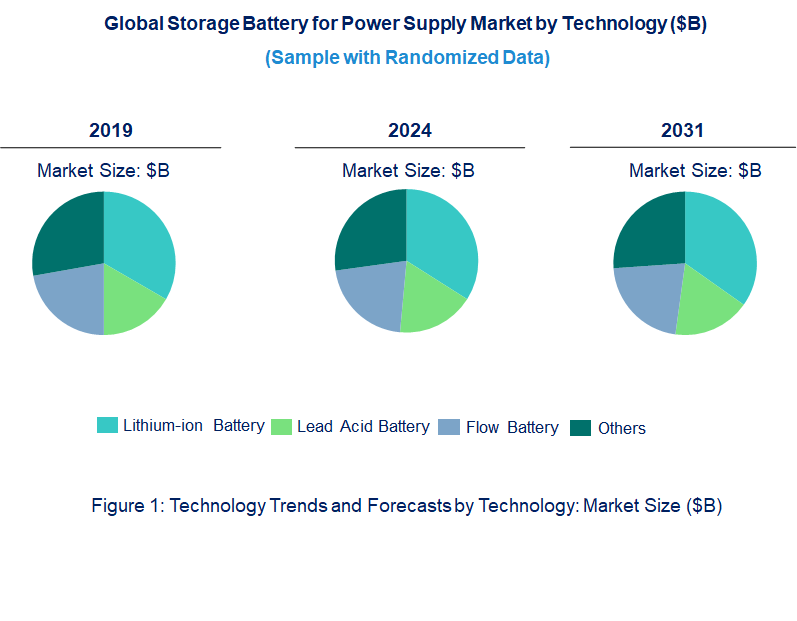
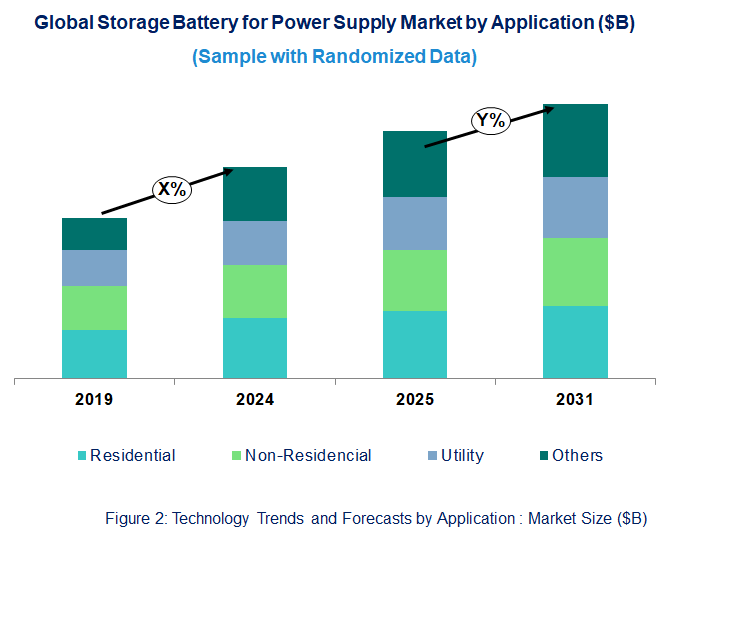
• Shift from Lead Acid to Lithium-ion Batteries: The market is increasingly transitioning from lead-acid batteries to more efficient lithium-ion batteries due to their longer lifespan, higher energy density, and better performance in both residential and industrial applications.
• Integration with Renewable Energy Sources: Storage systems are being optimized for integration with renewable sources like solar and wind, providing efficient energy storage and management.
• Advancements in Flow Battery Technology: Flow batteries, especially in utility-scale applications, are gaining attention due to their scalability, long cycle life, and ability to store large amounts of energy.
• Improved Battery Recycling Technologies: With the rise of lithium-ion batteries, there is a growing focus on improving recycling processes to ensure sustainability and reduce environmental impact.
• Energy Storage for Electric Vehicles (EVs): The development of large-scale battery storage systems for electric vehicle charging infrastructure is becoming increasingly important to support the growth of the EV market. These trends are reshaping the market by driving innovations that make energy storage more efficient, sustainable, and integrated with clean energy systems.
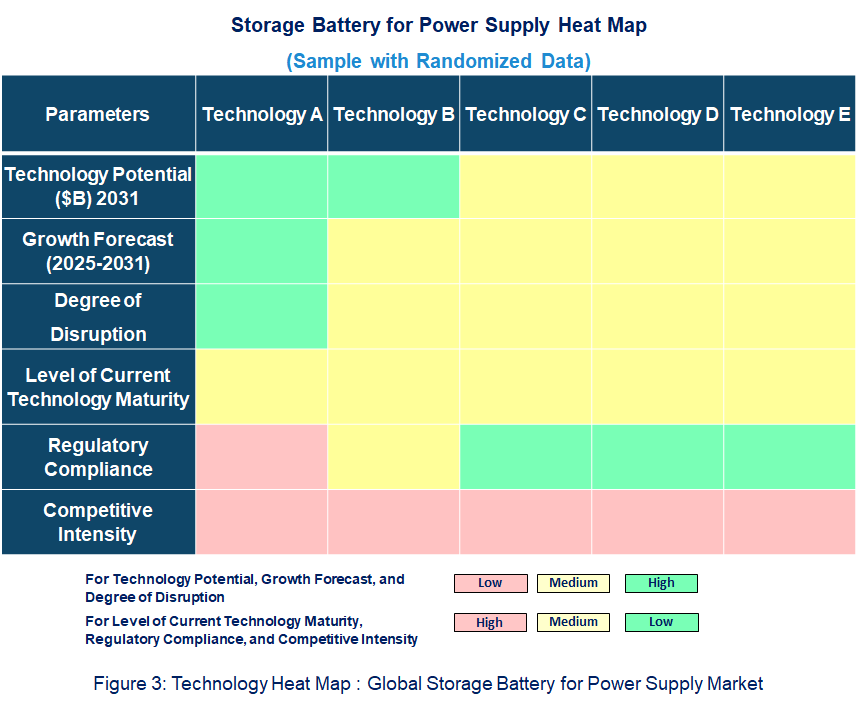
• Technology Potential: Storage battery technology for power supply is pivotal in enabling energy reliability, grid stability, and the transition to renewable power systems. With increasing adoption of solar, wind, and other intermittent energy sources, advanced storage batteries such as lithium-ion, solid-state, and flow batteries serve as critical solutions for balancing supply-demand dynamics. Their potential lies in applications across residential, commercial, industrial, and utility-scale sectors. Innovations in battery chemistry, energy density, lifecycle, and safety are expanding the performance envelope, while declining costs are making them more accessible. Integration with smart grids, EV infrastructure, and microgrids further enhances their strategic relevance in future energy ecosystems.
• Degree of Disruption: Storage batteries are highly disruptive to traditional centralized power systems. They enable decentralized energy generation and consumption, reduce dependence on fossil fuel peaker plants, and enhance energy resilience. For utilities, batteries shift operational models toward distributed energy resource management. For end-users, they offer energy independence, backup power, and cost savings via peak shaving and load shifting. The disruption is also seen in how energy is monetized, with batteries enabling energy trading and demand response services. Incumbents in fossil fuel-based generation and legacy grid infrastructure are increasingly challenged by this technological shift.
• Level of Current Technology Maturity: Lithium-ion batteries dominate the market and have reached commercial maturity, supported by robust supply chains and manufacturing scalability. Flow batteries, sodium-ion, and solid-state variants are in the late-development or early-commercial stages, showing promise in safety and longevity but needing further cost and scalability improvements. BMS (battery management systems) and integration platforms are also mature, ensuring reliable operation and grid interoperability. The industry benefits from advancements in EV battery research, which spill over into stationary storage applications. While technology maturity is high for certain chemistries, ongoing innovation aims to address lifecycle, raw material sustainability, and recycling challenges.
• Regulatory Compliance: Battery storage systems are subject to regulations regarding safety, performance, transportation, and environmental impact. Safety standards such as UL 9540/9540A and IEC certifications govern installation, fire protection, and thermal management. Regulatory bodies also oversee battery disposal and recycling, especially in regions like the EU and North America. Energy market participation, including grid connection and compensation for stored energy, is regulated at national or regional levels. Compliance with emissions targets and renewable integration mandates often encourages battery adoption through subsidies or tax incentives. As battery use proliferates, evolving policies will continue to focus on safety, recycling, and responsible sourcing of critical minerals.
• General Electric Company: GE has focused on enhancing energy storage solutions with the development of large-scale battery storage systems, helping utilities manage intermittent renewable energy sources.
• ABB: ABB has integrated advanced energy storage solutions with solar and wind energy systems, enabling greater grid stability and efficiency.
• Hitachi Chemical Co. Ltd.: This company has been expanding its portfolio in flow batteries, positioning itself for long-duration energy storage projects.
• Samsung SDI: Samsung has been advancing its lithium-ion battery technology, especially for electric vehicles and renewable energy integration.
• Siemens AG: Siemens is integrating energy storage systems into smart grids and utility-scale projects, contributing to the decarbonization of energy networks.
• Rising Demand for Renewable Energy Integration Energy storage batteries are vital in stabilizing the intermittent nature of solar and wind energy. By storing excess energy, they ensure a stable power supply and reduce reliance on fossil fuels.
• Growing Need for Reliable Backup Power Industries, data centers, and residential sectors increasingly require uninterrupted power, especially in regions facing frequent grid outages. Storage batteries provide an effective and immediate power backup solution.
• Electrification of Transportation and Infrastructure As electric vehicles (EVs) and smart grids expand, the need for robust power storage infrastructure grows. Storage batteries support charging stations and grid balancing.
• Government Policies and Incentives Policies promoting energy efficiency, subsidies for battery installations, and emission regulations are pushing the adoption of storage battery systems globally.
• Advancements in Battery Technologies Breakthroughs in lithium-ion, solid-state, and flow battery technologies are improving storage capacity, lifecycle, and safety, making them more commercially viable and scalable. Challenges
• High Initial Investment and Lifecycle Costs Despite falling prices, storage battery systems still entail significant upfront and maintenance costs, which can deter adoption, especially among small and medium enterprises.
• Raw Material Supply Constraints Critical minerals like lithium, cobalt, and nickel face supply chain disruptions, price volatility, and geopolitical risks, impacting production and pricing.
• Safety and Fire Hazards Thermal runaway and fire incidents in lithium-ion batteries pose major safety concerns, requiring stringent monitoring and risk management systems.
• Limited Recycling Infrastructure The lack of efficient recycling systems for spent batteries leads to environmental concerns and loss of valuable raw materials, creating sustainability issues.
• Grid Integration and Standardization Issues Inconsistent standards and lack of interoperability between battery systems and grid infrastructure create deployment challenges, especially in developing countries. The storage battery for power supply market is set for strong growth due to renewable integration, energy security needs, and technological progress. However, overcoming cost barriers, resource constraints, and safety issues is crucial. Addressing these challenges will determine the speed and scale of storage battery adoption globally.
• General Electric Company
• Abb
• Hitachi Chemical Co.Ltd.
• Samsung Sdi
• Siemens Ag
• Technology Readiness and Applications: Lithium-ion batteries are commercially mature and widely used in residential, commercial, and grid-scale energy storage due to their efficiency and scalability. Lead-acid batteries are highly mature, with established applications in backup power, telecom, and low-cost storage solutions. Flow batteries are in the early commercialization phase, mainly applied in utility-scale storage, requiring long-duration performance and deep discharge cycles. Other technologies, such as sodium-ion and solid-state, are in the R&D or early deployment stages but show promise for safety and raw material advantages. Each technology serves distinct applications based on cost, performance, and lifecycle characteristics, shaping the power supply landscape.
• Competitive Intensity and Regulatory Compliance: Lithium-ion batteries dominate the market with intense competition among global manufacturers, driving innovation and cost reductions, but face increasing regulatory scrutiny over raw material sourcing and recycling. Lead-acid battery producers compete mainly on price and reliability, often in regulated backup power applications. Flow battery companies compete in a niche, large-scale projects with fewer players but high entry barriers. Emerging technologies face competition in securing investment and pilot-scale deployments. Regulatory compliance revolves around safety, environmental impact, and lifecycle management, with lithium-ion and lead-acid batteries under stricter recycling and transport regulations due to their chemical compositions and potential hazards.
• Disruption Potential: Lithium-ion batteries exhibit the highest disruption potential in the storage battery for power supply market due to their high energy density, fast charging, and long cycle life, making them ideal for grid storage and renewable energy integration. Lead-acid batteries, while mature and cost-effective, face disruption due to environmental concerns and limited performance. Flow batteries offer promising disruption through scalability and long-duration storage, particularly for large-scale energy storage needs, though commercialization is still emerging. Other technologies like sodium-ion and solid-state batteries present future disruptive potential through improved safety and material availability, impacting grid resilience and decentralized energy systems.
• Lithium-ion Battery
• Lead Acid Battery
• Flow Battery
• Others
• Residential
• Non-Residencial
• Utility
• Others
• North America
• Europe
• Asia Pacific
• The Rest of the World
• Latest Developments and Innovations in the Storage Battery for Power Supply Technologies
• Companies / Ecosystems
• Strategic Opportunities by Technology Type


Choose a license that fits your team. Instant PDF delivery.
Prices exclude taxes. Instant delivery. Custom licensing available on request.
Market Report · May 18, 2026
Market Report · May 18, 2026
Market Report · May 18, 2026
Trusted partner for strategic intelligence and business growth


Receive a complimentary market analysis tailored to your industry. Our analysts will identify key growth opportunities and competitive dynamics specific to your business.

Market size, growth rate, and key trend analysis for your specific sector.

Top competitor positioning and market share analysis.

Strategic recommendations backed by data-driven insights.
Get curated market intelligence and competitive moves straight to your inbox.
By subscribing, you agree to receive our monthly insights. Unsubscribe anytime.
Receive a complimentary market analysis tailored to your industry. Our analysts will identify key growth opportunities and competitive dynamics specific to your business.
Market size, growth rate, and key trend analysis for your specific sector.
Top competitor positioning and market share analysis.
Strategic recommendations backed by data-driven insights.
Get curated market intelligence, emerging trends, and competitive moves straight to your inbox each month.
By subscribing, you agree to receive our monthly insights. Unsubscribe anytime.
We'll send your sample report shortly.