Steel Billet Market Report: Trends, Forecast and Competitive Analysis to 2035

Key data points: The market size in 2035 = $539 billion, growth forecast = 5.5% annually for the next 9 years. Scroll below to get more insights. This market report covers trends, opportunities and forecasts in steel billet market to 2035 by type (carbon steel billet, alloy steel billet, and stainless / special steel billet), application (construction, wire products, engineering, merchant bars, and others), and region (North America, Europe, Asia Pacific, and the Rest of the World)

Publisher: Lucintel Last Updated: July 2026
See Pricing

Download Sample Report

| ✨ New Download Sample report — Get instant insights! | ✨ New Download Sample report — Get instant insights!

Steel Billet Market Report: Trends, Forecast and Competitive Analysis to 2035

Steel Billet Market

The future of the global steel billet market looks promising with opportunities in the construction, wire product, engineering, and merchant bar markets. The global steel billet market is expected to reach an estimated $539 billion by 2035 with a CAGR of 5.5% from 2026 to 2035. The major drivers for this market are the increasing demand from construction infrastructure, the rising use in automotive machinery manufacturing, and the growing adoption in steel rolling fabrication.

  • Lucintel forecasts that, within the type category, carbon steel billet will remain the largest segment over the forecast period due to the increasing demand for cost-effective steel raw materials.
  • Within the application category, construction will remain the largest segment due to the rising infrastructure development activities.
  • In terms of regions, APAC will remain the largest region over the forecast period due to the growing construction sector expansion driving steel consumption.

Gain valuable insights for your business decisions with our comprehensive 150+ page report. Sample figures with some insights are shown below.
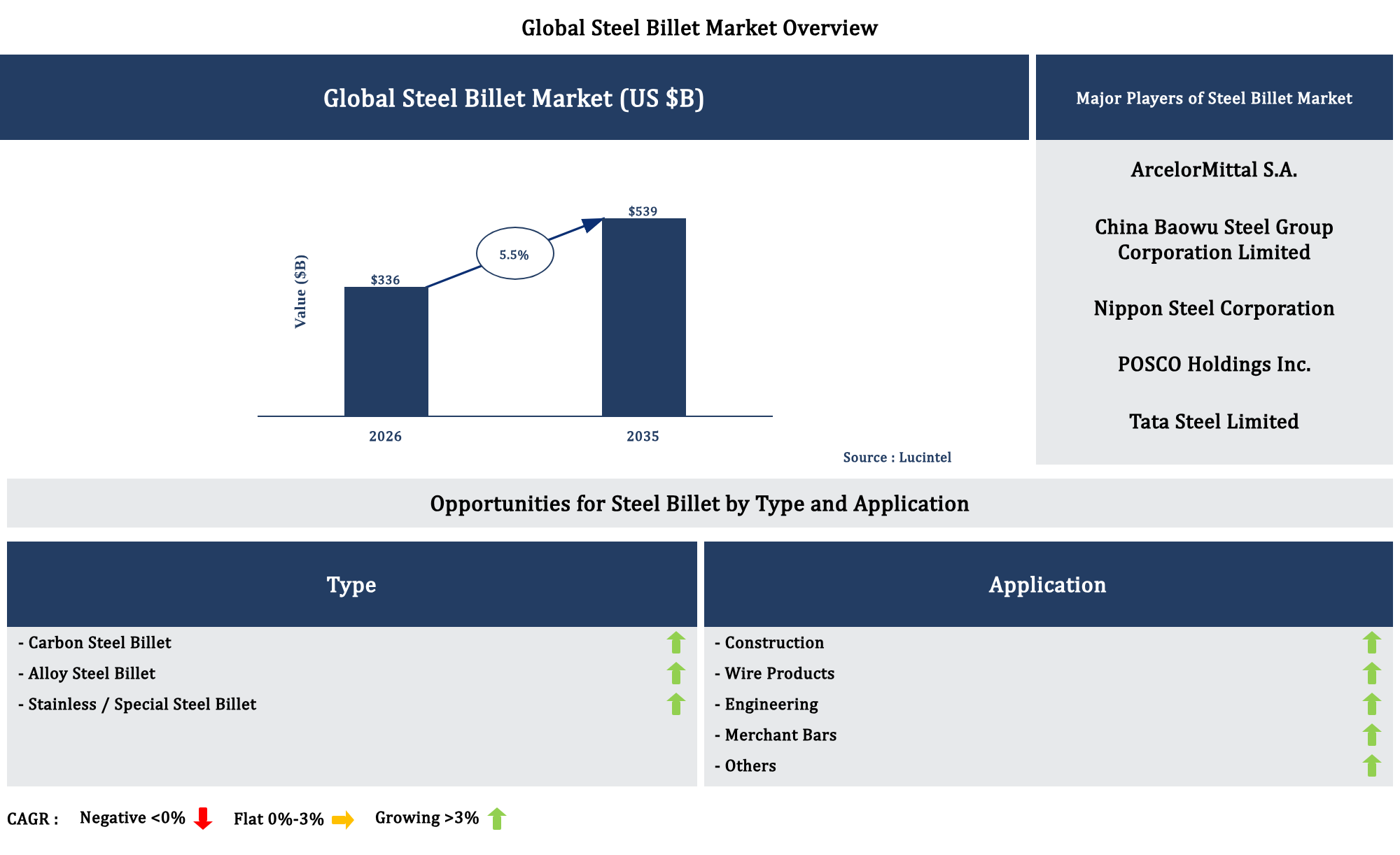
Steel Billet Market

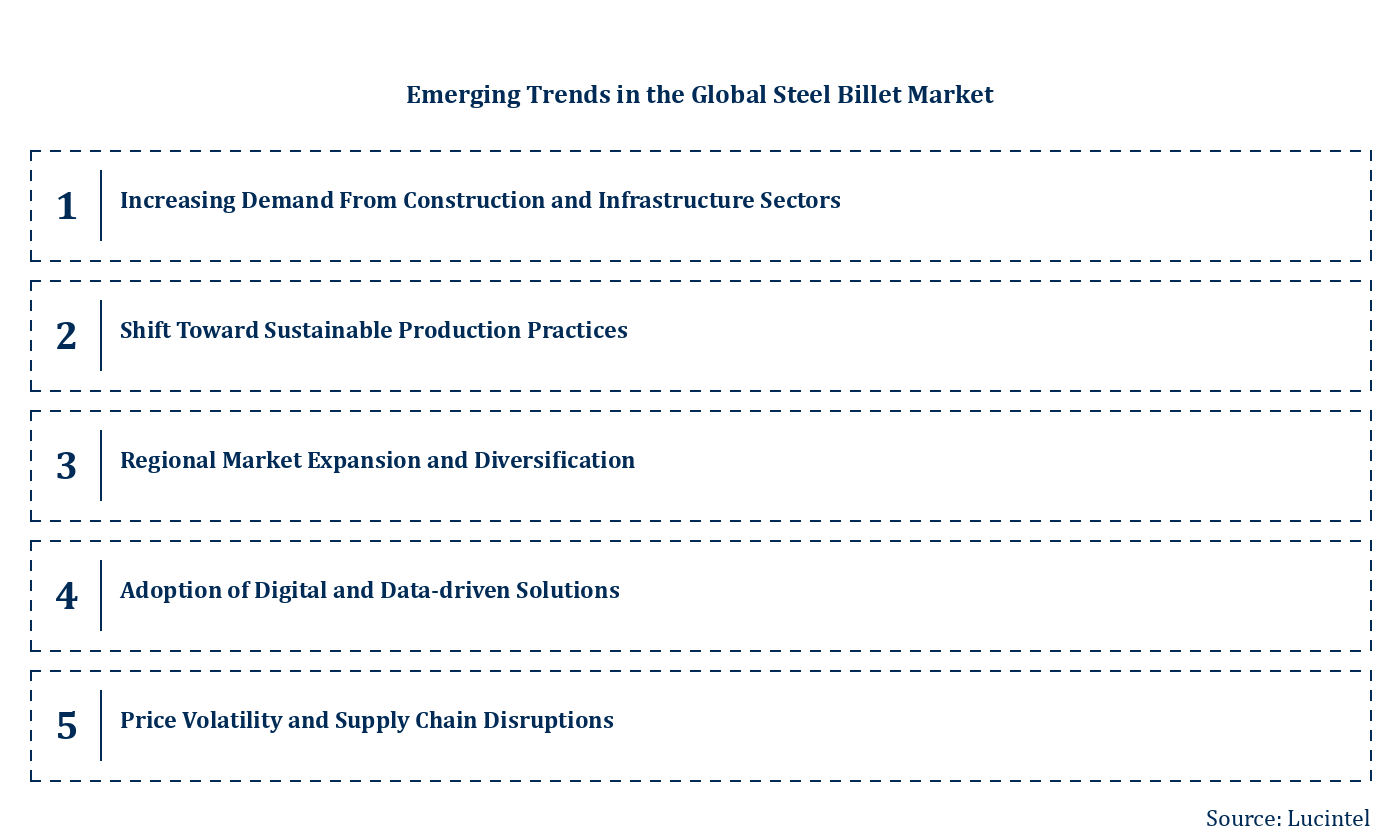
Emerging Trends in the Steel Billet Market

The steel billet market is experiencing significant transformation driven by evolving global demand, environmental considerations, and shifting manufacturing practices. As industries seek more efficient, sustainable, and cost-effective solutions, several key trends are emerging that are reshaping the landscape. These developments influence supply chains, production methods, and market strategies, ultimately impacting stakeholders from producers to end-users. Understanding these trends is crucial for navigating the future of the steel billet industry and capitalizing on new opportunities. The following are five key trends currently shaping this market.

  • Increasing Demand from Construction and Infrastructure Sectors: The rapid growth of urbanization and infrastructure projects worldwide is boosting steel billet consumption. Countries investing heavily in infrastructure development, such as Asia-Pacific and the Middle East, are driving demand for high-quality billets to meet construction needs. This trend results in higher production volumes, shifts in regional market dynamics, and increased competition among suppliers. It also encourages manufacturers to optimize supply chains and expand capacities to meet the rising demand efficiently.
  • Shift Toward Sustainable Production Practices: Environmental concerns and stricter regulations are prompting steel producers to adopt greener methods. This includes utilizing recycled scrap metal, reducing carbon emissions, and improving energy efficiency during billet manufacturing. Such practices not only help companies comply with environmental standards but also appeal to eco-conscious consumers and investors. The shift toward sustainability is fostering innovation in production processes and encouraging the development of eco-friendly steel billets, which are gaining market acceptance and creating new competitive advantages.
  • Regional Market Expansion and Diversification: Emerging markets in Africa, Southeast Asia, and Latin America are becoming key players in the steel billet industry. These regions are experiencing industrial growth, urbanization, and increased infrastructure investments, leading to higher local demand. Companies are diversifying their geographic presence to capitalize on these opportunities, establishing new plants or forming strategic alliances. This regional expansion helps mitigate risks associated with market saturation in traditional areas and provides access to new customer bases, ultimately fostering a more resilient and globally integrated market.
  • Adoption of Digital and Data-Driven Solutions: The integration of digital tools and data analytics is transforming how companies operate within the steel billet market. Real-time monitoring, predictive maintenance, and supply chain optimization are becoming standard practices. These solutions enhance operational efficiency, reduce costs, and improve product quality. Digital platforms also facilitate better market forecasting and customer engagement. As a result, firms that leverage data-driven strategies gain a competitive edge, enabling more agile responses to market fluctuations and customer demands, thus shaping a more responsive and efficient industry landscape.
  • Price Volatility and Supply Chain Disruptions: Fluctuations in raw material costs, geopolitical tensions, and global economic uncertainties are causing significant price volatility in the steel billet market. Supply chain disruptions, such as logistical delays and shortages of key inputs, further exacerbate these issues. Companies are adopting strategies like diversified sourcing and inventory management to mitigate risks. This volatility impacts pricing strategies, profit margins, and investment decisions. Market players must remain adaptable and resilient to navigate these uncertainties, which are likely to persist amid ongoing global economic shifts, influencing overall market stability and growth prospects.

These emerging trends are fundamentally reshaping the steel billet market by driving demand, promoting sustainability, expanding regional footprints, leveraging digital innovations, and managing market volatility. Together, they are fostering a more dynamic, competitive, and sustainable industry landscape, positioning stakeholders to better meet future challenges and capitalize on new opportunities.
Steel Billet Market by country

Recent Developments in the Steel Billet Market

The steel billet market is experiencing rapid transformation driven by technological advancements, increasing demand from construction and manufacturing sectors, and global economic shifts. These developments are shaping the future landscape, creating new opportunities for growth and innovation. Stakeholders are focusing on sustainability, efficiency, and expanding capacities to meet rising consumption. Understanding these key trends is essential for strategic planning and competitive positioning in this dynamic industry.

  • Growing Demand from Construction and Infrastructure: The expansion of urbanization and infrastructure projects worldwide is significantly boosting steel billet consumption. Rapid development in emerging economies and investments in transportation, commercial, and residential buildings are driving demand. This trend enhances market growth prospects, encourages capacity expansion, and fosters innovation in billet production to meet quality and sustainability standards.
  • Technological Innovations in Production Processes: Advances such as automation, AI, and energy-efficient methods are transforming billet manufacturing. These innovations improve productivity, reduce costs, and minimize environmental impact. Companies adopting these technologies gain competitive advantages, enhance product quality, and meet stricter environmental regulations, thereby strengthening their market position and enabling sustainable growth.
  • Increasing Focus on Sustainability and Eco-Friendly Practices: The industry is shifting towards greener production methods, including recycling scrap steel and reducing carbon emissions. Adoption of eco-friendly practices aligns with global sustainability goals, attracts environmentally conscious investors, and complies with stricter regulations. This focus on sustainability is fostering innovation in raw materials and process efficiency, ultimately shaping a more sustainable and resilient market.
  • Expansion of Capacity and New Market Entrants: Major steel producers are investing in new plants and expanding existing capacities to meet rising demand. This expansion increases market competition, stabilizes supply chains, and reduces lead times. Entry of new players, especially from emerging markets, diversifies the market landscape, stimulates innovation, and encourages price competitiveness, supporting overall industry growth.
  • Impact of Global Economic Fluctuations and Trade Policies: Economic shifts, tariffs, and trade agreements influence steel billet prices and supply chains. Fluctuations can lead to market volatility, affecting profitability and investment decisions. Strategic adaptation to these changes, including diversification and supply chain optimization, is crucial for market stability and growth amid uncertain global economic conditions.

The recent developments in the steel billet market are fostering innovation, sustainability, and capacity expansion, which collectively enhance competitiveness and resilience. These trends are driving market growth, attracting investments, and shaping a more sustainable industry landscape, ultimately positioning the market for long-term success amid evolving global demands.

Strategic Growth Opportunities in the Steel Billet Market

The steel billet market is experiencing significant growth driven by increasing demand from construction, automotive, and manufacturing sectors worldwide. Innovations in production processes, rising infrastructure projects, and the need for high-quality raw materials are fueling market expansion. Additionally, regional developments and government initiatives to promote steel industry growth are creating new opportunities. Companies are focusing on strategic investments, technological advancements, and expanding their product portfolios to capitalize on these trends, ensuring sustained growth and competitive advantage in the evolving market landscape.

  • Growing Construction and Infrastructure Projects Drive Market Expansion: The surge in global infrastructure development and urbanization is increasing demand for steel billets as essential raw materials for construction, bridges, and infrastructure projects. Governments and private sectors are investing heavily in large-scale projects, boosting steel consumption. This trend is particularly prominent in emerging economies, where rapid urbanization necessitates substantial steel production. The increased need for durable, high-quality steel billets to meet construction standards is expected to sustain market growth over the coming years.
  • Automotive Industry’s Shift Toward Lightweight Steel Components Presents Opportunities: The automotive sector’s focus on lightweight, fuel-efficient vehicles is increasing demand for high-strength steel billets suitable for manufacturing advanced automotive parts. Innovations in steel grades and processing techniques enable automakers to produce safer, more efficient vehicles. As electric and hybrid vehicles gain popularity, the need for specialized steel billets that meet specific performance criteria is rising. This shift offers manufacturers opportunities to develop tailored billets for automotive applications, driving market growth.
  • Technological Advancements in Steel Production Enhance Efficiency and Quality: Innovations such as continuous casting, automation, and eco-friendly processes are improving steel billet manufacturing efficiency and product quality. These advancements reduce production costs, energy consumption, and waste, making billets more competitive. Enhanced quality control ensures compliance with international standards, expanding market reach. Adoption of smart manufacturing and Industry 4.0 technologies further optimizes operations, enabling producers to meet increasing demand while maintaining sustainability and cost-effectiveness.
  • Regional Developments and Government Policies Support Market Growth: Governments in key regions are implementing policies and incentives to promote steel industry growth, including infrastructure investments and export support. Countries like China, India, and Brazil are expanding steel production capacities to meet domestic and international demand. Trade agreements and tariffs influence market dynamics, creating opportunities for regional players. Additionally, initiatives aimed at sustainable steel production are encouraging investments in environmentally friendly technologies, fostering long-term growth prospects in the global steel billet market.
  • Rising Demand from Manufacturing and Machinery Sectors Boosts Market Opportunities: The manufacturing sector’s expansion, including machinery, shipbuilding, and industrial equipment, is increasing demand for high-quality steel billets. These billets are essential for producing durable, precision-engineered components. The growth of industrialization in developing countries and the modernization of existing manufacturing facilities are key drivers. As industries seek stronger, lighter, and more versatile steel products, manufacturers are innovating to meet these needs, creating substantial opportunities for market players to expand their product offerings and capture new customer segments.

The overall market outlook remains positive, with these growth opportunities collectively driving increased demand, technological innovation, and regional development. Companies that strategically leverage these trends will be well-positioned to enhance their market share and sustain long-term growth in the competitive steel billet industry.

Steel Billet Market Drivers and Challenges

The steel billet market is influenced by a variety of technological, economic, and regulatory factors that shape its growth and stability. Technological advancements in manufacturing processes, such as automation and improved furnace technologies, enhance production efficiency and product quality. Economic factors like global demand for steel, infrastructure development, and fluctuations in raw material prices significantly impact market dynamics. Regulatory policies related to environmental standards, trade tariffs, and import-export restrictions also play a crucial role in shaping market conditions. These drivers and challenges collectively determine the market's trajectory, influencing investment decisions, pricing strategies, and overall competitiveness.

The factors responsible for driving the steel billet market include:-

  • Increasing Infrastructure Development: Rapid urbanization and infrastructure projects worldwide drive demand for steel billets, which are essential raw materials for construction, transportation, and manufacturing sectors. Governments investing in infrastructure development boost steel consumption, supporting market growth. The expanding construction industry in emerging economies further amplifies this demand, creating a positive outlook for steel billet producers. Additionally, the rise in smart city projects and transportation infrastructure enhances the need for high-quality steel billets, fostering innovation and capacity expansion within the industry.
  • Technological Advancements in Production: Innovations such as electric arc furnace (EAF) technology, automation, and process optimization improve efficiency and reduce costs in steel billet manufacturing. These advancements enable producers to meet increasing demand while maintaining quality standards. The adoption of Industry 4.0 practices, including IoT and data analytics, enhances operational control and predictive maintenance, minimizing downtime. Such technological progress not only boosts productivity but also helps companies adhere to stricter environmental regulations, making production more sustainable and competitive in the global market.
  • Fluctuations in Raw Material Prices: The cost of key raw materials like iron ore and coal significantly influences steel billet prices. Volatility in raw material prices, driven by geopolitical tensions, supply chain disruptions, and demand-supply imbalances, impacts profit margins for manufacturers. Companies often face challenges in cost management and pricing strategies due to these fluctuations. To mitigate risks, many firms are investing in long-term supply contracts and exploring alternative raw material sources. Managing raw material costs effectively is crucial for maintaining competitiveness and ensuring stable market growth amid price volatility.
  • Global Trade Dynamics and Tariffs: International trade policies, tariffs, and import-export restrictions directly affect the availability and pricing of steel billets. Trade tensions between major economies can lead to increased tariffs, affecting export opportunities and market access. Conversely, free trade agreements facilitate cross-border movement and market expansion. Companies must navigate complex regulatory environments and adapt their strategies accordingly. The ability to respond swiftly to changing trade policies determines market resilience and influences global supply chains, impacting overall market stability and growth prospects.
  • Environmental Regulations and Sustainability Initiatives: Stricter environmental standards and sustainability commitments influence production processes and product offerings. Regulations targeting carbon emissions, waste management, and energy consumption compel manufacturers to adopt cleaner technologies and improve efficiency. While these measures may increase operational costs initially, they also open opportunities for innovation in eco-friendly steel production. Companies investing in sustainable practices can enhance their brand reputation and meet the growing demand for environmentally responsible products, positioning themselves favorably in a competitive global market.

The challenges facing the steel billet market include:-

  • Volatility in Raw Material Prices: Fluctuations in the prices of iron ore, coal, and other raw materials pose significant challenges for steel billet manufacturers. Price volatility affects production costs, profit margins, and pricing strategies, making it difficult for companies to plan long-term investments. Supply chain disruptions, geopolitical tensions, and demand-supply imbalances exacerbate this volatility, leading to unpredictable market conditions. Companies need to develop risk mitigation strategies such as diversified sourcing and long-term contracts to manage these uncertainties effectively, ensuring financial stability and competitive positioning.
  • Environmental Regulations and Compliance Costs: Increasing environmental regulations impose additional costs on steel producers, requiring investments in cleaner technologies, emission control systems, and waste management practices. Compliance with these standards often involves substantial capital expenditure and operational adjustments, which can strain financial resources, especially for smaller players. Non-compliance risks include legal penalties, reputational damage, and market restrictions. Balancing regulatory adherence with cost efficiency remains a key challenge, prompting companies to innovate and adopt sustainable practices that align with evolving environmental policies while maintaining profitability.
  • Market Demand Fluctuations: The steel billet market is highly sensitive to fluctuations in global demand driven by economic cycles, industrial activity, and geopolitical factors. Economic downturns, trade restrictions, or reduced infrastructure spending can lead to decreased demand, causing oversupply and price declines. Conversely, rapid economic growth can lead to supply shortages and increased prices, creating volatility. Manufacturers must navigate these cyclical patterns by adjusting production levels, managing inventory, and diversifying markets. Unpredictable demand poses risks to revenue stability and long-term planning, requiring agile strategies to sustain growth amid market uncertainties.

The steel billet market is shaped by a complex interplay of technological innovations, economic trends, and regulatory frameworks. While increasing infrastructure development and technological progress drive growth, raw material price volatility, environmental compliance costs, and demand fluctuations present significant challenges. Companies that effectively adapt to these drivers and mitigate challenges through innovation, strategic sourcing, and sustainable practices are better positioned for long-term success. Overall, the market's future depends on balancing growth opportunities with resilience to external pressures, ensuring sustainable and competitive development.

List of Steel Billet Market Companies

Companies in the market compete on the basis of product quality offered. Major players in this market focus on expanding their manufacturing facilities, R&D investments, infrastructural development, and leverage integration opportunities across the value chain. Through these strategies steel billet market companies cater increasing demand, ensure competitive effectiveness, develop innovative products & technologies, reduce production costs, and expand their customer base. Some of the steel billet market companies profiled in this report include-

  • ArcelorMittal S.A.
  • China Baowu Steel Group Corporation Limited
  • Nippon Steel Corporation
  • POSCO Holdings Inc.
  • Tata Steel Limited
  • JSW Steel Limited
  • Nucor Corporation
  • Hyundai Steel Company
  • Emirates Steel Arkan
  • Jindal Steel & Power Limited

Steel Billet Market by Segment

The study includes a forecast for the global steel billet market by type, application, and region.

  • Steel Billet Market by Type [Value from 2019 to 2035]:
    • Carbon Steel Billet
    • Alloy Steel Billet
    • Stainless / Special Steel Billet
  • Steel Billet Market by Application [Value from 2019 to 2035]:
    • Construction
    • Wire Products
    • Engineering
    • Merchant Bars
    • Others
  • Steel Billet Market by Region [Value ($B) from 2019 to 2035]:
    • North America
    • Europe
    • Asia Pacific
    • The Rest of the World

Country Wise Outlook for the Steel Billet Market

The steel billet market has experienced significant shifts driven by global economic trends, technological advancements, and policy changes. As industries recover and expand, demand for steel billets has fluctuated across major economies. Countries are focusing on sustainable practices, increasing production capacities, and adopting innovative technologies to stay competitive. Trade policies and tariffs also influence market dynamics, impacting supply chains and pricing. These developments reflect broader industrial growth and the push towards greener, more efficient steel manufacturing processes. Understanding regional trends is crucial for stakeholders aiming to navigate this evolving landscape effectively.

  • United States: The US steel billet market has seen increased demand driven by infrastructure projects and automotive manufacturing. Technological upgrades in steel production have improved efficiency and reduced environmental impact. Trade tensions and tariffs have influenced import-export dynamics, prompting domestic capacity expansions. The focus on sustainable steel production is growing, with investments in greener technologies and recycling initiatives. Market players are also exploring automation and digitalization to enhance productivity and competitiveness.
  • China: China remains the world's largest steel producer and consumer, with ongoing capacity expansions and technological upgrades. The government emphasizes sustainable growth, promoting cleaner production methods and reducing excess capacity. The market has experienced fluctuations due to environmental regulations and trade policies. Investment in high-quality steel billets and innovation in production processes are priorities. China is also expanding its export markets while balancing domestic demand, aiming for a more sustainable and efficient industry.
  • Germany: Germany's steel billet market is characterized by high-quality standards and technological innovation. The country focuses on sustainable and energy-efficient production methods, aligning with EU environmental policies. Market growth is supported by automotive, machinery, and construction sectors. Germany is investing in digitalization and automation to improve productivity. The emphasis on green steel and recycling initiatives is prominent, aiming to reduce carbon emissions and meet EU climate targets.
  • India: The Indian steel billet market is witnessing rapid growth due to infrastructure development and urbanization. Government initiatives like "Make in India" are boosting domestic production and consumption. The industry is adopting new technologies to improve quality and efficiency. Capacity expansions and investments in modern plants are ongoing to meet rising demand. The focus on sustainable practices is increasing, with efforts to reduce environmental impact and improve energy efficiency. Export opportunities are also being explored to strengthen the industry’s global presence.
  • Japan: Japan's steel billet market is driven by advanced technology and high-quality standards. The country emphasizes innovation, energy efficiency, and sustainability in steel production. Domestic demand from automotive and manufacturing sectors remains strong. Japan is investing in research and development to create eco-friendly steel products. The market is also adapting to global trade dynamics, with strategic partnerships and exports playing a vital role. Efforts to reduce carbon footprint and adopt green technologies are central to Japan's industry strategy.

Features of the Steel Billet Market

  • Market Size Estimates: Steel billet market size estimation in terms of value ($B).
  • Trend and Forecast Analysis: Market trends (2019 to 2025) and forecast (2026 to 2035) by various segments and regions.
  • Segmentation Analysis: Steel billet market size by type, application, and region in terms of value ($B).
  • Regional Analysis: Steel billet market breakdown by North America, Europe, Asia Pacific, and Rest of the World.
  • Growth Opportunities: Analysis of growth opportunities in different types, applications, and regions for the steel billet market.
  • Strategic Analysis: This includes M&A, new product development, and competitive landscape of the steel billet market.
  • Analysis of competitive intensity of the industry based on Porter’s Five Forces model.

Top 5 Companies

  • ArcelorMittal S.A.
  • China Baowu Steel Group Corporation Limited
  • Nippon Steel Corporation
  • POSCO Holdings Inc.
  • Tata Steel Limited

Table of Contents

1. Executive Summary
13.1 Competitive Analysis Overview

List of Figures

List of Tables

Methodology

Lucintel has been in the business of market research and management consulting since 2000 and has published over 1000 market intelligence reports in various markets / applications and served over 1,000 clients worldwide. This study is a culmination of four months of full-time effort performed by Lucintel's analyst team. The analysts used the following sources for the creation and completion of this valuable report:

  • In-depth interviews of the major players in this market
  • Detailed secondary research from competitors' financial statements and published data
  • Extensive searches of published works, market, and database information pertaining to industry news, company press releases, and customer intentions
  • A compilation of the experiences, judgments, and insights of Lucintel's professionals, who have analyzed and tracked this market over the years.

Extensive research and interviews are conducted across the supply chain of this market to estimate market share, market size, trends, drivers, challenges, and forecasts. Below is a brief summary of the primary interviews that were conducted by job function for this report.

Lucintel's methodology for market research

Thus, Lucintel compiles vast amounts of data from numerous sources, validates the integrity of that data, and performs a comprehensive analysis. Lucintel then organizes the data, its findings, and insights into a concise report designed to support the strategic decision-making process. The figure below is a graphical representation of Lucintel's research process.

Primary interviews by job function

Buy Now

Choose a license that fits your team. Instant PDF delivery.

Market Report

1 User PDF

$4,850
Buy Now

Market Report

2-5 Users PDF

$6,700
Buy Now

Market Report

Corporate PDF

$8,850
Buy Now

Market Report

Global PDF

$10,000
Buy Now

Prices exclude taxes. Instant delivery. Custom licensing available on request.

Frequently Asked Questions

What is the steel billet market size?
The global steel billet market is expected to reach an estimated $539 billion by 2035.
What is the growth forecast for steel billet market?
The global steel billet market is expected to grow with a CAGR of 5.5% from 2026 to 2035.
What are the major drivers influencing the growth of the steel billet market?
The major drivers for this market are the increasing demand from construction infrastructure, the rising use in automotive machinery manufacturing, and the growing adoption in steel rolling fabrication.
What are the major segments for steel billet market?
The future of the steel billet market looks promising with opportunities in the construction, wire product, engineering, and merchant bar markets.
Who are the key steel billet market companies?

Some of the key steel billet companies are as follows:

  • ArcelorMittal S.A.
  • China Baowu Steel Group Corporation Limited
  • Nippon Steel Corporation
  • POSCO Holdings Inc.
  • Tata Steel Limited
  • JSW Steel Limited
  • Nucor Corporation
  • Hyundai Steel Company
  • Emirates Steel Arkan
  • Jindal Steel & Power Limited
Which steel billet market segment will be the largest in future?
Lucintel forecasts that, within the type category, carbon steel billet will remain the largest segment over the forecast period.
In steel billet market, which region is expected to be the largest in next 9 years?
In terms of region, APAC will remain the largest region over the forecast period.
Do we receive customization in this report?
Yes, Lucintel provides 10% customization without any additional cost.

Key Questions

  • What are some of the most promising, high-growth opportunities for the steel billet market by type (carbon steel billet, alloy steel billet, and stainless / special steel billet), application (construction, wire products, engineering, merchant bars, and others), and region (North America, Europe, Asia Pacific, and the Rest of the World)?
  • Which segments will grow at a faster pace and why?
  • Which region will grow at a faster pace and why?
  • What are the key factors affecting market dynamics? What are the key challenges and business risks in this market?
  • What are the business risks and competitive threats in this market?
  • What are the emerging trends in this market and the reasons behind them?
  • What are some of the changing demands of customers in the market?
  • What are the new developments in the market? Which companies are leading these developments?
  • Who are the major players in this market? What strategic initiatives are key players pursuing for business growth?
  • What are some of the competing products in this market and how big of a threat do they pose for loss of market share by material or product substitution?
  • What M&A activity has occurred in the last 6 years and what has its impact been on the industry?
Why Choose Us

The Lucintel Advantage

Trusted partner for strategic intelligence and business growth

25+ Years Excellence

25+ Years Excellence

Quarter century of proven expertise in management consulting and market research across global markets.
Game-Changer Ideas

Game-Changer Ideas

Innovative strategies and actionable insights that help clients become the smartest in their industry.
Global Reach

Global Reach

Extensive coverage across 50+ industries and markets worldwide with localized expertise.
Start Your Growth Journey

Get Your Free
Market Intelligence
Briefing

Receive a complimentary market analysis tailored to your industry. Our analysts will identify key growth opportunities and competitive dynamics specific to your business.

Custom Market Snapshot

Market size, growth rate, and key trend analysis for your specific sector.

Competitive Landscape Overview

Top competitor positioning and market share analysis.

Growth Opportunity Identification

Strategic recommendations backed by data-driven insights.

Subscribe

Subscribe to our Newsletter

Get curated market intelligence and competitive moves straight to your inbox.

By subscribing, you agree to receive our monthly insights. Unsubscribe anytime.

Industry Trends Market Signals Opportunities Competitor Moves