
Market Report · July 20, 2026

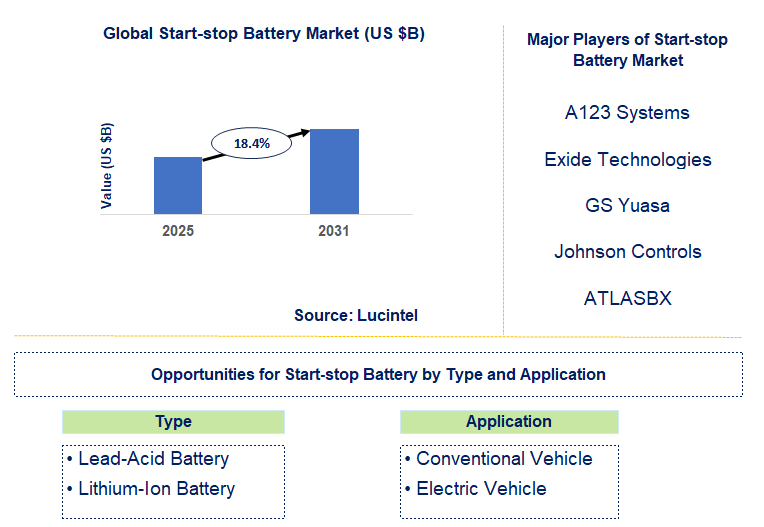
Key data points: The growth forecast = 18.4% annually for the next 7 years. Scroll below to get more insights. This market report covers Trends, opportunities and forecasts in start-stop battery market to 2031 by type (lead-acid battery and lithium-ion battery), application (conventional vehicle and electric vehicle), and region (North America, Europe, Asia Pacific, and the Rest of the World)
We'll send your sample report shortly.
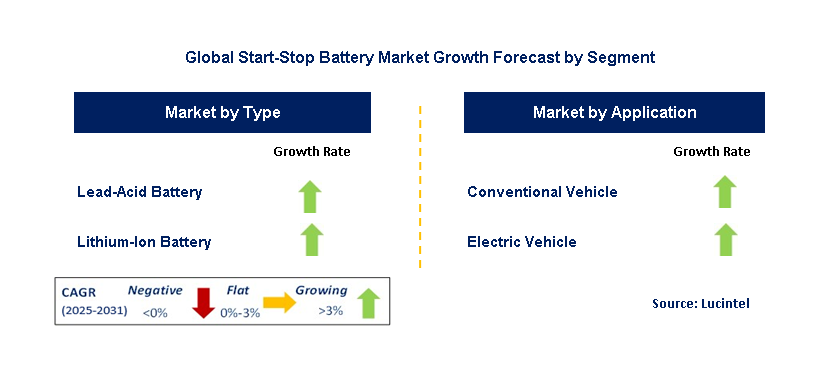
• Lucintel forecasts that, within the type category, lithium-ion battery is expected to witness higher growth over the forecast period due to the rising demand for longer-lasting batteries.
• Within the application category, electric vehicle is expected to witness higher growth due to the growing adoption of electric vehicles.
• In terms of region, APAC is expected to witness the highest growth over the forecast period due to the rising demand for fuel-efficient vehicles.
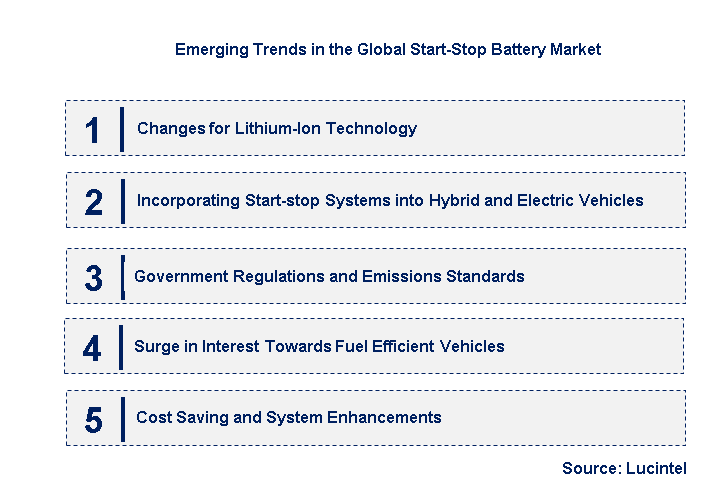
• Changes for Lithium-Ion Technology: The use of lithium-ion batteries in starting-stopping systems is expected to increase due to their higher energy capacity, greater life expectancy, and ability to endure more charge and discharge cycles. The expansion of lithium-ion technology is enhanced by the improvement and efficiency of these batteries in supporting starting-stopping applications. Lithium batteries are best for vehicles with high power demands and frequent rest periods of the engine. As the costs for batteries decline, the dominance of Lithium battery is inevitable in the start-stop battery market.
• Incorporating Start-stop Systems into Hybrid and Electric Vehicles: There is a need to improve energy efficiency in hybrid and electric vehicles which is why start-stop systems are being integrated. For example, in hybrid vehicles, start-stop systems help lessen the need for gas during idling. Electric vehicles are also using start-stop technology to optimize electric drive system efficiency which further lowers energy usage. These newer integrations allows for greater opportunities for start-stop battery manufacturers to supply the ever-growing hybrid and electric vehicle markets.
• Government Regulations and Emissions Standards: The increasing regulations from the government and emission standards globally is enabling the use of start-stop systems in vehicles. Regions like Europe where emissions standards are very high, automakers are incorporating start-stop technology to help improve fuel efficiency and emissions. The need for cleaner transportation and lowering CO2 emissions is what will increase the need for start-stop batteries. Other government policies which support these low emission and fuel efficient vehicles also greatly impacts the start-stop battery market positively.
• Surge in Interest Towards Fuel Efficient Vehicles: Due to increased fuel prices, consumers are looking for vehicles with superior fuel economy. Start-stop systems are a good alternative for customers that want to save more fuel and money. These systems are able to save fuel over time by shutting off an engine during times of idling, such as at traffic lights. The growing Interested in fuel efficient cars is increasing adoption of start-stop systems, and therefore, start-stop batteries.
• Cost Saving and System Enhancements: Improvements in technology and increased production are driving down costs of manufacturing start-stop batteries. As battery producers become more efficient in their production, the price of start-stop batteries will decline. Furthermore, the advancement of new battery kinds and better the battery management systems being developed are increasing the effectiveness and price competitiveness of start-stop batteries. These savings make it easier to purchase start-stop systems for most of the people, which is expanding the market. Advancements in lithium-ion battery technology, integration with hybrid and electric vehicles, government policies, rising customer interest in fuel-efficient cars, and pricing changes are some of the important factors changing the dynamics of the market. All of these trends are driving innovation, efficiency, and adoption of start-stop systems across the globe.
• Introduction of Advanced Lead-Acid Batteries: Due to their economic efficiency, reliable performance, and repeated charge/discharge cycle capability, advanced lead-acid batteries are becoming commonplace in start-stop systems. This kind of battery is undergoing considerable technological progress that allows better performance in start-stop applications. Lead-acid batteries are less expensive than lithium-ion batteries; therefore, they are appealing to car manufacturers who want to put start-stop systems in low-cost vehicles. Increased adoption of affordable advanced lead-acid batteries is propelling growth of the start-stop battery market.
• Development of High-Energy Density Lithium-ion Batteries: Like most other battery types, lithium-ion batteries have regionally seen the largest growth in energy density. This improvement makes it more desirable for use in start-stop systems in high-end vehicles. The increased energy density also improves efficiency, recharge rate, and battery life, which is vital for the continual starting and stopping of the engine in today’s vehicles. The increase of mid-range to premium compact cars is expected to be fueled by high-energy density lithium-ion batteries and will, in turn, increase the adoption of start-stop systems.
• Adoption of Start-stop Systems in Electric Vehicles is Rapidly Increasing: In the effort to enhance overall fuel economy, car manufacturers are increasing adoption of start-stop systems in electric vehicles. Start-stop systems improve the efficient use of power in electric vehicles by reducing energy wastage when the vehicle is not in use. This is beneficial in consideration of the current demand for electric vehicles as it improves the efficacy of electric drive systems and maximizes battery utilization. The increased integration of start-stop systems in electric vehicles is aiding the growth of the start-stop battery market.
• Offering of Start-stop Systems is being Broadened by Automakers: The offering of start-stop systems is now being used by a greater number of automobile manufacturers. Aside from high-end or hybrid models, start-stop technology is now available in most economical vehicles. This is due to higher market needs for low-consumption vehicles and the more stringent required regulations on emissions. The wider the offering of vehicles with integrated start-stop systems, there will be a greater need for start-stop batteries.
• Battery Management Systems Developments: The new battery management systems (BMS) technology is improving the performance and life of start-stop batteries. BMS technology manages the charging and discharging cycles which enhances the efficiency of the battery and extends its life. The BMS mitigates overcharging and deep discharging which ensures the reliability and durability of start-stop systems. Efforts in battery management are resolving some difficulties being faced in start-stop battery performance. There are changes in the start-stop battery market with the lead acid and lithium-ion technologies integration, embrace of electric vehicles, inclusion of more vehicle makes and models, and battery management systems improvements. These changes enhance the effectiveness, efficiency, and economic viability of start-stop systems, hence, increasing market growth.
• New Opportunities in Electric and Hybrid Vehicles: Manufacturers of start-stop batteries have every reason to cheer because of the rising demand for electric and hybrid automobiles. These power efficient vehicles utilize power management systems and start-stop technology can be leveraged to further improve their efficiency. The proliferation of hybrid and electric vehicles has created plenty of untapped potential for batteries with high-performance capabilities designed to endure frequent start-stop cycles.
• Research for Affordable Long-Life Batteries: The increased adoption of start-stop systems creates new opportunities for manufacturers to design economical batteries that last longer. Rapid improvements in battery chemistry and technology are enabling the development of more cost-efficient and long-lasting durable batteries, which in turn will reduce the cost of start-stop systems for consumers. This is a great opportunity for manufacturers to target mass-market vehicles.
• Subsidies and Ecological Policies: The start-stop battery market has been primarily driven by government subsidies and ecological issues. If history is any guide, then the push towards clean methods of transportation will likely result in increased adoption of start-stop systems. Manufacturers can take advantage of these regulatory pressures by developing batteries that will enable automakers to achieve emissions and fuel efficiency regulations.
• Solutions for Start-stop Batteries in the Aftermarket: From a market perspective, the retrofitting of older vehicles’ start-stop systems offers aftermarket opportunities which are yet to be captured. With an increase in the number of vehicles on the road, the aftermarket segment offers start-stop battery suppliers a chance to increase sales through servicing the many vehicles that were never originally designed with the technology.
• Improved Recycling of Batteries: The increase in demand for start-stop batteries will be followed by accompanying demand for effective recycling solutions. The manufacturers and the recyclers for start-stop batteries have an opportunity to design processes that would significantly elevate the ratio of useful materials recovered and the overall expenditure incurred towards environmental protection during the disposal of batteries. Adopting such approaches would guarantee a sustainable and circular supply chain for start-stop batteries and would make their use even more widespread. To the growth prospects in the start-stop battery market, there is the inclusion of electric and hybrid vehicles, development of affordably priced long-life batteries, government assistance, aftermarket solutions, and the like, together with enhanced recycling of the batteries. These are the prospects which will put the start-stop battery industry on the map, and truly make it a global powerhouse.
• A123 Systems
• Exide Technologies
• GS Yuasa
• Johnson Controls
• ATLASBX
• Duracell
• East Penn Manufacturing
• Lead-Acid Battery
• Lithium-Ion Battery
• Conventional Vehicle
• Electric Vehicle
• North America
• Europe
• Asia Pacific
• The Rest of the World
• U.S.: The Economic Times states that the start-stop battery market in the U.S. is expanding greatly which started to increase with improving fuel efficiency and new regulations. Companies such as Ford and General Motors have heavily incorporated start-stop technology in their new models to comply with the new fuel economy and emission targets. Additionally, the performance of start-stop systems have received a boost from new advancements in lithium ion and lead acid batteries. All this is, however, limited by the high costs that come with newer, more advanced battery technologies, and the Reagan era consumer apathy. Given the current attitude held by the U.S. government toward greener transportation and the new environmental laws, I can see the market expanding in the next few years.
• China: The combination of the rapidly growing automotive industry and the strong government push towards sustainable transport makes China a leader in the start-stop battery market. The Chinese government has set ambitious targets for fuel efficiency and electric vehicle adoption, which has, in turn, created demand for start-stop batteries. Additionally, growing consumer awareness of environmental issues is accelerating the need for gasoline and hybrid vehicles. China’s focus on lithium-ion electric vehicle production and battery technology also expands the start-stop battery market.
• Germany: Germany's automotive manufacturers, including Volkswagen, BMW, Mercedes-Benz, are incorporating start-stop systems in their vehicles and thus the country is a major player in the start-stop battery market. The European Union's strict emissions regulations also drive these manufacturers to adopt start-stop technology for fuel efficiency and environmental issues. Furthermore, the increasing adoption of hybrid and electric vehicles in Germany drives further adoption of start-stop battery systems. As the market for electric and hybrid vehicles increases, there are also more advanced battery technologies required to deal with the frequent start-stop cycles.
• India: In India, the market for start-stop batteries is still relatively new, as most automakers still focus on improving the fuel economy of their vehicles due to the continuous rise in fuel prices and environmental factors. Compared to other regions, the adoption of start-stop systems in India has been slower, but the development of electric vehicles and greater fuel efficiency standards by the Indian government will likely promote growth. As compact and mid-sized passenger cars, which greatly benefit from start-stop technology, become more popular, the demand for these batteries will increase. Nonetheless, the widespread implementation of start-stop systems in India will be slowed down by sensitivity to cost and limitations in infrastructure.
• Japan: Japan's automotive sector is well advanced, and there is significant investment in new technologies, including the adoption of start-stop systems. It is common for Japanese manufacturers like Toyota, Honda, and Nissan to incorporate start-stop systems in hybrid and electric models. The growth in the number of start-stop batteries in use is the result of Japan's push towards lowering their carbon footprint and maximizing fuel economy. Additionally, the country’s systematic focus on hybrid vehicles together with the innovations in lithium-ion batteries will benefit the market growth in the future. Japan’s constant innovations also result in the optimization of battery performance and efficiency, which contributes to the adoption of start-stop systems.


• A123 Systems
• Exide Technologies
• GS Yuasa
• Johnson Controls
• ATLASBX
• Duracell
• East Penn Manufacturing Q5. Which start-stop battery market segment will be the largest in future? Answer: Lucintel forecasts that, within the type category, lithium-ion battery is expected to witness higher growth over the forecast period due to the rising demand for longer-lasting batteries. Q6. In start-stop battery market, which region is expected to be the largest in next 5 years? Answer: In terms of region, APAC is expected to witness the highest growth over the forecast period due to the rising demand for fuel-efficient vehicles. Q7. Do we receive customization in this report? Answer: Yes, Lucintel provides 10% customization without any additional cost.


Choose a license that fits your team. Instant PDF delivery.
Prices exclude taxes. Instant delivery. Custom licensing available on request.
Market Report · July 20, 2026
Market Report · July 20, 2026
Market Report · July 20, 2026
Trusted partner for strategic intelligence and business growth


Receive a complimentary market analysis tailored to your industry. Our analysts will identify key growth opportunities and competitive dynamics specific to your business.

Market size, growth rate, and key trend analysis for your specific sector.

Top competitor positioning and market share analysis.

Strategic recommendations backed by data-driven insights.
Get curated market intelligence and competitive moves straight to your inbox.
By subscribing, you agree to receive our monthly insights. Unsubscribe anytime.
Receive a complimentary market analysis tailored to your industry. Our analysts will identify key growth opportunities and competitive dynamics specific to your business.
Market size, growth rate, and key trend analysis for your specific sector.
Top competitor positioning and market share analysis.
Strategic recommendations backed by data-driven insights.
Get curated market intelligence, emerging trends, and competitive moves straight to your inbox each month.
By subscribing, you agree to receive our monthly insights. Unsubscribe anytime.
We'll send your sample report shortly.