
Market Report · May 18, 2026

This market report covers trends, opportunities, and forecasts in the global spintronic market to 2031 by technology (giant magnetoresistance (gmr), tunnel magnetoresistance (tmr), spin-transfer torque (stt), spin hall effect, and others), end use industry (automotive, industrial, consumer electronics, healthcare, it & telecom, and others), and region (North America, Europe, Asia Pacific, and the Rest of the World)
We'll send your sample report shortly.
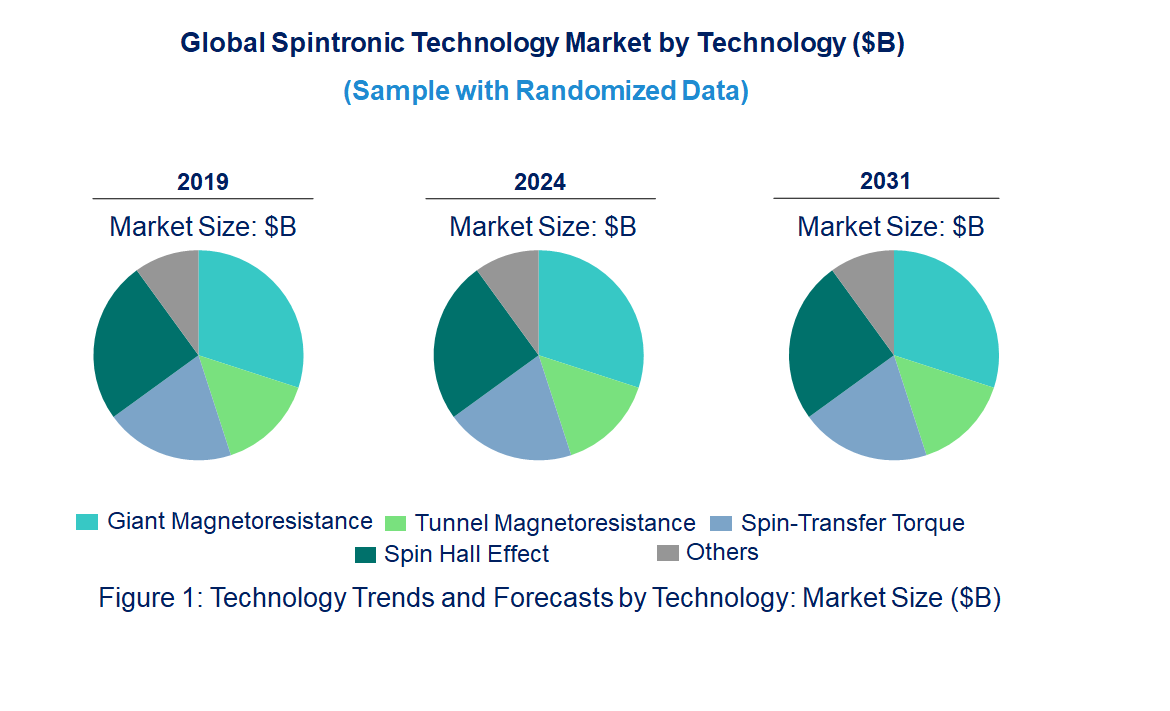
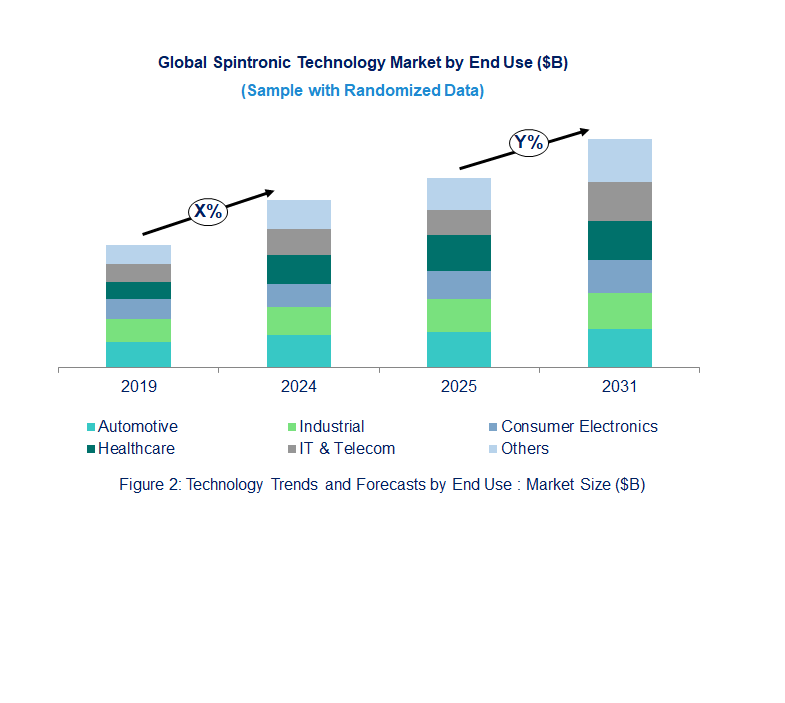
• Development of Spintronic Sensors: Innovations in spintronic sensors are enhancing sensitivity and miniaturization, leading to their increased use in automotive, aerospace, and industrial applications .
• Research on New Magnetic Materials: Ongoing research into new magnetic materials, such as van der Waals crystals, is opening up possibilities for more efficient and scalable spintronic devices .
• Strategic Partnerships and Collaborations: Companies are forming strategic partnerships to advance spintronics technology, expand product offerings, and enter new markets . These trends are reshaping the spintronic market by driving innovation, expanding applications, and fostering collaborations that accelerate the development and adoption of spintronic technologies.
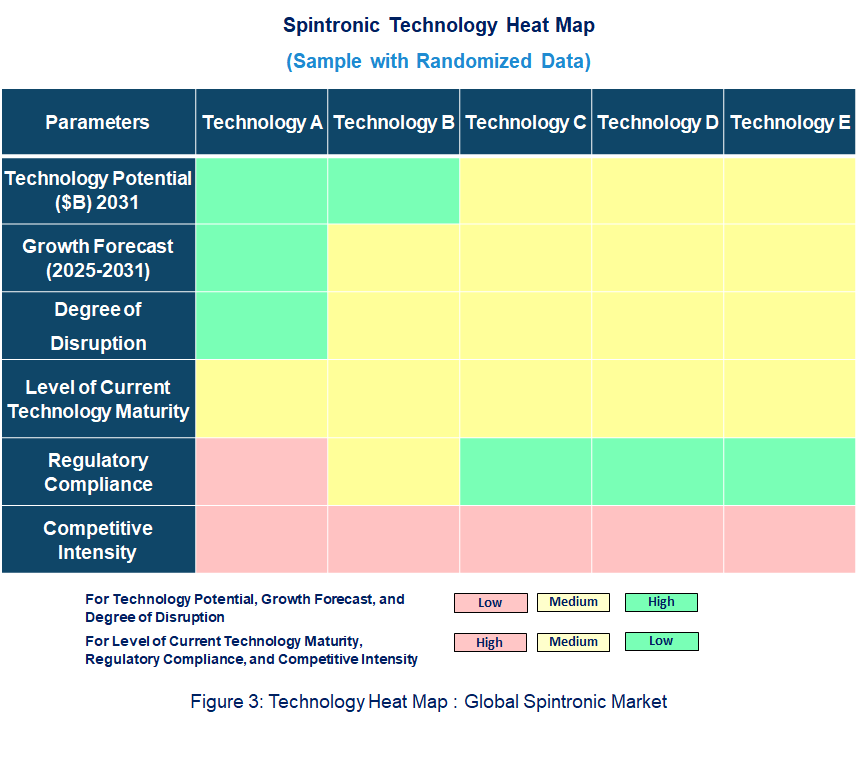
• Technology Potential: While some technologies like GMR and TMR are mature and widely adopted, others like STT and Spin Hall Effect are emerging with ongoing research and development.
• Degree of Disruption: The degree of disruption is high, particularly with the development of MRAM and integration into quantum computing.
• Level of Current Technology Maturity: GMR and TMR technologies exhibit high readiness, with GMR widely used in existing applications and TMR gaining traction in advanced memory solutions. In contrast, STT is moderately mature with early product availability, while Spin Hall Effect and other emerging concepts remain in the research or experimental phase with limited implementation.
• Regulatory Compliance: Regulatory compliance is evolving, with standards being developed to ensure safety and interoperability of spintronic devices.
• NVE Corporation: Invested approximately USD 50–70 million to expand its spintronic component production, addressing growing demand in various industries .
• Everspin Technologies: Secured funding of around USD 30–50 million to advance next-generation MRAM technologies, aiming to enhance data storage solutions .
• Crocus Technology: Partnered with automotive companies, investing USD 40–60 million to integrate spintronic sensors into vehicle systems, improving safety and performance .
• Synopsys: Collaborated with research institutions to develop design tools for spintronic devices, facilitating their integration into existing semiconductor workflows.
• Avalanche Technology: Launched its third-generation space-grade STT-MRAM devices, targeting aerospace applications requiring high reliability .
• Rising demand for MRAM (Magnetoresistive Random Access Memory): MRAM, powered by Spintronic technologies like TMR and STT, offers fast switching speeds and non-volatility, attracting major semiconductor players.
• Growing application in automotive and industrial sectors: Spintronic sensors are increasingly used for precision sensing, motion detection, and position tracking in vehicles and industrial automation.
• Advancements in quantum computing and neuromorphic engineering: Spintronic devices are being explored for their potential role in enabling quantum logic and brain-like computing systems.
• Energy efficiency and miniaturization benefits: Spintronic devices consume less power and can be fabricated at nanoscale, aligning with trends in portable and low-energy electronics.
• Supportive R&D ecosystem: Government and private investments in spintronic research are accelerating material innovation and product development. Challenges in the spintronic market are:
• High development costs and material challenges: Fabrication of spintronic devices requires precise materials like ferromagnetic layers, which are costly and complex to process.
• Limited large-scale commercialization: Despite promising R&D, few technologies like STT-MRAM have made it past the pilot phase to full-scale market deployment.
• Interfacing complexity with traditional CMOS architecture: Integrating spintronics with existing semiconductor processes remains a technical bottleneck.
• Sensitivity to external magnetic interference: Devices may suffer performance degradation in high EMI environments, affecting reliability.
• Regulatory and standardization issues: Lack of universally accepted standards for spintronic components impedes interoperability and industry adoption. In conclusion, the spintronic market is poised for significant growth driven by its potential in memory and sensing applications, especially where energy efficiency and speed are critical. However, overcoming commercialization, cost, and integration challenges will be crucial to unlock the full potential of spintronics in mainstream electronics.
• Nve
• Everspin Technologies
• Crocus Technology
• Synopsys
• Avalanche Technology
• Technology Readiness by Technology Type: Spintronic technologies are in varying stages of readiness, with mature applications like giant magnetoresistance (GMR), tunnel magnetoresistance (TMR), spin-transfer torque (STT), spin hall effect, and others already commercialized and used in niche memory and sensor markets. Emerging spintronic devices, such as spin-based logic and quantum computing components, are still largely in research and prototype phases. Continued material innovation and fabrication improvements are critical to advancing broader commercial adoption.
• Competitive Intensity and Regulatory Compliance: The spintronic market is moderately competitive, with key semiconductor and memory companies investing heavily in R&D to secure leadership in emerging applications like MRAM and quantum computing. Regulatory compliance primarily focuses on environmental and safety standards related to material sourcing and manufacturing processes. As the technology matures, standards for interoperability and device reliability are expected to become more stringent.
• Disruption Potential by Technology Type: Spintronic technology holds significant disruption potential by enabling faster, more energy-efficient memory and logic devices compared to traditional electronics. Its application in MRAM and emerging quantum computing components could revolutionize data storage and processing speeds. These advancements promise to reshape computing architectures and drive breakthroughs in AI and high-performance computing.
• Giant Magnetoresistance (GMR)
• Tunnel Magnetoresistance (TMR)
• Spin-Transfer Torque (STT)
• Spin Hall Effect
• Others
• Automotive
• Industrial
• Consumer Electronics
• Healthcare
• IT & Telecom
• Others
• North America
• Europe
• Asia Pacific
• The Rest of the World
• Latest Developments and Innovations in the Spintronic Technologies
• Companies / Ecosystems
• Strategic Opportunities by Technology Type


Choose a license that fits your team. Instant PDF delivery.
Prices exclude taxes. Instant delivery. Custom licensing available on request.
Market Report · May 18, 2026
Market Report · May 18, 2026
Market Report · May 18, 2026
Trusted partner for strategic intelligence and business growth


Receive a complimentary market analysis tailored to your industry. Our analysts will identify key growth opportunities and competitive dynamics specific to your business.

Market size, growth rate, and key trend analysis for your specific sector.

Top competitor positioning and market share analysis.

Strategic recommendations backed by data-driven insights.
Get curated market intelligence and competitive moves straight to your inbox.
By subscribing, you agree to receive our monthly insights. Unsubscribe anytime.
Receive a complimentary market analysis tailored to your industry. Our analysts will identify key growth opportunities and competitive dynamics specific to your business.
Market size, growth rate, and key trend analysis for your specific sector.
Top competitor positioning and market share analysis.
Strategic recommendations backed by data-driven insights.
Get curated market intelligence, emerging trends, and competitive moves straight to your inbox each month.
By subscribing, you agree to receive our monthly insights. Unsubscribe anytime.
We'll send your sample report shortly.