
Market Report · July 15, 2026

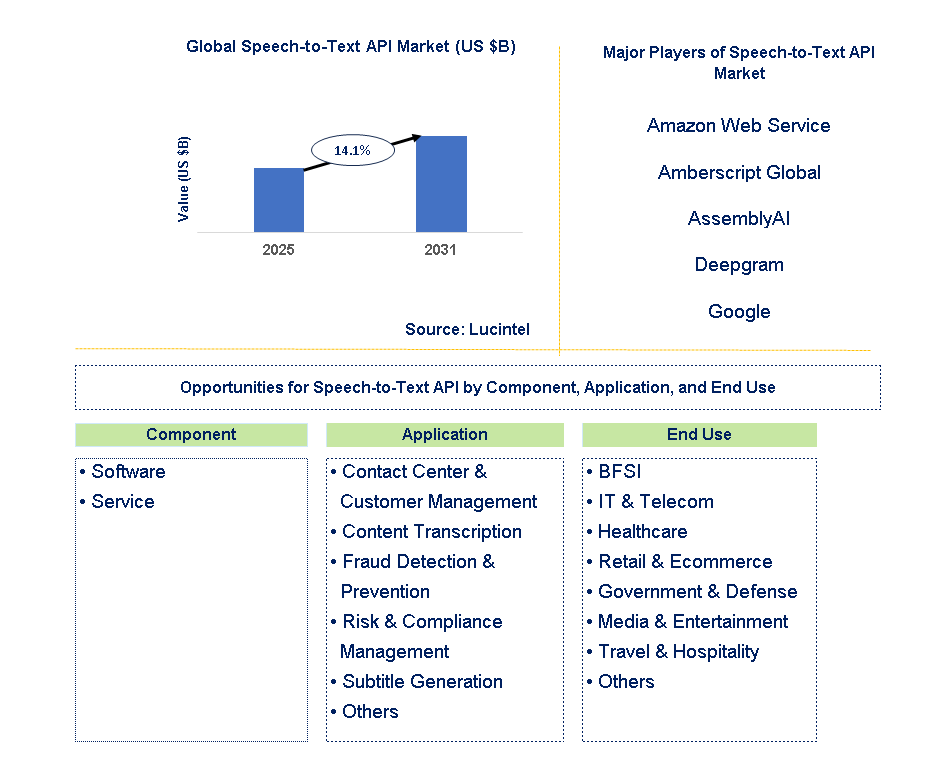
Key data points: The growth forecast = 14.1% annually for the next 7 years. Scroll below to get more insights. This market report covers trends, opportunities and forecasts in speech-to-text API market to 2031 by component (software and service), application (contact center & customer management, content transcription, fraud detection & prevention, risk & compliance management, subtitle generation, and others), end use (bfsi, it & telecom, healthcare, retail & ecommerce, government & defense, media & entertainment, travel & hospitality, and others), and region (North America, Europe, Asia Pacific, and the Rest of the World)
We'll send your sample report shortly.
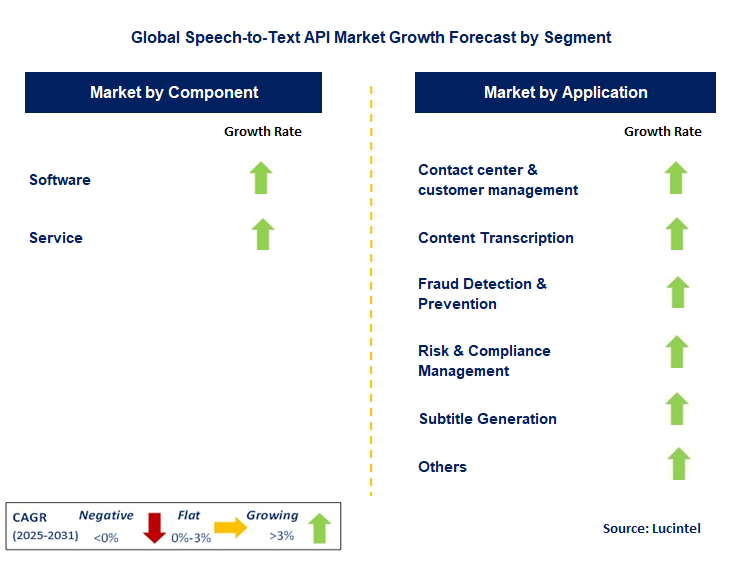
• Lucintel forecasts that, within the component category, service is expected to witness higher growth over the forecast period.
• Within the application category, fraud detection & prevention is expected to witness the highest growth.
• In terms of region, APAC is expected to witness the highest growth over the forecast period. Gain valuable insights for your business decisions with our comprehensive 150+ page report. Sample figures with some insights are shown below.
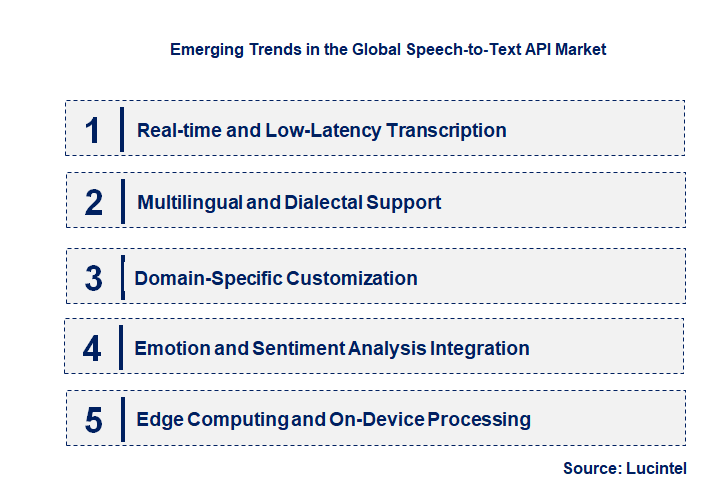
• Real-time and Low-Latency Transcription: The demand for instantaneous conversion of spoken words into text is a critical trend. Advances in processing power and algorithms enable APIs to transcribe speech with minimal delay, crucial for live captioning, call center interactions, and real-time virtual assistants, significantly improving responsiveness and user experience.
• Multilingual and Dialectal Support: Speech-to-text APIs are increasingly offering robust support for a multitude of languages, dialects, and accents. This development is vital for global enterprises and diverse populations, enabling accurate transcription regardless of linguistic nuances and fostering greater inclusivity and accessibility worldwide.
• Domain-Specific Customization: There’s a growing trend towards specialized APIs that can be fine-tuned for specific industries or use cases, such as healthcare, legal, or financial services. This customization allows for higher accuracy in recognizing industry-specific terminology and jargon, making the APIs more valuable and effective in niche applications.
• Emotion and Sentiment Analysis Integration: Beyond mere transcription, emerging APIs are incorporating capabilities to detect emotional tone and sentiment within spoken language. This integration provides deeper insights into customer interactions, call center performance, and user feedback, enhancing analytical capabilities for businesses.
• Edge Computing and On-Device Processing: A notable trend involves the development of speech-to-text capabilities that can run on edge devices or locally, reducing reliance on cloud connectivity. This improves privacy, reduces latency, and enables offline functionality, particularly crucial for applications in sensitive environments or where internet access is limited. These emerging trends are profoundly reshaping the speech-to-text API market by making the technology more accurate, versatile, and accessible. They are driving innovation towards more intelligent and context-aware voice recognition, expanding its utility across a broader spectrum of industries and applications, and pushing the boundaries of human-machine interaction.
• End-to-End Deep Learning Models: A significant development is the widespread adoption of end-to-end deep learning models in speech-to-text APIs. These models directly map audio input to text output, simplifying the architecture and leading to substantial improvements in recognition accuracy and efficiency across diverse acoustic environments and accents.
• Real-time Transcription Enhancements: Major players are continually optimizing their APIs for real-time transcription with extremely low latency. This is crucial for applications like live captioning, virtual meetings, and interactive voice response (IVR) systems, ensuring immediate feedback and seamless user experiences without noticeable delays.
• Improved Multilingual and Dialectal Accuracy: Recent advancements include more sophisticated training data and modeling techniques that enhance the API’s ability to accurately transcribe a wide range of languages, regional dialects, and accents. This broadens the market reach and utility for global businesses and diverse user bases.
• Speaker Diarization and Identification: Many APIs now feature advanced speaker diarization, accurately identifying and separating different speakers in a multi-participant audio stream. This is critical for meeting transcription, call center analytics, and legal proceedings, providing clarity and context to conversations.
• Customizable Language Models: Developers can increasingly customize language models within the APIs to better recognize domain-specific vocabulary and jargon. This allows businesses in specialized fields like healthcare, finance, or legal to achieve higher accuracy for their unique terminology, significantly improving transcription quality. These recent developments are collectively impacting the speech-to-text API market by raising the bar for accuracy and performance. They are enabling a wider array of innovative voice-enabled applications, driving automation, improving accessibility, and creating new opportunities across enterprises and consumer products, leading to accelerated market growth.
• Customer Service Automation: The contact center industry presents a massive opportunity for speech-to-text APIs to automate customer interactions, analyze call sentiment, and generate real-time transcripts. This improves agent efficiency, enhances customer experience, and provides valuable insights for service optimization and training.
• Healthcare Documentation & Transcription: The healthcare sector offers significant potential for medical dictation, clinical documentation, and electronic health record (EHR) integration. Speech-to-text APIs can streamline workflows, reduce administrative burden for clinicians, and improve the accuracy and speed of medical transcription.
• Media and Entertainment Content Creation: The growing demand for subtitles, captions, and searchable audio content in media and entertainment creates a strong opportunity. APIs can automate transcription for podcasts, videos, and broadcasts, improving accessibility for diverse audiences and enhancing content discoverability.
• Education and E-learning Platforms: With the rise of e-learning, there’s a strong need for transcribing lectures, generating captions for educational videos, and enabling voice-controlled learning tools. Speech-to-text APIs can make educational content more accessible and searchable for students with disabilities and those who prefer text-based learning.
• Legal and Judicial Transcription: The legal sector requires accurate and reliable transcription of court proceedings, depositions, and legal meetings. Speech-to-text APIs offer efficiency gains in generating transcripts, enabling quicker access to information and improving productivity for legal professionals, while ensuring compliance. These strategic growth opportunities are poised to profoundly impact the speech-to-text API market by driving specialized product development, expanding market penetration into high-value industries, and establishing speech-to-text as an indispensable technology for various business and consumer applications.
• Amazon Web Service
• Amberscript Global
• AssemblyAI
• Deepgram
• IBM Corporation
• Microsoft Corporation
• Nuance Communication
• Rev.com
• Speechmatics
• Software
• Service
• Contact Center & Customer Management
• Content Transcription
• Fraud Detection & Prevention
• Risk & Compliance Management
• Subtitle Generation
• Others
• North America
• Europe
• Asia Pacific
• The Rest of the World
• United States: The U.S. market leads in adopting advanced speech-to-text APIs, especially for real-time transcription in healthcare and legal sectors. Key players like Google, Amazon, and Microsoft are continuously improving accuracy and integrating with virtual assistants and smart devices, leveraging AI to enhance user experience and automate workflows.
• China: China’s speech-to-text API market is rapidly expanding, fueled by major domestic tech giants like Baidu and Tencent. There’s a strong focus on high accuracy for Mandarin and various dialects, with widespread application in smart speakers, customer service automation, and content transcription to support its vast digital ecosystem.
• Germany: Germany’s market for speech-to-text APIs emphasizes high-quality, secure solutions, particularly for enterprise applications and multilingual support. Developments focus on robust integration with business process monitoring and customer management systems, driven by strict data privacy regulations and a demand for efficient communication in diverse business environments.
• India: India’s speech-to-text API market is witnessing significant growth, driven by the need for multilingual support across its diverse linguistic landscape. Local providers like Reverie are focusing on accurate real-time transcription for various Indian languages and English, enabling voice-powered search, customer service, and meeting transcription.
• Japan: Japan’s speech-to-text API market is characterized by a strong push for accuracy in Japanese, with key players like Advanced Media introducing next-generation end-to-end speech recognition engines. Developments focus on improving recognition in various scenarios and supporting multilingual interactions, crucial for its aging population and global business needs.


• Amazon Web Service
• Amberscript Global
• AssemblyAI
• Deepgram
• IBM Corporation
• Microsoft Corporation
• Nuance Communication
• Rev.com
• Speechmatics Q5. Which speech-to-text API market segment will be the largest in future? Answer: Lucintel forecasts that, within the component category, service is expected to witness higher growth over the forecast period. Q6. In speech-to-text API market, which region is expected to be the largest in next 5 years? Answer: In terms of region, APAC is expected to witness the highest growth over the forecast period. Q7. Do we receive customization in this report? Answer: Yes, Lucintel provides 10% customization without any additional cost.


Choose a license that fits your team. Instant PDF delivery.
Prices exclude taxes. Instant delivery. Custom licensing available on request.
Market Report · July 15, 2026
Market Report · June 26, 2026
Market Report · June 24, 2026
Trusted partner for strategic intelligence and business growth


Receive a complimentary market analysis tailored to your industry. Our analysts will identify key growth opportunities and competitive dynamics specific to your business.

Market size, growth rate, and key trend analysis for your specific sector.

Top competitor positioning and market share analysis.

Strategic recommendations backed by data-driven insights.
Get curated market intelligence and competitive moves straight to your inbox.
By subscribing, you agree to receive our monthly insights. Unsubscribe anytime.
Receive a complimentary market analysis tailored to your industry. Our analysts will identify key growth opportunities and competitive dynamics specific to your business.
Market size, growth rate, and key trend analysis for your specific sector.
Top competitor positioning and market share analysis.
Strategic recommendations backed by data-driven insights.
Get curated market intelligence, emerging trends, and competitive moves straight to your inbox each month.
By subscribing, you agree to receive our monthly insights. Unsubscribe anytime.
We'll send your sample report shortly.