
Market Report · May 18, 2026

This market report covers trends, opportunities, and forecasts in the global space robotics market to 2031 by technology (remotely operated vehicles, remote manipulator system, software, and services), end use industry (commercial and government), and region (North America, Europe, Asia Pacific, and the Rest of the World)
We'll send your sample report shortly.
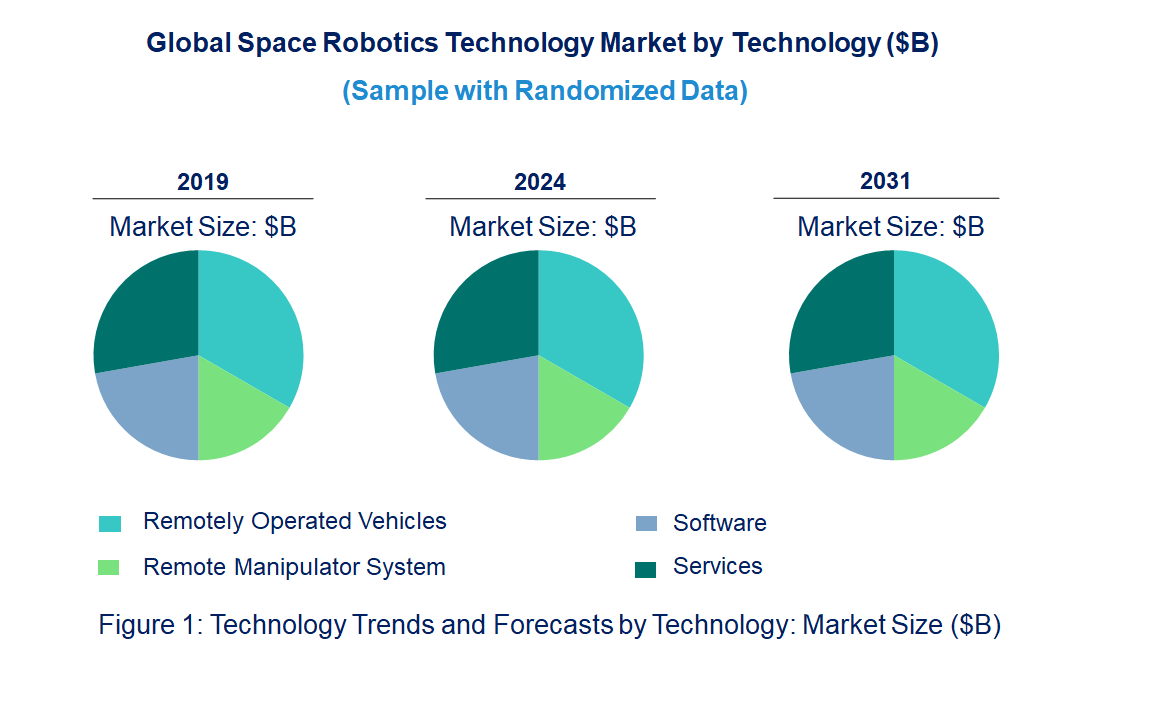
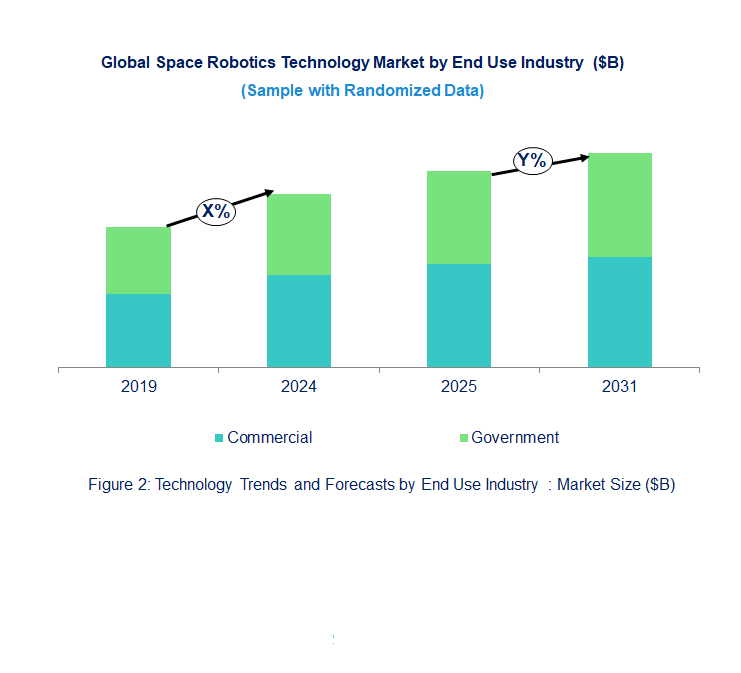
• Toward Autonomous Robotic Systems: Space robotics is evolving from remotely operated vehicles to totally autonomous robots, able to carry out space repair, station maintenance, and asteroid exploration with little or no human involvement. This trend improves operational efficiency and reduces the risk factor in space missions.
• AI and Machine Learning: With the inclusion of artificial intelligence (AI) and machine learning, space robots are now making decisions in real-time, learning from their environment. The trend helps the robots improve their capabilities, adapt to unexpected situations, and optimize performance on complex space missions.
• Increased Demand for Satellite Servicing: With the increasing number of satellites placed in orbit, the need for satellite servicing and maintenance is rising using space robotics. Robots with high-end manipulator systems are used for refueling, repairing, and upgrading satellites in space, increasing the life of critical space infrastructure.
• Space Mining and Exploration: Robotic technologies are increasingly being used in space exploration and resource extraction from celestial bodies, including asteroids and the Moon. This trend is expanding the scope of space robotics to include autonomous systems for mining valuable resources and supporting long-term human missions on the Moon or Mars.
• Commercialization of Space Robotics: The field of space robotics is gaining much commercial attention. With several private companies now heavily investing in robotic systems, there’s an increased demand for exploration and satellite services in space. This drives innovation, reduces the cost of launching into space, and increases commercial enterprise involvement with the creation of space-based infrastructure. These trends represent how the market for Space Robotics is shifting to more autonomous, intelligent, and commercially viable technologies, making possible more ambitious missions in space exploration, satellite servicing, and resource extraction that have profound implications for the industry and future space activities.
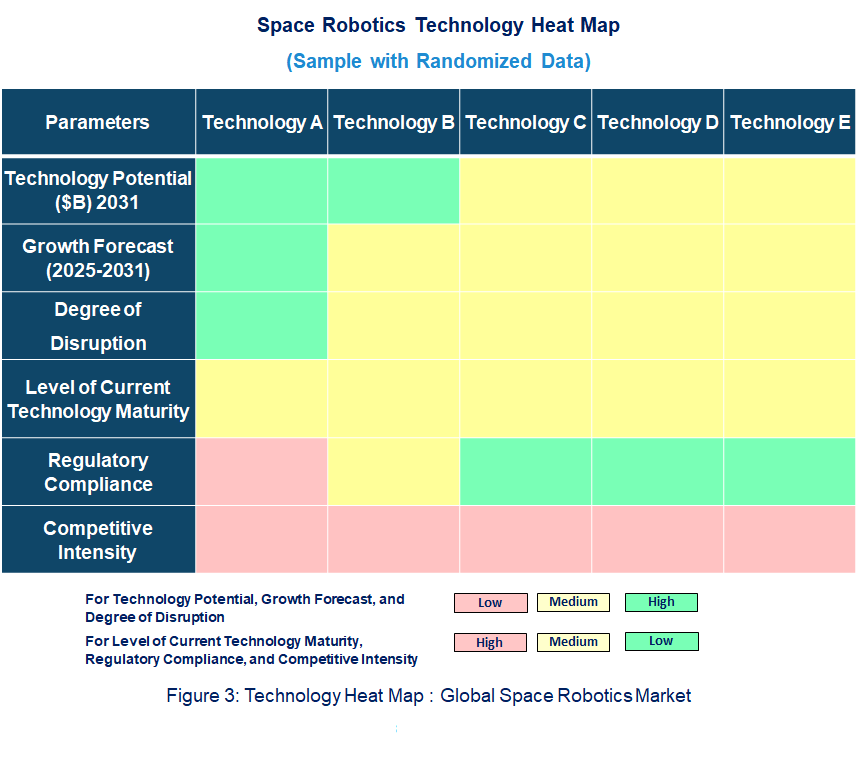
• Technology Potential: Space robotics holds the key to revolutionizing space exploration and commercial space activities. The robots can be used to repair satellites, assemble spacecraft in orbit, and autonomously explore distant planets and asteroids. The technology will reduce the cost and risk of human space travel by automating hazardous or repetitive tasks. With advancements in artificial intelligence, machine learning, and autonomous decision-making, space robotics can now allow for more complex and adaptive missions in deep space.
• Degree of Disruption: The technology is significantly disruptive in transforming traditional space operations. Robots are gradually becoming vital for performing missions that earlier were impossible or too dangerous for human astronauts. With the integration of robotics into space missions, a new era of space exploration and infrastructure development may be observed.
• Technology Maturity: Space robotics is still developing. Though the robotic arms used on the ISS are already in operation, there are more advanced, autonomous robotic systems that are under development and testing.
• Compliance with Regulations: This technology needs to adhere to space-related laws and regulations, such as the Outer Space Treaty governing peaceful use of space, while the robotics systems in use have to be built to meet safety standards according to NASA, ESA, or other private industry players’ expectations.
• Maxar Technologies has been leading the development of robotic systems for satellite servicing. Its robotic arm systems can repair and upgrade satellites, thereby reducing costs and enhancing the life of satellites. Maxar’s technologies are important for future space infrastructure development.
• Motiv Space Systems is engineering advanced robotic arms and manipulator systems for satellite servicing. Its robotic systems, such as the CubeRover and its deployment mechanisms, are for lunar exploration, with high flexibility and efficiency for space missions.
• Altius Space Machines is developing space robotics that can perform critical in-orbit operations, including robotic satellite servicing and assembly. Their innovations in modular robotic systems are set to play a major role in future space operations, enabling autonomous satellite servicing.
• Northrop Grumman has developed robotic systems such as the "Mission Extension Vehicle" (MEV), which is intended to service and extend the life of existing satellites. Northrop Grumman’s work in this area demonstrates the commercial potential for robotics in space infrastructure maintenance.
• Honeybee Robotics specializes in space exploration robotic technology with autonomous systems operating on their ability to make geological surveys as well as data collection on other planets or moons. Their work on lunar and Martian robotic exploration systems has been crucial for the upcoming NASA missions.
• Astrobotic Technology is developing advanced robotics to be used for lunar missions such as the Lunar Cargo Service. Their robotics are crucial in aiding cargo delivery and lunar exploration by providing automation and precision in tasks that humans used to do.
• Made In Space is innovating new developments in the areas of 3D printing and robotics for applications in space. Their technologies make complex tools and structures in space without requiring expensive transport from Earth.
• Effective Space Solutions is developing autonomous satellite servicing vehicles that can be used to reposition and extend the life of satellites. Its solutions are contributing to the growing satellite servicing sector where space robotics is playing a crucial role in enhancing space infrastructure. Space robotics stands increasingly at the forefront of growing demand across developing environments for space exploration, space satellite maintenance, and building new infrastructure. Companies are always seeking new ways to harness automation and autonomy in building efficient and sustainable space missions.
• Growing demand for servicing satellites: With the large number of satellites in orbit, servicing is being done through robotic means in terms of maintenance, upgrade, and refueling. Space robotics offers a cost-effective and efficient way of extending the lifecycles of satellites and reducing risks associated with their operations.
• Expansion of Space Exploration Programs: With increasing interest in deep space exploration and lunar missions, advanced robotic systems are needed. Robots are crucial in missions to planets, moons, and asteroids where human presence is not feasible or limited.
• Autonomous Technologies Advances: Artificial intelligence, machine learning, and autonomous systems in robotics are driving development toward smarter and more efficient robots that may operate for extended periods in space without constant human oversight.
• Commercialization of Space: The commercialization of space, including private companies offering satellite servicing and space exploration services, is increasing demand for reliable and affordable space robotics. This trend is accelerating innovation and providing new business opportunities in space operations. Challenges in the space robotics market include:
• High Development and Operational Costs: Developing advanced robotic systems capable of operating in space’s harsh conditions is expensive. The high costs associated with research, development, and manufacturing can be quite a barrier for many firms to enter the market.
• Complexity of Space Environments: The unpredictable and challenging nature of space environments, including microgravity and radiation, poses significant challenges for robotics. Creating systems that can reliably perform complex tasks in such conditions requires advanced engineering and design solutions.
• Technological and Operational Limitations: Many space robotics systems, even with advancements, are still not fully functional or autonomous. Completely autonomous robots capable of executing complex tasks independently, without human intervention, are still in the developmental stages and therefore cannot be used in all missions. It should be noted that satellite servicing, space exploration, and commercialization of space through the Space Robotics Market hold the driving forces. These, however, are surrounded by challenges such as the high cost of development, technological capabilities, and the complexity involved within a space environment.
• Maxar Technologies
• Motiv Space Systems
• Altius Space Machines
• Northrop Grumman
• Honeybee Robotics
• Astrobotic Technology
• Technology Readiness and Competitive Level for Space Robotics Market: ROVs and RMS are highly developed and used in satellite servicing, space station maintenance, and planetary exploration. RMS systems, like Canadarm, continue to improve in precision. AI and machine learning software are evolving to enhance mission adaptability. Services such as teleoperation and mission planning are essential for deep space exploration. Competitive intensity is driven by companies like SpaceX and Blue Origin, while regulatory compliance remains key to meeting space safety standards and international treaties. Key applications include satellite servicing, asteroid mining, and planetary exploration.
• Competitive Intensity and Regulatory Compliance in Space Robotics Market: Competition is intense in the space robotics market, with private companies (SpaceX, Blue Origin) and government agencies (NASA) investing in ROVs, RMS, and software. As the market grows, there’s a race to develop more efficient and cost-effective robotic solutions. Regulatory compliance is a major challenge, as these technologies must adhere to international safety and operational guidelines to prevent risks. Space robotics software must also meet cybersecurity standards, monitored by regulatory bodies such as the FAA and international space agencies.
• Disruption Potential by Various Technologies for Space Robotics Market: The space robotics market is being transformed by technologies like Remotely Operated Vehicles (ROVs), Remote Manipulator Systems (RMS), and advanced software. ROVs are improving autonomy, enabling complex space missions. Remote Manipulator Systems are enhancing satellite servicing, space station maintenance, and planetary exploration. Advancements in AI and machine learning are boosting the decision-making abilities of space robots. Space robotics services, such as maintenance and mission planning, are reducing exploration costs and opening new commercial opportunities in satellite servicing and space construction.
• Remotely Operated Vehicles
• Remote Manipulator System
• Software
• Services
• Commercial
• Government
• North America
• Europe
• Asia Pacific
• The Rest of the World
• Latest Developments and Innovations in the Space Robotics Technologies
• Companies / Ecosystems
• Strategic Opportunities by Technology Type


Choose a license that fits your team. Instant PDF delivery.
Prices exclude taxes. Instant delivery. Custom licensing available on request.
Market Report · May 18, 2026
Market Report · May 18, 2026
Market Report · May 18, 2026
Trusted partner for strategic intelligence and business growth


Receive a complimentary market analysis tailored to your industry. Our analysts will identify key growth opportunities and competitive dynamics specific to your business.

Market size, growth rate, and key trend analysis for your specific sector.

Top competitor positioning and market share analysis.

Strategic recommendations backed by data-driven insights.
Get curated market intelligence and competitive moves straight to your inbox.
By subscribing, you agree to receive our monthly insights. Unsubscribe anytime.
Receive a complimentary market analysis tailored to your industry. Our analysts will identify key growth opportunities and competitive dynamics specific to your business.
Market size, growth rate, and key trend analysis for your specific sector.
Top competitor positioning and market share analysis.
Strategic recommendations backed by data-driven insights.
Get curated market intelligence, emerging trends, and competitive moves straight to your inbox each month.
By subscribing, you agree to receive our monthly insights. Unsubscribe anytime.
We'll send your sample report shortly.