Space Battery Market Report: Trends, Forecast and Competitive Analysis to 2035

Key data points: The market size in 2035 = $503 million, growth forecast = 4.8% annually for the next 8 years. Scroll below to get more insights. This market report covers trends, opportunities and forecasts in space battery market to 2035 by type (rechargeable and non-rechargeable), platform (aviation, land, marine, space, and munitions), application (propulsion systems, communication & navigation systems, fire control systems, electro optics & thermal imaging systems, and others), and region (North America, Europe, Asia Pacific, and the Rest of the World)

Publisher: Lucintel Last Updated: July 2026
See Pricing

Download Sample Report

| ✨ New Download Sample report — Get instant insights! | ✨ New Download Sample report — Get instant insights!

Space Battery Market Report: Trends, Forecast and Competitive Analysis to 2035

Space Battery Market

The future of the global space battery market looks promising with opportunities in the propulsion system, communication & navigation system, fire control system, and electro optic & thermal imaging system markets. The global space battery market is expected to reach an estimated $503 million by 2035 with a CAGR of 4.8% from 2026 to 2035. The major drivers for this market are the increasing demand for high-energy-density batteries, the rising focus on long-lasting power solutions, and the growing adoption of advanced space battery technologies.

  • Lucintel forecasts that, within the type category, rechargeable is expected to witness higher growth over the forecast period due to reusability and longer mission life requirements in modern satellites.
  • Within the application category, the propulsion system is expected to witness the highest growth due to high energy demand for electric propulsion and spacecraft maneuvering.
  • In terms of regions, APAC is expected to witness the highest growth over the forecast period due to growing space programs and increasing satellite launch activities.

Gain valuable insights for your business decisions with our comprehensive 150+ page report. Sample figures with some insights are shown below.
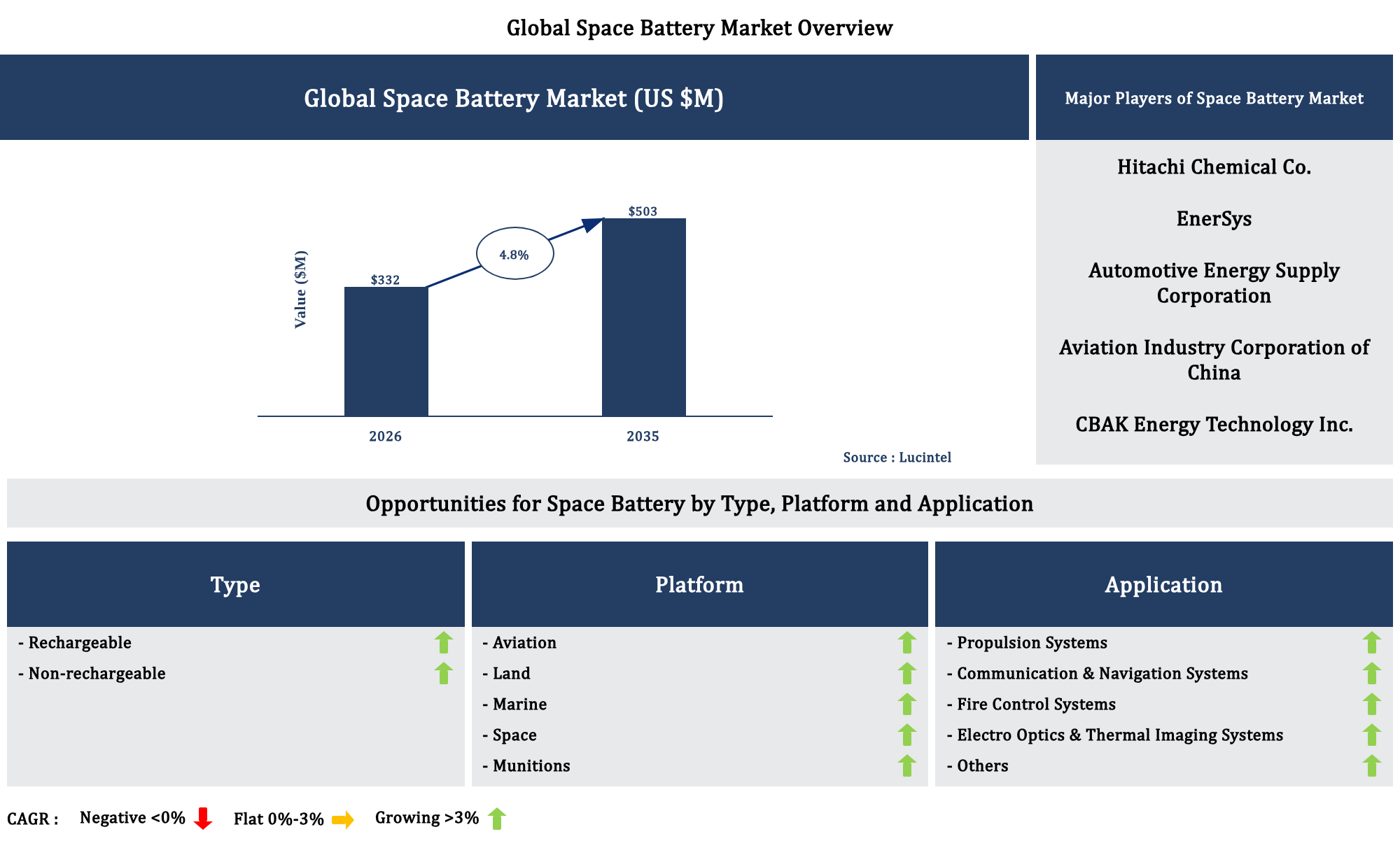
Space Battery Market

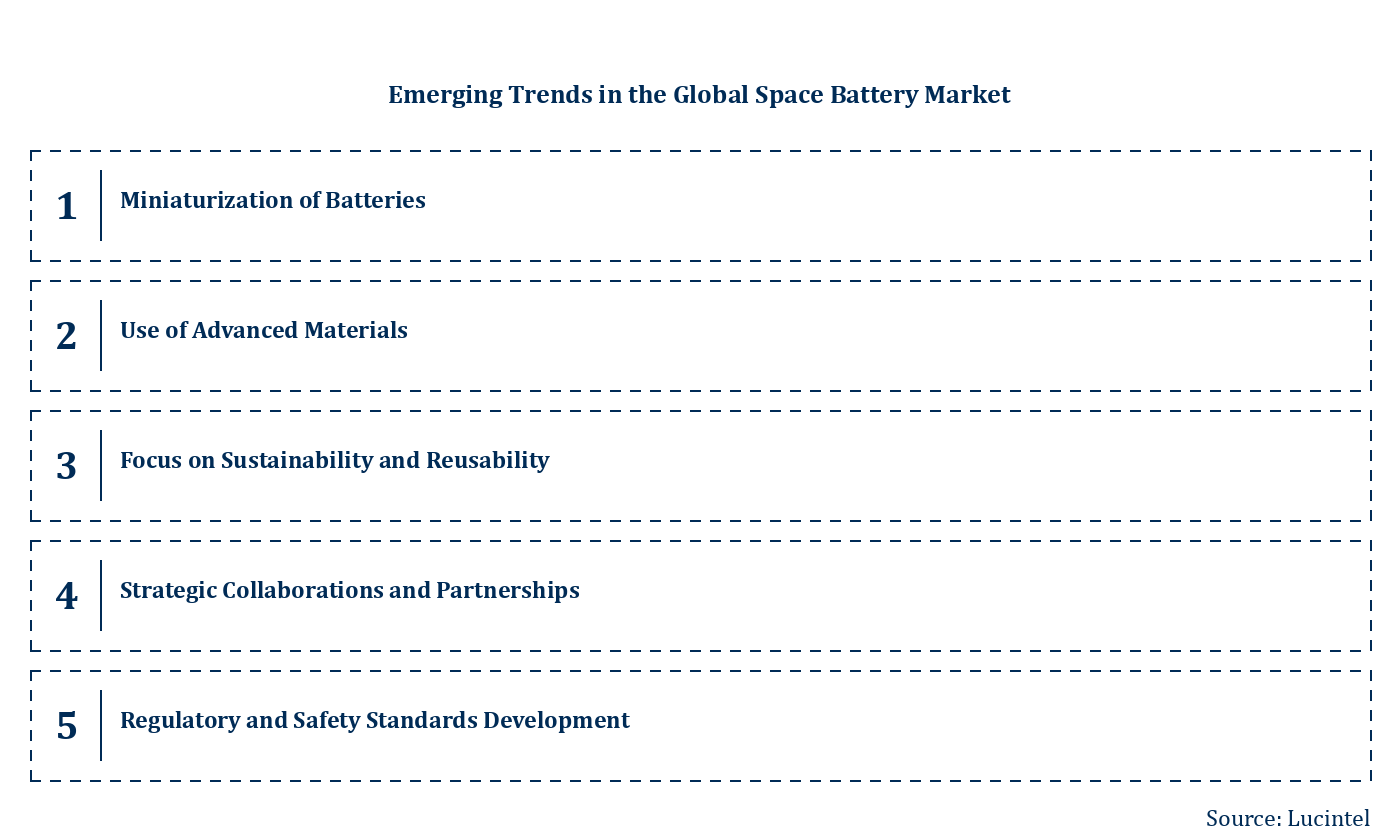
Emerging Trends in the Space Battery Market

The space battery market is experiencing rapid evolution driven by increasing demand for reliable energy storage solutions in space exploration, satellite technology, and emerging commercial space activities. As space missions become more complex and ambitious, the need for high-capacity, lightweight, and durable batteries is more critical than ever. Market players are investing heavily in research and development to meet these demands, leading to innovative products and strategic collaborations. These developments are not only enhancing the performance and lifespan of space batteries but also expanding their applications across various space missions. The following trends highlight the key shifts shaping this dynamic market landscape.

  • Miniaturization of Batteries: The trend towards smaller, more compact batteries is driven by the need to reduce payload weight and size. Advances in materials and design enable batteries to deliver high energy density in a smaller form factor, which is crucial for satellite miniaturization and small spacecraft. This miniaturization improves mission flexibility, reduces launch costs, and allows for more sophisticated onboard systems, ultimately expanding the scope of space missions and enabling new applications in space exploration and commercial ventures.
  • Use of Advanced Materials: The adoption of cutting-edge materials such as solid-state electrolytes and lightweight composites enhances battery performance. These materials offer higher energy density, improved safety, and greater resistance to extreme space conditions like radiation and temperature fluctuations. The integration of advanced materials is pivotal in extending battery lifespan and reliability, which are critical for long-duration missions. This trend is fostering innovation in battery design, making space batteries more resilient and efficient, thereby supporting more ambitious space exploration objectives.
  • Focus on Sustainability and Reusability: Sustainability is becoming a key consideration, with efforts to develop rechargeable and reusable batteries that can withstand multiple cycles. This reduces waste and lowers costs associated with battery replacement. Reusable batteries are particularly advantageous for reusable launch systems and long-term space stations, where maintenance opportunities are limited. The push towards sustainability aligns with broader environmental goals and enhances the economic viability of space missions, encouraging more sustainable practices within the industry.
  • Strategic Collaborations and Partnerships: Companies are increasingly forming alliances with research institutions, government agencies, and technology providers to accelerate innovation. These collaborations facilitate access to cutting-edge research, shared resources, and risk mitigation. Partnerships also enable the development of standardized battery solutions for various space applications, fostering interoperability and scalability. Such strategic alliances are vital for overcoming technical challenges and expediting the commercialization of advanced space battery technologies, ultimately driving market growth and technological progress.
  • Regulatory and Safety Standards Development: As space activities expand, establishing comprehensive safety and regulatory standards for space batteries is gaining importance. These standards ensure safe handling, transportation, and disposal of batteries, minimizing risks of accidents and environmental hazards. Regulatory frameworks also promote industry best practices and facilitate international cooperation. The development of these standards is crucial for building trust among stakeholders, ensuring compliance, and supporting the sustainable growth of the space battery market amid increasing commercial and governmental space missions.

These emerging trends are collectively transforming the space battery market by enhancing performance, safety, and sustainability. They are enabling more ambitious space missions, reducing costs, and fostering innovation. As these trends continue to evolve, they will significantly influence the future landscape of space exploration and satellite technology, making space batteries more efficient, reliable, and environmentally friendly.
Space Battery Market by country

Recent Developments in the Space Battery Market

The space battery market is experiencing rapid growth driven by advancements in satellite technology, space exploration missions, and the increasing demand for reliable energy storage solutions in space. Innovations in battery materials and design are enhancing performance, safety, and longevity. As space activities expand, the need for efficient, lightweight, and durable batteries becomes critical. This evolving landscape presents significant opportunities for manufacturers and stakeholders to capitalize on emerging applications and technological breakthroughs, shaping the future of space energy storage.

  • Growing Demand for Satellite Power Systems: The increasing deployment of satellites for communication, navigation, and Earth observation drives the need for advanced space batteries. These batteries must withstand harsh conditions, provide reliable power, and have long operational lifespans. Innovations in lithium-ion and solid-state batteries are meeting these demands, enabling satellites to operate efficiently over extended periods. This growth enhances global connectivity and data collection, making space batteries a vital component of modern infrastructure.
  • Expansion of Space Exploration Missions: Government and private sector investments in lunar, Martian, and deep-space missions are fueling demand for high-capacity, durable batteries. These batteries must endure extreme temperatures, radiation, and mechanical stresses. Developments in high-energy-density batteries are crucial for powering rovers, landers, and habitats. This trend accelerates technological innovation, supporting sustainable human and robotic exploration, and opens new markets for space battery manufacturers.
  • Advancements in Battery Materials and Technologies: Research into new materials like solid-state electrolytes and lithium-silicon anodes is leading to safer, more efficient space batteries. These innovations improve energy density, charge/discharge cycles, and thermal stability. Enhanced safety features reduce risks associated with space missions. Such technological progress is vital for meeting the rigorous demands of space environments, fostering confidence among stakeholders, and expanding application possibilities.
  • Focus on Lightweight and Compact Battery Designs: The push for miniaturization and weight reduction in space systems necessitates innovative battery designs. Lightweight, compact batteries enable more payload capacity and longer mission durations. Developments include flexible, thin-film batteries and integrated power systems. These advancements improve overall mission efficiency, reduce launch costs, and support the deployment of smaller, more versatile satellites and spacecraft.
  • Increasing Adoption of Renewable Energy Storage in Space: The integration of renewable energy sources like solar power with advanced batteries is transforming space energy management. High-capacity, efficient batteries facilitate energy storage for long-term missions and off-grid applications. This trend supports sustainable space operations, reduces reliance on traditional fuel sources, and enhances mission resilience. It also opens avenues for commercial ventures focused on space-based renewable energy solutions.

These developments are significantly transforming the space battery market by enhancing performance, safety, and efficiency. The integration of innovative materials, lightweight designs, and renewable energy solutions is expanding application scopes across satellites, exploration missions, and commercial ventures. As technological advancements continue, the market is poised for substantial growth, attracting investments and fostering new opportunities. Overall, these trends are shaping a more sustainable, reliable, and versatile space energy storage landscape.

Strategic Growth Opportunities in the Space Battery Market

The space battery market is poised for significant expansion driven by increasing demand for reliable energy storage solutions in space missions, satellite operations, and emerging space exploration initiatives. Advancements in battery technology, miniaturization, and the growing number of space launches are creating new opportunities for manufacturers and service providers. Strategic investments and innovations are essential to meet the unique challenges of space environments, ensuring sustained growth and technological leadership in this evolving sector.

  • Growing Demand for High-Energy Density Batteries for Satellites and Spacecraft: As satellite and spacecraft functionalities expand, the need for high-energy density batteries becomes critical. These batteries provide longer operational life, improved performance, and reduced weight, which are essential for space missions. Innovations in lithium-ion and solid-state batteries are enabling higher capacity and safety, making them ideal for demanding space applications. The increasing deployment of advanced satellites and deep-space probes is expected to drive this growth.
  • Development of Rechargeable Batteries for Long-Duration Space Missions: Long-duration space missions require durable, rechargeable batteries capable of withstanding extreme conditions. Advances in battery chemistry and design are enabling longer cycle life, better thermal stability, and enhanced safety. These batteries support crewed missions, lunar bases, and Mars exploration, where reliable energy storage is vital. The focus on developing lightweight, high-capacity rechargeable batteries is a key growth driver in supporting extended space operations.
  • Integration of Space-Grade Batteries in Satellite Constellations and IoT Applications: The rise of satellite constellations and space-based IoT networks demands scalable, efficient energy storage solutions. Space-grade batteries are increasingly integrated into these systems to ensure continuous operation and resilience against harsh environments. Their ability to operate reliably over extended periods enhances the performance of communication, navigation, and Earth observation services, fueling market growth driven by the proliferation of satellite networks and IoT applications.
  • Innovations in Solid-State Battery Technology for Space Applications: Solid-state batteries offer improved safety, higher energy density, and better thermal stability compared to traditional batteries. Their adoption in space applications is gaining momentum due to their ability to operate reliably in extreme conditions. Ongoing research aims to optimize materials and manufacturing processes, making solid-state batteries a promising solution for future space missions, including crewed missions and deep-space exploration, thereby opening new avenues for market expansion.
  • Strategic Collaborations and Investments To Accelerate Space Battery Development: Partnerships between government agencies, private companies, and research institutions are crucial for advancing space battery technology. Investments in R&D, pilot projects, and manufacturing facilities are accelerating innovation and commercialization. These collaborations facilitate knowledge sharing, reduce costs, and enable the development of customized solutions for specific space applications, ultimately strengthening the market position of key players and fostering sustainable growth in the space battery industry.

The overall impact of these opportunities is set to transform the space battery market, enabling more ambitious missions and expanding the capabilities of space systems. Continuous innovation and strategic collaborations will be vital in overcoming technical challenges and meeting the increasing energy demands of space exploration and satellite networks. This growth will solidify the market’s role in supporting the future of space technology and exploration.

Space Battery Market Drivers and Challenges

The space battery market is influenced by a complex interplay of technological advancements, economic factors, and regulatory frameworks. As space exploration and satellite deployment expand, the demand for reliable, high-capacity batteries increases. Innovations in battery technology aim to improve energy density, lifespan, and safety, while economic considerations such as cost reduction and supply chain stability drive market growth. Regulatory policies concerning space debris, environmental impact, and international cooperation also shape the market landscape. Navigating these drivers and challenges is crucial for stakeholders to capitalize on emerging opportunities and address potential risks in this rapidly evolving sector.

The factors responsible for driving the space battery market include:

  • Technological Innovation: The continuous development of advanced battery chemistries, such as lithium-ion and solid-state batteries, enhances energy density, safety, and longevity. These innovations enable space missions to operate more efficiently, supporting longer durations and increased payload capacities. As technology progresses, batteries become more adaptable to the harsh conditions of space, reducing mission risks and costs. This drives market growth by meeting the increasing demand for high-performance energy storage solutions in satellites, spacecraft, and lunar or Martian bases.
  • Growing Space Exploration Activities: The surge in government and private sector space missions fuels demand for reliable power sources. Initiatives like lunar exploration, Mars rovers, and satellite constellations require durable batteries capable of withstanding extreme temperatures and radiation. The expansion of commercial space travel and satellite deployment for telecommunications, Earth observation, and navigation further amplifies the need for efficient energy storage. This trend creates a robust market for space batteries, encouraging innovation and investment.
  • Cost Reduction and Supply Chain Optimization: Advances in manufacturing processes and economies of scale are lowering production costs of space batteries. Improved supply chain management ensures the availability of raw materials and components, reducing delays and expenses. Cost-effective batteries make space missions more economically viable, attracting more players into the market. This economic efficiency supports the proliferation of small satellites and commercial ventures, broadening market opportunities and fostering competitive pricing.
  • Regulatory and Policy Support: Governments and international agencies are establishing policies to promote sustainable space activities and responsible resource management. Regulations concerning space debris mitigation, environmental impact, and international cooperation influence market practices. Supportive policies and funding initiatives encourage research and development in space battery technology, fostering innovation. Compliance with these regulations ensures market participants can operate legally and sustainably, boosting confidence and investment in the sector.
  • Increasing Demand for Satellite and Spacecraft Power Systems: The proliferation of satellite networks for communication, navigation, and Earth monitoring necessitates high-capacity, reliable batteries. As satellite technology advances, the need for longer-lasting and more efficient power sources grows. Spacecraft designed for deep space exploration or long-term missions require batteries with enhanced energy density and durability. This rising demand drives technological improvements and market expansion, positioning space batteries as critical components in future space infrastructure.

The challenges facing the space battery market include:

  • Harsh Space Environment: Space batteries must operate reliably under extreme conditions such as vacuum, radiation, temperature fluctuations, and microgravity. Designing batteries that can withstand these factors without degradation is complex and costly. Material selection and engineering solutions are critical to ensure safety and performance, but these add to development time and expenses. Failure to address environmental challenges can lead to mission failures, impacting market confidence and investment.
  • High Development and Manufacturing Costs: Developing advanced space batteries involves significant R&D investment, specialized manufacturing, and rigorous testing. These costs can be prohibitive, especially for smaller companies or startups. Limited budgets may restrict innovation and slow market growth. Additionally, the high costs of launching and deploying space batteries further impact profitability, making it essential for market players to optimize processes and secure funding.
  • Regulatory and International Challenges: Navigating the complex web of international regulations, export controls, and space treaties can hinder market entry and collaboration. Compliance requirements may delay product development and deployment, increasing costs. Moreover, geopolitical tensions and differing national policies can restrict access to certain markets or technologies. These regulatory hurdles pose risks to market expansion and necessitate strategic planning to ensure compliance and foster international cooperation.

The space battery market is driven by technological innovation, expanding space activities, cost efficiencies, supportive policies, and rising satellite demands. However, it faces challenges such as environmental harshness, high costs, and regulatory complexities. These factors collectively shape the markets trajectory, requiring stakeholders to innovate, collaborate, and adapt to sustain growth and capitalize on emerging opportunities in space energy storage solutions.

List of Space Battery Market Companies

Companies in the market compete on the basis of product quality offered. Major players in this market focus on expanding their manufacturing facilities, R&D investments, infrastructural development, and leverage integration opportunities across the value chain. Through these strategies space battery market companies cater increasing demand, ensure competitive effectiveness, develop innovative products & technologies, reduce production costs, and expand their customer base. Some of the space battery market companies profiled in this report include-

  • Hitachi Chemical Co.
  • EnerSys
  • Automotive Energy Supply Corporation
  • Aviation Industry Corporation of China
  • CBAK Energy Technology Inc.
  • Saft Groupe
  • A123 Systems Inc.
  • BYD Company Ltd.
  • Bren-Tronics Inc.
  • Arotech Corporation

Space Battery Market by Segment

The study includes a forecast for the global space battery market by type, platform, application, and region.

  • Space Battery Market by Type [Value from 2019 to 2035]:
    • Rechargeable
    • Non-rechargeable
  • Space Battery Market by Platform [Value from 2019 to 2035]:
    • Aviation
    • Land
    • Marine
    • Space
    • Munitions
  • Space Battery Market by Application [Value from 2019 to 2035]:
    • Propulsion Systems
    • Communication & Navigation Systems
    • Fire Control Systems
    • Electro Optics & Thermal Imaging Systems
    • Others
  • Space Battery Market by Region [Value ($M) from 2019 to 2035]:
    • North America
    • Europe
    • Asia Pacific
    • The Rest of the World

Country Wise Outlook for the Space Battery Market

The space battery market is experiencing rapid growth driven by advancements in satellite technology, space exploration missions, and the increasing demand for reliable energy storage solutions in orbit. As countries and private companies invest heavily in space infrastructure, innovations in battery technology are crucial for supporting long-term missions and sustainable space operations. The United States, China, Germany, India, and Japan are at the forefront of this development, each contributing unique technological advancements and strategic initiatives to enhance their space capabilities and energy storage solutions.

  • United States: The US leads in space battery innovation with NASA's development of high-capacity, lightweight batteries for deep space missions. Private companies like SpaceX and Blue Origin are also investing in advanced battery systems to power their spacecraft and lunar missions, emphasizing durability and energy density. Recent collaborations aim to improve battery longevity and safety for long-term space habitation.
  • China: China has made significant progress with its space program, developing new lithium-ion batteries tailored for satellite applications and lunar exploration. The Chinese space agency is focusing on integrating energy storage solutions into their lunar rovers and space stations, aiming for increased efficiency and resilience in harsh environments. They are also exploring solid-state batteries for future missions.
  • Germany: Germany's contributions include advancements in battery materials and manufacturing processes, supporting European space initiatives. The European Space Agency collaborates with German firms to develop batteries that can withstand extreme temperatures and radiation, essential for interplanetary missions. Germany is also investing in research to improve battery recycling and sustainability.
  • India: India has enhanced its space battery technology through ISRO's recent missions, deploying batteries designed for satellite stability and power management. The focus is on developing cost-effective, reliable energy storage solutions for small satellites and upcoming lunar and Mars missions. India is also exploring innovations in battery charging and thermal management systems.
  • Japan: Japan is advancing in solid-state battery technology, aiming to improve safety and energy density for space applications. JAXA is working on integrating these batteries into their satellite systems and space probes. The country is also researching new materials to enhance battery performance in extreme space conditions, supporting their long-term exploration goals.

Features of the Space Battery Market

  • Market Size Estimates: Space battery market size estimation in terms of value ($M).
  • Trend and Forecast Analysis: Market trends (2019 to 2025) and forecast (2026 to 2035) by various segments and regions.
  • Segmentation Analysis: Space battery market size by type, platform, application, and region in terms of value ($M).
  • Regional Analysis: Space battery market breakdown by North America, Europe, Asia Pacific, and Rest of the World.
  • Growth Opportunities: Analysis of growth opportunities in different types, platforms, applications, and regions for the space battery market.
  • Strategic Analysis: This includes M&A, new product development, and competitive landscape of the space battery market.
  • Analysis of competitive intensity of the industry based on Porter’s Five Forces model.

Top 5 Companies

  • Hitachi Chemical Co.
  • EnerSys
  • Automotive Energy Supply Corporation
  • Aviation Industry Corporation of China
  • CBAK Energy Technology Inc.

Table of Contents

1. Executive Summary
14.1 Competitive Analysis Overview

List of Figures

List of Tables

Methodology

Lucintel has been in the business of market research and management consulting since 2000 and has published over 1000 market intelligence reports in various markets / applications and served over 1,000 clients worldwide. This study is a culmination of four months of full-time effort performed by Lucintel's analyst team. The analysts used the following sources for the creation and completion of this valuable report:

  • In-depth interviews of the major players in this market
  • Detailed secondary research from competitors' financial statements and published data
  • Extensive searches of published works, market, and database information pertaining to industry news, company press releases, and customer intentions
  • A compilation of the experiences, judgments, and insights of Lucintel's professionals, who have analyzed and tracked this market over the years.

Extensive research and interviews are conducted across the supply chain of this market to estimate market share, market size, trends, drivers, challenges, and forecasts. Below is a brief summary of the primary interviews that were conducted by job function for this report.

Lucintel's methodology for market research

Thus, Lucintel compiles vast amounts of data from numerous sources, validates the integrity of that data, and performs a comprehensive analysis. Lucintel then organizes the data, its findings, and insights into a concise report designed to support the strategic decision-making process. The figure below is a graphical representation of Lucintel's research process.

Primary interviews by job function

Buy Now

Choose a license that fits your team. Instant PDF delivery.

Market Report

1 User PDF

$4,850
Buy Now

Market Report

2-5 Users PDF

$6,700
Buy Now

Market Report

Corporate PDF

$8,850
Buy Now

Market Report

Global PDF

$10,000
Buy Now

Prices exclude taxes. Instant delivery. Custom licensing available on request.

Frequently Asked Questions

What is the space battery market size?
The global space battery market is expected to reach an estimated $503 million by 2035.
What is the growth forecast for space battery market?
The global space battery market is expected to grow with a CAGR of 4.8% from 2026 to 2035.
What are the major drivers influencing the growth of the space battery market?
The major drivers for this market are the increasing demand for high energy density batteries, the rising focus on long lasting power solutions, and the growing adoption of advanced space battery technologies.
What are the major segments for space battery market?
The future of the space battery market looks promising with opportunities in the propulsion system, communication & navigation system, fire control system, and electro optic & thermal imaging system markets.
Who are the key space battery market companies?

Some of the key space battery companies are as follows:

  • Hitachi Chemical Co.
  • EnerSys
  • Automotive Energy Supply Corporation
  • Aviation Industry Corporation of China
  • CBAK Energy Technology Inc.
  • Saft Groupe
  • A123 Systems Inc.
  • BYD Company Ltd.
  • Bren-Tronics Inc.
  • Arotech Corporation
Which space battery market segment will be the largest in future?
Lucintel forecasts that, within the type category, rechargeable is expected to witness higher growth over the forecast period.
In space battery market, which region is expected to be the largest in next 8 years?
In terms of region, APAC is expected to witness the highest growth over the forecast period.
Do we receive customization in this report?
Yes, Lucintel provides 10% customization without any additional cost.

Key Questions

  • What are some of the most promising, high-growth opportunities for the space battery market by type (rechargeable and non-rechargeable), platform (aviation, land, marine, space, and munitions), application (propulsion systems, communication & navigation systems, fire control systems, electro optics & thermal imaging systems, and others), and region (North America, Europe, Asia Pacific, and the Rest of the World)?
  • Which segments will grow at a faster pace and why?
  • Which region will grow at a faster pace and why?
  • What are the key factors affecting market dynamics? What are the key challenges and business risks in this market?
  • What are the business risks and competitive threats in this market?
  • What are the emerging trends in this market and the reasons behind them?
  • What are some of the changing demands of customers in the market?
  • What are the new developments in the market? Which companies are leading these developments?
  • Who are the major players in this market? What strategic initiatives are key players pursuing for business growth?
  • What are some of the competing products in this market and how big of a threat do they pose for loss of market share by material or product substitution?
  • What M&A activity has occurred in the last 5 years and what has its impact been on the industry?
Why Choose Us

The Lucintel Advantage

Trusted partner for strategic intelligence and business growth

25+ Years Excellence

25+ Years Excellence

Quarter century of proven expertise in management consulting and market research across global markets.
Game-Changer Ideas

Game-Changer Ideas

Innovative strategies and actionable insights that help clients become the smartest in their industry.
Global Reach

Global Reach

Extensive coverage across 50+ industries and markets worldwide with localized expertise.
Start Your Growth Journey

Get Your Free
Market Intelligence
Briefing

Receive a complimentary market analysis tailored to your industry. Our analysts will identify key growth opportunities and competitive dynamics specific to your business.

Custom Market Snapshot

Market size, growth rate, and key trend analysis for your specific sector.

Competitive Landscape Overview

Top competitor positioning and market share analysis.

Growth Opportunity Identification

Strategic recommendations backed by data-driven insights.

Subscribe

Subscribe to our Newsletter

Get curated market intelligence and competitive moves straight to your inbox.

By subscribing, you agree to receive our monthly insights. Unsubscribe anytime.

Industry Trends Market Signals Opportunities Competitor Moves