
Market Report · July 22, 2026

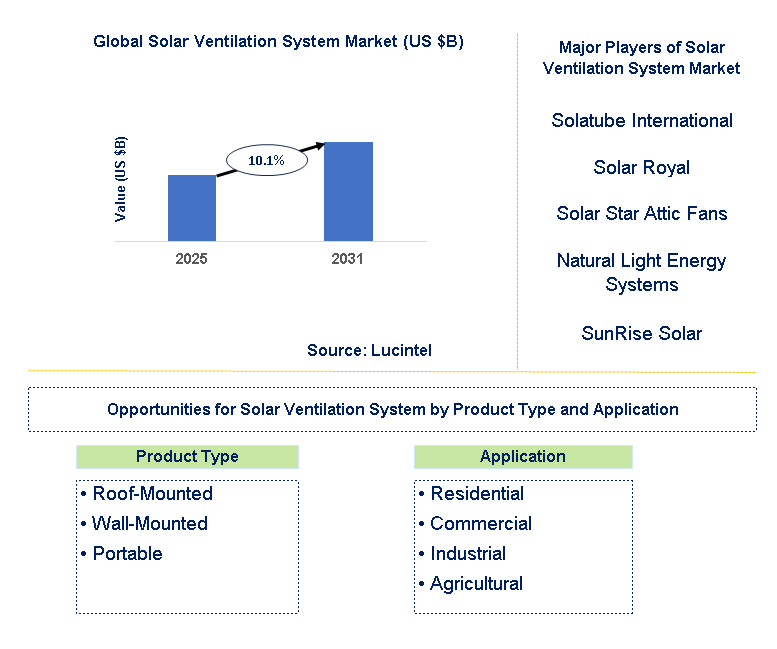
Key data points: The growth forecast = 10.1% annually for the next 7 years. Scroll below to get more insights. This market report covers trends, opportunities and forecasts in solar ventilation system market to 2031 by product type (roof-mounted, wall-mounted, and portable), application (residential, commercial, industrial, and agricultural), and region (North America, Europe, Asia Pacific, and the Rest of the World)
We'll send your sample report shortly.
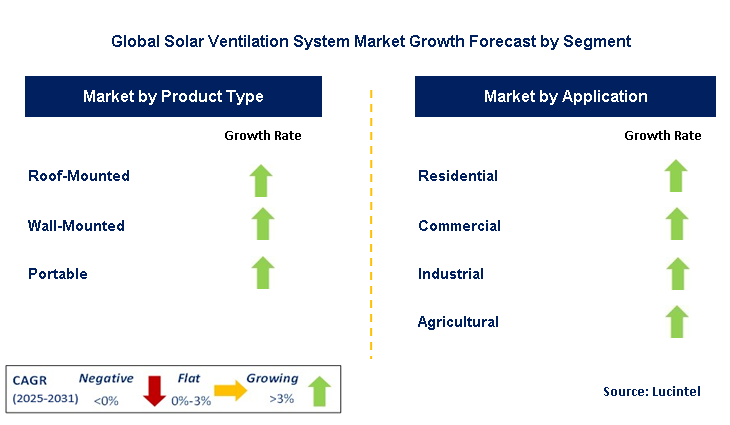
• Lucintel forecasts that, within the product type category, roof-mounted is expected to witness the highest growth over the forecast period.
• Within the application category, residential is expected to witness the highest growth.
• In terms of region, APAC is expected to witness the highest growth over the forecast period. Gain valuable insights for your business decisions with our comprehensive 150+ page report. Sample figures with some insights are shown below.
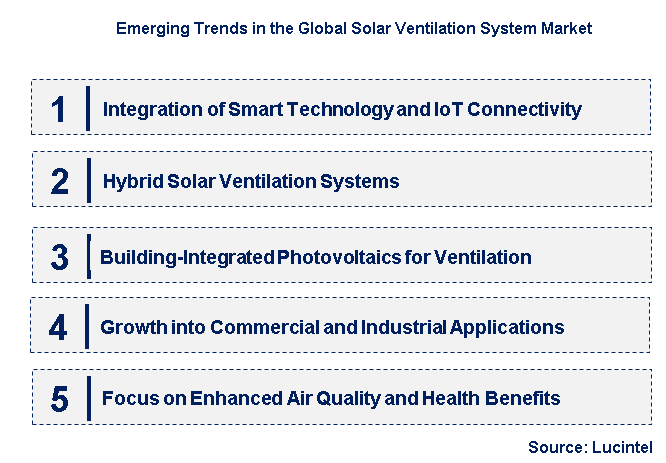
• Integration of Smart Technology and IoT Connectivity: A growing trend is the incorporation of smart technology and Internet of Things (IoT) connectivity into solar ventilation systems. This provides for remote monitoring, automated operation based on indoor air quality sensors or temperature, and energy consumption tracking through smartphone apps. The effect is increased convenience, energy optimization, and better indoor environmental quality. Users are able to control their ventilation systems more effectively, ensuring optimum performance and energy savings. This intelligent integration makes solar ventilation systems more attractive to tech-savvy consumers and smart building projects.
• Hybrid Solar Ventilation Systems: The other major trend is the development of hybrid solar ventilation systems combining solar power with a backup grid connection or battery storage. This assures uninterrupted operation even during low sunlight or at night. The effect is greater reliability and wider applicability. Hybrid systems address the intermittency issue of solely solar-powered units, with consistent ventilation that is not influenced by weather conditions or day and night. This makes them ideal for mission-critical applications wherein continuous airflow is a must, like commercial buildings or industrial plants.
• Building-Integrated Photovoltaics for Ventilation: There is a trend of integrating solar panels directly within building materials, i.e., Building-Integrated Photovoltaics (BIPV), that can later power integrated ventilation systems. It provides for smooth aesthetic integration and effective use of space. The result is an integrated and efficient building design. BIPV solutions do away with isolated solar panel installations, which adds to the architectural beauty and structural integrity. This trend is specific to new construction and green building applications with goals of high degrees of energy independence and sustainability.
• Growth into Commercial and Industrial Applications: Although historically more popular in residential attic applications, solar ventilation systems are becoming more commonly used in commercial and industrial applications, including warehouses, agricultural facilities, and small businesses. The growth is fueled by the necessity for affordable temperature control, humidity management, and enhanced air circulation in larger areas. The effect is an extensive expansion of the addressable segments and revenue channels of the market. Solar ventilation provides a renewable means of reducing energy costs related to traditional HVAC systems, which results in considerable operating cost savings.
• Focus on Enhanced Air Quality and Health Benefits: A major new trend is the greater focus on the potential of solar ventilation systems to enhance indoor air quality and maximize health advantages. This encompasses reducing problems such as mold development, lowering allergens, and releasing stale air. The effect is a higher level of consumer recognition and demand, especially in health-oriented markets. As individuals stay indoors more, air purity concerns have increased. Solar ventilation, by constantly circulating new air, becomes increasingly appealing as an option, sought after by homeowners and building administrators who value a healthier indoor climate. These new trends are essentially transforming the market for solar ventilation systems by making products more smart, dependable, adaptable, and responsive to health and environmental concerns. The convergence of hybrid systems and smart technology is improved user experience and operational reliability, whereas the emphasis on BIPV ensures aesthetic and functional efficiency. Additionally, the shift to commercial and industrial usage broadens the scope of the market considerably, and the focus on health benefits fuels greater consumer demand. Together, these trends are fueling innovation, broadening market penetration, and making solar ventilation systems an essential part of sustainable and healthy indoor spaces.
• Increased Solar Panel Efficiency and Longevity: A key recent advance is the ongoing enhancement of the efficiency and longevity of photovoltaic panels designed particularly for solar ventilation systems. This involves lighter and more powerful panels with enough capacity to produce energy even under reduced light levels, and highly durable designs that remain stable under unfavorable weather. The effect is better performance and reliability, enabling ventilation systems to function more efficiently and regularly through the day and over an extended period. This renders solar ventilation a more feasible and competitive option for various climatic conditions.
• Smart Controls and Sensor Integration: Yet another landmark feature is the universal integration of smart controls and environmental sensors (e.g., temperature, humidity, air quality) into solar ventilation systems. The smart systems can automatically vary fan speed and operation with indoor conditions in real time or with ambient weather conditions. The effect is maximum energy efficiency and better indoor air quality control. This automation increases user comfort, provides optimal ventilation without human input, and greatly enhances the overall performance of the system in providing a healthy and comfortable indoor environment.
• Extension of Hybrid Power Choices: Current developments are growing availability and use of hybrid solar ventilation systems with battery storage or interfacing with grid power. This enables the fan to function even if solar power is limited, like on overcast days or at night. The effect is continuous ventilation and increased reliability. Hybrid solutions bypass the weakness of intermittent solar power, and such systems are now applicable for uses demanding constant airflow, thereby broadening their uses beyond solely sun-based applications and driving more market demand.
• Diversification of Application Areas: Although originally in demand for residential attics, current trends indicate a strong diversification of end-use application areas for solar ventilation systems. They are increasingly being installed in commercial buildings, industrial warehouses, agricultural buildings (e.g., greenhouses, animal shelters), and even recreational vehicles. The outcome is expanded market coverage and new sources of revenue. This growth is fueled by the benefits of solar ventilation in cutting energy expenses, enhancing air circulation, and managing humidity within different big spaces or specialized settings.
• Government Incentives and Green Building Codes: One key development is increased government support through incentives, rebates, and the spread of green building codes and standards that support energy-efficient technology. These policies stimulate the installation of solar ventilation systems by making them more cost-effective and at times obligatory for new builds. The effect is spurred market expansion and higher consumer uptake. Such support and regulation reduces the upfront investment hurdle for consumers and developers, stimulating demand and creating a more environmentally friendly building sector. These critical advances are cumulatively influencing the solar ventilation system market by increasing the product’s functionality, widening its application, and making it more economically attractive. Enhanced efficiency of solar panels and intelligent controls result in superior performance and convenience, and hybrid alternatives provide reliability. Market opportunities are greatly increased through diversification into industrial and commercial segments, and government policies are providing a boost to uptake. All of these developments combined are pushing innovation, expanding market penetration, and cementing solar ventilation systems as an indispensable part of energy-efficient and healthy buildings worldwide.
• Residential Segment (Attic and Whole-House Ventilation): The residential segment offers the biggest strategic growth potential, specifically for attic and whole-house solar ventilation systems. Homeowners are increasingly looking for products and solutions aimed at lowering cooling bills, avoiding moisture accumulation, and enhancing overall indoor air quality. Strategic growth entails the promotion of the long-term energy savings, mold prevention advantage, and enhanced comfort. The effect is direct sales expansion through a huge consumer pool attuned to utility expenses and willing to adopt sustainable home upgrades. The segment enjoys easy installation and instant tangible benefits for the homeowner.
• Commercial Buildings (Offices, Retail, Warehouses): Commercial buildings provide plenty of strategic growth prospects. Large areas such as offices, retail facilities, and warehouses tend to have high cooling energy consumption and inadequate air movement. Solar ventilation systems can efficiently lower HVAC loads and enhance working conditions. Strategic growth involves proving measurable energy cost savings and enhanced worker comfort and productivity. The effect is volume installations of large projects, which attract companies with an interest in operational efficiency, green image, and building code compliance. This application typically involves specialized solutions to various building designs.
• Industrial Facilities (Factories, Workshops, Agricultural): Industrial facilities, such as factories, workshops, and agricultural buildings like greenhouses or animal barns, are a strategic growth area because they have huge ventilation requirements. These places usually suffer from heat gain, humidity, and airborne contaminants. Strategic growth entails creating heavy-duty, heavy-responsibility solar ventilation systems capable of withstanding harsh conditions. The application is a niche market segment aimed at enhancing worker safety, product quality (e.g., in storage), and operational energy cost savings within energy-intensive sectors. Tailored engineering and high-flow air movement applications are typically needed.
• New Construction and Green Building Initiatives: The increased adoption of new construction involving green building standards and certifications presents an excellent strategic growth opportunity. Architects and developers are increasingly seeking sustainable technologies that boost energy performance and support certifications such as LEED. Strategic expansion entails creating alliances with builders and architects to include solar ventilation systems in preliminary building plans. The effect is steady demand from large projects, making solar ventilation a key aspect of new green infrastructure from the foundation.
• Retrofit Market for Existing Buildings: The large market of existing buildings, especially older buildings with inadequate or non-existent ventilation systems, represents a significant strategic growth opportunity. Retrofitting solar ventilation systems can significantly enhance energy efficiency and indoor air quality with minimal structural modifications. Strategic growth entails focusing on property owners and managers with solutions that highlight ease of installation, rapid payback through energy savings, and enhanced tenant comfort. The effect is a wide market with high emphasis on cost savings and real returns for replacing aging infrastructure. All of these strategic growth opportunities are collectively influencing the solar ventilation system market by stimulating innovation and broadening its applications across various industries. The strong residential homeowner demand for energy conservation and enhanced indoor air quality, along with the high energy requirements of commercial and industrial buildings, make for a powerful market. In addition, the emerging green building trend and huge retrofit market for existing buildings guarantee ongoing opportunities. By strategically expanding into these uses, firms can optimize market penetration, meet diversified customer needs, and establish the solar ventilation system’s position as a vital solution for sustainable housing and working environments.
• Solatube International
• Solar Royal
• Solar Star Attic Fans
• Natural Light Energy Systems
• SunRise Solar
• Attic Breeze
• Air Vent
• Ventamatic
• Broan-NuTone
• Active Ventilation Products
• Roof-Mounted
• Wall-Mounted
• Portable
• Residential
• Commercial
• Industrial
• Agricultural
• North America
• Europe
• Asia Pacific
• The Rest of the World
• United States: The US solar ventilation system market is growing, fueled mainly by an increasing focus on energy efficiency and indoor air quality in the commercial and residential markets. More recently, demand for roof-mounted systems and improved thin-film technology and solar back sheet design have been additional drivers. Subsidies from the government and growing demand for green buildings are additional factors driving take-up. Producers are looking to create more efficient units (above 20 watts) and add smart capabilities to further improve performance and user convenience, especially in newbuild and retrofit applications.
• China: China, being the world’s leading manufacturer of solar technology, is experiencing strong development of its solar ventilation system market. While limited extensive specific data on ventilation systems themselves exists, the overall solar industry’s expansion to massive size suggests robust domestic supply chain and emphasis on low-cost solutions. Some developments are likely to include manufacturing highly efficient solar panels for ventilation systems with economies of scale. The focus is on mass adoption, driven by government initiatives in adopting renewable energy integration in industrial and urban planning, as well as improving air quality in residential space.
• Germany: Solar ventilation system demand in Germany is driven by strict energy efficiency standards and a high level of commitment to renewable energy. Whereas the solar thermal market for space heating is under strain, the market for solar-driven ventilation is going in the same direction as the nation’s overall interest in minimizing building energy consumption. The recent trends are sure to encompass improvements in integrated building packages, such that solar ventilation is perfectly integrated with highly efficient structures. Energy-efficient building retrofitting subsidies and higher public awareness of sustainable lifestyles are major drivers, calling for quality, long-lasting systems.
• India: India’s solar ventilation system market is witnessing strong growth, driven by the availability of abundant solar resources, urbanization, and a growing awareness of energy expenses as well as environmental issues. New trends involve the increasing popularity of rooftop solar systems, which tend to incorporate ventilation solutions for commercial as well as residential premises. Government policies encouraging solar energy, along with a focus on cost-effective and efficient solutions for urban as well as rural locations, are fueling demand. There is also a high demand for decentralized solar solutions, with solar ventilation available across different environments.
• Japan: The solar ventilation system market in Japan is driven by a strong emphasis on technological innovation, efficiency, and adaption to dense urban areas. Developments in this direction are consistent with Japan’s overall push towards carbon neutrality and improved energy resiliency. These include innovations in high-efficiency photovoltaic (PV) technology that can efficiently drive ventilation systems even in confined spaces. The market benefits from strong government initiatives promoting solar energy, increasing public awareness of environmental issues, and a demand for smart home solutions that incorporate energy-saving features like solar ventilation.


• Solatube International
• Solar Royal
• Solar Star Attic Fans
• Natural Light Energy Systems
• SunRise Solar
• Attic Breeze
• Air Vent
• Ventamatic
• Broan-NuTone
• Active Ventilation Products Q5. Which solar ventilation system market segment will be the largest in future? Answer: Lucintel forecasts that, within the product type category, roof-mounted is expected to witness the highest growth over the forecast period. Q6. In solar ventilation system market, which region is expected to be the largest in next 5 years? Answer: In terms of region, APAC is expected to witness the highest growth over the forecast period. Q7. Do we receive customization in this report? Answer: Yes, Lucintel provides 10% customization without any additional cost.


Choose a license that fits your team. Instant PDF delivery.
Prices exclude taxes. Instant delivery. Custom licensing available on request.
Market Report · July 22, 2026
Market Report · July 22, 2026
Market Report · July 17, 2026
Trusted partner for strategic intelligence and business growth


Receive a complimentary market analysis tailored to your industry. Our analysts will identify key growth opportunities and competitive dynamics specific to your business.

Market size, growth rate, and key trend analysis for your specific sector.

Top competitor positioning and market share analysis.

Strategic recommendations backed by data-driven insights.
Get curated market intelligence and competitive moves straight to your inbox.
By subscribing, you agree to receive our monthly insights. Unsubscribe anytime.
Receive a complimentary market analysis tailored to your industry. Our analysts will identify key growth opportunities and competitive dynamics specific to your business.
Market size, growth rate, and key trend analysis for your specific sector.
Top competitor positioning and market share analysis.
Strategic recommendations backed by data-driven insights.
Get curated market intelligence, emerging trends, and competitive moves straight to your inbox each month.
By subscribing, you agree to receive our monthly insights. Unsubscribe anytime.
We'll send your sample report shortly.