
Market Report · July 15, 2026

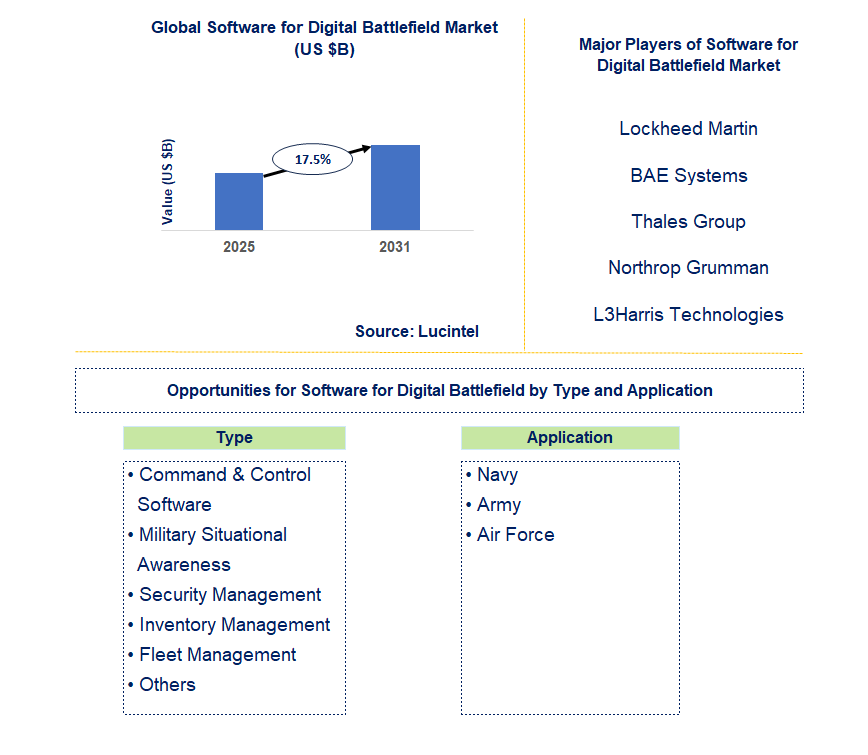
Key data points: The growth forecast = 17.5% annually for the next 7 years. Scroll below to get more insights. This market report covers Trends, opportunity and forecast in software for digital battlefield market to 2031 by type (command & control software, military situational awareness, security management, inventory management, fleet management, and others), application (navy, army, and air force), and region (North America, Europe, Asia Pacific, and the Rest of the World)
We'll send your sample report shortly.
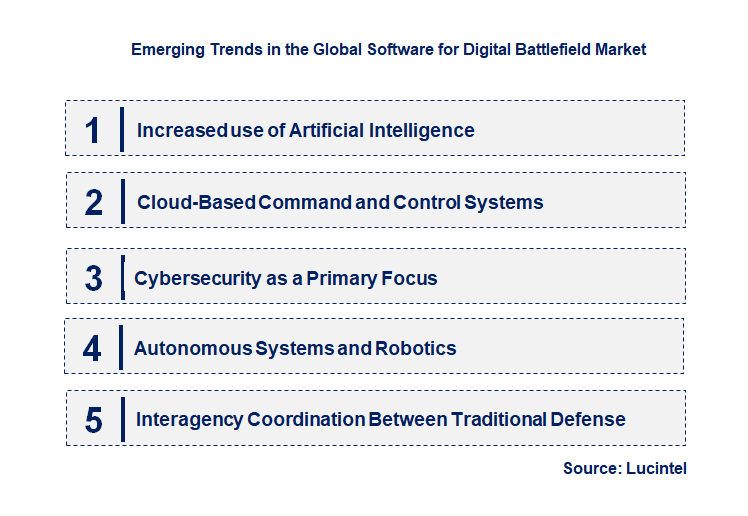
• Increased use of Artificial Intelligence: AI has become an essential part of developing digital battlefield software. AI facilitates real-time analysis of huge volumes of data that military forces can then make quick, more informed decisions from. Defense software using AI improves predictive ability, automates routine tasks, and enhances decision-making, hence an essential tool for modern warfare.
• Cloud-Based Command and Control Systems: The transition of command and control (C2) systems into the cloud is transforming the digital battlefield. Cloud-based systems offer military forces immediate access to data from multiple sources across domains for better coordination and decision-making. Cloud-based systems are also cost-effective and scalable, offering easier upgrades and integration with technologies such as AI and big data analytics.
• Cybersecurity as a Primary Focus: As digital warfare evolves, so does the need for robust cybersecurity solutions. With the growing use of software-based military operations, protecting sensitive data and communication channels has become more critical. Software solutions are increasingly being designed with built-in cybersecurity features to safeguard against cyberattacks that can disrupt military operations, espionage, and data theft.
• Autonomous Systems and Robotics: With the inclusion of autonomous systems and robotics in the digital battlefield software, military operations are changing in a radical manner. Unmanned vehicles, drones, and even robotic systems have been employed in reconnaissance, surveillance, and in some cases even combat missions. The software in these systems will allow them to operate in coordination and autonomously, thereby bringing down human risk but increasing operational efficiency within hostile environments.
• Interagency Coordination Between Traditional Defense: More interagency collaboration is seen in traditional defense companies and private technology firms, especially those focused on artificial intelligence, big data, and cybersecurity. In such collaborations, military needs converge with technological trends to create newer and more innovative and efficient battle software solutions that give defense forces the cutting-edge technologies needed for maintaining their competitive advantage. The emerging trends are significantly reshaping the software for digital battlefield market. AI, cloud technologies, and cybersecurity innovations are improving operational effectiveness. Autonomous systems and increased collaboration between defense and tech companies are driving the next generation of battlefield solutions. These trends will most probably evolve to bring more advanced, secure, and efficient digital battlefield software into existence and will eventually change the face of modern warfare. Their adoption will be key for defense forces looking to sustain strategic advantage in the digital age.
• AI-Driven Decision Support Systems: The biggest development in the adoption of AI in military decision-making software is the development of AI-driven systems. AI-driven systems help analyze vast amounts of battlefield data in real time, which enables commanders to make faster and more informed decisions. This advancement is crucial for adapting to rapidly changing combat environments.
• Cloud-Based Command and Control Systems: The shift to cloud-based command and control systems has transformed military operations by allowing real-time data sharing and communication across different domains. These systems are flexible, scalable, and cost-effective, which allows for more integrated and collaborative decision-making among various military branches.
• Advanced Cybersecurity Features: Cyber threats are increasingly becoming sophisticated. As such, integrated cybersecurity features within digital battlefield software have emerged as a high priority. State-of-the-art defense software employs advanced encryption, authentication, and monitoring tools that ensure sensitive military data and communication networks cannot be compromised by adversaries against critical operations.
• Autonomous Systems and Robotics: In the modern war, autonomous systems and robotics are becoming more widely used. The inclusion of drones, unmanned ground vehicles, and robotic systems into battle operations is an emerging feature of modern warfare. Software is developed to enable the systems to be able to function autonomously, communicate well, and carry out complex functions during combat, thus avoiding risk to human beings.
• Cooperation Between Defense Contractors and Private Tech Companies: Strategic alliances have been established between defense contractors and private tech firms to create innovative solutions for the digital battlefield. It has enabled collaboration between military know-how and innovative technology to push forward the creation of next-generation software, hence accelerating the growth of military preparedness and operational efficiency. Recent trends in the software for digital battlefield market show ongoing improvements in technology and an ever-increasing demand for effective, secure, and integrated military operations. Emphasis on AI, cloud computing, cybersecurity, and autonomous systems drives more advanced software development. Improvements in decision-making, efficiency, and security, critical to modern defense strategies, have become achievable with these innovations. As these trends continue, the future of the digital battlefield becomes more defined while allowing defense forces around the globe to stay a step ahead within increasingly complex battlegrounds.
• AI-Driven Military Decision Support Systems: A growth opportunity in the software for digital battlefield market is the growing demand for AI-driven decision support systems. Such systems process and analyze data in real time, thereby allowing military commanders to make timely decisions. Automation of decision-making processes in combat environments is a significant growth driver because it accelerates response times in relation to the emergence of changing threats.
• Cybersecurity Software for Defense Operations: As cyber threats increase, there is a growing need for integrated cybersecurity software within digital battlefield solutions. Advanced encryption, threat detection, and data protection systems are essential for safeguarding military operations. Companies that develop robust cybersecurity solutions tailored for military use are well-positioned to capitalize on this growing demand.
• Cloud-Based Command and Control Systems: Cloud computing offers cost-effective, scalable, and flexible solutions for military operations. As defense forces increasingly adopt cloud-based command and control (C2) systems, there is a significant opportunity for companies that provide cloud-based solutions that integrate multiple data sources, improve collaboration, and enable real-time decision-making.
• Autonomous Surveillance and Combat Systems: Autonomous systems have taken an integral position in the wars of today. In the development, there are very good opportunities on software needed for autonomous system management. Surveillance drones, reconnaissance, and ground or ground vehicles' autonomous drones/vehicles are currently being used, which may soon also come to combat applications. A vast amount of innovation and growth has gone into making that possible - autonomously working safety of the given system.
• Simulation Software for Training and Strategy: Simulation software is widely used for military training and strategic planning. As defense forces seek to enhance their readiness, there is an increasing demand for sophisticated simulation platforms that replicate real-world battlefield conditions. This market presents significant growth opportunities for companies developing high-fidelity simulation software solutions. The software for digital battlefield market presents various strategic growth opportunities across different applications. AI-driven decision support systems, cyber security solutions, cloud-based C2 systems, autonomous systems, and simulation software have great potential for innovation and further market expansion. Defense forces will continue to modernize their approach to warfare and seek more effective solutions for war, which can be expected to drive the creation of next-generation technologies. Companies that focus on these areas will be best-placed to capitalize on the evolving digital battlefield landscape and contribute to the future of military operations.
• Lockheed Martin Corporation
• BAE Systems
• Thales Group
• Northrop Grumman
• L3Harris Technologies
• Elbit Systems
• Rheinmetall
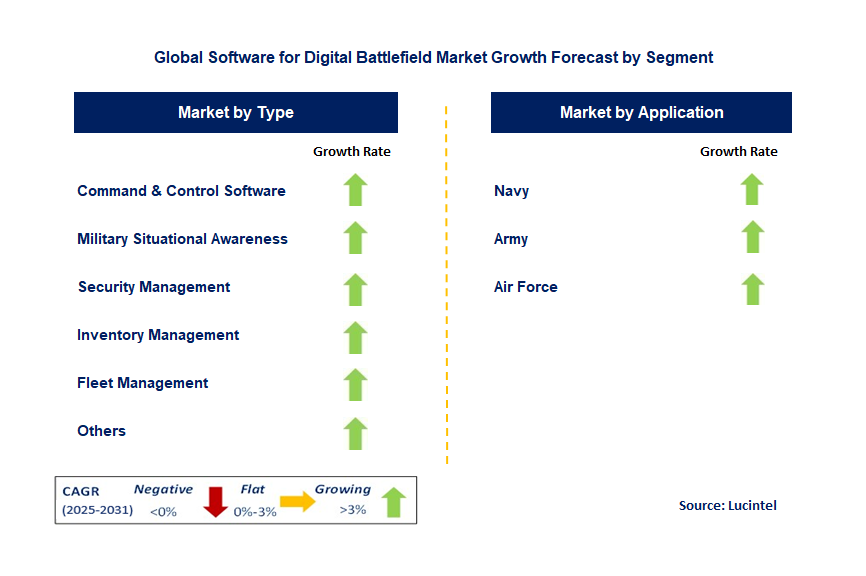
• Command & Control Software
• Military Situational Awareness
• Security Management
• Inventory Management
• Fleet Management
• Others
• Navy
• Army
• Air Force
• North America
• Europe
• Asia Pacific
• The Rest of the World
• United States: The United States is a global leader in the development of digital battlefield software, focusing on the integration of AI and ML into military operations. Recent developments include investments by the U.S. Department of Defense in integrated C2 systems, and cloud-based technologies are also used for data processing in real time. Initiatives like the Joint All-Domain Command and Control (JADC2) system focus on achieving seamless connectivity between the various military branches. In addition, U.S. defense companies are partnering with private tech firms to improve cybersecurity and simulation software, which will enhance defense preparedness in increasingly complex combat environments.
• China: China has been focusing on developing digital battlefield software to modernize its military and enhance its capabilities for integrated operations. With a strong emphasis on AI, big data, and cloud computing, China is investing heavily in advanced C2 systems. The People's Liberation Army is upgrading the network-centric warfare capabilities so that this warfare in any situation can be done based on real-time information to cooperate among units. This week, the AI-driven decision support systems were launched to improve military strategy and operations. China also fosters autonomous systems and cyber warfare tools to enhance its position in the digital battlefield, as it pushes for the modernization of its defense sector as a whole.
• Germany: Germany has been improving its digital battlefield capabilities through the development of sophisticated C2 software platforms that integrate real-time data from various military sources. Germany's emphasis on developing military solutions that are interoperable across NATO forces is seen in the investments it makes in software solutions to facilitate smooth interactions with its allied forces. Recent initiatives include the use of AI to optimize military logistics and supply chains and to improve battlefield simulation technologies. Germany is also focusing on developing cybersecurity protocols within its defense software, as safeguarding communication systems against cyber threats has become increasingly critical for national security.
• India: India has been investing in digital battlefield software to improve the military's ability, particularly to modernize command and control systems. The Indian Armed Forces are focused on improving interoperability among different branches of the military through integrated software solutions. In recent developments, the Defense Cyber Agency was established to further cybersecurity within military operations. India is also developing AI and machine learning to assist in data analytics, which has helped in supporting tactical decisions while enhancing operational efficiency. There is also emphasis on developing its own software and reducing dependence on foreign technology, especially in defense.
• Japan: Japan is using a variety of technological innovations, including digitalization, to upgrade its digital battle space capabilities to better enhance situational awareness and timely decision-making on the battlefield. The Japanese Self-Defense Forces have invested in C2 software to allow it to effectively manage military assets and coordinate with allies. The latest development includes AI-driven systems for cyber defense and autonomous systems for surveillance and reconnaissance. To keep up with these growing cyber threats, Japan is also placing greater emphasis on its capabilities in cybersecurity. Moreover, the integration of digital battlefield software with technologies based in space is currently underway in Japan to enhance overall military readiness and operational efficiency.


• Lockheed Martin Corporation
• BAE Systems
• Thales Group
• Northrop Grumman
• L3Harris Technologies
• Elbit Systems
• Rheinmetall Q5. Which software for digital battlefield market segment will be the largest in future? Answer: Lucintel forecasts that command & control software will remain the largest segment over the forecast period due to centralized decision-making and real-time operations. Q6. In software for digital battlefield market, which region is expected to be the largest in next 5 years? Answer: North America will remain the largest region over the forecast period due to large defense budget and government initiatives, global military presence and alliances. Q7. Do we receive customization in this report? Answer: Yes, Lucintel provides 10% customization without any additional cost.


Choose a license that fits your team. Instant PDF delivery.
Prices exclude taxes. Instant delivery. Custom licensing available on request.
Market Report · July 15, 2026
Market Report · June 26, 2026
Market Report · June 24, 2026
Trusted partner for strategic intelligence and business growth


Receive a complimentary market analysis tailored to your industry. Our analysts will identify key growth opportunities and competitive dynamics specific to your business.

Market size, growth rate, and key trend analysis for your specific sector.

Top competitor positioning and market share analysis.

Strategic recommendations backed by data-driven insights.
Get curated market intelligence and competitive moves straight to your inbox.
By subscribing, you agree to receive our monthly insights. Unsubscribe anytime.
Receive a complimentary market analysis tailored to your industry. Our analysts will identify key growth opportunities and competitive dynamics specific to your business.
Market size, growth rate, and key trend analysis for your specific sector.
Top competitor positioning and market share analysis.
Strategic recommendations backed by data-driven insights.
Get curated market intelligence, emerging trends, and competitive moves straight to your inbox each month.
By subscribing, you agree to receive our monthly insights. Unsubscribe anytime.
We'll send your sample report shortly.