
Market Report · July 15, 2026

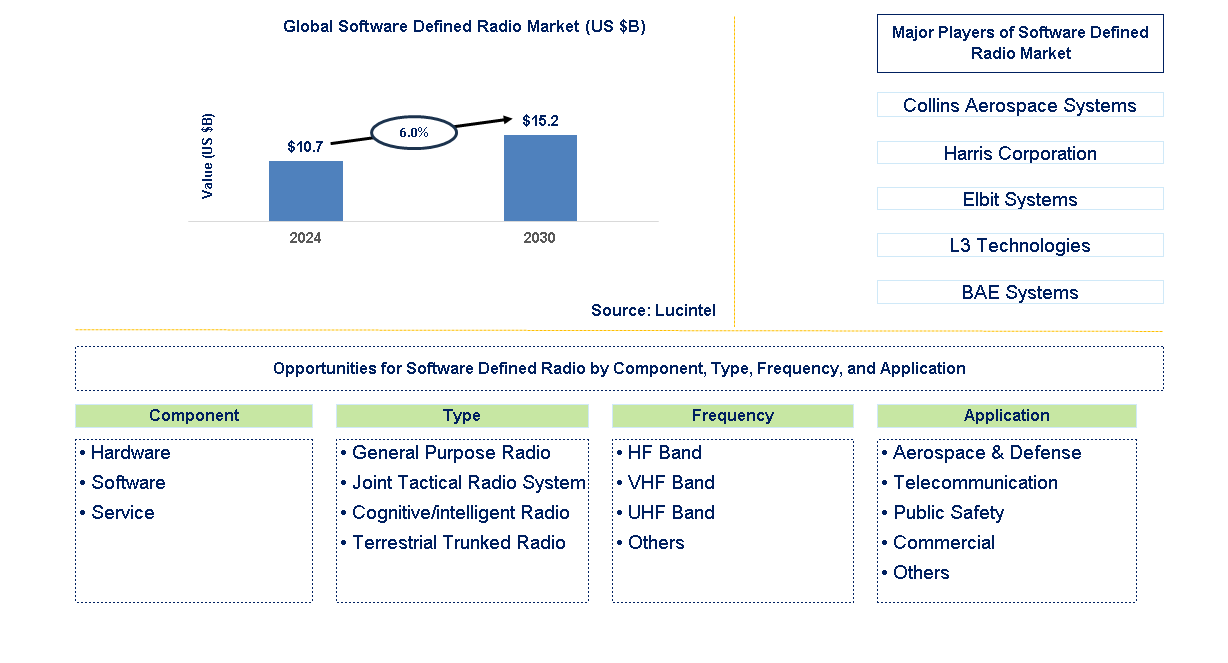
Key data points: The market size in 2030 = $15.2 billion, growth forecast = 6.0% annually for the next 6 years. Scroll below to get more insights. This market report covers trends, opportunities, and forecasts in the global software defined radio market to 2030 by component (hardware, software, and service), type (general purpose radio, joint tactical radio system (JTRS), cognitive/intelligent radio, and terrestrial trunked radio (TETRA)), frequency (HF band, VHF band, UHF band, and others), application (aerospace & defense, telecommunication, public safety, commercial, and others), and region (North America, Europe, Asia Pacific, and the Rest of the World)
We'll send your sample report shortly.
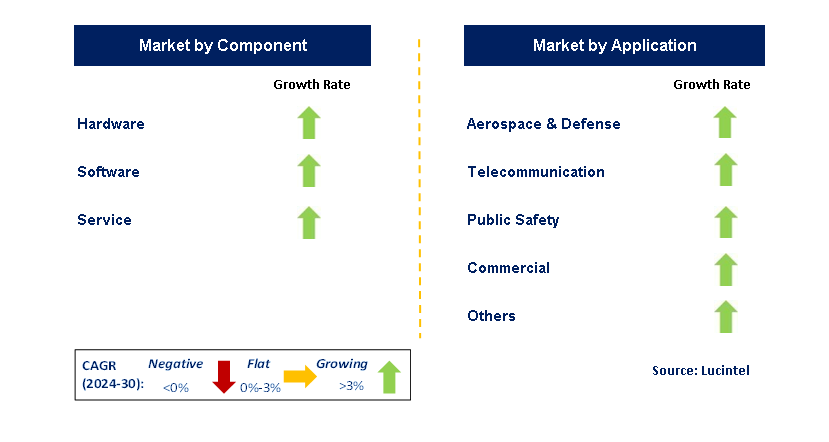
• Lucintel forecasts that, within the component category, service is expected to witness highest growth over the forecast period due to increasing acceptance of portable SDRs and combining of digital and analog technologies onto a single chip drives
• In terms of regions, APAC is expected to witness highest growth over the forecast period due to better information exchange and safe collaboration are made possible by law enforcement's need for enhanced communication during natural catastrophes. Gain valuable insights for your business decisions with our comprehensive 150+ page report.
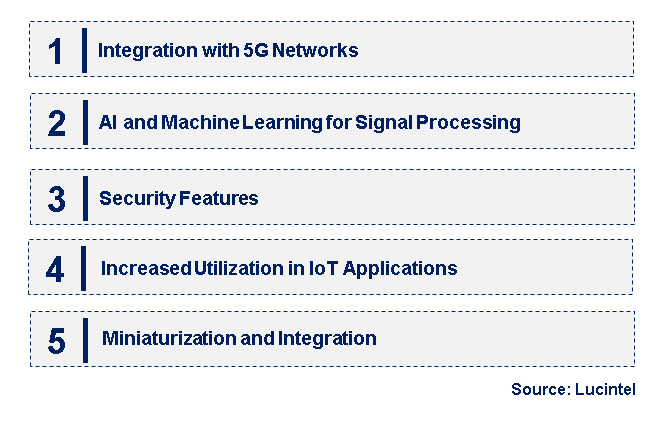
• Integration with 5G Networks: SDR finds its place increasingly in the integration with 5G networks to provide flexibility and efficiency in wireless communication. This trend enables dynamic management of spectrum access and opens up possibilities for various 5G use cases. Indeed, SDR technology contributes significantly to meeting the challenges of evolving 5G standards and network performance.
• AI and Machine Learning for Signal Processing: The utilization of AI and machine learning in SDR systems is skyrocketing, especially in the signal processing area. These technologies enable more efficient spectrum management, better clarity of signals, and interference mitigation. AI-driven SDR systems can adapt and morph in real time with changing requirements and environments of the signal being received.
• Security Features: Due to its growing usage, much attention is being diverted toward incorporating advanced security features in SDR. The new trend of encryption and secure protocols for communications is in vogue, catering to the need for securing systems from cyber threats. Enhanced security will be required for applications related to defense, public safety, and critical infrastructure.
• Increased Utilization in IoT Applications: The adaptability of SDR technology has encouraged its use in IoT applications. This is because SDR ensures good communication among devices and multiple networks using different protocols and frequencies, ensuring scalability. The trend is encouraging innovation in smart cities and industrial IoT solutions.
• Miniaturization and Integration: There is a trend toward miniaturization in SDR components and integration into compact systems. This development makes the deployment of SDR possible on more compact and portable devices and applications. Miniaturization helps advance mobile communications and wearable technologies. These emerging trends in SDR will remain important factors that raise flexibility, security, and the range of applications. Additionally, they will combine with 5G, AI in operation, security, and IoT to shape the future of SDR. In the future, these trends will continue to expand the capabilities and applications of SDR systems in various industries.
• Advanced Signal Processing Algorithms: New signal processing algorithms are significantly improving the performance of SDR systems. These advances improve signal clarity, reduce interference, and lead to better spectrum management. Enhanced algorithms support more reliable and efficient communication in all sorts of applications.
• Next-generation network integration: SDR systems are being integrated with next-generation networks, such as 5G and beyond. This integration supports flexible and adaptive communication solutions, enabling dynamic allocation of the radio frequency spectrum along with improved network performance. In other words, the synergy of SDR with advanced networks drives market growth.
• Amateur SDR platforms: These platforms have become extremely popular due to the low cost and customizability of the technology. The key to such innovation with SDR is the ability to change and develop SDR systems toward specific needs. Open-source projects inspire collaboration, increasing the speed of technological development.
• Series of SDposium: One of the top factors driving SDR growth is its use in applications ranging from simple shortwave radios to advanced personal communication systems. Growth into emerging markets is expected to increasingly demand more sophisticated communication technologies. More regions, such as Southeast Asia and Latin America, have adopted SDR systems for various purposes such as defense, telecommunications, and public safety. This expansion is one of the drivers of global market growth.
• Higher Mobility and Portability: SDR can support applications in highly dynamic environments. It will become even more mobile and portable, as enhanced miniaturization and integration enable its use in handheld and wearable devices. Further mobility will extend SDR applications into specialized areas like emergency response and field communications. Coupled with improved signal processing, advanced network integration, and geographical expansion, these recent developments are reshaping the structure of the SDR market. Innovations also continue to emerge in open-source platforms, with much focus on making systems highly portable and mobile. While these developments abound, advances in SDR technology and its applications across sectors will continue.
• Defense and Military Applications: Due to its flexibility and adaptability, SDR technology offers large potential in the defense and military sectors. Increased communication capabilities, transmission security, and interoperability make SDR an ideal solution for modern defense systems. Key areas of investment in modern SDR solutions include tactical communication and electronic warfare.
• Public Safety and Emergency Services: SDR systems are finding applications in public safety and emergency services, which demand reliable and versatile communication. This opens up opportunities for SDR in disaster response, first responder coordination, and emergency management. Improved signal clarity and multi-band communication capabilities support effective emergency operations.
• Telecommunication Infrastructure: SDR is revolutionizing telecommunications infrastructure by dynamically managing radio spectrums and offering multiple communication standards. Numerous opportunities exist in upgrading existing networks and deploying SDR systems for 5G and future generations of wireless technology. SDR’s flexibility helps optimize network performance and capacity.
• IoT: The IoT segment offers a promising future for SDR, which can support several communication protocols and frequencies. It will enable scalable communication for IoT devices and applications in smart cities, industrial automation, and connected devices, driving innovation and market expansion.
• Commercial and Consumer Electronics: SDR technology is increasingly being integrated into commercial and consumer electronics, including smartphones and wearables. Opportunities are emerging with the integration of SDR in mobile phones for advanced capabilities, also opening up new applications. The trend toward miniaturization and increased functionality drives growth in this segment. These emerging growth opportunities are shaping the SDR market, extending application areas in defense, public safety, telecommunications, IoT, and consumer electronics. Companies focused on these segments will have multiple opportunities to realize not only the versatility of SDR but also the adaptability that drives innovation and captures new market segments.
• Technological Advancements: Developments in digital signal processing and microelectronic technology propel the SDR market. The development of hardware, faster processors, and more effective analog-to-digital converters increases the capability and performance of SDR systems. Enhanced capacity leads to better clarity in signal reception, increased frequency agility, and diversified communication solutions, broadening the scope of SDR technology in various fields.
• Increasing Demand for Flexible Communication Systems: Modern applications require systems that can easily adopt any form of communication and frequencies. Thus, there is a high demand for SDR. SDR technology enables different standards for communication and frequency, making it ideal for areas where dynamism and scalability are needed. Its flexibility, especially in defense, telecommunications, and emergency services, demands SDR systems that can be reconfigured with minimal inconvenience.
• Increased Investment in Defense and Security: Significant investments in defense and security sectors drive the SDR market. Advanced communication systems offering secure, reliable, and interoperable operations are in high demand by defense organizations and governments. Since SDR technology offers better performance and integration capability, it is considered a major asset in military communications, electronic warfare, and intelligence operations. Challenges in the SDR market are:
• High Development Costs: SDR development and deployment costs are high due to the sophisticated integration of hardware and software. This becomes a barrier to entry for small companies, hindering the wide adoption of SDR solutions. Managing these costs while delivering advanced features remains a challenge for the market.
• Regulatory and Licensing Issues: Regulatory and licensing issues are part of the complex navigation process within the SDR market. Regulations related to spectrum usage, communication standards, and licensing vary considerably depending on location. These regulations heavily impact market entry, operational flexibility, and the deployment of SDR systems worldwide.
• Security Concerns: Security is a key challenge regarding SDR systems. With the growing popularity of SDR technology, active measures must be taken to address vulnerabilities against various cyber threats. Ensuring the integrity of communication systems and data is critical for maintaining trust and reliability in SDR applications. The SDR market is driven by factors such as emerging technology, increasing demand for flexible communication systems, and significant investment in defense. However, these developments are accompanied by challenges like high development costs, regulatory complications, and security concerns. A balance between these drivers and challenges is key to ensuring sustainability and growth in the SDR market, keeping this technology relevant to evolving communication needs.
• Collins Aerospace Systems
• Harris Corporation
• Elbit Systems
• L3 Technologies
• BAE Systems
• Huawei Technologies
• Datasoft Corporation
• Raytheon Company
• Northrop Grumman Corporation
• Hardware
• Software
• Service
• General Purpose Radio
• Joint Tactical Radio System (JTRS)
• Cognitive/intelligent Radio
• Terrestrial Trunked Radio (TETRA)
• HF Band
• VHF Band
• UHF Band
• Others
• Aerospace & Defense
• Telecommunication
• Public Safety
• Commercial
• Others
• North America
• Europe
• Asia Pacific
• The Rest of the World
• United States: The U.S. is a leader in the development of SDR technologies, with substantial investments in both military and commercial sectors. Recent developments include improvements in signal processing and the integration of AI for better spectrum management. The U.S. Department of Defense is leveraging SDR to make communication systems more versatile, while private companies push innovation at the commercial level in SDR products.
• China: In China, the SDR market is growing with the development of communication infrastructure and the military. Recent developments include the design of 5G SDR systems and the increased production of SDR components locally to reduce foreign dependence. China is heavily investing in SDR research due to growing demand in defense and telecommunications.
• Germany: Germany's SDR market is improving in both the defense and commercial sectors. Developments in Germany include the integration of SDR into public safety communications and improvements in interoperability across different communication systems. Germany also focuses on SDR solutions for smart grid applications and industrial automation.
• India: SDR technology is rapidly being adopted in India due to the modernization of the defense sector and developments in telecommunications. This includes deploying SDR systems for military communications and integrating SDR technology into mobile networks. The Indian government is emphasizing the indigenization and manufacturing of SDR components to build national capabilities.
• Japan: The Japanese SDR market is characterized by developments in high-frequency SDR systems and applications ranging from commercial to defense sectors. Recent developments include advancements in signal processing for disaster response and the integration of SDR technology in smart city initiatives. Japan is also focusing on SDR solutions for next-generation wireless communication systems.


• Collins Aerospace Systems
• Harris Corporation
• Elbit Systems
• L3 Technologies
• BAE Systems
• Huawei Technologies
• Datasoft Corporation
• Raytheon Company
• Northrop Grumman Corporation Q6. Which software defined radio market segment will be the largest in future? Answer: Lucintel forecasts that service is expected to witness highest growth over the forecast period due to increasing acceptance of portable SDRs and combining of digital and analog technologies onto a single chip drives. Q7. In software defined radio market, which region is expected to be the largest in next 5 years? Answer: APAC is expected to witness highest growth over the forecast period. Q.8 Do we receive customization in this report? Answer: Yes, Lucintel provides 10% customization without any additional cost.


Choose a license that fits your team. Instant PDF delivery.
Prices exclude taxes. Instant delivery. Custom licensing available on request.
Market Report · July 15, 2026
Market Report · June 26, 2026
Market Report · June 24, 2026
Trusted partner for strategic intelligence and business growth


Receive a complimentary market analysis tailored to your industry. Our analysts will identify key growth opportunities and competitive dynamics specific to your business.

Market size, growth rate, and key trend analysis for your specific sector.

Top competitor positioning and market share analysis.

Strategic recommendations backed by data-driven insights.
Get curated market intelligence and competitive moves straight to your inbox.
By subscribing, you agree to receive our monthly insights. Unsubscribe anytime.
Receive a complimentary market analysis tailored to your industry. Our analysts will identify key growth opportunities and competitive dynamics specific to your business.
Market size, growth rate, and key trend analysis for your specific sector.
Top competitor positioning and market share analysis.
Strategic recommendations backed by data-driven insights.
Get curated market intelligence, emerging trends, and competitive moves straight to your inbox each month.
By subscribing, you agree to receive our monthly insights. Unsubscribe anytime.
We'll send your sample report shortly.