Soft Wall Military Shelter Market Report: Trends, Forecast and Competitive Analysis to 2035

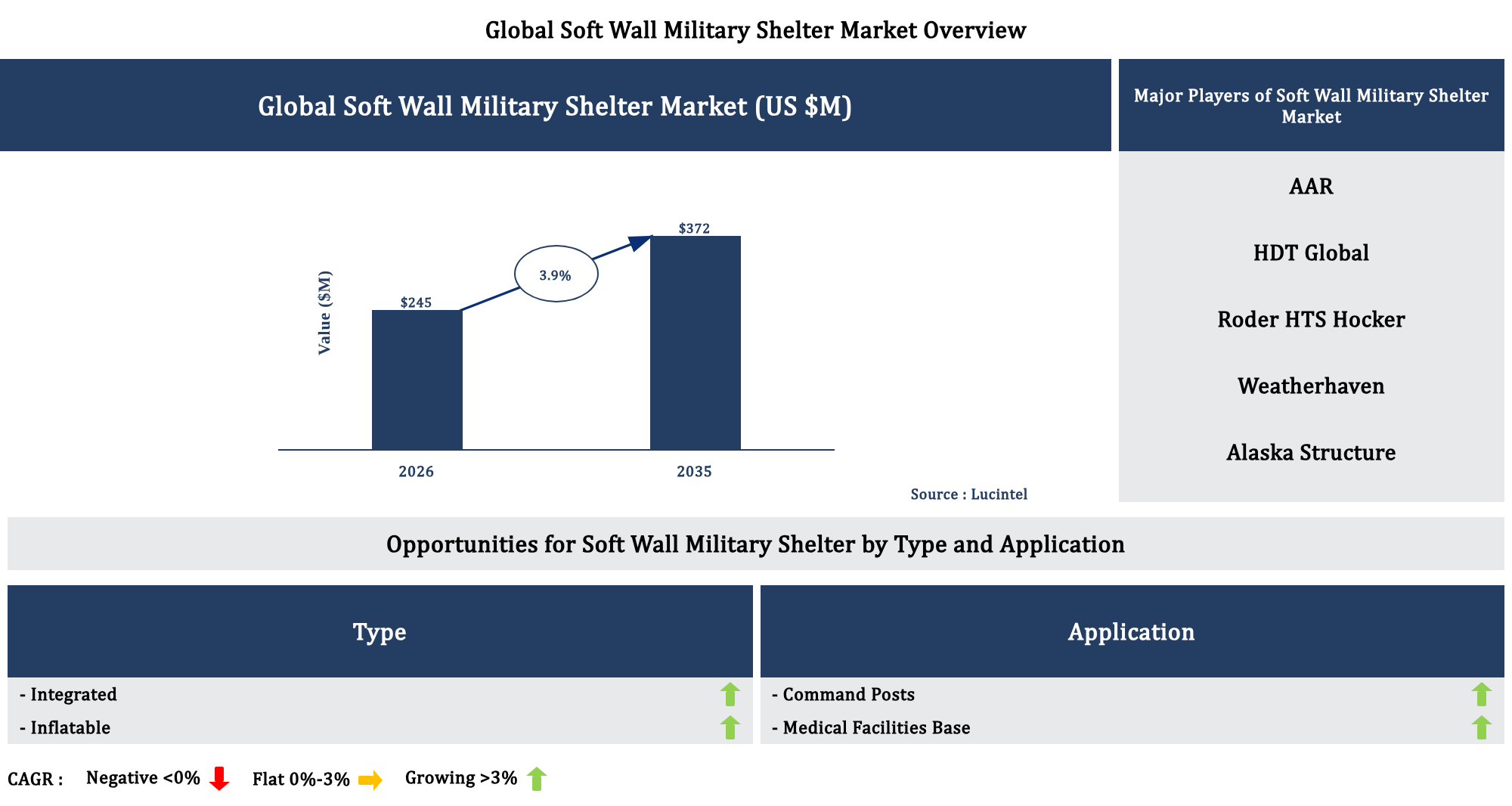
Key data points: The market size in 2035 = $372 million, growth forecast = 3.9% annually for the next 9 years. Scroll below to get more insights. This market report covers trends, opportunities, and forecasts in the global soft wall military shelter market to 2035 by type (integrated and inflatable), application (command posts and medical facilities base), and region (North America, Europe, Asia Pacific, and the Rest of the World)

Publisher: Lucintel Last Updated: July 2026
See Pricing

Download Sample Report

| ✨ New Download Sample report — Get instant insights! | ✨ New Download Sample report — Get instant insights!

Soft Wall Military Shelter Market Report: Trends, Forecast and Competitive Analysis to 2035

Soft Wall Military Shelter Market


The future of the global soft wall military shelter market looks promising with opportunities in the command posts and medical facilities base markets. The global soft wall military shelter market is expected to reach an estimated $372 million by 2035 with a CAGR of 3.9% from 2026 to 2035. The major drivers for this market are the increasing military deployments boosting shelter demand, the rising disaster response needs soft shelters and the growing defense modernization driving shelter adoption.

• Lucintel forecasts that, within the type category, inflatable will remain the largest segment over the forecast period as the increasing rapid response operational flexibility.

• Within the application category, command posts will remain the largest segment due to the he rising need for command battlefield management.

• In terms of regions, North America will remain the largest region over the forecast period due to the the growing defense modernization increasing procurement rising military readiness.

Gain valuable insights for your business decisions with our comprehensive 150+ page report.
Soft Wall Military Shelter Market

Emerging Trends in the Soft Wall Military Shelter Market

The soft wall military shelter market is evolving rapidly as armed forces seek greater mobility, modularity, and survivability in increasingly contested and climate-stressed environments. Demand is rising for shelters that deploy quickly, integrate advanced protection, and support high-tech command, medical, and logistics functions. Militaries are prioritizing lighter materials, improved thermal efficiency, and compatibility with digital battlefield systems, while also focusing on lifecycle cost reduction and sustainability. Vendors are responding with smarter, more resilient designs, often co-developed with end users. These emerging trends are reshaping procurement strategies, logistical planning, and operational concepts across the global defense ecosystem.
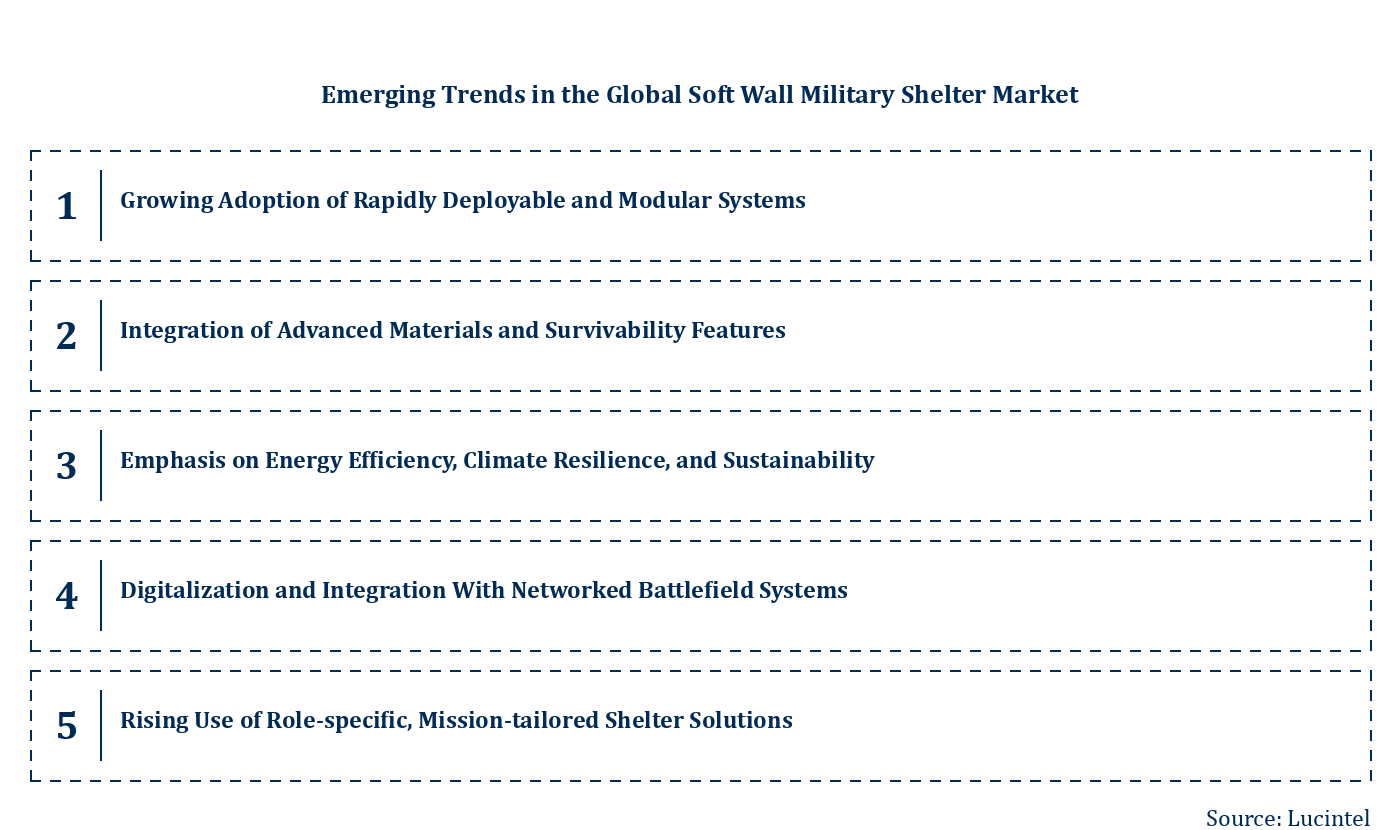
  • Growing Adoption of Rapidly Deployable and Modular Systems: Armed forces are prioritizing soft wall shelters that can be transported in compact form factors and erected within hours by small teams without heavy equipment. Modular panel and hub-and-spoke designs enable units to reconfigure layouts quickly for command posts, barracks, medical facilities, and storage as missions evolve. This trend improves operational agility, supports expeditionary and special operations, and reduces set-up time in high-threat environments. It also allows militaries to standardize components across missions and theaters, simplifying training, maintenance, and inventory management while improving overall mission readiness.
  • Integration of Advanced Materials and Survivability Features: The soft wall military shelter market is seeing increased use of high-strength textiles, composite fabrics, and multilayer membranes with superior ballistic, blast, and flame resistance. New coatings enhance durability against UV, sand, and chemical exposure while improving waterproofing and thermal performance. Integrated ballistic liners, fragmentation nets, and overpressure options improve troop protection in forward operating bases. These innovations extend shelter lifespans and reduce replacement cycles, lowering total ownership costs. Enhanced survivability features are particularly critical for contested logistics environments where fixed infrastructure is vulnerable and rapidly relocatable protection is essential.
  • Emphasis on Energy Efficiency, Climate Resilience, and Sustainability: Militaries are demanding shelters that significantly cut fuel consumption for heating and cooling, driven by both cost and logistics risk. Double-layer fabrics, improved insulation, reflective outer surfaces, and optimized airlock designs reduce thermal losses in extreme hot and cold climates. Integration with hybrid power systems, solar arrays, and energy storage enables more autonomous forward bases with fewer resupply convoys. This trend supports NATO and national net-zero objectives while improving soldier comfort and performance. Vendors are also exploring recyclable materials and lower-emission manufacturing processes to align with evolving defense sustainability mandates.
  • Digitalization and Integration with Networked Battlefield Systems: Soft wall shelters are increasingly designed as plug-and-play nodes in digital command, control, communications, computers, intelligence, surveillance, and reconnaissance (C4ISR) architectures. Pre-wired structures with cable management channels, EMP-shielded linings, and integrated mounting points support fast installation of servers, sensors, and communication equipment. Environmental monitoring, access control, and power management systems are being connected to centralized dashboards for remote oversight. This digital integration transforms shelters from simple physical enclosures into smart, networked infrastructure that enhances situational awareness, cyber resilience, and the speed of decision-making in dynamic operational theaters.
  • Rising Use of Role-specific, Mission-tailored Shelter Solutions: The market is shifting from generic tent systems toward specialized shelters optimized for medical, decontamination, maintenance, UAV operations, and intelligence functions. Medical shelters feature controlled environments, integrated HVAC and filtration, and compatibility with surgical and diagnostic equipment. Maintenance and UAV shelters offer higher internal clearance, overhead gantries, and specific anchoring systems. This specialization improves task efficiency and safety while enabling faster mission setup and teardown. Defense buyers increasingly favor modular families of shelters that share common interfaces but can be quickly configured into role-specific complexes, supporting multi-domain operations and joint forces deployments.

Soft Wall Military Shelter Market by country

Recent Developments in the Soft Wall Military Shelter Market

The soft wall military shelter market is undergoing rapid transformation as armed forces seek lighter, faster-deployable, and more survivable infrastructure for expeditionary and hybrid warfare environments. Recent conflicts, disaster-response missions, and multinational exercises have pushed demand for shelters that combine tactical mobility with higher levels of protection, connectivity, and energy efficiency. At the same time, defense budgets are being steered toward modular systems that reduce lifecycle costs and logistics footprints while improving troop comfort and mission readiness. The five developments below capture how technology, procurement models, and sustainability priorities are reshaping this evolving global market.

  • Integration of Advanced Materials and Fabrics: Manufacturers are incorporating high-tenacity textiles, ballistic fabrics, and multilayer composites to improve durability, weather resistance, and limited ballistic or fragmentation protection in the soft wall military shelter market. These material innovations extend service life, reduce maintenance, and allow lighter structures without sacrificing strength, enabling rapid deployment in harsh climates. The impact is lower through‑life cost, improved survivability of personnel and equipment, and greater operational flexibility across diverse theaters of operation.
  • Growth of Modular and Scalable Shelter Architectures: Recent designs emphasize modular panels, plug‑and‑play connectors, and standardized footprints that can be rapidly reconfigured to create command posts, field hospitals, maintenance bays, and accommodation blocks within the soft wall military shelter market. Forces can scale capacity up or down based on mission size and duration, which optimizes transport loads and reduces idle assets. This development improves interoperability among allied forces, accelerates setup and teardown times, and supports more agile basing concepts such as distributed and expeditionary operations.
  • Integration of Energy-efficient and Off‑grid Power Solutions: New soft wall shelters increasingly embed solar arrays, flexible photovoltaic fabrics, insulated liners, and smart power management to reduce reliance on diesel generators in the soft wall military shelter market. Hybrid energy systems and better thermal performance cut fuel consumption, lower resupply risks, and improve acoustic and thermal signatures for stealth. The impact is enhanced operational endurance, reduced logistical vulnerability, and better alignment with military sustainability goals, while improving habitability through more reliable heating, cooling, and power.
  • Adoption of Rapidly Deployable, Turnkey Shelter Systems: Armed forces and defense agencies are procuring shelter packages that include integrated flooring, HVAC, lighting, and C4ISR infrastructure as ready‑to‑use kits in the soft wall military shelter market. These turnkey systems can be erected by small teams in hours rather than days, drastically shortening the time from arrival in theater to full operational capability. This development boosts mission responsiveness in crises, supports high‑tempo expeditionary operations, and reduces training burdens, as standardized solutions simplify setup procedures across units and missions.
  • Increased Focus on C4ISR-ready and Networked Shelters: Recent offerings prioritize pre‑wired cable management, EMP‑resistant components, and provisions for antennas, sensors, and secure communications to support command‑and‑control functions within the soft wall military shelter market. Shelters serve as fully networked nodes capable of hosting data centers, tactical operations centers, and intelligence cells. The impact is improved situational awareness, faster decision‑making, and better integration with joint and coalition networks, transforming shelters from simple physical enclosures into critical digital infrastructure on the modern battlefield.

Strategic Growth Opportunities in the Soft Wall Military Shelter Market

The soft wall military shelter market is evolving as armed forces seek greater mobility, modularity, and mission readiness across diverse environments. Demand is rising for shelters that can be rapidly deployed, reconfigured, and integrated with digital command systems, medical support, and logistics infrastructure. Growth is being shaped by modernization programs, shifting threat landscapes, and the need for multi-domain operations support. Across applications such as command and control, field hospitals, troop housing, maintenance, and storage, vendors that offer lighter, more durable, and energy efficient soft wall shelters are well positioned to capture long-term procurement and upgrade cycles.

  • Command and Control Infrastructure: Expanding requirements for mobile, networked headquarters create strong potential for advanced soft wall shelters that integrate power distribution, climate control, and secure communications, enabling rapid establishment of fully functional command posts in contested or remote areas while reducing the cost and time associated with traditional fixed facilities.
  • Field Medical and Humanitarian Support: Increasing emphasis on forward medical care and dual-use disaster relief operations drives demand for modular soft wall medical shelters that provide controlled environments for surgery, triage, and isolation, supporting higher standards of care, accelerating casualty stabilization, and improving interoperability with civilian emergency response organizations.
  • Troop Housing and Morale Facilities: Ongoing overseas deployments and rotational training exercises fuel growth in soft wall shelters for barracks, dining halls, and welfare spaces, where improved insulation, acoustic control, and durability can significantly enhance soldier comfort, retention, and operational effectiveness while allowing bases to scale up or down quickly as missions change.
  • Maintenance, Workshop, and Aircraft Hangars: The need for flexible infrastructure to support vehicle, rotorcraft, and unmanned system maintenance in theater creates opportunities for large-span soft wall shelters that accommodate heavy equipment, integrate cranes and lighting, and withstand harsh climates, thereby improving fleet availability and reducing dependence on permanent infrastructure.
  • Logistics, Storage, and Supply Chain Hubs: Growing complexity of military supply chains increases demand for rapidly deployable soft wall shelters used as warehouses, ammunition depots, and cold-chain nodes, where enhanced load-bearing capacity, integrated racking, and environmental controls help protect high-value inventories and ensure reliable, responsive resupply in dynamic operational theaters.

Soft Wall Military Shelter Market Drivers and Challenges

The global soft wall military shelter market is shaped by a dynamic mix of technological, economic, and regulatory forces that influence demand, design priorities, and procurement cycles. Growing focus on expeditionary operations, rapid deployment capabilities, and survivability requirements is driving continuous innovation in shelter materials, modularity, and integration with support systems. At the same time, budget constraints, complex certification processes, and evolving threat environments create obstacles for suppliers and defense agencies. Understanding how these drivers and challenges interact helps stakeholders prioritize investments, optimize lifecycle costs, and ensure that soft wall shelters effectively support modern military missions across diverse theaters.

The factors responsible for driving the soft wall military shelter market include:

  • Operational Flexibility and Rapid Deployability: Modern armed forces increasingly prioritize rapid response, expeditionary missions, and agile basing concepts, which require shelters that are quick to transport, assemble, and reconfigure. Soft wall military shelters deliver high mobility, reduced logistics footprints, and shorter setup times compared with traditional hard structures, supporting forward operating bases, disaster relief operations, and special forces deployments. This operational flexibility drives sustained demand from defense ministries seeking to enhance readiness and theater-level responsiveness while maintaining the ability to scale infrastructure up or down in line with mission requirements.
  • Advancements in Materials and Structural Design: Continuous innovation in high-strength fabrics, advanced composites, and lightweight frame technologies significantly improves the durability, weather resistance, and ballistic protection of soft wall military shelters. Enhanced thermal insulation, fire resistance, and chemical or biological barrier properties enable safer and more comfortable environments for personnel and equipment in harsh climates. These material advances extend service life and reduce maintenance, supporting lower total cost of ownership. As defense customers increasingly evaluate shelters on performance metrics such as survivability, energy efficiency, and modularity, technology improvements become a critical growth driver for industry suppliers.
  • Focus on Energy Efficiency and Integrated Support Systems: Defense organizations face pressure to reduce fuel consumption, logistics burdens, and environmental impact across deployed operations. Soft wall shelters that incorporate energy-efficient insulation, smart HVAC systems, renewable energy integration, and power management solutions directly support these objectives. The ability to integrate lighting, communication, and sensor systems into modular shelter architectures enhances operational capability while improving comfort and safety for occupants. This shift toward holistic, systems-based shelter solutions encourages procurement of higher-value, technologically advanced shelters and stimulates collaborative innovation between shelter manufacturers and defense technology providers.
  • Rising Demand from Humanitarian and Dual-use Applications: Beyond traditional combat roles, soft wall military shelters are increasingly used in humanitarian assistance, disaster relief, medical field hospitals, command centers, and training facilities. Governments and international agencies value shelters that can transition seamlessly between defense and civil protection missions, allowing better utilization of procurement budgets and stockpiled assets. This dual-use appeal broadens the customer base to include organizations such as UN agencies, NGOs, and national emergency management bodies. As climate-related disasters and complex emergencies increase in frequency, demand for rapidly deployable, robust soft wall shelters expands, reinforcing overall market growth.
  • Modernization and Standardization of Military Infrastructure: Many armed forces are engaged in long-term modernization programs that include updating legacy field infrastructure, replacing older tents, and standardizing shelter systems across units and branches. Soft wall military shelters benefit from this trend as they offer scalable, interoperable solutions that can be configured for accommodation, command, storage, or maintenance. Standardization reduces training complexity, spare parts inventories, and lifecycle support costs, making modern shelter systems more attractive to procurement agencies. These modernization initiatives, often backed by multi-year defense budgets and alliance interoperability goals, create predictable demand and encourage competitive innovation among suppliers.

The challenges facing this Market include:

  • Budget Constraints and Shifting Defense Priorities: Despite persistent security threats, many governments operate under tight defense budgets and competing priorities such as cyber capabilities, advanced weapon systems, and unmanned platforms. Soft wall military shelters, often seen as support infrastructure rather than frontline capability, can face delayed or reduced procurement funding. Additionally, changes in geopolitical focus or drawdowns from overseas operations may lead to lower immediate demand for deployable shelters. Vendors must therefore contend with cyclical procurement patterns, extended approval timelines, and the need to demonstrate compelling value propositions to secure long-term contracts.
  • Stringent Regulatory, Safety, and Certification Requirements: Soft wall military shelters must comply with rigorous standards related to fire safety, ballistic protection, electromagnetic compatibility, chemical and biological defense, and environmental performance. Meeting these diverse and often country-specific requirements adds complexity, cost, and time to design, testing, and certification processes. Smaller manufacturers may struggle with the financial burden of repeated certifications and documentation, especially when adapting products for multiple export markets. Frequent updates to military specifications and environmental regulations also create uncertainty, forcing suppliers to continuously invest in compliance while managing the risk of obsolescence for existing product lines.
  • Supply Chain Volatility and Raw Material Cost Pressures: The soft wall military shelter market depends heavily on specialized textiles, high-performance coatings, advanced composites, and metal components sourced from global supply chains. Disruptions stemming from geopolitical tensions, trade restrictions, pandemics, or transportation bottlenecks can delay production and delivery schedules, undermining customer confidence and contract performance. Fluctuating prices for key inputs such as technical fabrics, aluminum, and energy add further margin pressure, particularly in fixed-price defense contracts. Manufacturers must balance inventory risk, supplier diversification, and cost-control measures while ensuring reliable quality and on-time delivery to demanding military clients.

The overall trajectory of the soft wall military shelter market reflects a balance between strong operational drivers and notable structural challenges. On the positive side, evolving mission profiles, ongoing modernization initiatives, and advances in materials and integrated systems support sustained demand for agile, high-performance shelters. At the same time, budgetary constraints, complex certification environments, and supply chain volatility temper growth and raise execution risk. Market participants that invest in innovation, compliance capabilities, and resilient sourcing strategies are better positioned to capture long-term opportunities, while end users benefit from more capable, adaptable, and efficient shelter solutions that enhance operational readiness.

List of Soft Wall Military Shelter Market Companies

Companies in the market compete on the basis of product quality offered. Major players in this market focus on expanding their manufacturing facilities, R&D investments, infrastructural development, and leverage integration opportunities across the value chain. Through these strategies soft wall military shelter market companies cater increasing demand, ensure competitive effectiveness, develop innovative products & technologies, reduce production costs, and expand their customer base. Some of the soft wall military shelter market companies profiled in this report include-

  • AAR
  • HDT Global
  • Roder HTS Hocker
  • Weatherhaven
  • Alaska Structure
  • M.Schall
  • Camel Manufacturing Company

Soft Wall Military Shelter Market by Segment

The study includes a forecast for the global soft wall military shelter market by type, application, and region.

  • Soft Wall Military Shelter Market by Type [Value ($M) from 2019 to 2035]:
    • Integrated
    • Inflatable
  • Soft Wall Military Shelter Market by Application [Value ($M) from 2019 to 2035]:
    • Command Posts
    • Medical Facilities Base
  • Soft Wall Military Shelter Market by Region [Value ($M) from 2019 to 2035]:
    • North America
    • Europe
    • Asia Pacific
    • The Rest of the World

Country Wise Outlook for the Soft Wall Military Shelter Market

The global soft wall military shelter market is evolving rapidly as armed forces seek lighter, more mobile, and modular infrastructure to support dispersed, expeditionary, and multi-domain operations. Advances in high-strength textiles, rapid-deployment frame systems, and integrated power and climate-control solutions are reshaping procurement priorities. NATO interoperability demands, humanitarian and disaster-response missions, and the need to operate in extreme climates are further driving innovation. At the same time, rising geopolitical tensions and elevated defense budgets in key economies are accelerating modernization of temporary shelter systems, creating distinct development trajectories in the United States, China, Germany, India, and Japan.

  • United States: In the United States, recent developments in soft wall military shelters focus on expeditionary readiness, energy efficiency, and rapid deployment to support Indo-Pacific and European force posture. The U.S. Department of Defense is procuring next-generation lightweight shelters with improved thermal insulation, integrated power distribution, and compatibility with hybrid energy systems to reduce fuel consumption. Contractors are upgrading Chemical, Biological, Radiological, and Nuclear protective variants and improving survivability against harsh weather, dust, and blast overpressure. Increasing emphasis on prepositioned stocks, agile combat employment, and joint exercises is driving demand for modular shelter complexes capable of housing command-and-control, medical, and maintenance functions.
  • China: In China, the soft wall military shelter market is expanding alongside broader force modernization and logistics reform aimed at supporting long-range and high-altitude operations. The People’s Liberation Army is adopting rapidly erectable shelters optimized for plateau, desert, and maritime climates, with emphasis on improved insulation, snow-load capacity, and integration with mobile command systems. Domestic manufacturers are scaling production of modular tent systems for field hospitals and emergency response, often dual-purposed for civil defense and disaster relief. Investment in indigenous technical textiles and composite frame materials is intended to reduce import dependence and enhance durability, while supporting China’s ambition to project power across diverse environments.
  • Germany: In Germany, developments in soft wall military shelters are shaped by Bundeswehr modernization, NATO readiness goals, and a strong emphasis on sustainability and interoperability. Recent programs prioritize climate-controlled, energy-efficient shelters that interface seamlessly with allied power, communications, and medical systems during multinational deployments. German suppliers are advancing low-signature materials to reduce thermal and radar visibility, as well as noise-dampening solutions for command posts and maintenance areas. Increased participation in NATO’s forward presence and large-scale exercises in Eastern Europe is driving demand for quickly deployable camps, while EU funding and national climate objectives push for shelters that reduce greenhouse gas emissions over their lifecycle.
  • India: In India, soft wall military shelter developments are closely tied to operational needs along high-altitude, border, and glacier fronts, as well as the government’s Make in India and Atmanirbhar Bharat initiatives. The Indian Armed Forces are procuring insulated, high-wind-resistant shelters capable of year-round deployment in the Himalayas, with enhanced heating efficiency and reduced logistical burden. Domestic firms and defense research organizations are developing lightweight, fire-retardant fabrics and modular shelters that can be airlifted or transported over challenging terrain. There is also growing interest in dual-use designs suitable for disaster relief and border infrastructure, supporting both military readiness and civilian resilience in remote regions.
  • Japan: In Japan, the soft wall military shelter market is driven by a focus on rapid disaster response, island defense, and interoperability with U.S. forces. The Japan Self-Defense Forces are investing in transportable shelters that can withstand typhoons, heavy rainfall, and seismic activity, while offering quick setup for medical, command, and humanitarian missions. Recent developments emphasize integration with advanced communications, power management, and air-filtration systems to support operations in contaminated or degraded environments. Domestic manufacturers are refining compact, high-quality shelter solutions suitable for deployment across dispersed island bases, balancing strict space constraints with the need for resilience in a complex regional security environment.

Features of the Soft Wall Military Shelter Market

  • Market Size Estimates: Soft wall military shelter market size estimation in terms of value ($M).
  • Trend and Forecast Analysis: Market trends (2019 to 2025) and forecast (2026 to 2035) by various segments and regions.
  • Segmentation Analysis: Soft wall military shelter market size by various segments, such as by type, application and region in terms of value ($M).
  • Regional Analysis: Soft wall military shelter market breakdown by North America, Europe, Asia Pacific, and the Rest of the World.
  • Growth Opportunities: Analysis of growth opportunities in different type, application and regions for the soft wall military shelter market.
  • Strategic Analysis: This includes M&A, new product development, and competitive landscape of the soft wall military shelter market.
  • Analysis of competitive intensity of the industry based on Porter's Five Forces model.

Article

Soft Wall Military Shelter Market: Are Agile, Intelligent Camps Reshaping Defense Logistics?

Dallas, July 21, 2026 – The soft wall military shelter market is entering a pivotal phase as armed forces, disaster response agencies, and defense technology companies demand faster deployment, smarter infrastructure, and more sustainable solutions. Once viewed as simple fabric tents, modern soft wall shelters are evolving into modular, sensor-enabled hubs that connect troops, systems, and data across contested and austere environments. This transformation is setting off a wave of innovation that cuts across defense, dual-use commercial applications, and the broader technology ecosystem.

Why Are Next-Generation Soft Wall Shelters Becoming Strategic Assets?

Soft wall shelters are moving from being tactical commodities to becoming strategic enablers of agile operations. Defense ministries are reassessing how quickly they can stand up command posts, field hospitals, maintenance depots, and data centers in theaters where fixed infrastructure is vulnerable or unavailable. The shift toward expeditionary and distributed operations, combined with geopolitical tensions and climate-driven disaster response needs, is driving demand for highly mobile, configurable shelter systems that integrate power, communications, and digital command capabilities from day one.

What Major Innovation Trends Are Rewriting the Market Landscape?

Several powerful trends are reshaping how soft wall shelters are designed, procured, and deployed, and each is poised to disrupt incumbent solutions and supplier relationships.

  • A key trend is the rise of modular, rapidly deployable shelter systems that can be configured like building blocks for different missions, from compact command posts to scalable medical complexes.
  • Another trend is the integration of power management, HVAC, and networking into pre-engineered shelter packages, enabling plug-and-play deployment of mission systems and reducing setup time and personnel requirements.
  • Digitalization is accelerating as shelters increasingly host integrated sensor networks, environmental monitoring, and Internet of Things (IoT) devices for health, security, and asset tracking.
  • Growing focus on survivability and resilience is driving the adoption of advanced textiles with improved ballistic resistance, thermal insulation, chemical and biological protection, and reduced thermal signatures.
  • Sustainability is rising on procurement agendas, pushing demand for energy-efficient insulation, low-embodied-carbon materials, and compatibility with renewable power sources such as solar microgrids and battery storage.

Which End Markets Will Feel the Deepest Impact from These Shifts?

Defense remains the primary buyer, but innovation in the soft wall military shelter market is spreading into adjacent sectors and reshaping spending priorities. Armed forces are reallocating budgets from permanent infrastructure toward scalable expeditionary capabilities that can be prepositioned and moved as conflict dynamics evolve. Humanitarian and disaster response agencies are adopting military-grade shelter systems to support rapid reaction to floods, earthquakes, and conflict-induced displacement, with a premium on medical, communications, and logistics hubs that can deploy in days rather than weeks. Defense contractors and systems integrators see soft wall shelters as an anchor platform for deploying radar, communications, and computing solutions in forward locations without the liabilities of permanent bases.

How Will These Innovations Disrupt Procurement and Competition?

As shelters become more intelligent and integrated, procurement models are shifting away from pure hardware purchases toward solution and lifecycle contracts. Defense buyers are increasingly seeking turnkey packages that combine shelters with power, climate control, IT infrastructure, and maintenance support under performance-based arrangements. Technology and defense electronics firms that previously had little exposure to shelter hardware are now partnering with fabric and frame manufacturers, aiming to embed their systems into standard shelter footprints. This is likely to disrupt traditional supplier lists, as prime contractors look for partners who can deliver interoperable shelter-based platforms rather than standalone components.

What Challenges Could Slow Adoption Despite the Innovation Momentum?

Despite strong interest, several structural obstacles complicate rapid adoption and scaling of next-generation soft wall shelters across defense and security ecosystems.

  • Budget constraints and multi-year procurement cycles in defense ministries make it difficult to swap out legacy tent systems rapidly, even when new solutions offer compelling lifecycle savings.
  • Complex interoperability requirements mean shelters must seamlessly integrate with existing generators, comms gear, medical equipment, and logistics systems, increasing testing and certification burdens.
  • Logistics and training hurdles remain significant, because advanced shelters with integrated systems demand specialized setup skills, maintenance capabilities, and supply chains for spare parts and textiles.
  • Durability in extreme climates, including arctic cold, desert heat, and high-wind environments, continues to challenge material science and can raise total cost of ownership if not properly addressed.
  • Security and cyber risks increase as shelters host more connected devices and communications equipment, creating new attack surfaces in forward-deployed locations.

Where Do the Most Attractive Opportunities Emerge for Industry Players?

While challenges are nontrivial, they also unlock opportunities for companies that can solve pain points across design, integration, and support. Vendors that couple shelter hardware with turnkey energy and HVAC solutions can differentiate on total cost of ownership rather than on upfront unit price alone. There is growing opportunity for technology firms to deliver shelter-centric digital platforms, encompassing environmental monitoring, energy optimization, and asset management dashboards accessible to commanders and facility managers. Partnerships with logistics and training providers can create bundled offerings that reduce deployment risk for governments, positioning suppliers as long-term capability partners rather than one-off equipment vendors. Innovation in advanced fabrics, coatings, and modular floor systems creates room for material science companies to move up the value chain by co-developing mission-specific shelter lines that address particular threats or climates.

How Is the Technology Industry Plugging into Shelter Use Cases?

The technology sector is increasingly treating soft wall shelters as mobile infrastructure for compute, sensing, and communications, extending networks and applications into environments where traditional buildings do not exist.

  • One prominent use case is the deployment of expeditionary data centers and edge computing nodes inside reinforced soft wall shelters to support command and control, intelligence, surveillance, and reconnaissance workloads close to the battlefield.
  • Another important application involves communications and network operations centers, where shelters house satellite terminals, tactical radio suites, and secure networking equipment for rapidly deployable connectivity.
  • Technology integrators are using shelters to host deployable cyber operations cells, with protected, climate-controlled environments for sensitive servers and operator workstations.
  • Medical technology firms are embedding diagnostic imaging, telemedicine hubs, and digital health records systems inside soft wall field hospitals, turning them into high-tech care facilities rather than simple treatment tents.
  • Autonomous systems and robotics providers are leveraging shelters as hubs for drone launch, recovery, data offload, and maintenance, bringing unmanned aerial and ground systems under one integrated canopy with power and data access.

What Recent Developments Signal Where the Market Is Heading Next?

Recent announcements and pilot projects indicate that soft wall shelters are moving further into the core of multi-domain operations and technology-enabled logistics. Defense agencies are trialing shelters pre-equipped with solar arrays, lithium-ion battery banks, and smart microgrid controllers to cut fuel consumption and reduce convoy exposure in contested zones. Several major defense suppliers have launched modular shelter families that share common structural components and interfaces, making it easier to reconfigure camps as missions evolve or rotate between training and operational theaters. Emerging textile solutions include radar-attenuating fabrics and adaptive camouflage skins that can reduce visual and thermal signatures, addressing survivability requirements for high-threat environments. There is also a growing push to standardize digital interfaces inside shelters so that power distribution units, HVAC controls, and sensor arrays can be monitored and managed via unified software dashboards.

How Should Stakeholders Position Themselves for the Next Phase of Market Evolution?

Defense ministries and security agencies face strategic choices about whether to refresh existing tent stocks incrementally or pivot toward fully integrated shelter ecosystems that align with broader modernization programs. Suppliers that invest now in interoperability, digital integration, and lifecycle support will be better positioned to win long-term framework contracts as buyers consolidate vendor lists. Technology companies should view shelters not as peripheral hardware but as critical endpoints in a broader architecture for data, power, and command capabilities, and should design their solutions accordingly. As the soft wall military shelter market continues to mature, the competitive edge will belong to those who can blend materials science, mechanical design, and digital innovation into cohesive, rapidly deployable infrastructure that keeps pace with the changing character of conflict and crisis response.

Top 5 Companies

1. AAR

  • Headquarters: Wood Dale, Illinois, USA
  • Website: https.www.aarcorp.com
  • Total Revenue: $1,820,000,000 (2024)
  • Establishment Year: 1955

AAR is a diversified aviation services company that also supports defense and government customers with deployable infrastructure and logistical solutions relevant to the soft wall military shelter market. Headquartered in Wood Dale, Illinois and established in 1955, AAR employs several thousand people across North America, Europe, Asia, and the Middle East, serving air forces, defense ministries, and international organizations. While its core business centers on maintenance, repair, and overhaul, parts supply, and integrated logistics, AAR participates in programs that require expeditionary base systems and field infrastructure, often integrating soft wall shelters, environmental control units, power, and ancillary systems to support rapid deployment. The company’s product and service portfolio linked to soft wall military shelters includes turnkey camp support solutions, containerized systems, and support equipment that enables air and ground forces to establish temporary operating locations in austere environments. AAR’s geographic presence is global, with operational hubs and program offices that allow it to respond quickly to military demands for temporary shelters and mission support. In recent years, AAR has expanded its government and defense footprint through new multi‑year contracts with the U.S. Department of Defense and allied governments, which often include deployable infrastructure and camp services. The company has pursued selective acquisitions and joint ventures in aviation services rather than direct mergers focused solely on soft wall shelters; however, these moves strengthen its integrated logistics and lifecycle support capability, making AAR a key partner when militaries procure soft wall shelter systems as part of broader base‑operations or contingency support packages.

2. HDT Global

  • Headquarters: Solon, Ohio, USA
  • Website: https.www.hdtglobal.com
  • Total Revenue: -
  • Establishment Year: 1937

HDT Global is a leading supplier of expeditionary infrastructure and survivability solutions to military, government, and humanitarian customers, and is widely recognized as one of the most important players in the soft wall military shelter market. Headquartered in Solon, Ohio and founded in 1937, HDT Global employs a workforce that spans engineering, manufacturing, and field support operations across the United States and selected international locations. The company’s product portfolio includes soft wall shelters, air‑supported and frame‑supported tactical tents, rapidly deployable command posts, medical treatment facilities, maintenance shelters, and modular base camps, as well as environmental control units, heaters, power generators, and CBRN collective protection systems. HDT Global’s shelters are designed for rapid deployment, high mobility, and compatibility with mission‑critical systems, enabling armed forces to set up protected living, working, and medical areas in harsh climates. The company has a strong geographic footprint with customers in North America, Europe, the Middle East, and Asia‑Pacific, supported by distribution partners and in‑theater support teams. In recent years, HDT Global has expanded its presence through new contracts with the U.S. Department of Defense, NATO allies, and coalition forces, including programs for deployable medical facilities and rapidly deployable command and control shelters. The company has also pursued strategic acquisitions in adjacent defense and survivability segments to enhance its integrated expeditionary systems offering, consolidating technologies in shelter structures, environmental control, and signature management to maintain a leading position in the soft wall military shelter market.

3. Roder HTS Hocker

  • Headquarters: Kefenrod, Germany
  • Website: https.www.roderhts.com
  • Total Revenue: -
  • Establishment Year: 1965

Roder HTS Hocker is a specialist in modular temporary and semi‑permanent structures with a growing role in supplying soft wall shelter solutions for defense and security applications. Headquartered in Kefenrod, Germany and established in 1965, the company operates manufacturing and design facilities in Germany and maintains sales and distribution networks across Europe, the Middle East, Africa, Asia‑Pacific, and the Americas. Roder HTS Hocker serves customers in defense, emergency management, logistics, aviation, and events, but for the soft wall military shelter market it focuses on modular tent systems, rapid‑deployment halls, storage shelters, aircraft hangars, and command or accommodation structures that use high‑strength aluminum frames and technical fabrics. These shelters can be configured for equipment storage, vehicle maintenance, troop housing, medical facilities, and field logistics hubs, with options for insulation, climate control, and ballistic or blast enhancements provided through partnerships. The company has expanded geographically through subsidiaries and partner networks in the United Kingdom, the Middle East, and Asia, enabling it to respond quickly to military and civil‑protection tenders requiring deployable soft wall infrastructure. In the defense segment, Roder HTS Hocker has participated in programs supplying temporary hangars and logistics shelters to European armed forces and NATO customers, enhancing its credibility in mission‑critical environments. While major mergers and acquisitions directly tied to soft wall military shelters have been limited, the company has strengthened its capability through continuous investment in engineering, fabric technology, and modular connection systems, positioning itself as a competitive European supplier for rapidly deployable soft wall structures used in training areas, operational bases, and humanitarian missions.

4. Weatherhaven

  • Headquarters: Burnaby, British Columbia, Canada
  • Website: https.www.weatherhaven.com
  • Total Revenue: -
  • Establishment Year: 1981

Weatherhaven is a prominent global provider of portable shelters and camp systems, with a strong specialization in soft wall military shelter solutions for defense, peacekeeping, and disaster‑relief missions. Founded in 1981 and headquartered in Burnaby, British Columbia, Canada, the company operates manufacturing, integration, and service facilities in Canada and maintains additional operations in strategic regions such as South America, Europe, and Asia‑Pacific through subsidiaries and partners. Weatherhaven designs and produces a broad portfolio of soft wall military shelters including rapidly deployable tent systems, expandable container‑based shelters with integrated soft wall components, modular medical facilities, command posts, accommodation camps, and specialized shelters for radar, communications, and intelligence equipment. Its shelters are engineered for extreme climates, ranging from arctic to desert environments, and are frequently deployed by NATO forces, United Nations missions, and national militaries worldwide. Weatherhaven’s geographic presence spans deployments in North America, Latin America, Europe, the Middle East, Africa, and Asia, supported by logistics and field‑service teams that provide installation, training, and lifecycle support. The company has expanded geographically through contracts with the Canadian Armed Forces and other NATO members, as well as large‑scale camp projects in South America and Africa for both military and resource‑sector clients. Weatherhaven has also engaged in strategic partnerships and selective acquisitions to strengthen its engineering and systems‑integration capability in deployable infrastructure. These moves support its evolution from a shelter manufacturer to a turnkey camp systems provider, integrating power, HVAC, water, waste, and communications infrastructure around its core soft wall shelters for mission‑ready military base camps and forward operating locations.

5. Camel Manufacturing Company

  • Headquarters: Pioneer, Tennessee, USA
  • Website: https.www.camelmanufacturing.com
  • Total Revenue: -
  • Establishment Year: 1919

Camel Manufacturing Company is a long‑standing U.S. producer of military and commercial tent systems and is a key contributor to the soft wall military shelter market. Established in 1919 and headquartered in Pioneer, Tennessee, Camel has over a century of experience supplying tentage to the U.S. Armed Forces and allied customers. The company’s workforce supports design, fabrication, quality assurance, and program management activities, primarily from its U.S. manufacturing operations, with products shipped to customers worldwide through government contracts and export channels. Camel’s product portfolio for the soft wall military shelter market includes general‑purpose tents, modular personnel shelters, command post tents, maintenance and storage shelters, and specialized systems designed to integrate with military heating, cooling, and power equipment. Its shelters are used for troop housing, field kitchens, medical units, logistics storage, and training facilities, emphasizing durability, rapid setup, and interoperability with existing military support infrastructure. Camel’s geographic presence is anchored in North America but extends globally through U.S. Foreign Military Sales and direct export programs that place its shelters with allied defense forces and international organizations. The company has participated in multiple U.S. Department of Defense programs aimed at modernizing tentage and base camp systems, reinforcing its reputation as a reliable soft wall shelter supplier. While large, high‑profile mergers or acquisitions specifically targeting the soft wall shelter segment have not been central to its growth, Camel has leveraged long‑term contracts, incremental capacity investments, and product innovation to maintain competitiveness, focusing on improved materials, modularity, and compatibility with expeditionary base components used in contemporary military operations.

Table of Contents

1. Executive Summary
13.1 Competitive Analysis

List of Figures

List of Tables

Methodology

Lucintel has been in the business of market research and management consulting since 2000 and has published over 1000 market intelligence reports in various markets / applications and served over 1,000 clients worldwide. This study is a culmination of four months of full-time effort performed by Lucintel's analyst team. The analysts used the following sources for the creation and completion of this valuable report:

  • In-depth interviews of the major players in this market
  • Detailed secondary research from competitors' financial statements and published data
  • Extensive searches of published works, market, and database information pertaining to industry news, company press releases, and customer intentions
  • A compilation of the experiences, judgments, and insights of Lucintel's professionals, who have analyzed and tracked this market over the years.

Extensive research and interviews are conducted across the supply chain of this market to estimate market share, market size, trends, drivers, challenges, and forecasts. Below is a brief summary of the primary interviews that were conducted by job function for this report.

Lucintel's methodology for market research

Thus, Lucintel compiles vast amounts of data from numerous sources, validates the integrity of that data, and performs a comprehensive analysis. Lucintel then organizes the data, its findings, and insights into a concise report designed to support the strategic decision-making process. The figure below is a graphical representation of Lucintel's research process.

Primary interviews by job function

Buy Now

Choose a license that fits your team. Instant PDF delivery.

Market Report

1 User PDF

$4,850
Buy Now

Market Report

2-5 Users PDF

$6,700
Buy Now

Market Report

Corporate PDF

$8,850
Buy Now

Market Report

Global PDF

$10,000
Buy Now

Prices exclude taxes. Instant delivery. Custom licensing available on request.

Frequently Asked Questions

What is the Soft Wall Military Shelter Market size?
The global Soft Wall Military Shelter Market is expected to reach an estimated $372 million by 2035.
What is the growth forecast for Soft Wall Military Shelter Market?
The global Soft Wall Military Shelter Market is expected to grow with a CAGR of 3.9% from 2026 to 2035.
What are the major drivers influencing the growth of the Soft Wall Military Shelter Market?
The major drivers for this market are the increasing military deployments boosting shelter demand, the rising disaster response needs soft shelters and the growing defense modernization driving shelter adoption.
What are the major segments for Soft Wall Military Shelter Market?
The future of the Soft Wall Military Shelter Market looks promising with opportunities in the Command Posts and Medical Facilities Base markets.
Who are the key Soft Wall Military Shelter Market companies?
Some of the key Soft Wall Military Shelter Market companies are as follows: • AAR • HDT Global • Roder HTS Hocker • Weatherhaven • Alaska Structure • M.Schall • Camel Manufacturing Company
Which Soft Wall Military Shelter Market segment will be the largest in future?
Lucintel forecasts that, within the Type category, Inflatable will remain the largest segment over the forecast period.
In Soft Wall Military Shelter Market, which region is expected to be the largest in next 9 years?
In terms of region, North America is expected to witness the highest growth over the forecast period.
Do we receive customization in this report?
Yes, Lucintel provides 10% customization without any additional cost.

Key Questions

  • What are some of the most promising, high-growth opportunities for the Soft Wall Military Shelter Market by Type (Integrated and Inflatable), Application (Command Posts and Medical Facilities Base), and region (North America, Europe, Asia Pacific, and the Rest of the World)?
  • Which segments will grow at a faster pace and why?
  • Which region will grow at a faster pace and why?
  • What are the key factors affecting market dynamics? What are the key challenges and business risks in this market?
  • What are the business risks and competitive threats in this market?
  • What are the emerging trends in this market and the reasons behind them?
  • What are some of the changing demands of customers in the market?
  • What are the new developments in the market? Which companies are leading these developments?
  • Who are the major players in this market? What strategic initiatives are key players pursuing for business growth?
  • What are some of the competing products in this market and how big of a threat do they pose for loss of market share by material or product substitution?
  • What M&A activity has occurred in the last 9 years, and what has its impact been on the industry?
Why Choose Us

The Lucintel Advantage

Trusted partner for strategic intelligence and business growth

25+ Years Excellence

25+ Years Excellence

Quarter century of proven expertise in management consulting and market research across global markets.
Game-Changer Ideas

Game-Changer Ideas

Innovative strategies and actionable insights that help clients become the smartest in their industry.
Global Reach

Global Reach

Extensive coverage across 50+ industries and markets worldwide with localized expertise.
Start Your Growth Journey

Get Your Free
Market Intelligence
Briefing

Receive a complimentary market analysis tailored to your industry. Our analysts will identify key growth opportunities and competitive dynamics specific to your business.

Custom Market Snapshot

Market size, growth rate, and key trend analysis for your specific sector.

Competitive Landscape Overview

Top competitor positioning and market share analysis.

Growth Opportunity Identification

Strategic recommendations backed by data-driven insights.

Subscribe

Subscribe to our Newsletter

Get curated market intelligence and competitive moves straight to your inbox.

By subscribing, you agree to receive our monthly insights. Unsubscribe anytime.

Industry Trends Market Signals Opportunities Competitor Moves