
Market Report · July 15, 2026

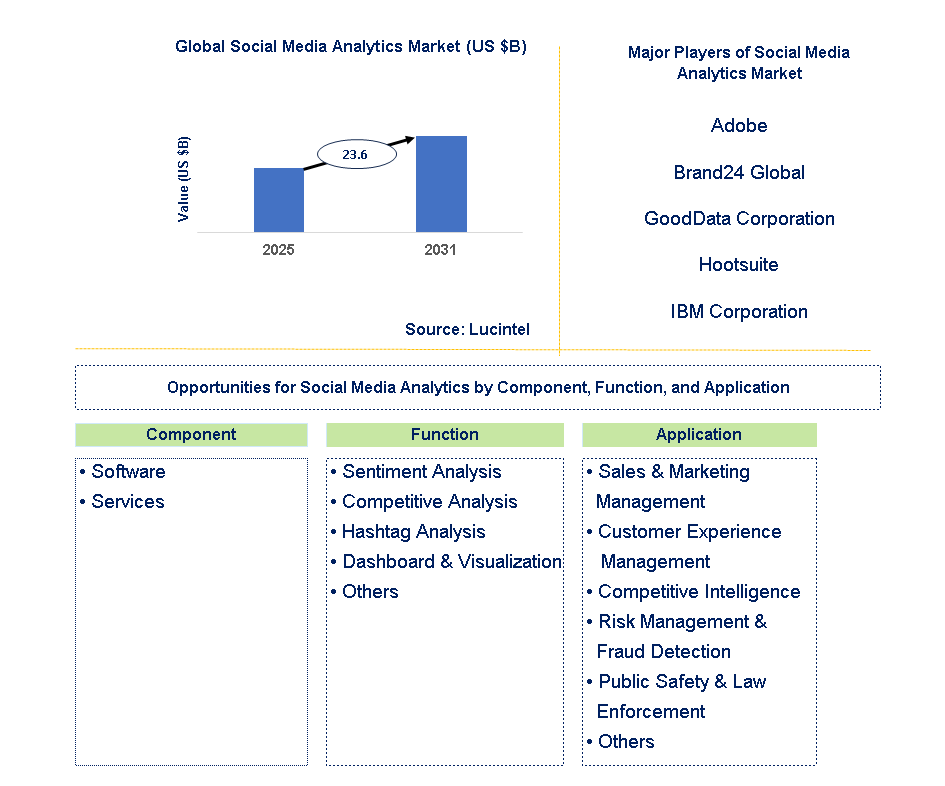
Key data points: The growth forecast = 23.6% annually for the next 7 years. Scroll below to get more insights. This market report covers trends, opportunities and forecasts in social media analytics market to 2031 by component (software and services), function (sentiment analysis, competitive analysis, hashtag analysis, dashboard & visualization, and others), application (sales & marketing management, customer experience management, competitive intelligence, risk management & fraud detection, public safety & law enforcement, and others), and region (North America, Europe, Asia Pacific, and the Rest of the World)
We'll send your sample report shortly.
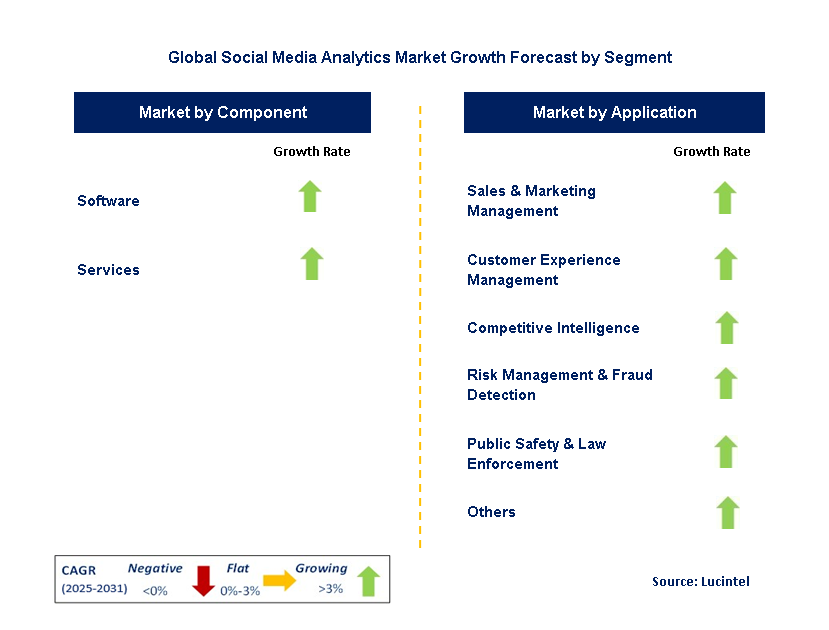
• Lucintel forecasts that, within the component category, software is expected to witness higher growth over the forecast period.
• Within the application category, sales & marketing management is expected to witness the highest growth.
• In terms of region, North America is expected to witness the highest growth over the forecast period. Gain valuable insights for your business decisions with our comprehensive 150+ page report. Sample figures with some insights are shown below.
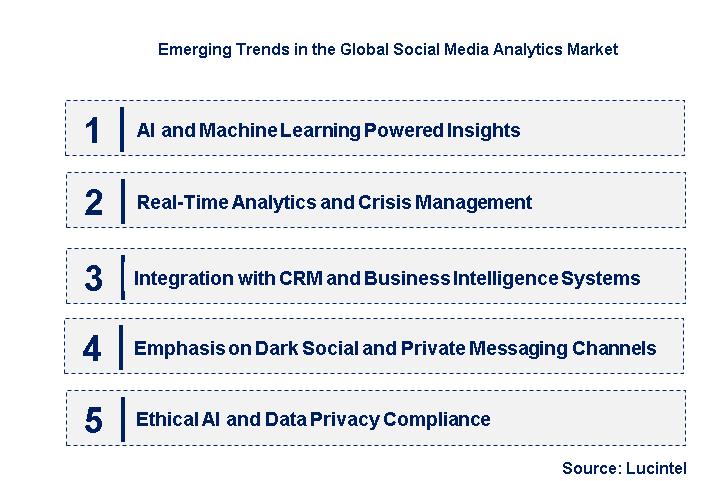
• AI and Machine Learning Powered Insights: The essence of this trend is the deeper integration of AI and ML algorithms in social media analytics platforms. These technologies allow more accurate sentiment analysis, automatic detection of trends, sophisticated image and video recognition, and predictive analytics. Their effect is a move away from descriptive reporting towards prescriptive and predictive insights, enabling companies to foresee future trends and act proactively. This improves decision-making in marketing, customer service, and product development.
• Real-Time Analytics and Crisis Management: There is a heightening need for social media analytics software that enables real-time monitoring and alerting of data. This enables organizations to spot and act on developing issues, brand mentions, or impending crises in real time. The effect is enhanced crisis management and reputation safeguarding, which allows businesses to counter negative sentiment at the earliest opportunity. Real-time insights are essential for quick-footed marketing campaigns and reactive customer engagement strategies.
• Integration with CRM and Business Intelligence Systems: Social media analytics is being combined with more comprehensive business intelligence BI platforms and customer relationship management CRM systems. This provides an integrated view of customer data, linking social data with transactional and demographic data. The result is a better understanding of the overall customer journey and better customer segmentation. More targeted marketing, better customer service, and product development based on data are enabled through this combination.
• Emphasis on Dark Social and Private Messaging Channels: As public social media discourse becomes more editorialized, there's increasing enthusiasm for understanding "dark social" channels, including private messaging apps WhatsApp, Telegram, and invitation-only forums. Although challenging due to privacy issues, new techniques and tools are being developed to gain insight into shared content and sentiment in these environments. The effect is gaining insights from heretofore inaccessible conversations, gaining a more comprehensive view of consumer behavior and brand sentiment where genuine interactions tend to take place.
• Ethical AI and Data Privacy Compliance: With increasing sensitivity to data privacy laws such as GDPR and CCPA, a key trend is the creation of social media analytics tools that are driven by ethical AI practices and compliance. This includes open data gathering, anonymization methods, and upholding user consent. The effect is gaining the trust of consumers and being legally compliant, which is essential for long-term viability. Businesses are looking for tools that are not only strong but also responsible in their data treatment. These trends are extensively redefining the social media analytics industry by increasing the level of data analysis sophistication, broadening the scope of data analysis, and embedding social intelligence within business operations. They are reorienting social media analytics from a separate application to a critical element of end-to-end business strategy, prioritizing predictive analytics, real-time responsiveness, and ethical data practices.
• AI and Natural Language Processing NLP advancements: Recent advances encompass major gains in AI and NLP to support more advanced sentiment analysis, topic identification, and automated social conversation summarization. This makes it possible for tools to recognize subtleties of human language, such as irony and sarcasm. The effect is improved accuracy in reading public opinion and brand perception, resulting in more accurate marketing campaigns and faster brand mention response. It also provides the ability to analyze larger volumes of data with increased efficiency
• Real-Time Data Processing and Alerting Systems: One of the major developments is the ability of social media analytics tools to analyze huge volumes of data in real time and issue instant alerts for important mentions or popular topics. This is critical for agile marketing and crisis management. The result is enabling companies to respond quickly to online discussions, counteract negative opinions, and leverage growing trends. This real-time awareness is essential to help manage brand reputation and interact with consumers properly.
• Cross-Platform Integration and Unified Dashboards: Strong development has been seen in the integration of data across various social media platforms into a unified, one-view dashboard. This gives an overview of an organization's social presence and performance on all channels. The effect is ease of reporting and analysis without the need to switch between multiple tools. The overall view allows for strategic decision-making and resource allocation across social media activities to be better.
• Emphasis on Measuring Influencer Marketing and ROI: Recent advancements involve sophisticated analytics tailored to gauge the return on investment ROI and effectiveness of influencer marketing campaigns. Capabilities in tools now enable identifying the right influencers, monitoring reach and engagement, and assigning sales or leads. The effect is increased accountability and optimization of influencer strategies. Brands are able to make informed decisions on influencer partnerships based on data, allowing their investments to provide quantifiable results.
• Focus on Predictive Analytics and Forecasting: One of the key advancements is the growing ability of social media analytics software to break free from the shackles of past reporting and provide predictive analysis. This entails predicting future trends, expecting consumer actions, and determining possible market change based on patterns in social data. The result is making companies more proactive in their strategies, ranging from product innovation to campaign strategy. Predictive analytics assist in being able to predict market requirements and remain ahead of the competitors. These advances are having a deep impact on the social media analytic industry by making insights smarter, more real-time, and more complete. By applying cutting-edge AI, real-time capabilities, integrated platforms, and predictive modeling, companies are turning social media data into a strategic asset for decision-making, thereby propelling more effective marketing, improved customer experiences, and better brand performance.
• Improved Customer Experience Management: One of the biggest opportunities for growth is through using social media analytics to drive customer experience directly. The use of social listening helps determine customer pain points, collect product feedback, and monitor sentiment about service interactions in real-time. The result is a more responsive, customer-driven approach, resulting in increased customer satisfaction and loyalty. Businesses can create stronger relationships and lower churn by proactively addressing issues that are revealed by social channels.
• Competitive Intelligence and Market Trend Analysis: Using social media analytics for complete competitive intelligence holds significant growth. This means tracking the social strategies of competitors, campaign effectiveness, product releases, and customer attitudes. At the same time, it means finding new market trends and white spaces. The effect is to empower businesses to make strategic decisions based on facts, respond rapidly to changes in markets, and find opportunities to differentiate. This is a key benefit in fast-changing industries.
• Brand Reputation Protection and Risk Management: One of the most important growth opportunities is using social media analytics for active risk management and brand reputation protection. It includes the establishment of real-time alerts on negative word of mouth, early detection of potential crises, and monitoring the propagation of misinformation. The benefit is reducing reputational loss and upholding public trust. Through quick identification and response to threats, organizations are able to protect their brand image and financial sustainability.
• Product Development and Innovation Insights: Utilizing social media analytics for insight collection to inform product development and innovation is an attractive growth opportunity. This entails examining consumer wants, unmet demands, feature wants, and opinions on current products from social chatter. The effect is developing more customer-oriented products and services that actually connect with the target audience. This analytical approach lowers development risk and higher chances of product success.
• Maximizing Influencer Marketing and Campaign Effectiveness: A strategic growth area is the use of social media analysis to maximize influencer marketing campaigns and marketing performance measurement. This includes identifying the most appropriate influencers, monitoring campaign reach and engagement, and attributing social-conversion to overall marketing efforts. The effect is to maximize ROI on marketing expenditure through fact-based decisions across channel allocation and creative content. This means that campaigns will be more effective and resources will be used optimally. These growth prospects for strategic expansion are fundamentally shaping the social media analytic market by diversifying its application from conventional marketing purposes. By helping companies improve customer experience, gather competitive intelligence, manage risks, fuel product development, and maximize marketing performance, social media analytics is emerging as a crucial tool for integrated business expansion and strategic decision-making for multiple sectors.
• Adobe
• Brand24 Global
• GoodData Corporation
• Hootsuite
• IBM Corporation
• NetBase Quid
• Oracle
• Salesforce
• Sprinklr
• Sprout Social
• Software
• Services
• Sentiment Analysis
• Competitive Analysis
• Hashtag Analysis
• Dashboard & Visualization
• Others
• North America
• Europe
• Asia Pacific
• The Rest of the World
• United States: The US social media analytics market is very mature and innovation-oriented. Recent trends include greater use of AI-driven tools for advanced sentiment analysis and predictive analytics to enable brands to predict trends and consumer actions. There is strong emphasis placed upon blending social data with wider customer relationship management CRM and business intelligence BI solutions. Data privacy laws like CCPA heavily impact the way companies harvest and use social data, creating a need for compliant solutions.
• China: China's social media analytics industry is distinguished by the prevalence of localized platforms such as WeChat, Weibo, and Doyin TikTok. Innovation revolves around maximization of the usage of these platforms for hyper-localized consumer insights and real-time trend tracking. With the sheer size of the user base, the application of sophisticated AI and big data analytics is essential to process gargantuan amounts of unstructured data. Social listening is becoming more and more prevalent in companies' uses for public opinion tracking and brand reputation management within its unique digital ecosystem.
• Germany: In Germany, the social media analytics industry is dominated by a high focus on data privacy and being GDPR-compliant. Some recent trends include an increasing need for solutions that provide strong anonymization of data and safe processing of data. Companies, especially manufacturers and auto makers, are implementing analytics for competitive intelligence as well as managing brand reputation. There is also an increasing trend in leveraging social analytics to improve customer service and engagement across omnichannel channels.
• India: India's social media analytics industry is growing at a fast pace, driven by improving internet penetration and booming social media usage, particularly in tier 2 and tier 3 cities. Trends are the emergence of low-cost, cloud-based social media analytics solutions designed specifically for local businesses. A major emphasis is on identifying consumer sentiment and behavior among different linguistic and cultural segments. The expansion of e-commerce and online advertising also fuels the use of social media analytics to optimize campaigns.
• Japan: Japan's social media analytics industry is gradually growing, emphasizing advanced sentiment analysis and influencer marketing performance. Manufacturing, electronics, and automotive companies are embracing analytics solutions for monitoring public attitudes and streamlining digital marketing efforts. Importantly, there is high emphasis on grasping subtle online cultural differences.


• Adobe
• Brand24 Global
• GoodData Corporation
• Hootsuite
• IBM Corporation
• NetBase Quid
• Oracle
• Salesforce
• Sprinklr
• Sprout Social Q5. Which social media analytics market segment will be the largest in future? Answer: Lucintel forecasts that, within the component category, software is expected to witness higher growth over the forecast period. Q6. In social media analytics market, which region is expected to be the largest in next 5 years? Answer: In terms of region, North America is expected to witness the highest growth over the forecast period. Q7. Do we receive customization in this report? Answer: Yes, Lucintel provides 10% customization without any additional cost.


Choose a license that fits your team. Instant PDF delivery.
Prices exclude taxes. Instant delivery. Custom licensing available on request.
Market Report · July 15, 2026
Market Report · June 26, 2026
Market Report · June 24, 2026
Trusted partner for strategic intelligence and business growth


Receive a complimentary market analysis tailored to your industry. Our analysts will identify key growth opportunities and competitive dynamics specific to your business.

Market size, growth rate, and key trend analysis for your specific sector.

Top competitor positioning and market share analysis.

Strategic recommendations backed by data-driven insights.
Get curated market intelligence and competitive moves straight to your inbox.
By subscribing, you agree to receive our monthly insights. Unsubscribe anytime.
Receive a complimentary market analysis tailored to your industry. Our analysts will identify key growth opportunities and competitive dynamics specific to your business.
Market size, growth rate, and key trend analysis for your specific sector.
Top competitor positioning and market share analysis.
Strategic recommendations backed by data-driven insights.
Get curated market intelligence, emerging trends, and competitive moves straight to your inbox each month.
By subscribing, you agree to receive our monthly insights. Unsubscribe anytime.
We'll send your sample report shortly.