
Market Report · July 15, 2026

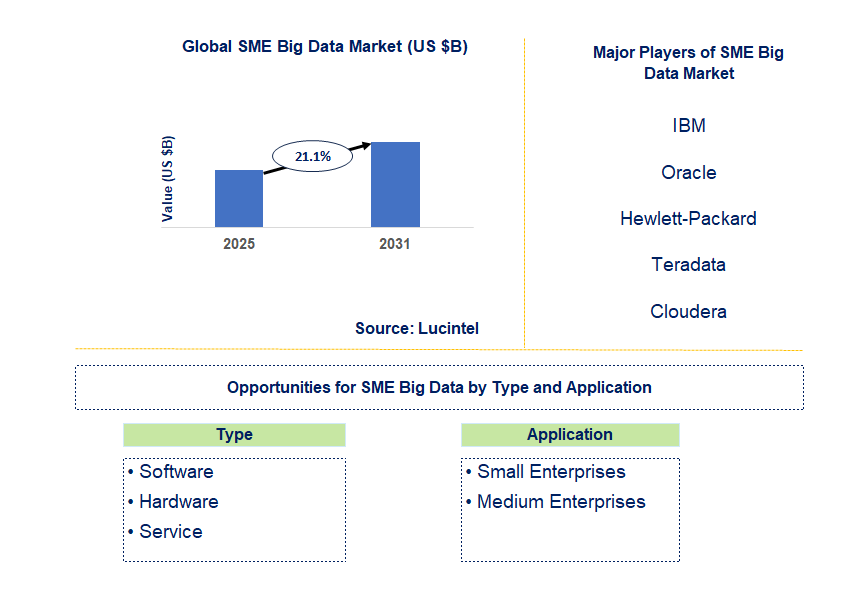
Key data points: The growth forecast = 21.1% annually for the next 7 years. Scroll below to get more insights. This market report covers Trends, opportunity and forecast in SME big data market to 2031 by type (software, hardware, and service), application (small enterprises and medium enterprises), and region (North America, Europe, Asia Pacific, and the Rest of the World)
We'll send your sample report shortly.
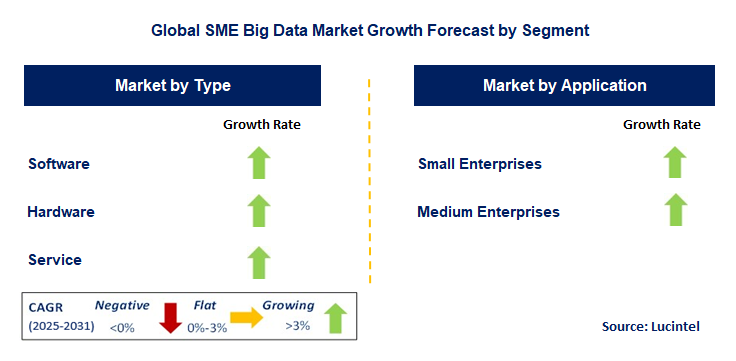
• Lucintel forecasts that, within the type category, software is expected to witness the highest growth over the forecast period.
• Within the application category, small enterprise is expected to witness higher growth.
• In terms of region, APAC is expected to witness the highest growth over the forecast period. Gain valuable insights for your business decisions with our comprehensive 150+ page report. Sample figures with some insights are shown below.
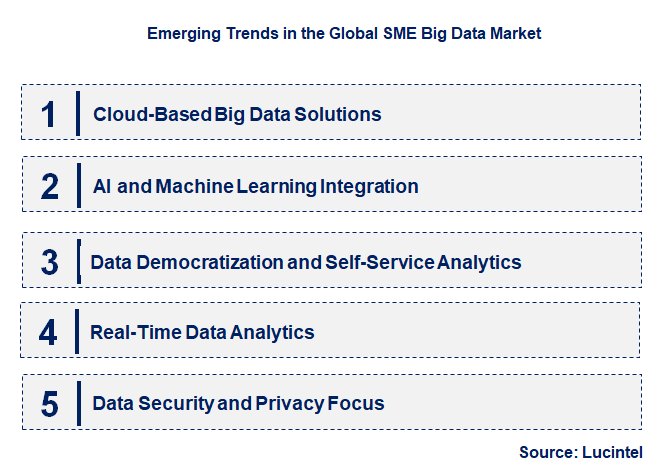
• Cloud-Based Big Data Solutions: Cloud computing has become a game-changer for SMEs in the Big Data market. Cloud-based platforms offer cost-effective, scalable, and flexible solutions, allowing SMEs to access powerful Big Data analytics tools without the need for extensive infrastructure investment. These platforms enable businesses to store, process, and analyze large datasets on demand, making it easier for SMEs to manage and extract value from their data. As SMEs migrate to cloud-based solutions, they benefit from improved data accessibility, collaboration, and scalability, leading to enhanced decision-making and operational efficiency.
• AI and Machine Learning Integration: AI and machine learning are transforming how SMEs approach data analytics. By leveraging these technologies, SMEs can gain predictive insights, automate processes, and optimize decision-making. Machine learning models enable businesses to analyze patterns and trends in customer behavior, sales, and market conditions, which can be used for personalized marketing, inventory management, and product recommendations. AI-driven analytics also help SMEs automate data analysis, reducing the reliance on manual processes and improving operational efficiency. The integration of AI and machine learning makes Big Data more accessible and actionable for SMEs, driving innovation and growth.
• Data Democratization and Self-Service Analytics: Data democratization is a growing trend in the SME big data market, where companies are empowering non-technical staff to access and analyze data through self-service analytics tools. These tools allow employees to generate insights and make data-driven decisions without relying on IT or data science teams. With user-friendly interfaces and intuitive dashboards, SMEs can ensure that decision-making is informed by real-time data insights across departments. This trend is leading to a more data-driven culture within SMEs, where every employee has the ability to leverage data to drive business outcomes and improve overall efficiency.
• Real-Time Data Analytics: Real-time data analytics is becoming increasingly crucial for SMEs to remain competitive in fast-paced markets. By analyzing data as it is generated, businesses can gain immediate insights into customer behavior, market trends, and operational performance. Real-time analytics enable SMEs to make quick decisions, optimize processes, and respond to changing conditions more effectively. This trend is particularly important for industries such as retail, e-commerce, and manufacturing, where the ability to track inventory, monitor customer interactions, and adjust strategies in real-time can provide a significant competitive advantage.
• Data Security and Privacy Focus: As SMEs adopt Big Data solutions, the need for robust data security and privacy measures has become a top priority. With the increasing amount of sensitive data being collected, businesses must ensure that they comply with data protection regulations such as GDPR and CCPA. SMEs are investing in security technologies like encryption, data masking, and secure access controls to protect customer and business data from cyber threats. A focus on data security also builds trust with customers, ensuring that their personal information is protected and that the business adheres to legal and regulatory standards. The SME big data market is being reshaped by key trends such as the adoption of cloud-based solutions, AI and machine learning integration, data democratization, real-time analytics, and enhanced data security. These trends are making Big Data more accessible and valuable for SMEs, enabling them to gain actionable insights, optimize operations, and improve decision-making without the need for large-scale infrastructure or technical expertise. As SMEs continue to embrace these innovations, they can remain competitive in an increasingly data-driven business environment, leading to greater efficiency, innovation, and growth.
• Cloud-Based Big Data Solutions for SMEs: Cloud computing has become a central enabler for SMEs to adopt big data tools without needing expensive infrastructure investments. SaaS (Software as a Service) provides scalable, affordable, and flexible options tailored for SMEs. This allows them to access powerful analytics tools and resources typically reserved for larger enterprises. The shift to cloud-based Big Data solutions has democratized data accessibility, enabling SMEs to use insights for enhanced decision-making, customer personalization, and business optimization, ultimately leading to increased competitiveness in their respective markets.
• Government Support for Digitalization Initiatives: Governments across the globe are increasingly recognizing the value of data-driven technologies for SMEs and have introduced initiatives to encourage their adoption. In countries like India and China, national programs such as “Digital India” and “Made in China 2025” aim to foster the digital transformation of SMEs. These initiatives often include financial incentives, tax breaks, and easy access to affordable Big Data tools. Government support helps SMEs overcome budgetary constraints, allowing them to invest in big data solutions that drive growth and innovation and boost overall market productivity.
• AI Integration into Big Data Analytics: Artificial Intelligence (AI) is revolutionizing the Big Data landscape for SMEs, providing automation, predictive capabilities, and actionable insights. AI-powered Big Data tools are now being integrated into various sectors, such as retail, finance, and healthcare, to streamline operations, automate customer interactions, and improve marketing strategies. The ability to process vast amounts of unstructured data and predict future trends or customer behaviors is transforming how SMEs engage with their data. AI’s inclusion in the Big Data toolkit has opened up new opportunities for SMEs to become more agile, responsive, and customer-centric.
• Focus on Data Security and Compliance: As SMEs embrace Big Data solutions, data security and compliance have become major concerns. Recent regulations like GDPR in Europe and various data protection laws in the U.S. and China have emphasized the need for SMEs to secure sensitive data and ensure privacy. To mitigate these risks, many SMEs are opting for secure cloud-based solutions with built-in compliance features. The increasing importance of cybersecurity is pushing SMEs to prioritize the protection of their data, driving innovations in secure Big Data tools. These developments ensure that SMEs can leverage Big Data while remaining compliant with industry regulations.
• Adoption of Predictive Analytics for Business Insights: Predictive analytics is rapidly becoming a key application of Big Data for SMEs, enabling businesses to anticipate market trends, customer preferences, and operational needs. By leveraging machine learning algorithms and historical data, SMEs can now predict future outcomes with higher accuracy. This empowers businesses to make proactive decisions, optimize supply chains, improve product offerings, and streamline marketing efforts. The ability to anticipate market shifts gives SMEs a competitive edge, allowing them to stay ahead of the curve and mitigate risks in their operations. The recent developments in the SME big data market, including the rise of cloud-based solutions, government support, AI integration, enhanced data security, and predictive analytics, are transforming how SMEs interact with data. These advancements enable businesses to make smarter decisions, improve efficiency, and create more personalized customer experiences. By overcoming traditional barriers to technology adoption and embracing Big Data tools, SMEs are gaining the ability to innovate, compete, and scale at an unprecedented rate. The cumulative effect of these developments is accelerating the growth and digital transformation of SMEs across industries globally.
• Customer Analytics and Personalization: SMEs can leverage Big Data to better understand their customers and deliver personalized experiences. By analyzing customer behavior, preferences, and feedback, businesses can develop targeted marketing campaigns, improve product offerings, and enhance customer satisfaction. The ability to segment customers and tailor offerings based on data-driven insights opens new opportunities for SMEs to build stronger customer relationships. As personalized experiences become increasingly important, SMEs that effectively use customer analytics to improve engagement and loyalty are likely to gain a competitive edge in their respective industries.
• Supply Chain Optimization: Big Data tools offer SMEs the ability to streamline and optimize their supply chains. By analyzing data from suppliers, logistics partners, and inventory systems, SMEs can forecast demand more accurately, optimize stock levels, and improve delivery times. Predictive analytics help businesses identify bottlenecks and inefficiencies, allowing for better resource allocation and cost reduction. This application of Big Data enhances operational efficiency, reduces operational costs, and ensures that SMEs can meet customer demands more effectively, driving growth and profitability in the supply chain management domain.
• Sales Forecasting and Demand Planning: Sales forecasting and demand planning represent a key growth area for SMEs utilizing Big Data. By analyzing historical sales data, market trends, and external factors, SMEs can predict future demand and adjust their sales strategies accordingly. Data-driven insights enable businesses to optimize inventory levels, reduce overstocking, and prevent stockouts, leading to better cash flow management. Accurate sales forecasts also enhance decision-making in areas such as pricing, marketing, and production planning, ensuring that SMEs can align their operations with market needs, driving growth and profitability.
• Marketing Optimization and Campaign Effectiveness: Big Data is transforming how SMEs approach marketing by enabling them to optimize campaigns in real-time. By analyzing data from multiple channels such as social media, email, and web analytics, SMEs can gain insights into customer behavior and preferences. This allows businesses to fine-tune their marketing strategies, personalize advertisements, and improve customer targeting. The ability to measure the effectiveness of marketing campaigns and adjust tactics based on data-driven insights provides SMEs with a competitive advantage, improving ROI on marketing spend and driving business growth.
• Financial Management and Risk Analysis: Big Data tools offer SMEs enhanced capabilities in financial management and risk analysis. By analyzing financial data, market conditions, and historical performance, SMEs can identify potential risks, optimize cash flow, and make more informed financial decisions. Predictive analytics help businesses anticipate market fluctuations, enabling them to mitigate financial risks and seize growth opportunities. Additionally, data-driven insights improve budgeting, forecasting, and investment decisions, allowing SMEs to allocate resources more efficiently and maintain financial stability while pursuing growth strategies. The strategic growth opportunities in the SME big data market are vast and diverse, spanning across customer analytics, supply chain optimization, sales forecasting, marketing, and financial management. These applications enable SMEs to leverage data-driven insights to optimize their operations, improve customer satisfaction, and enhance decision-making. By adopting Big Data technologies in these key areas, SMEs can achieve greater efficiency, reduce costs, and enhance their competitive positioning. The continuous adoption of Big Data solutions is empowering SMEs to drive innovation, improve profitability, and remain agile in an increasingly data-driven business environment.
• IBM
• Oracle
• Hewlett-Packard
• Teradata
• Cloudera
• Dell
• Microsoft
• SAP
• Splunk
• Software
• Hardware
• Service
• Small Enterprises
• Medium Enterprises
• North America
• Europe
• Asia Pacific
• The Rest of the World
• United States: In the United States, the SME big data market is growing rapidly due to the increasing availability of cloud-based solutions, AI tools, and affordable analytics platforms. The proliferation of software-as-a-service (SaaS) offerings has enabled SMEs to adopt Big Data technologies without the need for significant upfront investment in infrastructure. Key developments include the rise of advanced analytics platforms designed to simplify data collection, processing, and visualization for SMEs. Additionally, U.S. SMEs are increasingly focusing on using Big Data to personalize customer experiences and optimize supply chain management. The government’s initiatives to support digital transformation among SMEs have also contributed to market growth.
• China: In China, the SME big data market is expanding due to government-backed initiatives to digitalize the economy, along with the growing presence of technology giants offering Big Data solutions. Chinese SMEs are increasingly adopting AI and Big Data to improve operational efficiency and customer engagement. The government’s policies and the availability of financial incentives for digital adoption have made it easier for SMEs to invest in Big Data infrastructure. In addition, Chinese SMEs are capitalizing on local data platforms and analytics tools, enabling them to tap into the wealth of data generated by their rapidly growing digital economy.
• Germany: Germany is positioning itself as a leader in the SME big data market in Europe, with a strong focus on Industry 4.0 initiatives that leverage Big Data for manufacturing optimization. German SMEs are increasingly adopting IoT sensors, AI, and Big Data analytics to improve product quality, streamline production, and minimize costs. The country’s emphasis on data privacy and security is influencing the adoption of local cloud infrastructure, enabling SMEs to maintain compliance with GDPR regulations. Furthermore, German SMEs are embracing predictive analytics and automation to gain insights into market trends, consumer behavior, and supply chain management.
• India: In India, the SME big data market is experiencing robust growth, driven by increasing internet penetration, mobile adoption, and the proliferation of affordable cloud-based solutions. Indian SMEs are adopting Big Data tools to improve decision-making and gain insights into customer preferences. Government initiatives like “Digital India” are helping to encourage digital adoption among SMEs. In addition, the rise of Big Data startups in India is fueling the ecosystem by providing cost-effective and scalable solutions tailored to the needs of SMEs. Data-driven marketing and supply chain optimization are emerging as key use cases for Indian SMEs.
• Japan: In Japan, the SME big data market is growing steadily, particularly in the manufacturing and retail sectors. Japanese SMEs are leveraging Big Data technologies to improve product quality, increase operational efficiency, and develop innovative customer service solutions. The Japanese government’s “Society 5.0” initiative, which aims to integrate digital technologies into everyday life, is driving the adoption of Big Data among SMEs. Moreover, the rise of AI and automation technologies in Japan is encouraging SMEs to adopt Big Data analytics for predictive maintenance, demand forecasting, and supply chain optimization, helping them stay competitive in the global market.


• IBM
• Oracle
• Hewlett-Packard
• Teradata
• Cloudera
• Dell
• Microsoft
• SAP
• Splunk Q5. Which SME big data market segment will be the largest in future? Answer: Lucintel forecasts that software is expected to witness the highest growth over the forecast period. Q6. In SME big data market, which region is expected to be the largest in next 5 years? Answer: APAC is expected to witness the highest growth over the forecast period. Q7. Do we receive customization in this report? Answer: Yes, Lucintel provides 10% customization without any additional cost.


Choose a license that fits your team. Instant PDF delivery.
Prices exclude taxes. Instant delivery. Custom licensing available on request.
Market Report · July 15, 2026
Market Report · June 26, 2026
Market Report · June 24, 2026
Trusted partner for strategic intelligence and business growth


Receive a complimentary market analysis tailored to your industry. Our analysts will identify key growth opportunities and competitive dynamics specific to your business.

Market size, growth rate, and key trend analysis for your specific sector.

Top competitor positioning and market share analysis.

Strategic recommendations backed by data-driven insights.
Get curated market intelligence and competitive moves straight to your inbox.
By subscribing, you agree to receive our monthly insights. Unsubscribe anytime.
Receive a complimentary market analysis tailored to your industry. Our analysts will identify key growth opportunities and competitive dynamics specific to your business.
Market size, growth rate, and key trend analysis for your specific sector.
Top competitor positioning and market share analysis.
Strategic recommendations backed by data-driven insights.
Get curated market intelligence, emerging trends, and competitive moves straight to your inbox each month.
By subscribing, you agree to receive our monthly insights. Unsubscribe anytime.
We'll send your sample report shortly.