
Market Report · July 16, 2026

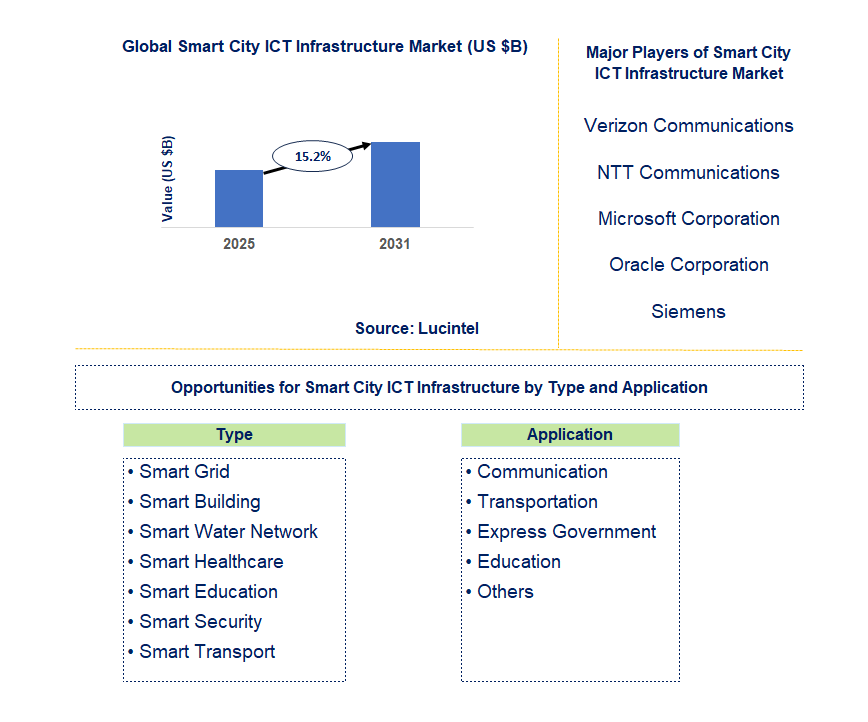
Key data points: The growth forecast = 15.2% annually for the next 7 years. Scroll below to get more insights. This market report covers Trends, opportunity and forecast in smart city ICT infrastructure market to 2031 by type (smart grid, smart building, smart water network, smart healthcare, smart education, smart security, and smart transport), application (communication, transportation, express government, education, and others), and region (North America, Europe, Asia Pacific, and the Rest of the World)
We'll send your sample report shortly.
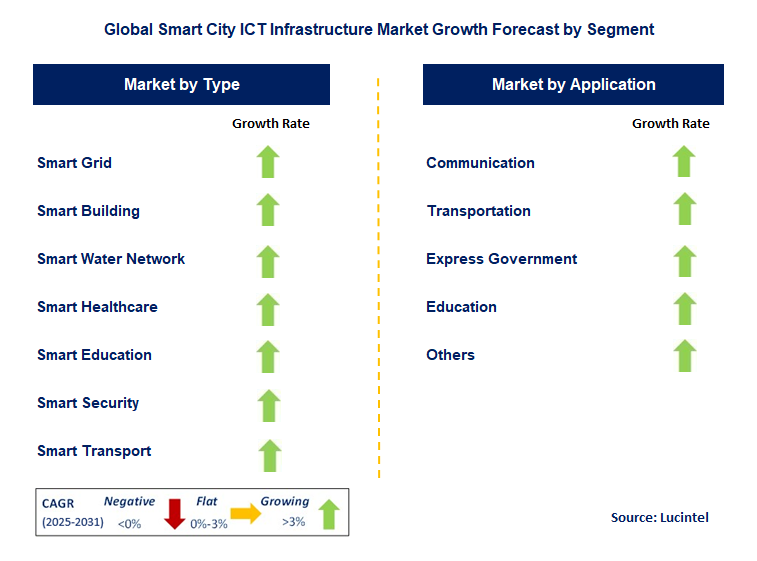
• Lucintel forecasts that, within the type category, smart grid is expected to witness the highest growth over the forecast period.
• Within the application category, communication is expected to witness the highest growth.
• In terms of region, APAC is expected to witness the highest growth over the forecast period. Gain valuable insights for your business decisions with our comprehensive 150+ page report. Sample figures with some insights are shown below.
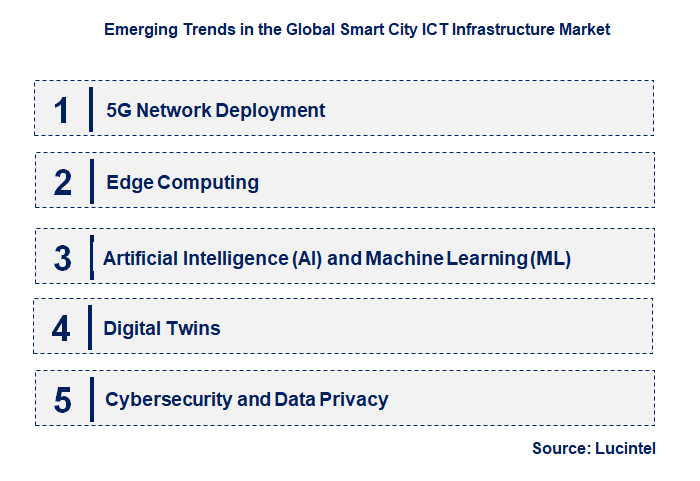
• 5G Network Deployment: The rollout of 5G networks is a transformative trend, providing the high bandwidth and low latency required for many smart city applications. 5G enables real-time data transfer, supporting applications like autonomous vehicles, smart grids, and large-scale IoT deployments. This enhanced connectivity is crucial for creating truly connected and responsive smart cities.
• Edge Computing: Edge computing is gaining prominence, processing data closer to the source, such as IoT devices and sensors. This reduces latency, improves real-time decision-making, and enhances the security of smart city applications. Edge computing is essential for applications that require immediate processing, such as autonomous driving and real-time video analytics.
• Artificial Intelligence (AI) and Machine Learning (ML): AI and ML are being integrated into smart city infrastructure to analyze vast amounts of data collected from various sources. These technologies enable predictive analytics, optimize resource allocation, and improve the efficiency of city services. AI and ML are crucial for creating intelligent and adaptive smart city systems.
• Digital Twins: The concept of digital twins, virtual replicas of physical city infrastructure, is emerging. Digital twins allow cities to simulate different scenarios, optimize infrastructure performance, and improve planning and decision-making. This technology enables cities to proactively manage their infrastructure and improve resilience.
• Cybersecurity and Data Privacy: As cities become more connected, cybersecurity and data privacy are paramount. Smart city infrastructure must be designed with robust security measures to protect sensitive data from cyberattacks and ensure citizen privacy. This focus on security is crucial for building trust and ensuring the responsible use of data in smart cities. These emerging trends are reshaping the smart city ICT infrastructure market by driving the development of more powerful, secure, and intelligent city systems. The deployment of 5G, edge computing, AI/ML, digital twins, and a strong emphasis on cybersecurity are transforming how cities operate and serve their citizens. These advancements are creating more efficient, sustainable, and livable urban environments, paving the way for the smart cities of the future.
• 5G Network Expansion: The rapid expansion of 5G networks is a key development, providing the high bandwidth and low latency required for many smart city applications. 5G enables real-time data transfer, supporting applications like autonomous vehicles, smart grids, and large-scale IoT deployments. This enhanced connectivity is crucial for creating truly connected and responsive smart cities, enabling faster communication and improved performance of various smart city systems.
• Growth of Edge Computing: Edge computing is gaining significant traction, processing data closer to the source, such as IoT devices and sensors. This reduces latency, improves real-time decision-making, and enhances the security of smart city applications. Edge computing is essential for applications that require immediate processing, such as autonomous driving and real-time video analytics, improving responsiveness and reducing reliance on centralized infrastructure.
• Integration of Artificial Intelligence (AI): AI and machine learning are being increasingly integrated into smart city infrastructure to analyze vast amounts of data collected from various sources. These technologies enable predictive analytics, optimize resource allocation, and improve the efficiency of city services. AI is crucial for creating intelligent and adaptive smart city systems, enabling proactive management of city resources and improved service delivery.
• Development of Open Data Platforms: Cities are developing open data platforms to share data with citizens, businesses, and researchers. This promotes transparency, encourages innovation, and facilitates the development of new smart city applications. Open data platforms empower citizens and businesses to participate in the development and improvement of city services, fostering collaboration and innovation.
• Emphasis on Cybersecurity: As cities become more connected, cybersecurity and data privacy are paramount. Smart city infrastructure must be designed with robust security measures to protect sensitive data from cyberattacks and ensure citizen privacy. This focus on security is crucial for building trust and ensuring the responsible use of data in smart cities, protecting citizen data, and ensuring the integrity of city systems. These recent developments are significantly impacting the smart city ICT infrastructure market by driving the creation of more connected, intelligent, and secure urban environments. The expansion of 5G networks, the growth of edge computing, the integration of AI, the development of open data platforms, and the emphasis on cybersecurity are transforming how cities operate and serve their citizens. These advancements are leading to more efficient, sustainable, and livable urban spaces, paving the way for the smart cities of the future.
• Intelligent Transportation Systems (ITS): The development of ITS presents a major growth opportunity. Smart traffic management systems, connected vehicles, and real-time traffic information can optimize traffic flow, reduce congestion, and improve road safety. This includes smart parking solutions, electric vehicle charging infrastructure, and public transportation management systems. ITS can significantly enhance urban mobility and reduce travel times for citizens.
• Smart Energy Grids: Smart grids offer significant growth potential by enabling efficient energy distribution, reducing energy waste, and integrating renewable energy sources. Smart meters, sensors, and data analytics can optimize energy consumption and improve grid reliability. This includes solutions for smart lighting, building energy management, and demand response programs. Smart grids are crucial for creating sustainable and energy-efficient cities.
• Public Safety and Security: Smart city ICT infrastructure plays a vital role in enhancing public safety and security. Surveillance systems, video analytics, and emergency response systems can improve crime prevention and incident management. This includes gunshot detection systems, predictive policing platforms, and citizen reporting apps. Enhanced public safety contributes to a more secure and livable urban environment.
• Environmental Monitoring and Management: Smart city infrastructure can support environmental monitoring and management through the deployment of sensors and data analytics platforms. Real-time air quality monitoring, water quality management, and waste management systems can help cities address environmental challenges and improve sustainability. This includes noise pollution monitoring, smart irrigation systems, and environmental data platforms. Effective environmental management is crucial for creating healthy and sustainable cities.
• Citizen Engagement and Services: Smart city platforms can improve citizen engagement and access to government services. Mobile apps, online portals, and digital kiosks can provide citizens with easy access to information, enable them to report issues and facilitate communication with city officials. This includes online permitting systems, digital service delivery platforms, and citizen feedback mechanisms. Enhanced citizen engagement fosters a more participatory and responsive city government. These growth opportunities are significantly impacting the smart city ICT infrastructure market by driving innovation and investment across various sectors. The increasing demand for smart city solutions is creating a strong market for technology providers, telecommunication companies, and other stakeholders involved in building smart city infrastructure. The convergence of these trends is accelerating the transformation of urban environments and paving the way for more efficient, sustainable, and livable cities. These opportunities are shaping the future of urban living and creating new possibilities for innovation and economic growth.
• Verizon Communications
• NTT Communications
• Microsoft Corporation
• Oracle Corporation
• Siemens
• IBM Corporation
• Hitachi
• Cisco Systems
• Ericsson
• ABB
• Smart Grid
• Smart Building
• Smart Water Network
• Smart Healthcare
• Smart Education
• Smart Security
• Smart Transport
• Communication
• Transportation
• Express Government
• Education
• Others
• North America
• Europe
• Asia Pacific
• The Rest of the World
• United States: The US market is highly mature, with a strong focus on innovation and private sector involvement. Cities are investing in 5G networks, edge computing infrastructure, and IoT platforms to support smart city applications. There is a growing emphasis on data privacy and cybersecurity in smart city deployments. The US government is also supporting smart city initiatives through funding programs and regulatory frameworks.
• China: China is rapidly expanding its smart city ICT infrastructure, with large-scale deployments of 5G networks, IoT sensors, and AI-powered platforms. The Chinese government is playing a leading role in driving smart city development, with significant investments in infrastructure projects. Chinese companies are at the forefront of developing and deploying smart city technologies.
• Germany: Germany is focusing on developing sustainable and citizen-centric smart cities. German cities are investing in smart grids, energy-efficient buildings, and intelligent transportation systems. There is a strong emphasis on data privacy and security, with strict regulations governing the collection and use of citizen data. The German government is supporting smart city initiatives through research and development programs.
• India: India is an emerging market with a large and growing urban population. The Indian government is promoting smart city development through its Smart Cities Mission, which focuses on improving urban infrastructure and services. The market is witnessing increasing adoption of cost-effective ICT solutions for smart city applications.
• Japan: Japan is a technologically advanced market with a strong focus on innovation and efficiency. Japanese cities are investing in smart energy management systems, intelligent transportation systems, and disaster preparedness technologies. There is a growing emphasis on using technology to address social challenges, such as aging populations and declining birth rates.


• Verizon Communications
• NTT Communications
• Microsoft Corporation
• Oracle Corporation
• Siemens
• IBM Corporation
• Hitachi
• Cisco Systems
• Ericsson
• ABB Q5. Which smart city ICT infrastructure market segment will be the largest in future? Answer: Lucintel forecasts that smart grid is expected to witness the highest growth over the forecast period. Q6. In smart city ICT infrastructure market, which region is expected to be the largest in next 5 years? Answer: APAC is expected to witness the highest growth over the forecast period. Q7. Do we receive customization in this report? Answer: Yes, Lucintel provides 10% customization without any additional cost.


Choose a license that fits your team. Instant PDF delivery.
Prices exclude taxes. Instant delivery. Custom licensing available on request.
Market Report · July 16, 2026
Market Report · May 18, 2026
Market Report · May 18, 2026
Trusted partner for strategic intelligence and business growth


Receive a complimentary market analysis tailored to your industry. Our analysts will identify key growth opportunities and competitive dynamics specific to your business.

Market size, growth rate, and key trend analysis for your specific sector.

Top competitor positioning and market share analysis.

Strategic recommendations backed by data-driven insights.
Get curated market intelligence and competitive moves straight to your inbox.
By subscribing, you agree to receive our monthly insights. Unsubscribe anytime.
Receive a complimentary market analysis tailored to your industry. Our analysts will identify key growth opportunities and competitive dynamics specific to your business.
Market size, growth rate, and key trend analysis for your specific sector.
Top competitor positioning and market share analysis.
Strategic recommendations backed by data-driven insights.
Get curated market intelligence, emerging trends, and competitive moves straight to your inbox each month.
By subscribing, you agree to receive our monthly insights. Unsubscribe anytime.
We'll send your sample report shortly.