
Market Report · July 15, 2026

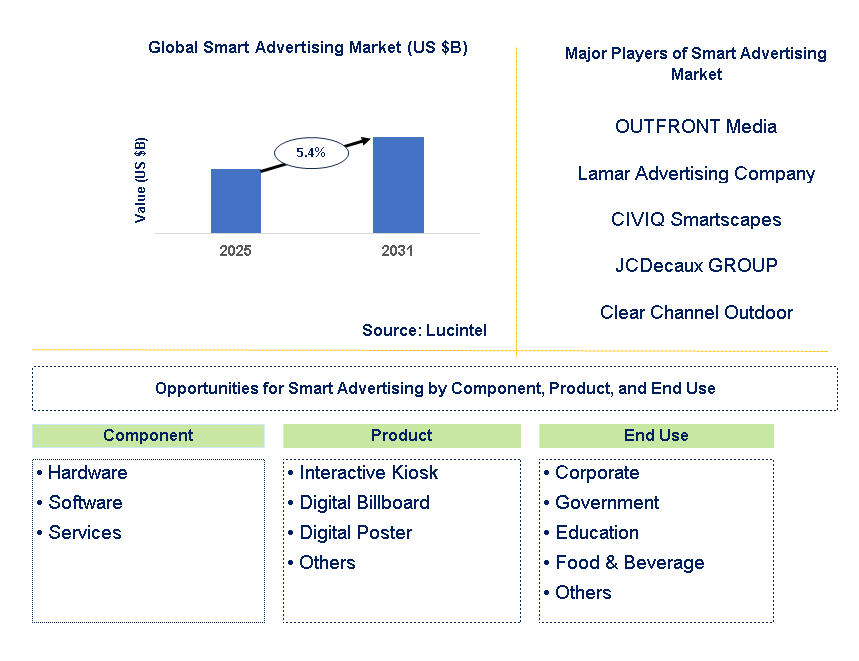
Key data points: The growth forecast = 5.4% annually for the next 7 years. Scroll below to get more insights. This market report covers trends, opportunities and forecasts in smart advertising market to 2031 by component (hardware, software, and services), product (interactive kiosk, digital billboard, digital poster, and others), end use (corporate, government, education, food & beverage, and others), and region (North America, Europe, Asia Pacific, and the Rest of the World)
We'll send your sample report shortly.
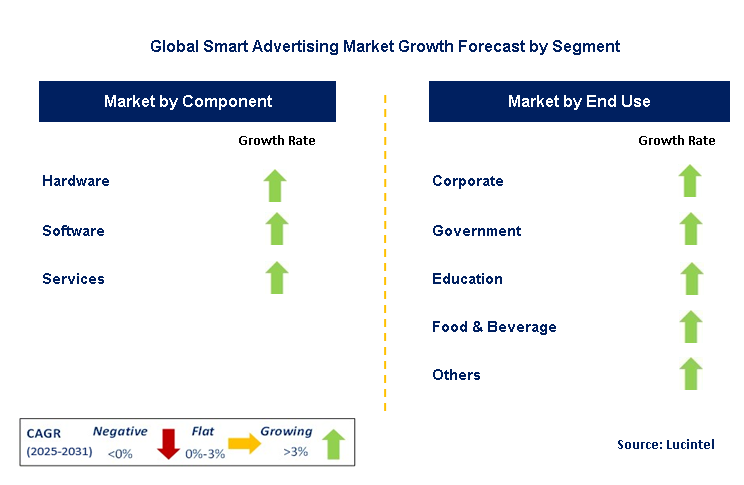
• Lucintel forecasts that, within the component category, software is expected to witness higher growth over the forecast period.
• Within the end use category, corporate is expected to witness the highest growth.
• In terms of region, North America is expected to witness the highest growth over the forecast period. Gain valuable insights for your business decisions with our comprehensive 150+ page report. Sample figures with some insights are shown below.
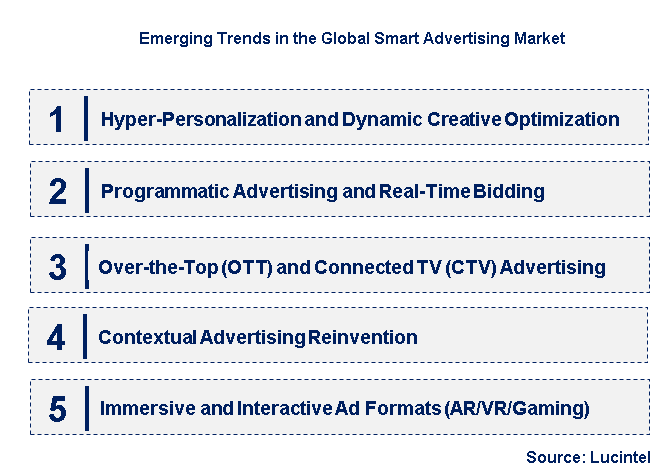
• Hyper-Personalization and Dynamic Creative Optimization: This movement is about serving highly personalized ad copy to individual shoppers according to their actual-time conduct, inclinations, and demographics. Using artificial intelligence and machine learning, dynamic creative optimization enables advertisers to produce several versions of an advertisement, testing and delivering automatically the most successful mix of headlines, imagery, and calls to action. This maximizes relevance and engagement, dramatically enhancing conversion rates by addressing individual needs directly.
• Programmatic Advertising and Real-Time Bidding: Programmatic advertising involves automated buying and selling of advertisement inventory by real-time auctions. This trend leverages algorithms to optimize the positions of ads and bids in milliseconds to ensure that advertisements are displayed to the most appropriate audiences at the best times. Its effect is to bring enhanced efficiency, lower manual workloads, and enhanced campaign performance. Programmatic advertising supports highly targeted campaigns on multiple digital channels to optimize the return on ad spend.
• Over-the-Top (OTT) and Connected TV (CTV) Advertising: With the growth of streaming media and connected TVs, there have been new opportunities created for smart advertising. CTV and OTT advertising send targeted ads in the middle of video content watched on connected devices, providing a broadcast-style experience with digital sophistication. This trend enables advertisers to connect cord-cutters and engaged viewers using data-driven segmentation. Its effect is a more cohesive and less obtrusive ad experience for consumers, combined with more sophisticated targeting capabilities for advertisers.
• Contextual Advertising Reinvention: With data privacy regulations becoming more stringent and third-party cookies being phased out, contextual advertising is back in focus but more sophisticated. The trend sees advertisements placed against the content of the webpage or video being consumed, not against individual users’ data. Using AI, new contextual advertising can interpret content meaning and sentiment to provide brand safety and pertinence. Its effect is a privacy-friendly solution for targeting with effective reach at the price of respecting consumer data privacy.
• Immersive and Interactive Ad Formats (AR/VR/Gaming): Trend sees highly interactive and engaging ad experiences with technologies such as augmented reality, virtual reality, and gaming integrations. Consumers are able to interact with 3D product simulations, engage with branded mini-games, or visit virtual showrooms within an ad. The effect is much increased engagement, brand remembrance, and purchase consideration, changing advertisement from a passive consumption to an active, memorable experience that engages the viewer on an emotional level. These new trends are deeply changing the smart advertising landscape to make campaigns more personal, effective, and engaging. They are departing from ubiquitous, unsegmented communication towards specific, data-informed engagement with a focus on consumer experience and measurable impact. This shift allows brands to establish more meaningful connections with their audiences, optimize their ad spend, and successfully navigate the rich digital environment to drive business.
• Third-Party Cookie Phase-out and First-Party Data Concentration: One of the most important developments is the industry-wide shift away from third-party cookies, sparked mainly by privacy legislation and browser updates. It has prompted a heavy concentration on first-party data strategies, where brands are collecting and using data directly from their customers. This evolution requires new methods of measurement and audience targeting, encouraging advertisers to construct more profound direct connections with consumers and depend on consent-driven data collection processes, which increase trust and transparency.
• AI and Machine Learning Proliferation in Ad Operations: The widespread adoption of artificial intelligence and machine learning has revolutionized virtually every component of smart advertising. AI is currently employed for predictive analytics, audience segmentation, real-time optimization of bidding, and even creative dynamic generation. This advancement enables unmatched levels of accuracy in targeting, budgeting efficiency, and capacity to automate sophisticated campaign management functions, substantially increasing campaign performance and lowering the level of manual effort required by advertisers.
• Programmatic Digital Out-of-Home (DOOH) growth: Programmatic DOOH is a fast-growing sector, using data and automation to serve dynamic content advertising on digital screens and billboards in public areas. The evolution enables advertisers to reach people by utilizing real-time variables such as location, weather, time of day, and demographics traveling by. It combines the classic reach of OOH with digital ease and measurability, allowing hyper-local and contextually aware advertising campaigns that are extremely effective.
• Growth of Connected TV (CTV) Advertising and Addressable TV: The growing migration from linear TV to streaming services on Connected TV platforms has unlocked new horizons for smart advertising. CTV advertising facilitates highly targeted advertising sent directly to homes through demographics, viewing behavior, and other points of data, referred to as addressable TV. This innovation brings digital advertising capability to the television screen, allowing for specific audience reach and measurable results on a high-quality viewing platform, shaking traditional TV ad models.
• Progress in Measurement and Attribution Models: The smart advertising industry has witnessed groundbreaking progress in measurement and attribution modeling tools and processes for campaign performance and conversion attribution. Multi-touch attribution models, sophisticated analytics suites, and data collaboration clean rooms are increasingly becoming the norm. This innovation creates a better picture for advertisers of their return on investment, allowing them to better optimize across touchpoints and make wiser budget allocation decisions, driving greater accountability and transparency. These innovations are deeply influencing the smart advertising industry by making it data-driven, automated, and targeted like never before. The emphasis on privacy-focused solutions along with the strength of AI and penetration into new channels such as CTV and programmatic DOOH is making the advertising ecosystem more intelligent and efficient. This evolution enables brands to reach consumers with more unprecedented accuracy and relevance, driving their marketing impact to the maximum.
• Personalization in Retail and E-commerce: The retail and e-commerce industries provide enormous growth prospects for smart advertising through hyper-personalization. This entails leveraging Browse history data, purchase activity, and demographics to provide highly personalized product suggestions and offers on websites, social media, and email. This use of application improves the customer experience, enhances conversion rates, and enhances customer lifetime value by rendering the shopping experience as uniquely personalized to each consumer.
• Automotive Sector for Hightly Targeted Vehicle Sales and Services: The auto sector can utilize smart advertising to promote extremely targeted campaigns, ranging from new vehicle launches to post-sales services. This entails targeting prospective customers based on their online research, car ownership history, and lifestyle segments, serving up customized ads for individual models or maintenance reminders. This usage enables the manufacturers of cars and dealerships to target interested consumers more efficiently, maximize marketing expenditures, and send visitors to showrooms or service appointments.
• Travel and Hospitality Dynamic Packaging and Offers: The hospitality and travel industry holds a bright promise for smart advertising via dynamic ad content. This entails creating real-time ads for flight, hotel, and travel package offers based on user search activity, location, and history of travel choices. For example, an active search for beach vacations can lead to ads from particular resorts or flights. This app pushes bookings by serving extremely relevant and timely promotions, leveraging current consumer intent.
• Pharmaceutical and Healthcare for Patient Education and Engagement: Intelligent advertising can be dynamically used in the healthcare and pharmaceutical sector for patient education, health awareness, and marketing of certain medical services. It means directing health-related information to patients with their conditions or interests and following strict privacy guidelines. This usage can enhance public health outcomes, increase patient engagement with healthcare professionals, and transmit important health messages to the targeted audience responsibly.
• Gaming and Entertainment for User Acquisition and In-Game Ads: The fast-growing gaming and entertainment markets present important expansion opportunities for smart advertising, especially in user acquisition and in-game advertising. This includes targeting potential players with announcements of new titles according to their gaming interests or showing dynamic, unobtrusive ads within games themselves. This tool assists developers in gaining high-value users, successfully monetizing free-to-play games, and improving the gaming experience as a whole via contextual ad placement. These strategic growth opportunities are having a profound influence on the smart advertising market by showcasing its versatility and value across a broad spectrum of industries. They are emphasizing the growth in the market beyond typical, generic campaigns to very specialized and data-based solutions that solve particular business needs. By targeting these application-specific solutions, smart advertising providers can gain meaningful market share and deliver substantial value to their customers.
• OUTFRONT Media
• Lamar Advertising Company
• CIVIQ Smartscapes
• JCDecaux GROUP
• Clear Channel Outdoor
• Include
• Intersection
• IKE SMART CITY
• CAPTIVATE
• Changing Environments
• Hardware
• Software
• Services
• Interactive Kiosk
• Digital Billboard
• Digital Poster
• Others
• North America
• Europe
• Asia Pacific
• The Rest of the World
• United States: In the United States smart ad market, there is substantial investment in programmatic advertising and AI-optimized optimization. There is a high emphasis on first-party data approaches as third-party cookies are phased out, in conjunction with innovations surrounding connected TV advertising. Brands are using machine learning for hyper-personalization and real-time bidding to optimize campaign efficiency and reach. There is also increased focus on privacy-compliant data solutions and transparent advertising.
• China: China’s smart advertising market is extremely dynamic and technologically sophisticated with dominance from mobile and live commerce platforms. Short-video platforms such as Doyin are primary channels for interactive and shoppable advertisements. The market relies extensively on AI for consumer profiling, personalized recommendations, and dynamic ad content generation. Localized data ecosystems and super apps facilitate deep integration of advertising in day-to-day consumer behavior, creating a seamless and extremely effective advertising experience.
• Germany: In Germany, the smart advertising market is increasing steadily, with a strong focus on data privacy and ethical advertising methods. Programmatic advertising is on the rise, but with very strict compliance with GDPR standards. Brands are making greater investments in contextual advertising and solutions that have lower dependency on individual user data. Digital out of home advertising that combines with smart technologies for localized and targeted messaging also sees significant growth.
• India: India’s smart advertising economy is seeing fast growth, driven by growing internet penetration, smartphone use, and a thriving e-commerce industry. Mobile marketing and video marketing are major drivers, serving a youth-heavy, digitally-connected population. The economy is seeing strong growth in localized and vernacular ad messaging, with AI used for audience segmentation and targeted messaging across various regional markets. Cost efficiency and scalability are top of mind for brands.
• Japan: Japan’s smart advertising market is continuously developing with emphasis on high-quality content and brand security. Programmatic buying continues to be embraced and is usually combined with traditional media planning for omnichannel approaches. Data-driven personalization and consumer privacy are becoming more popular. Advertisers are also looking into innovative formats such as augmented reality advertising and combining smart advertising with new technologies such as 5G for more immersive and engaging experiences.


• OUTFRONT Media
• Lamar Advertising Company
• CIVIQ Smartscapes
• JCDecaux GROUP
• Clear Channel Outdoor
• Include
• Intersection
• IKE SMART CITY
• CAPTIVATE
• Changing Environments Q5. Which smart advertising market segment will be the largest in future? Answer: Lucintel forecasts that, within the component category, software is expected to witness higher growth over the forecast period. Q6. In smart advertising market, which region is expected to be the largest in next 5 years? Answer: In terms of region, North America is expected to witness the highest growth over the forecast period. Q7. Do we receive customization in this report? Answer: Yes, Lucintel provides 10% customization without any additional cost.


Choose a license that fits your team. Instant PDF delivery.
Prices exclude taxes. Instant delivery. Custom licensing available on request.
Market Report · July 15, 2026
Market Report · June 26, 2026
Market Report · June 24, 2026
Trusted partner for strategic intelligence and business growth


Receive a complimentary market analysis tailored to your industry. Our analysts will identify key growth opportunities and competitive dynamics specific to your business.

Market size, growth rate, and key trend analysis for your specific sector.

Top competitor positioning and market share analysis.

Strategic recommendations backed by data-driven insights.
Get curated market intelligence and competitive moves straight to your inbox.
By subscribing, you agree to receive our monthly insights. Unsubscribe anytime.
Receive a complimentary market analysis tailored to your industry. Our analysts will identify key growth opportunities and competitive dynamics specific to your business.
Market size, growth rate, and key trend analysis for your specific sector.
Top competitor positioning and market share analysis.
Strategic recommendations backed by data-driven insights.
Get curated market intelligence, emerging trends, and competitive moves straight to your inbox each month.
By subscribing, you agree to receive our monthly insights. Unsubscribe anytime.
We'll send your sample report shortly.