
Market Report · July 20, 2026

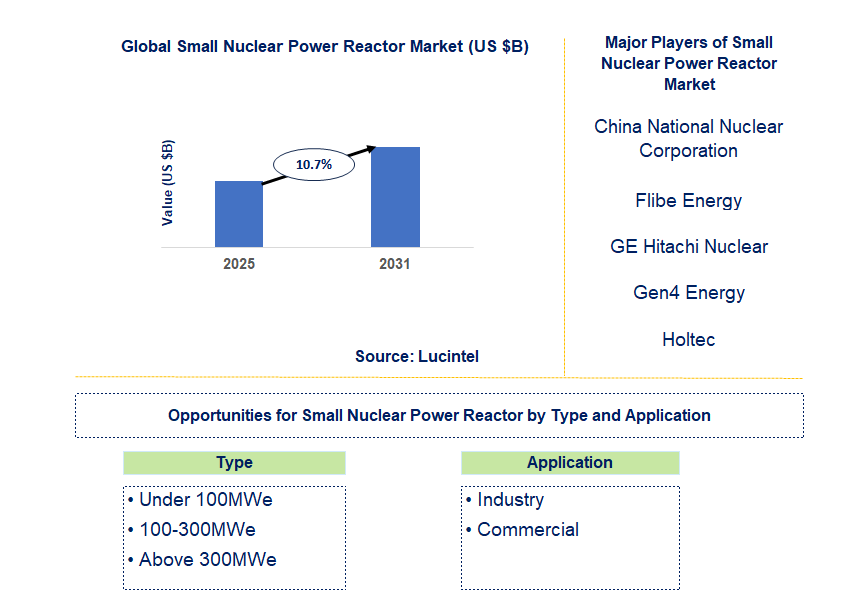
Key data points: The growth forecast = 10.7% annually for the next 7 years. Scroll below to get more insights. This market report covers Trends, opportunities and forecasts in small nuclear power reactor market to 2031 by type (under 100MWe, 100-300MWe, and above 300MWe), application (industry and commercial), and region (North America, Europe, Asia Pacific, and the Rest of the World)
We'll send your sample report shortly.
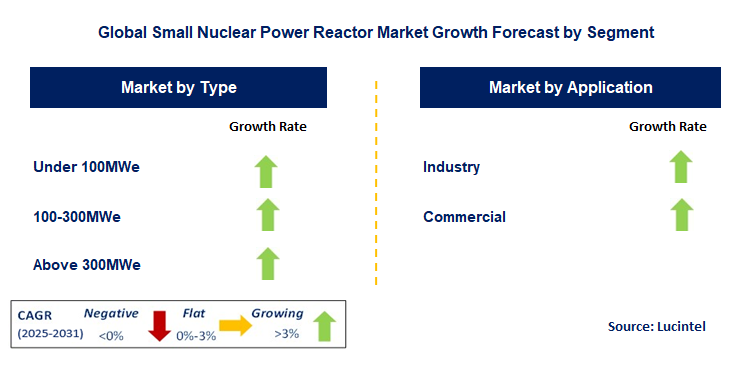
• Lucintel forecasts that, within the type category, under 100MWe is expected to witness the highest growth over the forecast period due to the growing demand for smaller power solutions.
• Within the application category, industry is expected to witness higher growth due to the increasing need for reliable power in industrial operations.
• In terms of region, APAC is expected to witness the highest growth over the forecast period due to the rising demand for cleaner power sources.
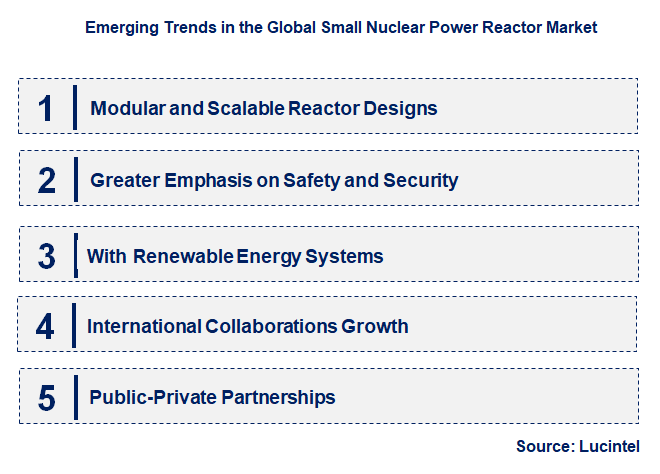
• Modular and Scalable Reactor Designs: Modular and scalable reactor design is one of the major trends in the small nuclear reactor market. These reactors are manufactured in factories and transported to site locations, limiting construction time and expenditure. The modular design provides versatility in power production, allowing plants to increase capacity on demand. This makes small nuclear reactors a viable option for areas with variable energy needs and an increasing demand for clean, dependable power.
• Greater Emphasis on Safety and Security: Safety and security are still paramount in the design of small nuclear reactors. Most designs include passive safety features that minimize the risk of accidents and reduce risks in case of a failure. Furthermore, advancements in cyber protection measures are being incorporated to shield the reactors against cyber-attacks. These include such features that are important to build public confidence and dispel doubts about nuclear power's safety, particularly in light of historical nuclear disasters.
• With Renewable Energy Systems: Small nuclear reactors are increasingly being combined with renewable energy systems like wind and solar power to develop hybrid energy solutions. This combination provides a steadier and more reliable source of energy, balancing the volatility of renewable sources. Governments, in their drive for clean energy transitions, can have small nuclear reactors complement renewables through offering base-load power and grid stabilization when renewable output is minimal.
• International Collaborations Growth: Global cooperation is increasingly becoming the order of the day in the small nuclear reactor industry. Nations are collaborating to cooperate on research, development, and investment in small nuclear technology. International partnerships aid in minimizing the risks of developing the technologies as they speed up advancements. Nations with high-level nuclear capabilities, such as the U.S. and Russia, are entering into collaboration with nations like India and China to commercialize small reactors and increase their nuclear capabilities.
• Public-Private Partnerships: The market for small nuclear reactors is increasingly being supported by public-private partnerships, which facilitate joint investments and lower financial risks. Governments are offering funding and regulatory assistance to promote the creation of small nuclear reactors, while private enterprises are spearheading innovation and commercialization. This partnership is critical in getting small reactors to market faster, particularly since they provide a clean, dependable, and scalable solution to address increasing energy needs. These new trends are redesigning the small nuclear reactor market as they make nuclear energy safer, more adaptable, and more incorporated into the international energy mix.
• Modular Reactor Design Advances: Advances in modular reactor designs are becoming more cost-effective and scalable for small nuclear reactors. The reactors can be produced in factories, cutting down on construction time and costs. Modular reactors are especially attractive to nations with smaller, isolated energy grids or those that want to diversify their energy mix. This innovation has seen governments and private entities show greater interest in using small reactors.
• Technological Advances in Passive Safety Features: Small nuclear reactors are being developed with improved passive safety features, which function without active control. Such advances are natural circulation for cooling and the utilization of advanced materials that can sustain high temperatures. The focus on passive safety features is propelling the use of small nuclear reactors, as they provide improved security and reduce the risks of possible nuclear accidents.
• Regulatory Support for Small Modular Reactors: Governments across the globe are offering regulatory support for the development and deployment of small modular reactors. In the United States, the Nuclear Regulatory Commission (NRC) has made approval procedures for SMRs more streamlined, while nations such as Canada and the UK have revised regulations to ease the deployment of these reactors. Regulatory support is critical to overcome market entry barriers and drive the commercialization of small nuclear power.
• Private Sector Investment: Private sector investment in the development of small nuclear reactors is growing, led by firms such as Nucala Power, Rolls-Royce, and others. These firms are aggressively engaged in the design, development, and deployment of small reactors, with a view to reducing costs and enhancing efficiency. Private investment is speeding up the development of small nuclear power technology and enhancing competition in the market.
• Global Partnerships and Collaborations: Nations and firms are partnering to push the evolution of small nuclear reactors. For instance, the U.S. and Canada have partnered on SMR research, while global partnerships among nations such as the U.S., China, and Russia are working on the development of cutting-edge nuclear technologies. These partnerships are speeding up the rate of innovation and making small nuclear reactors more available in the international market. These advances suggest a move towards more compact, flexible, and secure nuclear energy solutions that are capable of fulfilling the increasing need for clean, reliable power.
• Distant Power Generation: Small nuclear reactors are the perfect solution for delivering power to remote areas and islands that do not have connections to national grids. Small nuclear reactors have the capability to offer reliable power with minimal carbon emission, assisting in minimizing fossil fuel dependency. With increasing demands for decentralized power generation, small nuclear reactors will be pivotal in delivering power to off-grid communities.
• Energy Transition in Emerging Markets: Emerging markets with expanding energy needs are increasingly considering small nuclear reactors to address their requirements for low-carbon, reliable energy. Small nuclear reactors are an affordable and scalable option, and therefore, are perfect for nations wanting to transition away from fossil fuels without having to sacrifice energy security. This opportunity for growth is especially pertinent in the case of Southeast Asia and Sub-Saharan Africa.
• Supplementing Renewable Energy Systems: Small nuclear reactors can be combined with hybrid energy systems in conjunction with renewables such as wind and solar. Such systems can assist in delivering stable, consistent power and improving the grid's reliability. With increasing nations opting for a clean energy shift, small nuclear reactors will be essential in maintaining the stability of energy supply while decreasing dependence on fossil fuels.
• Industrial and Military Uses: Small nuclear reactors have immense potential in industrial and military uses. For instance, small reactors can be utilized to supply power to remote mining camps, research camps, and military camps. The capability of delivering stable energy in off-grid conditions makes small nuclear reactors a good choice for industrial and defense purposes.
• Water Treatment and Desalination: Small nuclear reactors can be employed to fuel desalination facilities, generating clean water for regions experiencing water shortage. The fact that small reactors can generate both electricity and heat make them suitable for energizing desalination plants. This use is especially significant in the Middle East and North Africa, where water shortages are a pressing concern. These expansion prospects illustrate the potential of small nuclear reactors to offer varied, dependable, and sustainable energy solutions in different industries.
• China National Nuclear Corporation
• Flibe Energy
• GE Hitachi Nuclear
• Gen4 Energy
• Holtec
• NuScale Power
• Rolls-Royce
• Under 100MWe
• 100-300MWe
• Above 300MWe
• Industry
• Commercial
• North America
• Europe
• Asia Pacific
• The Rest of the World
• United States: In America, the market for small nuclear reactors is also moving very fast, with some companies and government departments working towards developing and installing small modular reactors (SMRs). The U.S. Department of Energy (DOE) has been actively investing in research on the safety and efficiency of SMRs, as these are regarded as a vital part of America's future clean energy plan. They are joined by other companies that are in the process of building next-generation reactors, with some of the next three SMRs already being licensed in the United States. Others, such as Nucala Power, have a design being considered for deployment in multiple U.S. states.
• China: China is also heavily investing in the construction of small nuclear power reactors as part of efforts to shift towards a cleaner energy mix. The nation has progressed significantly in utilizing its SMR technology, with current projects such as the CAP1400, which will provide a more efficient and safer nuclear power source. China's increasing energy demands, especially in remote regions, make small nuclear reactors a viable choice. Additionally, the reduction of carbon emissions is being emphasized by the Chinese government, which agrees with the drive for next-generation nuclear technologies. China's accelerated growth in this field has made it a world leader in SMR technology.
• Germany: Germany's strategy toward small nuclear reactors has been slower, especially in the wake of the nation's move to drop nuclear power for renewable energy. But recent developments suggest a change of heart by Germany. The nation has been growing more interested in investigating the potential of small nuclear reactors, particularly in the context of its energy transition (Evergreened). Although the emphasis is on renewables, small nuclear reactors are being looked at for their potential to offer stable, low-carbon power in areas where renewables cannot supply enough. Germany's large-scale research into nuclear fusion also provides a foundation for future developments in nuclear power technology.
• India: India's nuclear energy horizon is widening, with a heavy emphasis on small nuclear reactors. The energy requirements of the country are increasing at a fast pace, particularly in rural and remote regions where large power plants are not viable. Small nuclear reactors provide a cost-effective, scalable solution to these problems. India is seeking both indigenous and foreign collaborations to design next-generation small reactors. The government is also eager to achieve its carbon-cutting targets through the addition of nuclear energy to the energy mix. Thorium-based reactor research is a key area of investigation, as India seeks to utilize its vast thorium reserves for the generation of nuclear energy.
• Japan: Japan's interest in small nuclear reactors has grown more fervent since the 2011 Fukushima Daiichi accident. The nation is currently in the process of refurbishing its nuclear power industry, with specific attention to small modular reactors as a more flexible, safer substitute for conventional big reactors. Japan also sees small reactors as the key to resolving its aging facilities and the difficulty of satisfying energy needs in hard-to-reach areas. Firms such as Toshiba and Hitachi are already developing SMRs, which can potentially be a crucial part of Japan's future energy mix, guaranteeing energy security while mitigating public concerns regarding nuclear safety.


• China National Nuclear Corporation
• Flibe Energy
• GE Hitachi Nuclear
• Gen4 Energy
• Holtec
• NuScale Power
• Rolls-Royce Q5. Which small nuclear power reactor market segment will be the largest in future? Answer: Lucintel forecasts that, within the type category, under 100MWe is expected to witness the highest growth over the forecast period due to the growing demand for smaller power solutions. Q6. In small nuclear power reactor market, which region is expected to be the largest in next 5 years? Answer: In terms of region, APAC is expected to witness the highest growth over the forecast period due to the rising demand for cleaner power sources. Q7. Do we receive customization in this report? Answer: Yes, Lucintel provides 10% customization without any additional cost.


Choose a license that fits your team. Instant PDF delivery.
Prices exclude taxes. Instant delivery. Custom licensing available on request.
Market Report · July 20, 2026
Market Report · July 20, 2026
Market Report · July 20, 2026
Trusted partner for strategic intelligence and business growth


Receive a complimentary market analysis tailored to your industry. Our analysts will identify key growth opportunities and competitive dynamics specific to your business.

Market size, growth rate, and key trend analysis for your specific sector.

Top competitor positioning and market share analysis.

Strategic recommendations backed by data-driven insights.
Get curated market intelligence and competitive moves straight to your inbox.
By subscribing, you agree to receive our monthly insights. Unsubscribe anytime.
Receive a complimentary market analysis tailored to your industry. Our analysts will identify key growth opportunities and competitive dynamics specific to your business.
Market size, growth rate, and key trend analysis for your specific sector.
Top competitor positioning and market share analysis.
Strategic recommendations backed by data-driven insights.
Get curated market intelligence, emerging trends, and competitive moves straight to your inbox each month.
By subscribing, you agree to receive our monthly insights. Unsubscribe anytime.
We'll send your sample report shortly.