
Report Feature
Sleep Monitoring Milimeter-Wave Radar Market Trends and Forecast
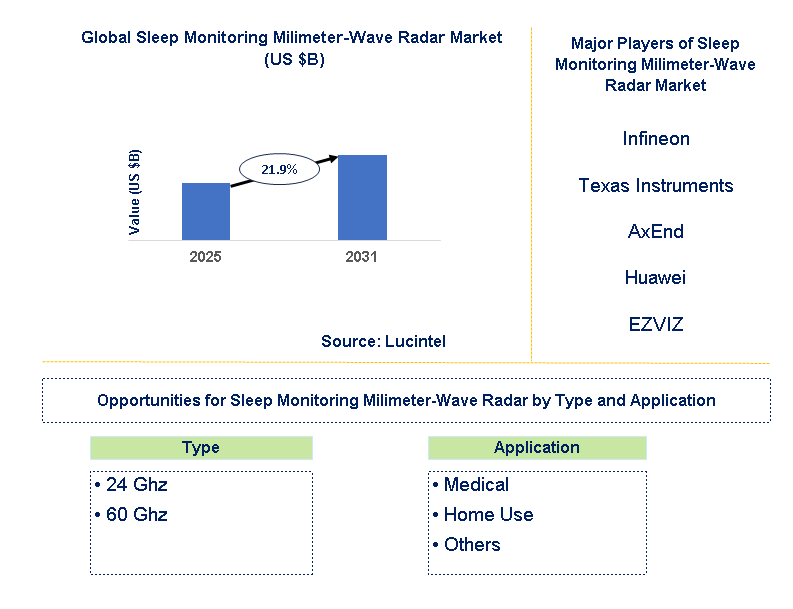
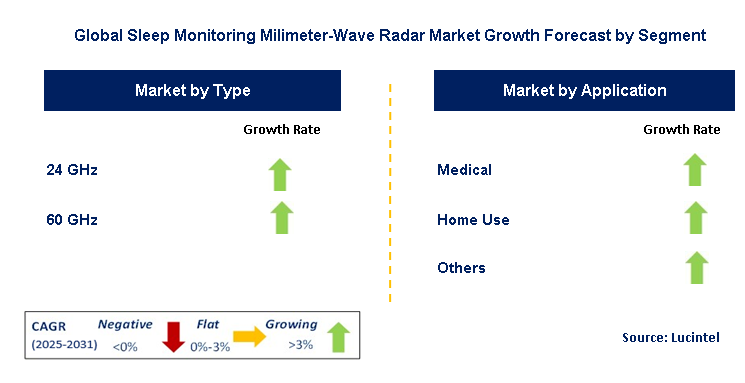
The future of the global sleep monitoring milimeter-wave radar market looks promising with opportunities in the medical and home use markets. The global sleep monitoring milimeter-wave radar market is expected to grow with a CAGR of 21.9% from 2025 to 2031. The major drivers for this market are the rising demand for non-invasive health monitoring, the growing awareness about sleep-related health issues, and ithe ncreasing advancements in radar technology & miniaturization.• Lucintel forecasts that, within the type category, 60 GHz is expected to witness higher growth over the forecast period.
• Within the application category, medical use is expected to witness higher growth.
• In terms of region, North America is expected to witness the highest growth over the forecast period. Gain valuable insights for your business decisions with our comprehensive 150+ page report. Sample figures with some insights are shown below.
Emerging Trends in the Sleep Monitoring Milimeter-Wave Radar Market
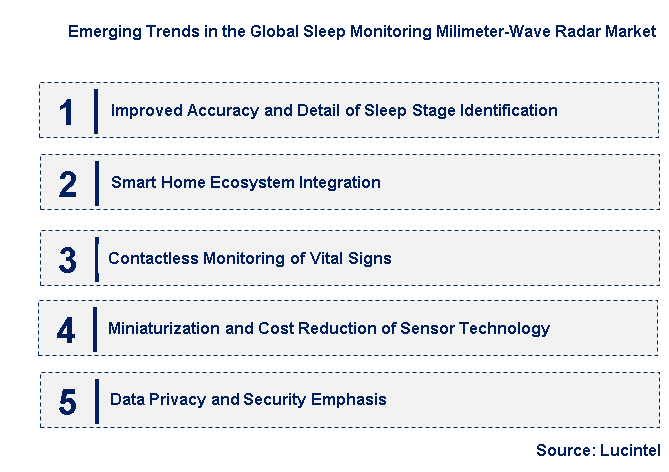
The sleep monitoring milimeter-wave radar market is defined by fast innovation and increasing emphasis on user experience and data convergence. A number of emerging trends are dictating the future direction of this technology, promising more precise, easier, and more informative sleep analysis.• Improved Accuracy and Detail of Sleep Stage Identification: Current research is directed towards refining the algorithms and sensor technology to provide more precise and detailed identification of sleep stages (e.g., REM, light, deep sleep). Sophisticated signal processing methods and machine learning are being used to process the minute radar signals and compare them with polysomnography (PSG), the gold standard for sleep monitoring. This improved precision will make the user more trustworthy and actionable insights regarding sleep patterns.
• Smart Home Ecosystem Integration: One major trend is the effortless integration of milimeter-wave radar sleep monitors with smart home ecosystems. The devices can be easily integrated into other smart home devices, like lighting systems, thermostats, and smart speakers, to develop customized sleeping environments and automate activities according to sleep routines. For instance, lights can automatically turn off as a person drifts to sleep. This integration provides greater convenience to the users and builds a complete smart living experience.
• Contactless Monitoring of Vital Signs: One of the biggest strengths of milimeter-wave radar is that it detects not just movement but also small variations in breathing and heart rate without touching the body. New trends focus on the enhancement of such capabilities to enable continuous and non-intrusive monitoring of vital signs while asleep. This paves the way for early warning of possible health problems and a more holistic insight into the quality of sleep rather than just stages of sleep.
• Miniaturization and Cost Reduction of Sensor Technology: For mass adoption, there is a high tendency to miniaturize the milimeter-wave radar sensors and cut their costs. The compact and cheaper sensors can easily be embedded in many different devices, such as bedside lamps, headboards, or even into the mattresses themselves. This will popularize the technology among a larger user base and allow it to be integrated into a greater variety of sleep-related products.
• Data Privacy and Security Emphasis: Since sleep tracking produces personal and potentially sensitive health information, there is a growing emphasis on guaranteeing data privacy and security within milimeter-wave radar-based systems. Trends involve the creation of on-device data processing and encryption strategies to safeguard user data. Clarity on the collection, storage, and utilization of the data will be paramount for generating user trust and widespread penetration of this technology. These new trends are collectively transforming the sleep monitoring milimeter-wave radar market by propelling innovation toward more precise, integrated, cost-effective, and privacy-sensitive solutions. The capacity to deliver contactless and continuous sleep analysis with increased insights and seamless integration into everyday life places milimeter-wave radar at the forefront of attractive technologies for the future of sleep health management.
Recent Development in the Sleep Monitoring Milimeter-Wave Radar Market
The market for sleep monitoring milimeter-wave radar is experiencing tremendous developments as scientists and businesses try to tap its possibilities for continuous and non-contact sleep monitoring. Developments of late are aimed at streamlining the technology, broadening its scope, and investigating various applications.• Signal Processing Algorithm Advancements: One significant advancement is the improvement in signal processing algorithms that can pull out finer details of sleep patterns and physiological parameters from the radar signals. The sophisticated algorithms differentiate more accurately among the various sleep stages, capture subtle movements reflective of sleep disorders, and enhance breathing and heart rate monitoring accuracy non-physically. This results in more meaningful and accurate sleep data.
• Artificial Intelligence and Machine Learning integration: The use of artificial intelligence (AI) and machine learning (ML) methods is greatly improving the performance of milimeter-wave radar sleep monitors. AI/ML models can decipher the intricate radar signals to detect patterns, tailor sleep insights, and even forecast sleep disorders from long-term tracking in the future. Integration enables more advanced and user-oriented sleep analysis.
• Lower Power and Smaller Form Factor Sensor Development: Recent development has been geared towards lowering milimeter-wave radar sensors‘ power consumption as well as their physical size. Lower power consumption makes the technology acceptable for use in battery-powered devices and continuous operation. Lower form factors enable easier integration into different consumer electronics and healthcare devices without compromising.
• Investigation of Multi-Sensor Fusion: To enhance the precision and reliability of sleep tracking even further, researchers are investigating combining milimeter-wave radar data with data from other sensors, including ambient light sensors, temperature sensors, and sound sensors. Fusing data from several sources can give a better sense of the sleep setting and sleep habits, resulting in stronger and more accurate sleep analysis.
• Pilot Studies in Healthcare and Elderly Care: Pilot studies and trials are increasingly performed in healthcare facilities and elderly care centers to test the effectiveness of milimeter-wave radar for non-invasive monitoring of sleep. These pilot studies intend to measure the technology‘s potential to identify sleep disorders, track vital signs among susceptible groups, and issue early alerts of upcoming health problems without wearing bulky devices. Such advancements are influencing the sleep monitoring milimeter-wave radar market in that technology is becoming more accurate, smart, power-effective, and versatile, most notably in healthcare and consumer wellness. The continued innovations in signal processing, artificial intelligence integration, sensor miniaturization, multi-sensor fusion, and field testing are opening doors to wider adoption and commercialization of this revolutionary sleep monitoring technology.
Strategic Growth Opportunities in the Sleep Monitoring Milimeter-Wave Radar Market
The sleep monitoring milimeter-wave radar market offers several strategic growth opportunities across various applications, building on its non-contact and continuous tracking ability. Addressing specific user requirements and incorporating the technology into the appropriate ecosystem can unlock considerable market potential.• Consumer Wellness and Smart Homes: Blending milimeter-wave radar with smart home appliances such as bedside lamps, smart speakers, and even furniture presents a great growth opportunity. These products can offer passive and perpetual monitoring of sleep without requiring wearables, resonating with a wide consumer audience interested in enhancing their sleep quality and overall wellness in their home surroundings.
• Elderly Care and Assisted Living: The non-contact aspect of milimeter-wave radar renders it well-suited to track sleep patterns and vital signs of the elderly in their own homes or assisted living homes. This technology can be used to give a better understanding of their sleep health and potentially catch early indicators of decline in their health without discomfort or active engagement from the individuals being tracked, filling an urgent need among the elderly population.
• Healthcare and Clinical Sleep Analysis: Although not a substitute for polysomnography, milimeter-wave radar has potential as a low-cost, convenient device for extended sleep observation in clinical environments and as a screening measure for initial sleep evaluation. Its incorporation into hospital beds or home care equipment can give ongoing feedback on patients‘ sleep and life signs, which can be useful for diagnosis and treatment monitoring.
• Driver Fatigue Detection for Automotive Industry: The capability of milimeter-wave radar to sense slight movements and vital signs can be utilized in the automobile industry for non-invasive driver fatigue detection. Mounting radar sensors inside vehicles could enable real-time monitoring of driver fatigue, possibly averting accidents and improving vehicle safety. This is a new and high-impact application field.
• Hospitality and Wellness Retreats: Hotels and wellness retreats intent on delivering best-in-class sleep experiences can incorporate milimeter-wave radar technology into their rooms. Providing guests with precise information about their sleep quality without the requirement for wearables can elevate their visit and position these properties as sleep-focused hospitality leaders. This creates a special value proposition for a niche clientele. These strategic development opportunities recognize the flexibility of milimeter-wave radar for sleep tracking across industries. Emphasizing the specific advantage of non-contact and around-the-clock monitoring and adapting the technology for precise applications in consumer health, aging care, healthcare, vehicle safety, and hospitality, the market can gain meaningful growth and influence.
Sleep Monitoring Milimeter-Wave Radar Market Driver and Challenges
The market for the sleep monitoring milimeter-wave radar is driven by an interplay of technological improvements, rising health consciousness, and changing consumer tastes, both as major drivers as well as serious challenges. It is essential to understand these forces for stakeholders in order to efficiently navigate the market and unlock its full potential. The factors responsible for driving the sleep monitoring milimeter-wave radar market include: 1. Evolving Sleep Health Consciousness: Sustained awareness among the public about the significance of sleep to overall health and wellness is a key impetus for sleep monitoring technologies‘ adoption. As individuals become increasingly aware of their sleep quality, they are looking to address their sleep patterns through innovative monitoring devices such as milimeter-wave radar. 2. Non-Contact and Unobtrusive Monitoring Demand: Most traditional sleep monitoring solutions use wearable devices or contact sensors, which can be bothersome and disrupt natural sleep. Millimeter-wave radar provides a non-contact and unobtrusive solution, enabling full-time monitoring without the need for the user to wear anything or actively participate with the device, thus a more desirable solution for most. 3. Developments in Millimeter-Wave Radar Technology: Ongoing developments in milimeter-wave radar sensor technology, such as increased sensitivity, precision, and miniaturization, are increasingly making it appropriate for sleep monitoring purposes. Such advances facilitate the identification of slight movements and vital signals with higher dependability, which in turn fuels the evolution of more potent sleep monitoring systems. 4. Smart Home and Healthcare Ecosystem Integration: The increasing trend of smart devices and the integration of health monitoring into smart home and healthcare ecosystems are fueling demand for sleep analysis using milimeter-wave radar. The ability to integrate with other devices and systems seamlessly simplifies user experience and offers a more complete understanding of health and wellness. 5. Remote Health Monitoring Potential: The potential of milimeter-wave radar to remotely monitor sleep and vital signs without contact provides vast potential in remote healthcare and aged care. The technology has the potential to provide around-the-clock monitoring of susceptible groups at home, enabling useful information for early identification of health complications and ease of early interventions. Challenges in the sleep monitoring milimeter-wave radar market are: 1. Accuracy and Reliability vis-a-vis Gold Standard: Although milimeter-wave radar has potential, the same accuracy and reliability as polysomnography (PSG) in sleep stage identification and monitoring of physiological parameters are difficult to achieve at present. Clinical validation of the technology against the gold standard of PSG and gaining the trust of clinicians would require additional research and development. 2. Data Security and Privacy Issues: The gathering of individual sleep information, such as movement patterns and vital signs, raises data security and privacy issues. Ascertaining that milimeter-wave radar sleep tracking systems are secure and that user information is kept safe is important for achieving user confidence and mass adoption. Transparent data use policies and strong security practices are important. 3. Cost of Implementation and Consumer Affordability: The implementation cost of milimeter-wave radar sensor technology and the supporting signal processing hardware and software can be fairly prohibitive, which might curb its initial deployment in consumer-level devices. Cost savings without loss of performance will be essential to make this technology more penetrating into the wider market. The non-contact sleep monitoring milimeter-wave radar market is stimulated by increasing understanding of sleep well-being, the need for non-contact monitoring, and improving radar technology. The opportunity to integrate into smart home and healthcare systems and for remote health monitoring offers compelling opportunity. Despite such a tremendous impact, there are still challenges involving precision in relation to clinic standards, data privacy issues, and the implementation cost that must be resolved to gain massive adoption and reap the full benefits of this advanced technology.List of Sleep Monitoring Milimeter-Wave Radar Companies
Companies in the market compete on the basis of product quality offered. Major players in this market focus on expanding their manufacturing facilities, R&D investments, infrastructural development, and leverage integration opportunities across the value chain. With these strategies sleep monitoring milimeter-wave radar companies cater increasing demand, ensure competitive effectiveness, develop innovative products & technologies, reduce production costs, and expand their customer base. Some of the sleep monitoring milimeter-wave radar companies profiled in this report include-• Infineon
• Texas Instruments
• AxEnd
• Huawei
• EZVIZ
• Seeed Technology
• WHST
• Shenzhen Ferry Smart
• Uniview
• Tsingray
Sleep Monitoring Milimeter-Wave Radar Market by Segment
The study includes a forecast for the global sleep monitoring milimeter-wave radar market by type, application, and region.Sleep Monitoring Milimeter-Wave Radar Market by Type [Value from 2019 to 2031]:
• 24 Ghz
• 60 Ghz
Sleep Monitoring Milimeter-Wave Radar Market by Application [Value from 2019 to 2031]:
• Medical
• Home Use
• Others
Sleep Monitoring Milimeter-Wave Radar Market by Region [Value from 2019 to 2031]:
• North America
• Europe
• Asia Pacific
• The Rest of the World
Country Wise Outlook for the Sleep Monitoring Milimeter-Wave Radar Market
The sleep monitoring milimeter-wave radar market for sleep monitoring is a new industry taking advantage of the distinct strengths of milimeter-wave technology to offer non-contact and continuous sleep monitoring. Compared to conventional approaches that tend to necessitate wearables or contact sensors, milimeter-wave radar can sense slight body movements and vital signs at a distance, promoting a more relaxing and non-intrusive sleep monitoring experience. Latest developments center on enhancing the precision and reliability of these radar-based systems, reducing the size of the sensor technology, and implementing it in various health and consumer applications. This prelude paves the way for investigating country-level developments and latest trends in this new market.• United States: The US market is observing growing research and development efforts in the use of milimeter-wave radar for sleep monitoring, specifically among technology firms and healthcare facilities. Growing interest in applying this technology to home-based sleep analysis and integration into smart home systems exists. In addition, the possibility of remote monitoring of the elderly or sleep disorder patients is fueling development and pilot studies in healthcare environments. Collaborations between technology companies and sleep research institutes are increasingly prevalent.
• China: China is soon to become an important player in the market for sleep technology, with growing use of smart sleep solutions. Recent trends in the milimeter-wave radar industry include the production of affordable and merged radar sensors by local manufacturers. There is a strong drive towards implementing this technology in smart home equipment and health monitoring platforms. Large population base and increasing health consciousness are driving the high-speed commercialization of milimeter-wave radar-based sleep monitoring systems.
• Germany: With its robust engineering and medical industries, Germany is investing in the precision and reliability of milimeter-wave radar for monitoring sleep. Studies aim to obtain high accuracy in the measurement of sleep stages and detection of slight changes in physiology during sleep. Possible applications in clinical sleep diagnostics and long-term care facilities are being strongly investigated. Interdisciplinary collaborations among research institutions and medical device manufacturers are driving developments in this field.
• India: The Indian market for sophisticated sleep monitoring solutions is yet in its embryonic stage but is projected to expand with growing awareness of sleep health and increasing disposable incomes. Recent advances involve early research activities and the possibility of incorporating milimeter-wave radar technology into low-cost health monitoring devices. Cost-effective solutions likely to offer basic sleep analysis for a broad population are what the focus may be on. Collaborations with global technology vendors might help spur market expansion.
• Japan: Aging population and high healthcare technology emphasis are propelling Japan to be very interested in contact-less sleep monitoring systems. New developments involve the creation of highly sensitive milimeter-wave radar sensors that can detect subtle movement and vital signs. Elderly care home and personal health management are areas where applications are being considered. User comfort and data privacy are the focus for Japanese firms‘ milimeter-wave based sleep monitoring solutions.

Features of the Global Sleep Monitoring Milimeter-Wave Radar Market
Market Size Estimates: Sleep monitoring milimeter-wave radar market size estimation in terms of value ($B). Trend and Forecast Analysis: Market trends (2019 to 2024) and forecast (2025 to 2031) by various segments and regions. Segmentation Analysis: Sleep monitoring milimeter-wave radar market size by type, application, and region in terms of value ($B). Regional Analysis: Sleep monitoring milimeter-wave radar market breakdown by North America, Europe, Asia Pacific, and Rest of the World. Growth Opportunities: Analysis of growth opportunities in different types, applications, and regions for the sleep monitoring milimeter-wave radar market. Strategic Analysis: This includes M&A, new product development, and competitive landscape of the sleep monitoring milimeter-wave radar market. Analysis of competitive intensity of the industry based on Porter’s Five Forces model.
FAQ
Q1. What is the growth forecast for sleep monitoring milimeter-wave radar market? Answer: The global sleep monitoring milimeter-wave radar market is expected to grow with a CAGR of 21.9% from 2025 to 2031. Q2. What are the major drivers influencing the growth of the sleep monitoring milimeter-wave radar market? Answer: The major drivers for this market are the rising demand for non-invasive health monitoring, the growing awareness about sleep-related health issues, and ithe ncreasing advancements in radar technology & miniaturization. Q3. What are the major segments for sleep monitoring milimeter-wave radar market? Answer: The future of the sleep monitoring milimeter-wave radar market looks promising with opportunities in the medical and home use markets. Q4. Who are the key sleep monitoring milimeter-wave radar market companies? Answer: Some of the key sleep monitoring milimeter-wave radar companies are as follows:• Infineon
• Texas Instruments
• AxEnd
• Huawei
• EZVIZ
• Seeed Technology
• WHST
• Shenzhen Ferry Smart
• Uniview
• Tsingray Q5. Which sleep monitoring milimeter-wave radar market segment will be the largest in future? Answer: Lucintel forecasts that, within the type category, 60 GHz is expected to witness higher growth over the forecast period. Q6. In sleep monitoring milimeter-wave radar market, which region is expected to be the largest in next 5 years? Answer: In terms of region, North America is expected to witness the highest growth over the forecast period. Q7. Do we receive customization in this report? Answer: Yes, Lucintel provides 10% customization without any additional cost.
Table of Contents
Methodology
- In-depth interviews of the major players in this market
- Detailed secondary research from competitors’ financial statements and published data
- Extensive searches of published works, market, and database information pertaining to industry news, company press releases, and customer intentions
- A compilation of the experiences, judgments, and insights of Lucintel’s professionals, who have analyzed and tracked this market over the years.


Buy Now
Choose a license that fits your team. Instant PDF delivery.
Prices exclude taxes. Instant delivery. Custom licensing available on request.
Key Questions
- • What are some of the most promising, high-growth opportunities for the sleep monitoring milimeter-wave radar market by type (24 GHz and 60 GHz), application (medical, home use, and others), and region (North America, Europe, Asia Pacific, and the Rest of the World)?
- • Which segments will grow at a faster pace and why?
- • Which region will grow at a faster pace and why?
- • What are the key factors affecting market dynamics? What are the key challenges and business risks in this market?
- • What are the business risks and competitive threats in this market?
- • What are the emerging trends in this market and the reasons behind them?
- • What are some of the changing demands of customers in the market?
- • What are the new developments in the market? Which companies are leading these developments?
- • Who are the major players in this market? What strategic initiatives are key players pursuing for business growth?
- • What are some of the competing products in this market and how big of a threat do they pose for loss of market share by material or product substitution?
- • What M&A activity has occurred in the last 5 years and what has its impact been on the industry? For any questions related to Sleep Monitoring Milimeter-Wave Radar Market, Sleep Monitoring Milimeter-Wave Radar Market Size, Sleep Monitoring Milimeter-Wave Radar Market Growth, Sleep Monitoring Milimeter-Wave Radar Market Analysis, Sleep Monitoring Milimeter-Wave Radar Market Report, Sleep Monitoring Milimeter-Wave Radar Market Share, Sleep Monitoring Milimeter-Wave Radar Market Trends, Sleep Monitoring Milimeter-Wave Radar Market Forecast, Sleep Monitoring Milimeter-Wave Radar Companies, write Lucintel analyst at email: helpdesk@lucintel.com. We will be glad to get back to you soon.


