
Market Report · May 18, 2026

This market report covers trends, opportunities, and forecasts in the global sic schottky rectifier diodes market to 2031 by technology (gallium nitride additionals, sic corporeal devices, and silicon technology), end use (automotive, consumer electronics, and industrial), and region (North America, Europe, Asia Pacific, and the Rest of the World)
We'll send your sample report shortly.

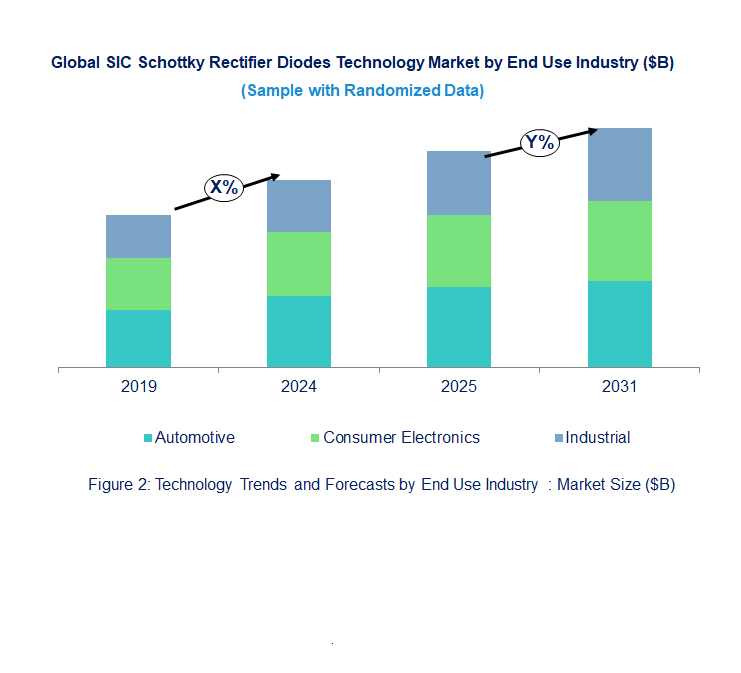
• Trend Toward Wide Bandgap Semiconductors: There is an increasing preference for wide bandgap semiconductors such as SiC and GaN due to their excellent properties: better heat resistance, efficiency, and faster switching speeds compared to silicon-based counterparts. These materials are crucial in power electronics applications.
• Adoption in Electric Vehicles (EVs): The demand for electric vehicles is growing rapidly, making SiC Schottky rectifier diodes essential for EV powertrains. SiC diodes enable faster charging, improved energy efficiency, and higher power density in electric vehicle charging stations, motors, and inverters, enhancing overall performance and sustainability.
• Increasing Application in Renewable Energy Systems: The growing use of renewable energy sources such as solar and wind power requires efficient power conversion. SiC schottky diodes are particularly suited for solar inverters and wind power applications due to their high efficiency, thermal stability, and ability to withstand higher voltages, making them a preferred choice for green energy applications.
• Miniaturization of Power Electronics: The miniaturization of power electronics is growing, especially in consumer electronics. SiC schottky diodes can be made small without compromising performance, enabling the design of lightweight, portable products with enhanced power conversion efficiency.
• Automated Manufacturing and Cost Reduction: Advances in manufacturing technologies, such as automated production techniques and improved wafer processing, are helping to reduce the cost of SiC schottky diodes. As these manufacturing techniques mature, the cost of SiC diodes is expected to decrease, making them more affordable for a broader range of applications. These trends indicate that the SiC schottky rectifier diodes market is evolving to meet the increasing demand for high-performance, energy-efficient power systems. The adoption of wide bandgap semiconductors, particularly in industries like automotive, renewable energy, and consumer electronics, is reshaping the power electronics landscape.
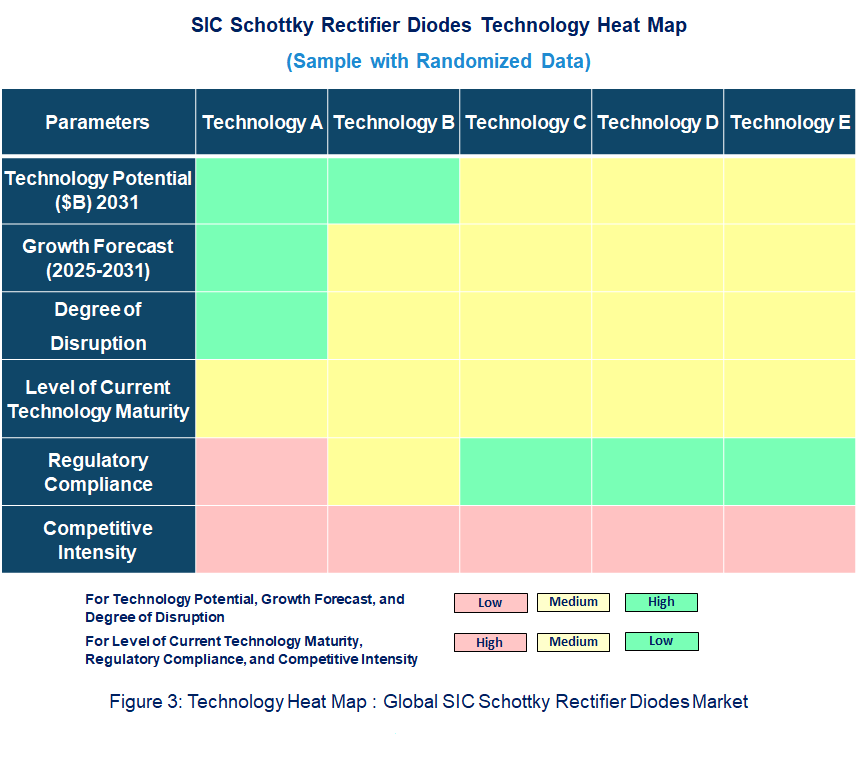
• Technology Potential: The technology potential of SiC Schottky rectifier diodes is high, particularly with advancements in semiconductor materials and manufacturing processes. Their ability to operate at higher temperatures, voltages, and frequencies with lower conduction losses places SiC diodes at the forefront of next-generation power electronics. With growing demand for energy efficiency and sustainability, SiC technology is expected to be widely applied in power systems, electric vehicles, and smart grids.
• Level of Disruption: SiC Schottky diodes are on the verge of major disruption in power electronics. Their efficiency, long life, and miniaturization will revolutionize applications from renewable energy inverters to EV chargers. The adoption of SiC technology is likely to accelerate the transition to more energy-efficient and sustainable technologies.
• Current Technology Maturity: The technology of SiC Schottky diodes is mature and widely used in high-power applications. However, ongoing research aims to reduce production costs and further improve scalability and integration. Compliance with industrial standards such as IEC and UL certifications is essential for ensuring safety, reliability, and performance in critical sectors like automotive and energy.
• Disruption Potential of Various Technologies: The addition of Gallium Nitride (GaN), SiC-based devices, and silicon technologies each offers different disruption potentials in the SiC Schottky rectifier diode market. GaN offers higher electron mobility, enabling more efficient power conversion and smaller form factors. SiC devices are positioned to disrupt high-power applications due to their superior thermal conductivity and voltage handling, making them ideal for electric vehicles (EVs), renewable energy systems, and industrial motor drives. Silicon, while still widely used, faces increasing competition from GaN and SiC due to their higher efficiency. As power electronics demand better performance and smaller form factors, SiC and GaN technologies are expected to increasingly replace traditional silicon-based diodes.
• ABB Ltd. launched advanced SiC-based power modules for use in industrial and automotive applications with the growing demand for energy-efficient solutions. These new SiC Schottky diodes improve the performance of electric drives, renewable energy systems, and electric vehicles by offering greater efficiency and lower energy losses.
• CREE, Inc. (Wolfspeed) is a leader in SiC technology and has expanded its SiC Schottky diode product line to cater to automotive, industrial, and consumer electronics markets. Wolfspeed’s SiC diodes provide superior thermal performance, faster switching, and higher voltage handling, making them ideal for power conversion and energy storage systems.
• Diodes Incorporated has developed several new SiC Schottky diodes for high-voltage, high-current applications. These diodes are suitable for use in automotive and industrial power supplies. The new products are designed to achieve better energy efficiency and higher power density, addressing the growing demand for compact and reliable power systems.
• Dynex is expanding its SiC-based rectifier diode portfolio for high-power applications, including electric vehicle chargers and industrial power equipment. These newly designed SiC products from Dynex offer highly efficient power conversion in various rugged, high-temperature applications.
• Fuji Electric Co., Ltd. has released a range of SiC Schottky diodes to enhance power conversion efficiency across a wide range of industrial and consumer applications. These diodes are designed to reduce power loss and improve switching speed, making them ideal for energy-efficient solutions in electric vehicles, renewable energy systems, and industrial machinery.
• GeneSiC Semiconductor Inc. is expanding its innovation with SiC-based power semiconductor solutions, focusing on energy-efficient products for electric vehicles and renewable energy applications. GeneSiC’s SiC Schottky diodes are designed for higher currents and better thermal performance, enabling more efficient power electronics.
• Infineon Technologies AG launched a new series of SiC Schottky diodes as part of its efforts to improve efficiency in power supply systems for automotive, industrial, and renewable energy applications. These diodes are distinguished by their high breakdown voltage and low forward voltage drop, leading to energy conservation and system reliability.
• Littelfuse, Inc. expanded its SiC Schottky diode portfolio for high-efficiency power conversion in automotive and industrial applications. Littelfuse’s solutions are designed to reduce energy loss and improve the reliability of power electronics in demanding environments.
• Microsemi Corporation (now part of Microchip Technology) is enhancing its SiC Schottky diode portfolio for use in high-power applications. Microsemi’s SiC products are known for their superior performance in harsh environments, providing lower switching losses and higher thermal stability in power supplies and industrial machinery. These developments show that market leaders in the SiC Schottky rectifier diode market are continuously innovating their product offerings to meet the increasing demand for high-performance, energy-efficient solutions in the automotive, industrial, and consumer electronics sectors.
• Demand for Increased Efficiency in Power Conversion: The evolving needs of the world are demanding higher efficiency, particularly in electric vehicles and renewable energy systems. SiC schottky diodes are in high demand as they offer superior efficiency with less energy loss, thus enhancing system performance.
• Growth in the Electric Vehicle Market: The electric vehicle (EV) market is expanding, increasing the need for high-performance, energy-efficient SiC schottky diodes. These diodes are integral to the EV powertrain, enabling faster charging, increased efficiency, and lower overall energy consumption, which drives the growth of the electric vehicle market.
• Advances in Wide Bandgap (WBG) Semiconductors: The increasing application of wide bandgap semiconductors, particularly SiC and GaN, is driving the development of diodes with better performance. SiC schottky diodes are finding use in more demanding applications that require higher voltages and temperatures, such as industrial equipment and renewable energy systems. The rising adoption of renewable energy is positively influencing the demand for efficient power conversion systems, particularly for solar and wind power. SiC schottky diodes help improve the efficiency of inverters and power supplies in renewable energy applications, thereby boosting the usage of sustainable energy sources. Challenges in the SiC schottky rectifier diodes market include:
• High Initial Cost of SiC Diodes: Although SiC Schottky diodes offer many advantages, they are more expensive to manufacture than silicon diodes. The high initial costs limit their use in certain applications, especially in emerging markets.
• Complexity in Manufacturing: The production of SiC Schottky diodes requires advanced manufacturing techniques and equipment, which adds to the complexity and cost of production. Achieving high yields in SiC wafer fabrication remains a challenge, impacting the scalability of SiC technology.
• Competition with Silicon-Based Technologies: Despite their higher cost, silicon-based diodes are widely implemented in many applications due to their lower production costs and established manufacturing processes. It will be challenging for SiC diode manufacturers to compete with well-established silicon-based technologies. Competitive intensity in the SiC schottky rectifier diode market is rising, especially between GaN and SiC devices, which offer better performance in high-voltage and high-temperature environments. While silicon technology remains cost-effective and widely available, it faces increasing pressure from GaN and SiC in emerging applications like EVs and renewable energy. Regulatory compliance is crucial, as these devices must meet stringent standards for electrical efficiency, safety, and durability. SiC and GaN diodes generally meet high-voltage safety standards, such as UL and IEC certifications. The rapid rise of SiC and GaN technologies in power electronics applications means manufacturers must adapt to evolving environmental and sustainability regulations. Silicon-based devices are well-integrated into regulatory frameworks but may need to adjust to new energy efficiency standards.
• ABB Ltd.
• CREE, Inc. (Wolfspeed)
• Diodes Incorporated
• Dynex Semiconductor Ltd.
• Fuji Electric Co., Ltd.
• GeneSiC Semiconductor Inc.
• Technology Readiness by Technology Type: Silicon is the most mature technology used in making schottky rectifier diodes, because of an established manufacturing process and a broad application of silicon-based Schottky diodes in low-power and low-voltage consumer electronics and power supplies. SiC corporeal devices are increasingly ready for large-scale deployment, particularly in high-power and high-temperature applications like industrial motor drives, power grids, and electric vehicles, where they deliver superior performance. GaN additions, while showing significant promise, are still in the early stages of widespread adoption but are rapidly gaining traction in applications requiring high efficiency, such as RF amplifiers and high-frequency power converters. The two strongest competitors are SiC and GaN, which both are likely to disrupt the market with higher efficiency and performance, although SiC is more mature in terms of commercialization. Silicon carbide- and gallium nitride-based devices are more strictly regulated due to their applications in mission-critical and high-voltage environments.
• Competitive Intensity and Regulatory Compliance. Competitive intensity in the SiC schottky rectifier diode market is intensifying, particularly between GaN add-ons and SiC corporeal devices, which offer better performance in high-voltage and high-temperature environments. Silicon technology, though cost-effective and widely available, is under pressure due to the superior performance of GaN and SiC in emerging applications like EVs and renewable energy. Regulatory compliance is a must since these devices have to pass stringent standards regarding electrical efficiency, safety, and durability. SiC and GaN diodes generally comply with high-voltage safety standards, such as UL and IEC certificates. The fast rise of SiC and GaN technologies in power electronics applications also implies that manufacturers have to be adaptive to the evolving environmental and sustainability regulations. Silicon-based devices are well-integrated into regulatory frameworks but are likely to undergo some adjustments with new energy efficiency standards that may be proposed.
• Disruption Potential of Various Technologies: The addition of Gallium Nitride (GaN), SiC corporeal devices, and silicon technology each offers different disruption potentials in the SiC schottky rectifier diode market. GaN additions are a disruptive force because they have higher electron mobility, leading to more efficient power conversion and smaller form factors. SiC corporeal devices are especially well-positioned to disrupt high-power applications with their superior thermal conductivity and voltage handling, making them perfect for electric vehicles (EVs), renewable energy systems, and industrial motor drives. Silicon technology, though widely used, faces increasing competition due to its lower efficiency compared to GaN and SiC. As power electronics continue to demand higher efficiency and smaller form factors, SiC and GaN technologies are expected to increasingly displace traditional silicon-based diodes, particularly in sectors requiring high performance and durability.
• Gallium Nitride Additionals
• Sic Corporeal Devices
• Silicon Technology
• Automotive
• Consumer Electronics
• Industrial
• North America
• Europe
• Asia Pacific
• The Rest of the World
• Latest Developments and Innovations in the SIC Schottky Rectifier Diodes Technologies
• Companies / Ecosystems
• Strategic Opportunities by Technology Type


Choose a license that fits your team. Instant PDF delivery.
Prices exclude taxes. Instant delivery. Custom licensing available on request.
Market Report · May 18, 2026
Market Report · May 18, 2026
Market Report · May 18, 2026
Trusted partner for strategic intelligence and business growth


Receive a complimentary market analysis tailored to your industry. Our analysts will identify key growth opportunities and competitive dynamics specific to your business.

Market size, growth rate, and key trend analysis for your specific sector.

Top competitor positioning and market share analysis.

Strategic recommendations backed by data-driven insights.
Get curated market intelligence and competitive moves straight to your inbox.
By subscribing, you agree to receive our monthly insights. Unsubscribe anytime.
Receive a complimentary market analysis tailored to your industry. Our analysts will identify key growth opportunities and competitive dynamics specific to your business.
Market size, growth rate, and key trend analysis for your specific sector.
Top competitor positioning and market share analysis.
Strategic recommendations backed by data-driven insights.
Get curated market intelligence, emerging trends, and competitive moves straight to your inbox each month.
By subscribing, you agree to receive our monthly insights. Unsubscribe anytime.
We'll send your sample report shortly.