
Market Report · July 22, 2026

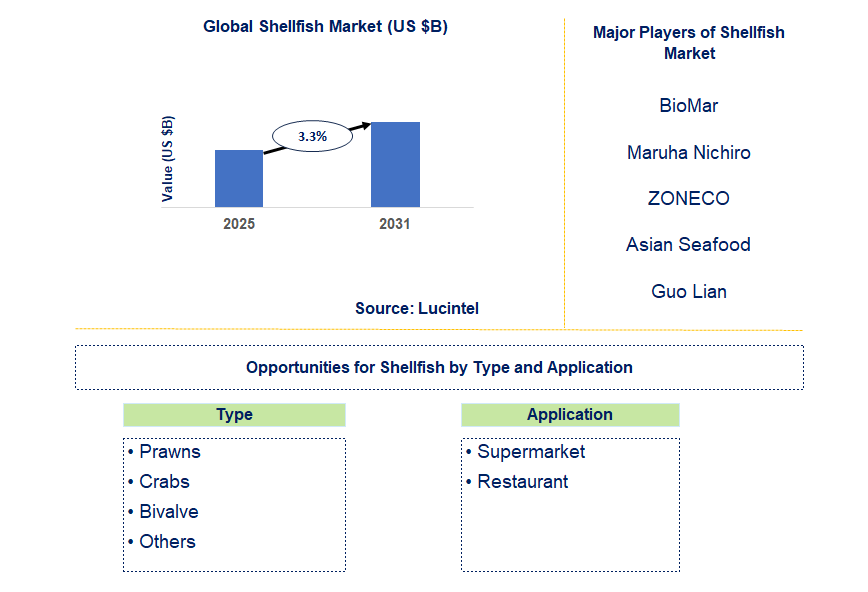
Key data points: The growth forecast = 3.3% annually for the next 7 years. Scroll below to get more insights. This market report covers Trends, opportunities and forecasts in shellfish market to 2031 by type (prawns, crabs, bivalve, and others), application (supermarket and restaurant), and region (North America, Europe, Asia Pacific, and the Rest of the World)
We'll send your sample report shortly.
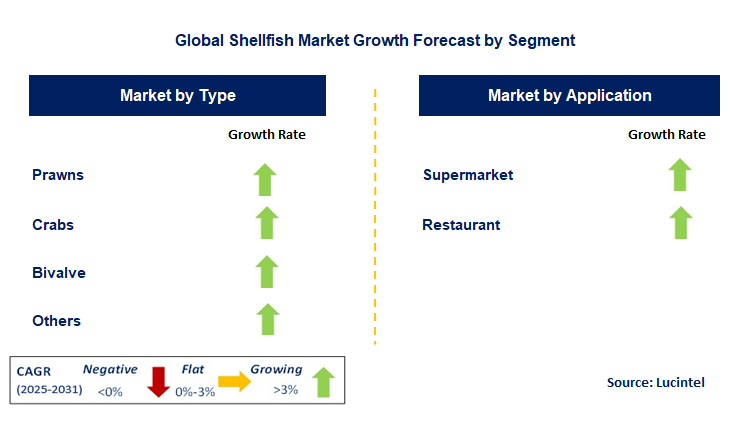
• Lucintel forecasts that, within the type category, prawn is expected to witness the highest growth over the forecast period due to the increasing demand for prawns in global seafood.
• Within the application category, restaurant is expected to witness higher growth due to the rising consumer preference for dining out.
• In terms of region, APAC is expected to witness the highest growth over the forecast period.
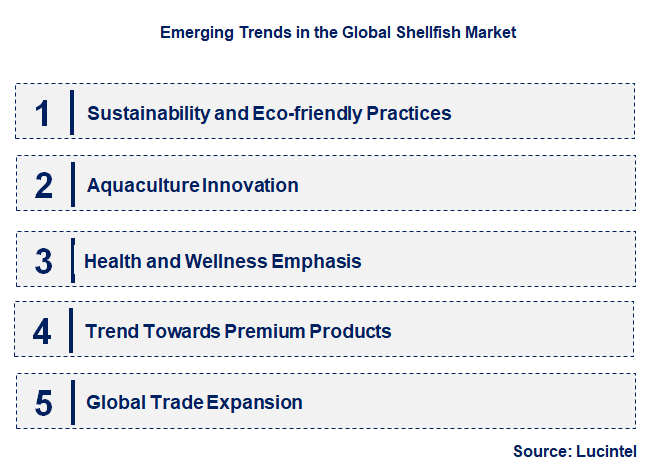
• Sustainability and Eco-friendly Practices: Sustainability is a driving force in the shellfish industry, with customers demanding responsibly sourced products. Both producers and consumers are making a conscious choice to adopt eco-friendly practices like sustainable farming, minimizing waste, and using eco-friendly packaging. Governments and institutions are enacting stronger regulations to make harvesting and production sustainable. This trend is prompting the industry to embrace aquaculture systems with lower environmental footprints, including land-based operations and shellfish restoration. An emphasis on sustainability not only satisfies consumer demand but also assures the long-term sustainability of the industry.
• Aquaculture Innovation: Technological advancements in aquaculture are transforming the shellfish industry. As the demand for shellfish continues to grow, producers are embracing innovative farming techniques to increase production and enhance efficiency. Automation, precision agriculture, and biotechnology are all contributing to optimizing the production process. Advances such as offshore aquaculture systems and closed-loop systems provide means for shellfish growth with minimal environmental impact. Such technologies also increase the quality and safety of shellfish products, as high as the consumers and regulators demand.
• Health and Wellness Emphasis: With consumers increasingly health-conscious, there is growing demand for health foods such as shellfish. Shellfish contain high levels of proteins, vitamins, and necessary fatty acids, and thus form a popular option among those looking for a healthy diet. Furthermore, as part of a trend toward clean eating, consumers are ever more concerned with the health aspects of shellfish. This increased consciousness has resulted in a surge in demand for premium and organic shellfish products since consumers are willing to pay extra for healthier, high-quality products.
• Trend Towards Premium Products: The world demand for premium shellfish products is increasing, particularly in markets such as the U.S., Japan, and Europe. Consumers are becoming increasingly sophisticated about the quality of the products that they eat, and this has resulted in a trend toward premium shellfish varieties, including oysters, lobsters, and specialty shrimp. There is also increasing interest in traceability, as consumers opt for sustainably sourced and traceable products. The premium product trend is remaking the market, as suppliers adapt to serve an increasingly affluent, quality-aware consumer.
• Global Trade Expansion: The international trade in shellfish is growing, fueled by rising demand in developing economies and the requirement for cross-border supply chains. China, the U.S., and Japan are at the forefront of shellfish exports, while developing economies in Southeast Asia, Latin America, and Africa are emerging as major importers. Global commerce is further shaped by technology advancements in logistics and transportation that enable easy supply of fresh shellfish to geographically distant markets. Global commerce expansion creates opportunity for producers while it brings some challenges, such as price fluctuation, regulation compliance, and geopolitics conflicts. These new trends are dramatically transforming the shellfish industry to become more sustainable, innovative, and customer-focused. The industry, as it transforms to these trends, stands to continue growing with a growing focus on quality, sustainability, and health-oriented products. These changes are revolutionizing how shellfish are farmed, distributed, and consumed throughout the world.
• Adoption of Sustainable Aquaculture Practices: The transition toward sustainable aquaculture is the most significant thing to happen to the shellfish industry. Aquaculture units are becoming less wasteful and more environmentally efficient, with recent technologies aimed at minimizing waste, reducing energy costs, and preventing harm to aquatic ecosystems. This is making it possible for the industry to comply with increasing consumers‘ demand for green seafood products while maintaining sustainability in the long term. The growing adoption of certified sustainable agricultural practices has also enabled businesses to differentiate their products in the market, targeting more environmentally aware consumers.
• Shellfish Farming Technological Developments: Technological innovations in shellfish farming are revolutionizing production efficiency and product quality. Automation, drone technology, and smart sensors are being incorporated into shellfish farming operations to keep track of water quality, feed schedules, and minimize labor. These technologies improve productivity while increasing the quality of shellfish for safety and freshness. Precision aquaculture practices are also lowering environmental footprints and making more sustainable practices a reality in the industry.
• Growing Consumer Demand for Premium and Tracible Shellfish: Consumer demand for premium and traceable shellfish is growing, as consumers increasingly look for products that are of high quality and sustainable. This has prompted the creation of certification schemes and blockchain-based traceability options that enable consumers to authenticate the origin and sustainability of their shellfish purchase. As the market is gravitating towards high-end products, suppliers are shifting towards high-end, local, and organic to fulfill this requirement, transforming the global shellfish supply chain.
• Environmental Policies and Policy Reform: More stringent environmental policies and policy reforms are affecting the shellfish sector, compelling producers to be more environmentally friendly. In most parts of the world, governments are imposing tougher legislation on water quality, harvesting methods, and waste management. Although these regulations are intended to safeguard the environment and promote sustainability, they also pose difficulties for producers, who have to invest in new processes and technologies to meet them. In spite of the difficulties, these policies are stimulating innovation and a more sustainable shellfish industry.
• Growth of Shellfish Exports to Emerging Markets: The growth of shellfish exports to emerging markets, especially in Asia and Africa, is transforming the global shellfish trade. As incomes increase in these countries, premium shellfish products are becoming more in demand. China, the U.S., and Japan are at the forefront of exports, with higher quantities of shellfish being exported globally. This growth is creating new opportunities for manufacturers, but it also brings complexities in terms of supply chain management, regulatory requirements, and market volatility. These are recent trends that are leading the shellfish industry towards increased sustainability, new technologies, and market diversification. With growth, these will continue to dominate the market, and new opportunities will be created for companies to tap
• Shellfish Aquaculture Expansion: The growth of shellfish aquaculture offers a substantial growth prospect. As consumer demand for sustainable seafood increases, aquaculture is emerging as a critical element of shellfish production. Investment in offshore and onshore aquaculture systems can expand the capacity of production while lessening environmental footprint. The systems also provide more control over production conditions, promoting better product quality. With growing consumer interest in sustainable shellfish, aquaculture stands to play an important role in responding to this interest.
• Increase in Shellfish Exports to Emerging Economies: The emerging middle class in the emerging economies of Asia and Africa is an opportunity for more shellfish exports. With the increasing disposable incomes in these regions, there is a growing demand for premium seafood. By exporting to these markets, shellfish farmers can access new revenue streams, and also expand their customer base. Trade agreement development and the advancement of cold-chain logistics will be the critical factors in seizing this opportunity.
• Shellfish Processing and Packaging Innovation: Processing and packaging innovation is another growth driver. Technological advances in freezing, canning, and packaging will be able to lengthen the shelf life of shellfish and enhance distributional efficiency. Innovations in packaging that are environmentally friendly, such as biodegradable or recyclable packaging, will also resonate with green consumers. These innovations will enable producers to satisfy demand for fresh, high-quality products while minimizing waste and costs.
• Focus on Health-Conscious Consumers: As more people embrace health-focused diets, the nutritional value of shellfish positions it as a strong option. Shellfish contain less fat but a high level of necessary nutrients, a factor that resonates with the increased interest in clean eating. Positioning shellfish as a sustainable and healthy food option taps into the expanding health-focused consumer base. Furthermore, the creation of products to suit special dietary requirements, such as low-sodium or allergen-free shellfish products, is an additional opportunity.
• Establishing Sustainable Shellfish Farming Practices: The demand for sustainable products is growing, and this is pushing the establishment of environmentally friendly shellfish farming practices. Investing in environmentally friendly practices like restorative aquaculture, integrated multi-trophic aquaculture, and organic shellfish farming can not only satisfy consumer demand for environmentally friendly products but also make producers trendsetters in the sustainability movement. These practices minimize environmental degradation and maximize long-term sustainability in the shellfish industry. The strategic opportunities for growth in the shellfish industry are a reflection of trends toward sustainability, innovation, and healthier consumer demand. Businesses can gain a competitive advantage and support future growth and development in the industry through exploiting these opportunities.
• BioMar
• Maruha Nichiro
• ZONECO
• Asian Seafood
• Guo Lian
• Zhoushan Fisheries
• Xing Ye
• Oriental Ocean
• Liao Yu
• Homey
• Prawns
• Crabs
• Bivalve
• Others
• Supermarket
• Restaurant
• North America
• Europe
• Asia Pacific
• The Rest of the World
• United States: The United States‘ market for shellfish is growing because consumers are becoming more interested in sustainable seafood choices. Demand for oysters, mussels, and clams is rising as consumers embrace a healthier diet containing nutrient-dense shellfish. The U.S. is also investing in enhancing aquaculture methods, such as shellfish farming, to minimize the environmental footprint and benefit local economies. In addition, regulatory policies and programs for sustainable seafood are helping the industry by promoting environmentally responsible practices. Even with these developments, the U.S. market has challenges associated with supply chain problems, which can impact product availability and prices.
• China: China, being the biggest global producer and consumer of shellfish, continues to push the market outward using advancements in technology and expanding consumption. It boasts an extensive home-consumer base with rising per-capita shellfish consumption brought on by greater awareness of seafood as a healthier form of sustenance. Aquaculture technology is being modernized, and environmental stress from the process is declining while it maximizes the production rate. Further, China is aiming at enhancing the sustainability of its shellfish farming sector through enhanced regulatory standards. Nevertheless, China is faced with water quality, overfishing, and environmental degradation challenges that might influence long-term market expansion.
• Germany: Germany‘s shellfish market is, in turn, affected by the growing demand towards sustainability and environmentally friendly consumption patterns. Shellfish like mussels and oysters are becoming increasingly popular because of their low environmental footprint relative to other animal proteins. Germany‘s focus on environmental policies and sustainable aquaculture methods is contributing to market expansion. Additionally, the country‘s position as a dominant force in the European Union seafood market provides the potential for expansion in exports. But Germany is also confronted with issues such as restricted domestic production, dependency on imports, and apprehensions regarding sustainability practices in shellfish cultivation.
• India: India‘s shellfish market is growing at a fast pace, with increasing domestic as well as foreign demand. Expansion of the export market for shrimp, prawns, and other shellfish is among the major driving forces behind the industry‘s development. India has concentrated efforts on developing its aquaculture facilities, refining breeding methods, and maintaining high-quality production. With more seafood products being shipped overseas, the market for shellfish is also enjoying rising demand in markets such as Europe and the Middle East. Challenges, though, are the necessity for improved regulatory environments and sustainability practices in order to sustain long-term growth.
• Japan: Japan continues to be an important player in the international market for shellfish, with a long history of eating shellfish like clams, oysters, and scallops. The nation‘s aggressive emphasis on sustainable seafood practices has resulted in investment in modern aquaculture techniques to sustain a continuous supply of quality shellfish. In addition, Japan‘s strong demand for seafood is complemented by its expanding export business, primarily in neighboring countries. Even with the developments, however, environmental issues like pollution and overfishing pose problems to the long-term sustainability of shellfish farming in Japan.


• BioMar
• Maruha Nichiro
• ZONECO
• Asian Seafood
• Guo Lian
• Zhoushan Fisheries
• Xing Ye
• Oriental Ocean
• Liao Yu
• Homey Q5. Which shellfish market segment will be the largest in future? Answer: Lucintel forecasts that, within the type category, prawn is expected to witness the highest growth over the forecast period due to the increasing demand for prawns in global seafood. Q6. In shellfish market, which region is expected to be the largest in next 5 years? Answer: In terms of region, APAC is expected to witness the highest growth over the forecast period. Q7. Do we receive customization in this report? Answer: Yes, Lucintel provides 10% customization without any additional cost.


Choose a license that fits your team. Instant PDF delivery.
Prices exclude taxes. Instant delivery. Custom licensing available on request.
Market Report · July 22, 2026
Market Report · July 22, 2026
Market Report · July 22, 2026
Trusted partner for strategic intelligence and business growth


Receive a complimentary market analysis tailored to your industry. Our analysts will identify key growth opportunities and competitive dynamics specific to your business.

Market size, growth rate, and key trend analysis for your specific sector.

Top competitor positioning and market share analysis.

Strategic recommendations backed by data-driven insights.
Get curated market intelligence and competitive moves straight to your inbox.
By subscribing, you agree to receive our monthly insights. Unsubscribe anytime.
Receive a complimentary market analysis tailored to your industry. Our analysts will identify key growth opportunities and competitive dynamics specific to your business.
Market size, growth rate, and key trend analysis for your specific sector.
Top competitor positioning and market share analysis.
Strategic recommendations backed by data-driven insights.
Get curated market intelligence, emerging trends, and competitive moves straight to your inbox each month.
By subscribing, you agree to receive our monthly insights. Unsubscribe anytime.
We'll send your sample report shortly.