
Market Report · May 18, 2026

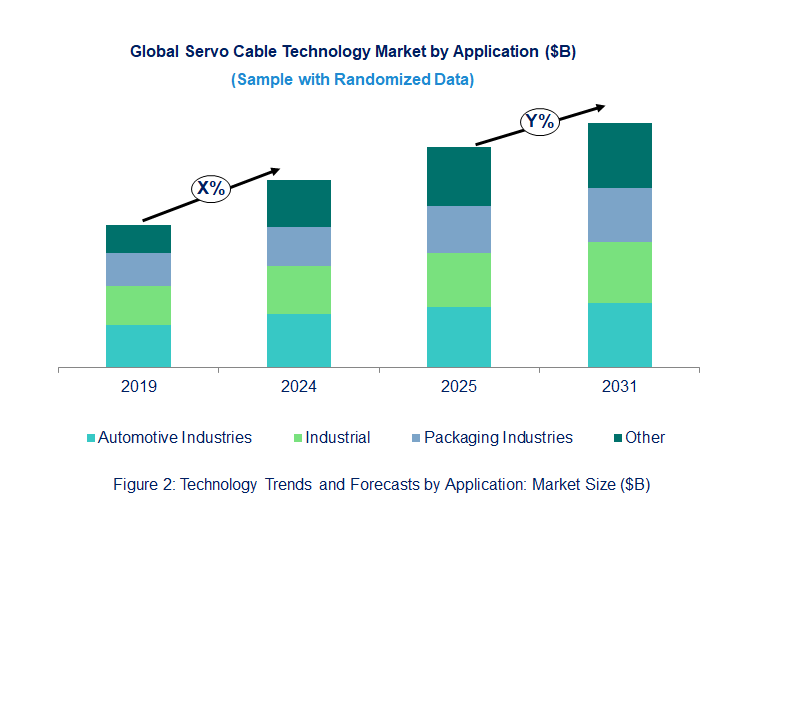
This market report covers trends, opportunities, and forecasts in the global servo cable market to 2031 by technology (flexible servo cables, armored servo cables, high-frequency servo cables, hybrid servo cables, and ethernet-integrated servo cables), application (automotive industries, industrial, packaging industries, and other), and region (North America, Europe, Asia Pacific, and the Rest of the World)
We'll send your sample report shortly.
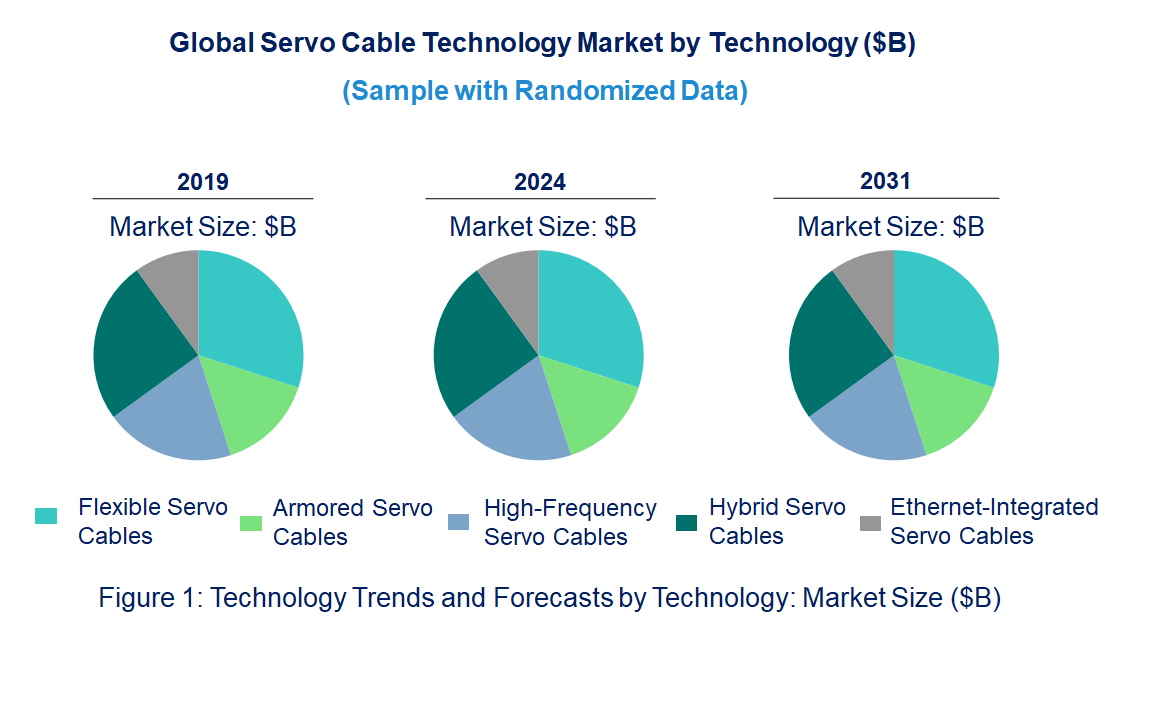
• Increase in the Speed of Data Transmission: The need for speed in data transfer related to automation systems, including robots and CNC machines, elevates the popularity of high-frequency servo cables.
• Use of Hybrid Servo Cables: More focus needs to be placed on combining as many unused cables as possible into one hybrid cable, considering how robotics, automotive manufacturing, and the packaging industry could greatly benefit from such developments.
• Growth of the Ethernet Integrated Servo Cables: With the concepts of Industry 4.0 comes Ethernet-integrated servo cables, bringing more communication possibilities between machines and controllers for easier remote supervision of these more intelligent machines.
• Increased Requests for Durable and Flexible Cables: There appears to be a preference for flexible servo cables designed for high flexing cycles and harsh environments, especially in the robotics and automotive industries, where durability and reliability are vital.
• Emphasis on Green Alternatives: Servo cable production has shifted to a more environmentally friendly approach using recyclable materials due to the increasing number of regulations on environmental protection. The servo cable market is characterized by high speed, high efficiency, and seamless integration around the world. High-speed data transmission, hybrid cables, and Ethernet integration are improving industrial automation and connectivity, while performance improvement and eco-friendly materials are also aiding environmental sustainability. Such trends are critical in advancing technologies around servo cables as industries enter a more connected, efficient, and sustainable environment.
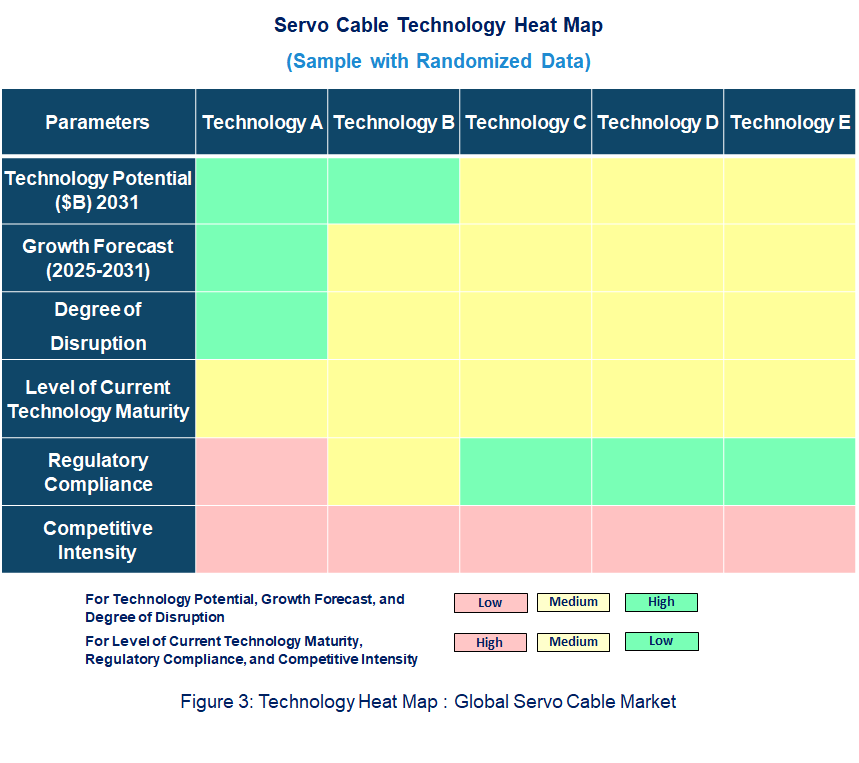
• Potential in Technology: The technology has significant potential as global industries shift towards greater automation and precision engineering. Its ability to handle high-speed data transmission while withstanding mechanical stress, electrical interference, and harsh environmental conditions enhances its value across sectors.
• Degree of Disruption: The degree of disruption is moderate to high, especially as smart manufacturing and Industry 4.0 demand more reliable, high-performance cable solutions that can support real-time data and energy transfer. While conventional cables may suffice in some applications, servo cables with enhanced shielding, flexibility, and temperature resistance are rapidly replacing older options.
• Current Technology Maturity Level: In terms of maturity, the technology is well-developed but continues to evolve with advancements in insulation materials, EMI shielding, and miniaturization to meet higher system integration demands.
• Regulatory Compliance: Regulatory compliance is stringent due to the application in safety-critical and high-performance environments. Servo cables must meet standards such as UL, CE, RoHS, and IEC for electrical safety, fire resistance, and environmental impact. As the industrial automation landscape evolves, servo cables are positioned as a critical enabler of efficiency, accuracy, and durability in next-generation manufacturing environments.
• Alpha Wire: Alpha has managed to maintain a competitive advantage over its competitors by expanding its marketing scope and introducing flexible and efficient high-end cables ideal for robotic environments.
• FlexoTech: FlexoTech’s strength lies in developing flexible and custom-engineered servo cable systems within the automotive space, specifically improving cable reliability and performance under severe conditions, including vibration and temperature extremes.
• HELUKABEL: HELUKABEL has made considerable progress in manufacturing Ethernet-integrated servo cables, supporting machine-to-machine connections in automated systems, and paving the way for integrated manufacturing systems.
• Lapp Group (Lapp Mulle): Lapp Group introduced new hybrid servo cables for power and signal transmission in one cable, which helps save space in complex machines and decreases installation time in packaging and robotics industries.
• TPC Wire & Cable: TPC Wire & Cable now focuses on armored and flexible cables, primarily for the oil and gas industries, requiring rugged, dependable servo cables that withstand harsh operating conditions.
• MURRPLASTIK SYSTEMTECHNIK: MURRPLASTIK SYSTEMTECHNIK offers high-frequency servo cables and high-performance connectors intended for advanced industrial automation and robotics with minimal signal loss for efficient performance.
• Automation and Robotics: The increasing levels of automation in industries such as automotive and manufacturing positively impact the market growth of servo cables. These components ensure smooth power and signal performance, critical for these systems.
• Growth in Industrial IoT: The market for Industrial IoT is expanding, driving the demand for automated systems that can operate autonomously, which in turn increases the need for high-performance servo cables. These cables are crucial for smart factory efficiency and real-time data flow.
• Advancements in Robotics and AI: The growing role of robotics in industries like healthcare, logistics, and manufacturing requires precise control of motion, which servo cables ensure. The integration of AI increases automation, demanding more reliable and faster servo cables.
• Electric Vehicles (EVs): As the EV market expands, the focus on more efficient motion control, including servo cables, is increasing. Servo cables are used in EV motors, and the need for these cables in the automotive industry will continue to grow.
• Investments in Aerospace and Defense: As investments in aerospace and defense increase, the need for servo cables capable of performing under extreme conditions rises. These cables are essential for the smooth operation of systems in aircraft and military devices. Major Challenges
• Costly Servo Cables: Servo cables with special insulation tend to be costly, particularly those designed to withstand harsh environments. High production costs may deter adoption and usability in applications with budget limitations.
• Time-Intensive Integration: Integrating new or existing servo cables into complex systems requires time and skill, making it a non-hassle-free experience. The market may grow slowly due to businesses hesitating to change or install new servo cables due to system intricacy.
• Wear and Tear: Servo cables tend to suffer from wear and tear, especially with heavy industrial use. While customer satisfaction and operational efficiency are critical, long-term reliability and healthy maintenance costs remain central challenges. The servo cable market is affected by factors like increasing automation, advancements in robotics, and the growing electric vehicle market. However, challenges such as high production costs, complex installations, and maintenance requirements must be addressed for the market to grow. These growth drivers are expected to push market expansion but will require continuous innovation to overcome the challenges they present.
• Alpha Wire
• FlexoTech
• HELUKABEL
• Lapp Group (Lapp Mulle)
• TPC Wire & Cable
• MURRPLASTIK SYSTEMTECHNIK
• Technology Readiness by Technology Type: Flexible Servo Cables are mature and widely adopted in dynamic automation, offering high flexibility and strong compliance with safety standards. Armored Servo Cables are also mature, best suited for mining, marine, and industrial plants where mechanical protection is vital. High-Frequency Servo Cables are advancing rapidly, driven by demand for high-speed motion control in semiconductor and packaging lines. Hybrid Servo Cables are in mid-to-high readiness, increasingly used in compact robots and integrated systems to simplify wiring. Ethernet-Integrated Servo Cables are emerging yet gaining momentum, critical to Industry 4.0 communication systems. Competitive intensity is highest among flexible and hybrid types due to broad demand. Regulatory compliance varies by type but generally aligns with international norms like UL and CE. Key applications span from automotive robotics to packaging, renewable energy, and smart factories, depending on specific cable features and operational environments. Competitive Intensity and Regulatory Compliance: The servo cable market is highly competitive, with numerous players offering advanced variants to meet rising automation standards. Flexible and High-Frequency Servo Cables compete on durability and transmission speed, while Armored variants target niche heavy-duty applications. Hybrid and Ethernet-Integrated types see strong adoption in smart manufacturing. Regulatory compliance is critical, with products requiring adherence to UL, CE, RoHS, and IEC standards for safety, electromagnetic compatibility, and environmental impact. Ethernet-integrated variants face stricter network protocol compliance. The push toward eco-friendly and low-halogen cables adds to the compliance burden. Manufacturers differentiate via certifications, insulation materials, and temperature ratings. Market dynamics are driven by innovation speed and cost competitiveness, with regulatory benchmarks acting as gatekeepers for market entry and international deployment.
• Disruption Potential by Technology Type: Flexible Servo Cables are disrupting traditional automation by offering enhanced movement adaptability in robotic arms and dynamic machinery. Armored Servo Cables introduce ruggedized alternatives suitable for extreme environments, reducing system failures. High-Frequency Servo Cables enable fast data transmission, essential for real-time control systems and high-speed operations. Hybrid Servo Cables integrate power and signal lines, reducing installation complexity and boosting compact automation design. Ethernet-Integrated Servo Cables offer seamless communication in smart factories, enabling Industry 4.0 connectivity. These technologies enhance system uptime, reduce space requirements, and improve EMI resistance. Their compatibility with evolving automation infrastructure boosts their adoption. Each variant supports miniaturization and advanced motion applications. Overall, these innovations redefine servo cabling by aligning with growing demands for flexible, efficient, and intelligent connectivity in industrial systems.
• Flexible Servo Cables
• Armored Servo Cables
• High-Frequency Servo Cables
• Hybrid Servo Cables
• Ethernet-Integrated Servo Cables
• Automotive Industries
• Industrial
• Packaging Industries
• Other
• North America
• Europe
• Asia Pacific
• The Rest of the World
• Latest Developments and Innovations in the Servo Cable Technologies
• Companies / Ecosystems
• Strategic Opportunities by Technology Type


Choose a license that fits your team. Instant PDF delivery.
Prices exclude taxes. Instant delivery. Custom licensing available on request.
Market Report · May 18, 2026
Market Report · May 18, 2026
Market Report · May 18, 2026
Trusted partner for strategic intelligence and business growth


Receive a complimentary market analysis tailored to your industry. Our analysts will identify key growth opportunities and competitive dynamics specific to your business.

Market size, growth rate, and key trend analysis for your specific sector.

Top competitor positioning and market share analysis.

Strategic recommendations backed by data-driven insights.
Get curated market intelligence and competitive moves straight to your inbox.
By subscribing, you agree to receive our monthly insights. Unsubscribe anytime.
Receive a complimentary market analysis tailored to your industry. Our analysts will identify key growth opportunities and competitive dynamics specific to your business.
Market size, growth rate, and key trend analysis for your specific sector.
Top competitor positioning and market share analysis.
Strategic recommendations backed by data-driven insights.
Get curated market intelligence, emerging trends, and competitive moves straight to your inbox each month.
By subscribing, you agree to receive our monthly insights. Unsubscribe anytime.
We'll send your sample report shortly.