
Market Report · July 16, 2026

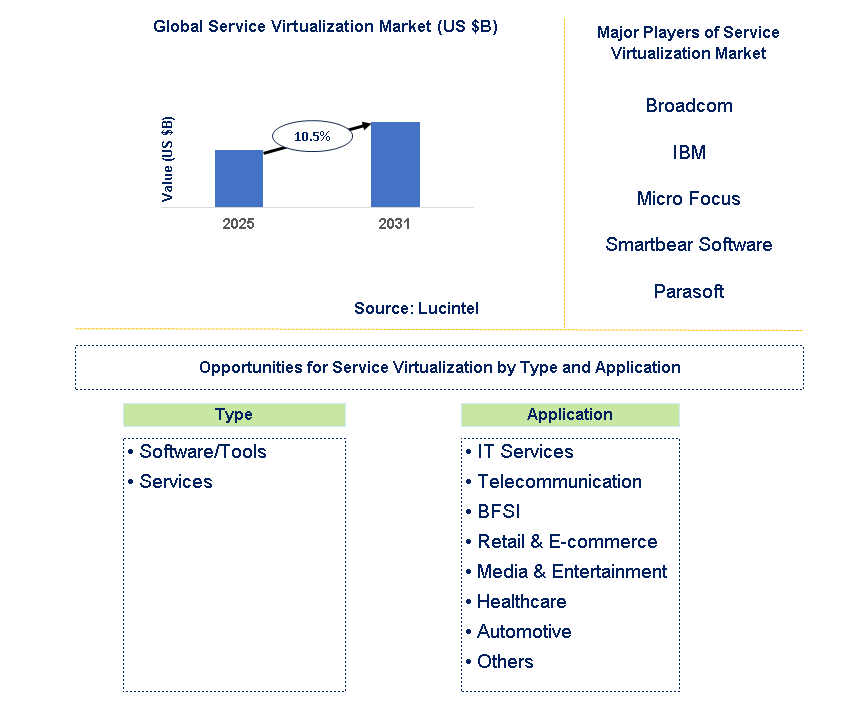
Key data points: The growth forecast = 10.5% annually for the next 7 years. Scroll below to get more insights. This market report covers trends, opportunities and forecasts in service virtualization market to 2031 by type (software/tools and services), application (It services, telecommunication, BFSI, retail & E-commerce, media & entertainment, healthcare, automotive, and others), and region (North America, Europe, Asia Pacific, and the Rest of the World)
We'll send your sample report shortly.
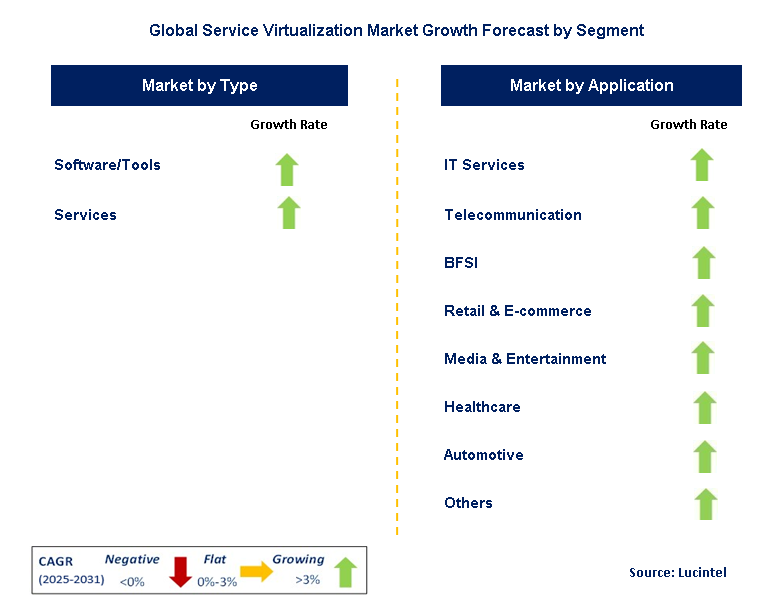
• Lucintel forecasts that, within the type category, software/tool is expected to witness higher growth over the forecast period.
• Within the application category, It service is expected to witness the highest growth.
• In terms of region, APAC is expected to witness the highest growth over the forecast period. Gain valuable insights for your business decisions with our comprehensive 150+ page report. Sample figures with some insights are shown below.
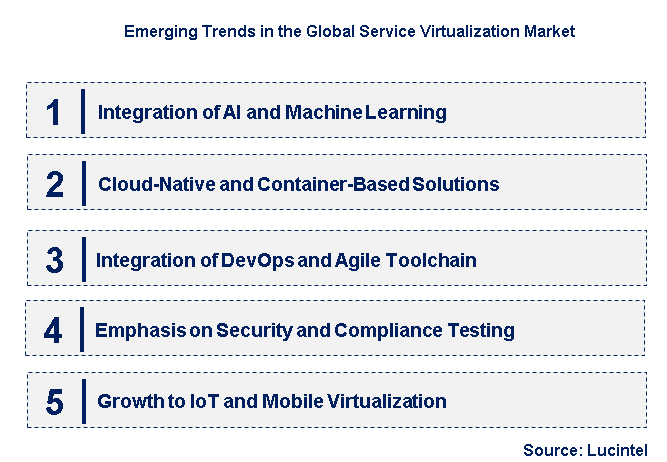
• Integration of AI and Machine Learning: One of the main emerging trends involves the integration of artificial intelligence and machine learning into service virtualization technology. AI and ML are being employed to automate virtual service generation, to intelligently inspect API traffic, and to create more realistic test data. The result is an enhanced and more efficient testing infrastructure that can model complex behaviors and can detect defects faster. This trend is minimizing the labor involved with service virtualization and is opening it up to more development teams.
• Cloud-Native and Container-Based Solutions: Another prominent trend is the move towards cloud-native and container-based service virtualization solutions. Such solutions are crafted to integrate smoothly into cloud infrastructures and with container orchestration tools such as Kubernetes. The effect is a more agile and scalable testing environment that can be provisioned and de-provisioned as needed. This trend is making it easier for organizations to incorporate service virtualization into their CI/CD pipelines and assist in the creation of applications based on microservices.
• Integration of DevOps and Agile Toolchain: The industry is witnessing a shift towards the extensive integration of service virtualization with a larger array of DevOps and Agile tools. It means that service virtualization is integrated with continuous integration, continuous delivery, and test automation tools. The result is a smoother and automated software development cycle, where testing can be done earlier and more often. This practice is assisting in reducing silos between operations and development teams and is a key enabler of quicker time-to-market.
• Emphasis on Security and Compliance Testing: Increasingly, there is a trend towards applying service virtualization for compliance and security testing. Virtualization of a service allows developers to develop a secure, controlled environment for vulnerability testing without sending sensitive data to third-party services. The result is an improved, more compliant software development process. This is especially the case in highly regulated markets such as healthcare and finance, where data security and regulatory compliance are paramount.
• Growth to IoT and Mobile Virtualization: The industry is moving towards an extension of service virtualization into the Internet of Things (IoT) and mobile. IoT and mobile systems frequently depend on a broad variety of external services and devices that may be hard to test or simulate. The effect is a new use for service virtualization that will emulate those intricate ecosystems, enabling more thorough testing. This trend is creating new opportunity for growth and is making service virtualization an essential technology for the creation of new connected applications. All of these emerging trends are collectively transforming the service virtualization market to make it smarter, automated, and deeply embedded in the new software development lifecycle. This integration of AI and cloud-native solutions is driving efficiency and scalability. The emphasis on DevOps integration and security testing is making service virtualization a more intrinsic and useful tool. The move into new uses such as IoT is increasing the reach of the market. Overall, it’s a market that is more dynamic, more technologically sophisticated, and better tuned to the complicated demands of software development today.
• Widespread Use of Cloud-Based Solutions: One of the major recent trends is the ubiquitous use of cloud-based service virtualization solutions. Instead of installing and running software on-premises, companies are now turning more towards cloud-based platforms that are more scalable, flexible, and cost-effective. The effect is a more pervasive and nimble service virtualization solution that can easily be incorporated into cloud-native development environments. This innovation is fueling market growth and is making service virtualization more attractive to a broader base of businesses, including small and medium-sized businesses.
• Integration with DevOps and CI/CD Pipelines: The market is experiencing a trend where there is a deep integration of service virtualization with DevOps and CI/CD pipelines. With companies embracing these practices for continuous delivery, service virtualization has emerged as an essential piece for facilitating continuous testing. The result is a smoother and automated development process, where testing bottlenecks are removed and applications can be delivered faster. This development is making service virtualization a central tool for contemporary software development.
• Introduction of AI-Powered Features: Another critical advancement is the integration of AI-enabled capabilities into service virtualization platforms. Vendors are leveraging AI and machine learning to automate the virtual service creation, to create test data, and to process test results. The result is a tremendous decrease in manual effort involved in service virtualization. This advance is making the technology more intelligent and efficient and is enabling development teams to work on more advanced tasks.
• Emphasis on Open Source and API Ecosystems: There are notable advancements in the emphasis on open-source and API ecosystems. The marketplace is witnessing an emergence of open-source frameworks and tools for service virtualization, and more emphasis on solutions that are capable of integrating with numerous APIs. The consequence is a more adaptable and customizable solution for service virtualization. This advancement is providing companies with greater control over their testing environment and creating a more collaborative and innovative ecosystem.
• Strategic Acquisitions and Alliances: The market has witnessed a trend where there is strategic partnership and acquisition among major players. Technology firms are acquiring smaller companies to improve their service virtualization processes and reach a wider market. The effect is that the market is consolidating and the competitive environment is becoming stronger. This trend is resulting in the formation of more complete and integrated solutions with a better variety of features to provide to customers. All the recent developments in the service virtualization market are together propelling it toward an automated, cloud-centric, and integrated future. The integration with DevOps pipelines and the adoption of cloud-based solutions are making the technology accessible and more valuable. The innovation is being facilitated through the focus on open source and the addition of AI-powered features that are improving efficiency. The strategic partnerships are resulting in a more consolidated and mature market. Overall, the result is a market that is more technologically focused, more dynamic, and better suited to meet the needs of software development today.
• Microservices and Containerized Applications: The trend to microservices and containerized applications represents a huge growth potential. Microservices-based architectures depend on a complex web of interconnected services, testing which may be hard. The potential is to offer a service virtualization solution that is capable of simulating efficiently these complex webs, enabling thorough testing without bottlenecks on dependencies. This use case is leading edge software development and represents a high-value market segment.
• Internet of Things (IoT) and Connected Devices: The Internet of Things and networked devices represent a large growth opportunity. IoT applications frequently depend on large collections of devices and services that are hard to access or reproduce in a test environment. The chance lies in providing a specialty service virtualization solution that can mimic these complicated ecosystems, enabling complete testing of IoT applications. This market is a high-growth area in which the requirement for trustworthy testing solutions is paramount.
• Banking, Financial Services, and Insurance: The BFSI industry is one of the prime growth opportunities. Banks are experiencing huge digital overhauls, and they depend on intricate webs of internal as well as external services, including payment gateways and legacy systems. The chance is to offer a service virtualization product that is able to allow these organizations to test their new applications without affecting their live systems and without exposing sensitive data. This app provides a high-margin market segment where compliance and security are primary concerns.
• Healthcare and Life Sciences: The life sciences and healthcare application is a strategic growth opportunity. These businesses are digitizing everything from electronic health records to telemedicine platforms. The potential is to provide a service virtualization solution that can aid in the testing of these applications for reliability, security, and adherence to stringent regulations such as HIPAA. This application is a high-growth market with an urgent requirement for specialized and secure testing solutions.
• Cloud Migration and Hybrid Cloud Environments: The market has a strategic opportunity for growth in the use of service virtualization for cloud migration and hybrid cloud environments. As companies migrate their applications to the cloud, they struggle with testing the integrations with their on-premises legacy systems. The opportunity is to offer a service virtualization solution that can mimic these legacy systems so that cloud migration can be done smoothly and risk-free. This solution is critical to a great many companies and presents a high-impact trajectory for expansion. These strategic expansion opportunities are affecting the service virtualization market by broadening its applicability from mainstream software development to any number of industries and uses. By targeting high-growth areas such as microservices and IoT, organizations are able to diversify their revenue streams and decrease their dependency on one market sector. The BFSI and healthcare opportunities are driving the market towards specialized, high-value solutions. The use of cloud migration is cementing the market as a key enabler of digital transformation. Overall, the effect is a market that is becoming increasingly versatile, increasingly specialized, and increasingly interconnected with the wider digital economy.
• Broadcom
• IBM
• Micro Focus
• Smartbear Software
• Parasoft
• Tricentis
• Cavisson Systems
• Cigniti
• Cognizant
• Wipro Limited
• Software/Tools
• Services
• IT Services
• Telecommunication
• BFSI
• Retail & E-commerce
• Media & Entertainment
• Healthcare
• Automotive
• Others
• North America
• Europe
• Asia Pacific
• The Rest of the World
• United States: US market is the leader in the service virtualization market, driven by a large base of prominent vendors and a strong IT infrastructure. New trends are centered on growing adoption of cloud-based offerings and embedding of service virtualization within more comprehensive DevOps toolsets. US firms are investing heavily in sophisticated software testing tools to drive their digital transformation processes. Security and compliance are also being heavily emphasized in the market, particularly in industries such as healthcare and finance, where service virtualization is applied to test applications securely without exposing data.
• China: The Chinese market is experiencing notable growth with an increase in digital transformation coupled with cloud computing growth. The latest trends have centered on utilizing service virtualization to aid in the fast-paced software development lifecycle of the country. The market is witnessing increasing demand for service virtualization products, especially in the IT and telecommunications industry. With Chinese companies focusing on making their software development processes better, the uptake of Agile and DevOps practices is growing, thus generating tremendous demand for service virtualization for continuous integration and continuous delivery (CI/CD).
• Germany: Germany’s service virtualization market continues to grow, with emphasis on optimization of operations and the modernization of IT infrastructure. The latest trends focus on the integration of service virtualization as a means to save costs and enhance software quality. The market is experiencing an increasing demand for elastic and scalable solutions that can accommodate the nation’s drive for digital transformation. German businesses are increasingly using service virtualization to break dependence on systems that are not available and to speed their software testing, which is a main component of their overall strategy for innovation.
• India: India’s market is one in very rapid growth with huge potential for growth, driven by a massive push for digitalization and a huge IT and telecom sector. Recent trends involve an increasing adoption of service virtualization to facilitate Agile and DevOps approaches. The market is witnessing rising demand for economical testing products to allow for quicker time-to-market. India’s emphasis on locally developed technology and its increasing skill level in software development are drivers of prime importance, thus positioning India as an important market for service virtualization.
• Japan: Japan’s technology-driven market is experiencing a keen interest in service virtualization to make processes more efficient and save on development. Recent trends are fueled by an effort to modernize aged applications and bring them in line with new, cloud-native software. The market is experiencing a concentration of interest in using service virtualization to break dependencies upon mainframe systems and other hard-to-reach services. The necessity to speed up software testing and provide quality within an extremely competitive marketplace is one of the main reasons for the take-up of service virtualization in Japan.


• Broadcom
• IBM
• Micro Focus
• Smartbear Software
• Parasoft
• Tricentis
• Cavisson Systems
• Cigniti
• Cognizant
• Wipro Limited Q5. Which service virtualization market segment will be the largest in future? Answer: Lucintel forecasts that, within the type category, software/tool is expected to witness higher growth over the forecast period. Q6. In service virtualization market, which region is expected to be the largest in next 5 years? Answer: In terms of region, APAC is expected to witness the highest growth over the forecast period. Q7. Do we receive customization in this report? Answer: Yes, Lucintel provides 10% customization without any additional cost.


Choose a license that fits your team. Instant PDF delivery.
Prices exclude taxes. Instant delivery. Custom licensing available on request.
Market Report · July 16, 2026
Market Report · May 18, 2026
Market Report · May 18, 2026
Trusted partner for strategic intelligence and business growth


Receive a complimentary market analysis tailored to your industry. Our analysts will identify key growth opportunities and competitive dynamics specific to your business.

Market size, growth rate, and key trend analysis for your specific sector.

Top competitor positioning and market share analysis.

Strategic recommendations backed by data-driven insights.
Get curated market intelligence and competitive moves straight to your inbox.
By subscribing, you agree to receive our monthly insights. Unsubscribe anytime.
Receive a complimentary market analysis tailored to your industry. Our analysts will identify key growth opportunities and competitive dynamics specific to your business.
Market size, growth rate, and key trend analysis for your specific sector.
Top competitor positioning and market share analysis.
Strategic recommendations backed by data-driven insights.
Get curated market intelligence, emerging trends, and competitive moves straight to your inbox each month.
By subscribing, you agree to receive our monthly insights. Unsubscribe anytime.
We'll send your sample report shortly.