
Market Report · July 29, 2026

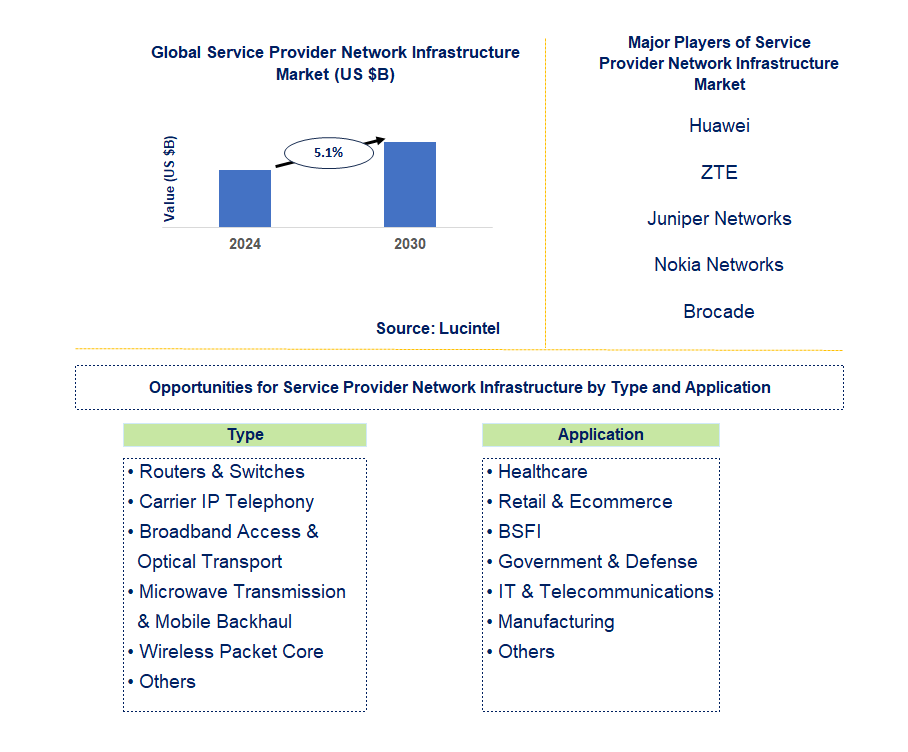
Key data points: The growth forecast = 5.1% annually for the next 7 years. Scroll below to get more insights. This market report covers Trends, opportunity and forecast in service provider network infrastructure market to 2031 by type (routers & switches, carrier IP telephony, broadband access & optical transport, microwave transmission & mobile backhaul, wireless packet core, and others), application (healthcare, retail & ecommerce, BFSI, government & defense, IT & telecommunications, manufacturing, and others), and region (North America, Europe, Asia Pacific, and the Rest of the World)
We'll send your sample report shortly.
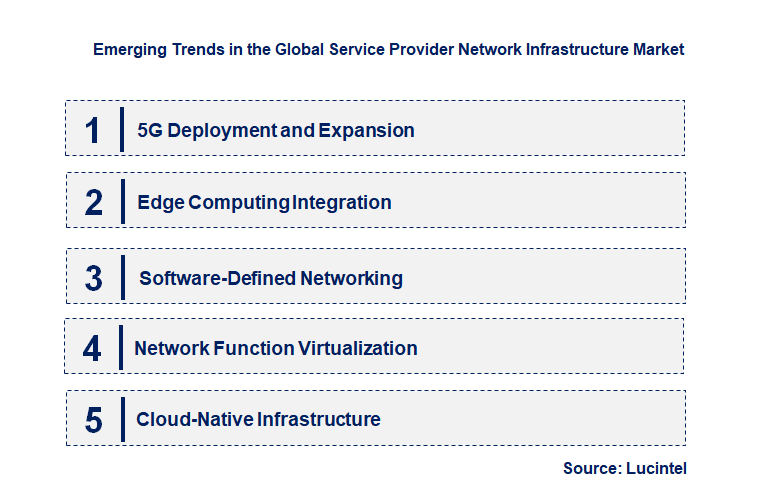
• 5G Deployment and Expansion: A rollout of 5G networks is one of the transformative trends in the service provider network infrastructure market. 5G promises to deliver significantly faster speed, a much lower latency, and greater network capacity in comparison with the previous generations. Growth in demand for mobile data and new applications like autonomous cars, smart cities, and IoT made service providers spend big on 5G infrastructure. The expansion of 5G networks is expected to drive the growth of related technologies and services, including edge computing and network slicing.
• Edge Computing Integration: Edge computing is increasingly important as a complement to traditional cloud computing in service provider networks. The processing of data near the sources decreases latency and improves the speed and efficiency of applications, including real-time applications like autonomous vehicles and industrial IoT. In a bid to meet performance, providers are establishing edge data centers as well as introducing edge computing solutions in network infrastructures for optimization and efficient serving of customers.
• Software-Defined Networking: Software-defined networking (SDN) is transforming how networks are designed, managed, and optimized. SDN allows service providers to separate the control plane from the data plane, enabling more agile and flexible network management. This trend is driving the adoption of SDN as it allows for dynamic, automated network provisioning and improved scalability. SDN is also an important enabler for 5G networks as it provides the flexibility needed to manage the complex traffic patterns and diverse use cases associated with 5G services.
• Network Function Virtualization: Network function virtualization is transforming the way service providers manage and deploy network services. NFV makes it possible to virtualize network functions so that service providers can run traditional network services as software on standard hardware platforms. This reduces the dependency on expensive proprietary hardware and increases the flexibility of network management. With NFV, service providers can make operations leaner, cheaper, and more scalable, which results in faster new service deployment.
• Cloud-Native Infrastructure: Cloud-native infrastructure is a critical trend in the service provider network infrastructure market. In the wake of the increasing demand for scalable, on-demand services, service providers are shifting toward cloud-native architectures to enhance the flexibility and responsiveness of their networks. Cloud-native approaches allow service providers to develop and manage applications in a much more efficient and cost-effective way by using microservices and containerization. This shift is certainly improving the pace at which new services are both developed and launched, and it optimizes resources usage in the network. These emerging trends are revolutionizing the service provider network infrastructure market by providing more flexibility, scalability, and efficiency in networks. With 5G, edge computing, SDN, NFV, and cloud-native architectures, service providers can address rising demand for data, minimize their cost of operations, and provide new services to customers.
• Enormous Investment in 5G Networks: One of the most significant investments going on in the service provider network infrastructure is 5G networks. Governments across the world are putting billions of dollars into building and developing 5G infrastructure for telecoms. It is enabling service providers to deliver faster speeds, improved coverage, and lower latency, which makes 5G one of the key growth triggers for the telecommunication industry. The 5G network is also opening pathways for new applications such as IoT, autonomous driving, and augmented reality.
• Expansion in Fiber Optic Networks: An important growth within the service provider network infrastructure market is fiber-optic networks' expansion. Such networks give out high-speed connectivity for the Internet and are required to back this growing data request in the future in the developed as well as developing rural cities. Service providers are investing in fiber to ensure they have enough capacity to meet the rising demand for high-speed internet and support future growth in 5G and IoT applications. Fiber optic networks also provide higher reliability and lower latency, which are critical for modern digital services.
• Network Function Virtualization: The adoption of NFV is transforming the way service providers deploy and manage network services. NFV allows service providers to virtualize network functions and run them on standard hardware platforms, reducing the need for expensive and complex proprietary equipment. This development is enabling more flexible, scalable, and cost-effective networks. As service providers move toward NFV, they can deploy new services more rapidly, optimize network resource usage, and reduce operational costs.
• Cloud Integration and SDN: Increasingly, cloud technologies are integrated with software-defined networking (SDN) for the creation of more agile and efficient networks by service providers. SDN enhances flexibility in traffic management, whereas cloud integration facilitates scalability and effective resource management. Through the implementation of cloud and SDN, service providers improve network performance and enhance customer experience while supporting rising data and connectivity demands. This is especially important during a time when service providers are shifting towards 5G networks and enhancing their cloud services.
• Sustainability and Energy Efficiency: There is an increased interest in sustainability and energy efficiency in the infrastructures built and expanded by service providers. Companies are embracing energy-efficient technologies that minimize carbon footprints and lower the cost of operation. The use of renewable sources of energy for data centers and network equipment is on the rise, supporting the global goal of sustainability. Green practices are increasingly becoming part of the considerations for planning and development of service provider network infrastructures. The key developments will transform the service provider network infrastructure market by supporting faster, more efficient, and sustainable networks. The integration of 5G, fiber optics, NFV, cloud technologies, and energy-efficient solutions will continue to support innovation and advance the capabilities of service providers toward better customer experiences.
• 5G Infrastructure Deployment: The deployment of 5G infrastructure is going to be one of the big growth opportunities for service providers. With 5G networks offering higher speeds, lower latency, and greater network capacity, the service providers will look to aggressively expand their 5G coverage in order to cater to an ever-growing mobile data demand. Investment in further network upgrades by 5G will create the opportunities for the service providers to benefit from an increased demand for high-speed connectivity and new applications enabled by 5G.
• Edge Computing and IOT Integration: Edge computing has become one of the more important applications in service provider network infrastructure markets. In this way, edge computing decreases latency, significantly enhancing real-time applications performance, especially in the IoT sector. Service providers have the chance to build out edge data centers and incorporate edge computing solutions into their networks, promoting the use of IoT applications such as autonomous vehicles, smart cities, and industrial automation, growing this emerging market.
• Cloud-Native Infrastructure and Services: As service providers shift towards cloud-native architectures, there is increasing opportunity to build new services around cloud computing. Cloud-native infrastructure enables more efficient application deployment, scalability, and resource management. This is in line with growing demand for services that are hosted on the cloud. Service providers can tap into this opportunity by offering flexible and scalable cloud solutions that support both business and consumer needs, unlocking new revenue streams.
• Network Slicing in 5G: Network slicing is one of the key features of 5G technology, allowing service providers to create customized virtual networks within a single physical 5G infrastructure. This will allow providers to optimize network performance for different use cases, such as IoT, autonomous vehicles, and virtual reality. The ability to offer tailored services through network slicing presents significant growth opportunities, allowing service providers to offer differentiated services to meet the needs of diverse industries and applications.
• Energy-Efficient Network Solutions: As sustainability increases in importance, there is tremendous opportunity for service providers to emphasize energy-efficient network solutions. Spending on green technologies, such as data centers run on renewable energy and low-power network equipment, can reduce operating costs and diminish environmental impact. By focusing on energy efficiency, service providers are able to fulfill regulatory requirements, attract environmentally responsive consumers, and decrease their total carbon footprint. These growth opportunities are allowing service providers to scale their networks and provide innovative services that support the digital economy. The future of success for service providers will focus on 5G, edge computing, cloud-native solutions, network slicing, and energy efficiency, which will make them stronger competitors in an increasingly connected world.
• Huawei
• ZTE
• Juniper Networks
• Nokia Networks
• Brocade
• Avaya
• Ericsson
• Aruba Networks
• Blue Coat Systems
• Cisco
• Routers & Switches
• Carrier IP Telephony
• Broadband Access & Optical Transport
• Microwave Transmission & Mobile Backhaul
• Wireless Packet Core
• Others
• Healthcare
• Retail & Ecommerce
• BFSI
• Government & Defense
• IT & Telecommunications
• Manufacturing
• Others
• North America
• Europe
• Asia Pacific
• The Rest of the World
• United States: With a major focus on the rollout of 5G networks and expansion of fiber-optic infrastructure, this service provider network infrastructure market in the United States is facing a great transformation. Rise in demand for higher-speed internet and improved mobile connectivity has led to an increase in investment from key players like AT&T, Verizon, and T-Mobile. In addition, cloud computing, edge computing, and SDN advances are enabling service providers to make their networks more agile and efficient. The U.S. government is also promoting network extension, especially in rural areas, to bridge the digital gap and boost economic growth.
• China: China is rapidly modernizing its network infrastructure, and the focus is on the deployment of 5G, which is regarded as the core technology for the country's technology strategy. The government has heavily invested in creating a robust 5G ecosystem, and companies like Huawei and China Mobile are leading the charge. Apart from 5G, the focus is on fiber-optic broadband expansion in China, to improve internet speeds for both urban and rural populations. Further, the adoption of SDN and NFV is making the network more flexible and scalable, enabling service providers across the nation to be more competent.
• Germany: Germany is on the move for the digitalization of its network infrastructure, 5G and fiber-optic deployment. Germany has set up ambitious goals to make high-speed internet accessible across the country for the digital transformation of businesses and consumers. Deutsche Telekom, Vodafone, and Telefonica are among the key companies leading the expansion of the country's network infrastructure with significant investment in 5G infrastructure. Edge computing and cloud technologies will be integrated into Germany to further improve network performance and reduce latency in support of applications such as autonomous vehicles and industrial IoT.
• India: The network infrastructure for India's service provider is undergoing rapid changes as its population increases, along with a growing number of mobile internet users. The Indian government is focused on implementing 4G and 5G networks, which will eventually lead to better connectivity across the country. Leading players such as Reliance Jio, Bharti Airtel, and Vodafone Idea are investing in expanding their fiber optic networks and enhancing network coverage in rural areas. The government's drive for digitization, e-governance, and the digital economy is also driving improvements in the country's telecom infrastructure, paving the way for future innovations in 5G and IoT.
• Japan: Japan's service provider network infrastructure is highly advanced, with a strong focus on 5G deployment, IoT integration, and cloud computing. The country boasts one of the world's most advanced telecommunications markets, with key players such as NTT Docomo, SoftBank, and KDDI leading the way in improving network capabilities. Japan is also utilizing SDN and NFV to develop more flexible and efficient networks. The government has been actively promoting the development of 5G infrastructure to strengthen the country's position as a global leader in digital innovation and smart city initiatives.


• Huawei
• ZTE
• Juniper Networks
• Nokia Networks
• Brocade
• Avaya
• Ericsson
• Aruba Networks
• Blue Coat Systems
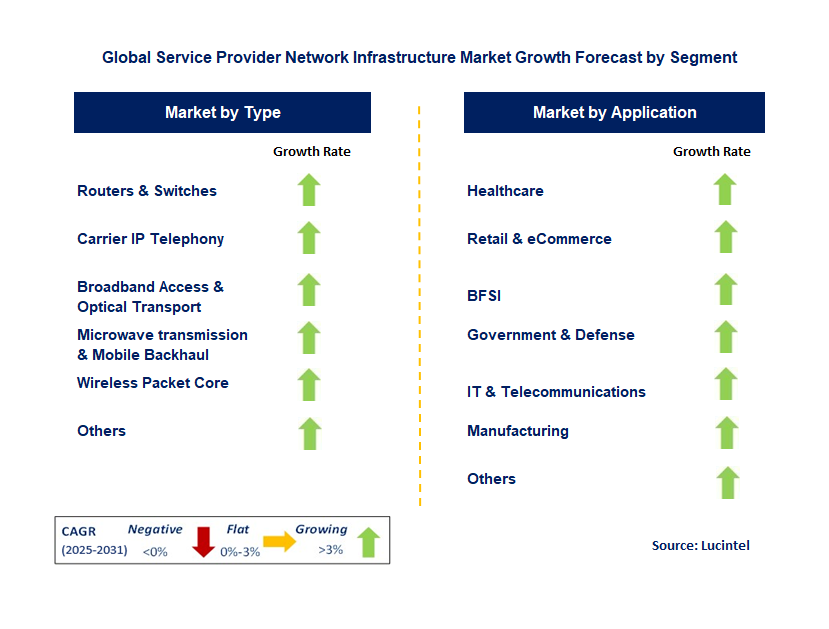
• Cisco Q5. Which service provider network infrastructure market segment will be the largest in future? Answer: Lucintel forecasts that broadband access & optical transport is expected to witness the highest growth over the forecast period due to growing consumption of video streaming and cloud-based services requires robust optical transport infrastructure. Q6. In service provider network infrastructure market, which region is expected to be the largest in next 5 years? Answer: APAC is expected to witness the highest growth over the forecast period. Q7. Do we receive customization in this report? Answer: Yes, Lucintel provides 10% customization without any additional cost.


Choose a license that fits your team. Instant PDF delivery.
Prices exclude taxes. Instant delivery. Custom licensing available on request.
Market Report · July 29, 2026
Market Report · July 20, 2026
Market Report · July 20, 2026
Trusted partner for strategic intelligence and business growth


Receive a complimentary market analysis tailored to your industry. Our analysts will identify key growth opportunities and competitive dynamics specific to your business.

Market size, growth rate, and key trend analysis for your specific sector.

Top competitor positioning and market share analysis.

Strategic recommendations backed by data-driven insights.
Get curated market intelligence and competitive moves straight to your inbox.
By subscribing, you agree to receive our monthly insights. Unsubscribe anytime.
Receive a complimentary market analysis tailored to your industry. Our analysts will identify key growth opportunities and competitive dynamics specific to your business.
Market size, growth rate, and key trend analysis for your specific sector.
Top competitor positioning and market share analysis.
Strategic recommendations backed by data-driven insights.
Get curated market intelligence, emerging trends, and competitive moves straight to your inbox each month.
By subscribing, you agree to receive our monthly insights. Unsubscribe anytime.
We'll send your sample report shortly.