
Market Report · July 15, 2026

Key data points: The growth forecast = 8.5% annually for the next 7 years. Scroll below to get more insights. This market report covers trends, opportunities and forecasts in sensor market to 2031 by type (radar sensors, touch sensors, temperature & humidity sensors, biosensors, level sensors, pressure & flow sensors, optical sensors, image sensors, and others), technology (MEMS, CMOS, and others), end use (consumer electronics, automotive, biomedical & healthcare, industrial, aerospace & defense, and others), and region (North America, Europe, Asia Pacific, and the Rest of the World)
We'll send your sample report shortly.
• Lucintel forecasts that, within the type category, biosensor is expected to witness the highest growth over the forecast period.
• Within the end use category, automotive is expected to witness the highest growth.
• In terms of region, APAC is expected to witness the highest growth over the forecast period. Gain valuable insights for your business decisions with our comprehensive 150+ page report. Sample figures with some insights are shown below.
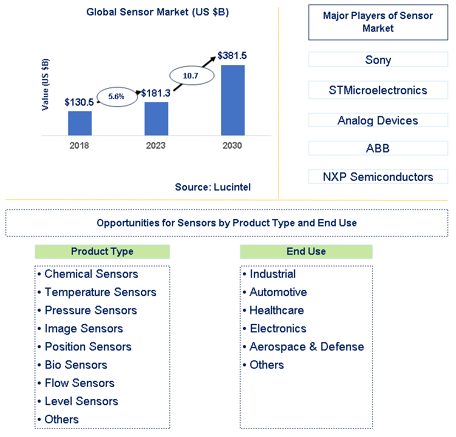
• IoT-Enabled Sensors: IoT-enabled sensors are revolutionizing industries by allowing real-time data collection and remote monitoring. These sensors are crucial in sectors like healthcare, automotive, and manufacturing. As the adoption of IoT devices grows, the demand for sensors capable of seamlessly connecting to networks is driving the development of smart, connected sensors that provide valuable insights and predictive analytics.
• Miniaturization of Sensors: Miniaturization is a key trend, with sensors becoming smaller while maintaining high functionality and accuracy. This trend enables sensors to be integrated into smaller devices like wearables, medical implants, and automotive systems. As the demand for compact and efficient solutions grows, miniaturized sensors are opening new possibilities for applications in healthcare, consumer electronics, and robotics.
• Advanced Material Integration: The integration of advanced materials like nanomaterials, piezoelectric materials, and graphene into sensors is enhancing their performance. These materials enable sensors to be more sensitive, durable, and energy-efficient. This trend is particularly impactful in sectors like environmental monitoring, healthcare, and industrial automation, where high-performance sensors are required for precise measurements under harsh conditions.
• AI-Powered Sensors: AI-powered sensors are leveraging machine learning and data analytics to provide smarter, more accurate measurements. These sensors can learn from data over time, improving their predictive capabilities and performance. In industries like manufacturing, automotive, and healthcare, AI-powered sensors are enabling real-time decision-making, predictive maintenance, and more efficient operations, thus enhancing productivity and reducing downtime.
• Sustainability and Green Sensors: Sustainability is driving the demand for green sensors that are energy-efficient and environmentally friendly. These sensors are being designed with a focus on reducing energy consumption and minimizing environmental impact. The growth of renewable energy, smart grids, and electric vehicles is creating opportunities for green sensor technologies to support sustainability initiatives across various industries. These emerging trends in the sensor market are transforming how industries operate, enabling greater efficiency, connectivity, and sustainability. As sensor technology continues to evolve with IoT integration, miniaturization, AI, and advanced materials, its applications will expand across more sectors, driving innovation and improving operational capabilities globally.
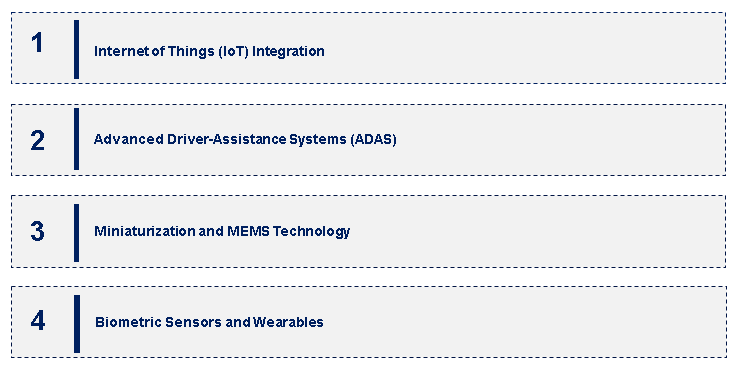
• IoT Sensor Integration: The integration of sensors with IoT technologies has enabled real-time data collection and remote monitoring. This development is revolutionizing industries like healthcare, agriculture, and smart homes, allowing for continuous data streams, remote diagnostics, and automation. The rise of IoT-enabled sensors is also driving advancements in predictive maintenance and process optimization.
• MEMS Sensor Advancements: Micro-Electro-Mechanical Systems (MEMS) sensors are gaining popularity for their compact size, low power consumption, and high precision. MEMS sensors are being used in a wide range of applications, from automotive to healthcare. They are particularly important in the development of wearable devices, autonomous vehicles, and environmental monitoring, where size, accuracy, and energy efficiency are critical.
• Autonomous Vehicle Sensors: The demand for sensors in autonomous vehicles is growing, particularly with the advancements in lidar, radar, and vision sensors. These sensors are vital for enabling self-driving cars to detect obstacles, monitor their environment, and navigate safely. As the autonomous vehicle market grows, so does the need for more advanced and reliable sensors for vehicle safety and navigation.
• Environmental Monitoring Sensors: Sensors for environmental monitoring are gaining traction as industries and governments focus on sustainability and environmental protection. These sensors are used to monitor air quality, water quality, and waste management, providing real-time data that can drive policy decisions and improve sustainability efforts. Innovations in sensor materials and design are enabling better accuracy and longer life spans for these devices.
• Wearable Health Sensors: Wearable health sensors, including those used in fitness trackers, medical diagnostics, and remote patient monitoring, have seen significant advancements. These sensors can monitor vital signs such as heart rate, blood pressure, and glucose levels, providing real-time health data for personalized care. The growing demand for telemedicine and remote health monitoring is fueling the development of more advanced, user-friendly wearable sensors. These key developments in the sensor market are revolutionizing industries by improving accuracy, enabling automation, and enhancing connectivity. As sensor technologies continue to evolve, their applications will broaden, fostering innovation and increasing efficiency in fields like healthcare, automotive, and environmental monitoring.
• Smart Agriculture: Sensors are increasingly used in agriculture for precision farming, monitoring soil conditions, crop health, and water usage. These sensors help farmers optimize resources, reduce waste, and increase crop yields. The growing demand for sustainable farming practices and food security is driving the need for more advanced sensor technologies in the agriculture sector.
• Automotive and Electric Vehicles: The automotive industry is experiencing growth opportunities in sensor integration, especially in electric vehicles (EVs) and autonomous driving. Sensors are critical for navigation, safety, and performance optimization in EVs, while self-driving cars rely heavily on sensors like lidar, radar, and cameras. The rise of EVs and autonomous vehicles is creating significant demand for advanced sensor solutions.
• Industrial Automation and Manufacturing: With the shift toward Industry 4.0, industrial automation is driving the demand for sensors that can enhance process optimization, predictive maintenance, and real-time monitoring. Sensors integrated into automated systems are crucial for increasing productivity, reducing downtime, and improving product quality. The manufacturing sector is heavily investing in sensor technologies to streamline operations.
• Healthcare and Remote Monitoring: Wearable sensors and remote monitoring devices are creating new growth opportunities in healthcare. These sensors allow for continuous monitoring of patient health, offering real-time data for doctors and reducing the need for in-person visits. As healthcare moves toward more personalized and preventative care, sensors will play a vital role in the delivery of efficient healthcare services.
• Environmental and Sustainability Monitoring: As the world focuses on sustainability, sensors for environmental monitoring are becoming crucial. These sensors track air and water quality, waste levels, and other environmental factors, providing valuable data for governments, organizations, and researchers. The increased emphasis on climate change and environmental protection is pushing the growth of these sensor applications. These growth opportunities reflect the increasing importance of sensor technologies in driving efficiency, sustainability, and innovation across a wide range of industries. As the demand for smarter, more integrated solutions grows, sensors will continue to play a pivotal role in shaping the future of automation, healthcare, and environmental sustainability.
• Siemens
• NXP Semiconductors
• Infineon Technologies
• Texas Instruments Incorporated
• Analog Devices
• STMicroelectronics
• Bosch Sensortec
• Microchip Technology
• Honeywell International
• OMRON Corporation
• Radar Sensors
• Touch Sensors
• Temperature & Humidity Sensors
• Biosensors
• Level Sensors
• Pressure & Flow Sensors
• Optical Sensors
• Image Sensors
• Others
• MEMS
• CMOS
• Others
• Consumer Electronics
• Automotive
• Biomedical & Healthcare
• Industrial
• Aerospace & Defense
• Others
• North America
• Europe
• Asia Pacific
• The Rest of the World
• United States: The U.S. sensor market is driven by advancements in IoT, automotive, and healthcare sectors. Key developments include the adoption of smart sensors in autonomous vehicles and the healthcare industry’s increased use of wearables. Additionally, the shift toward Industry 4.0 and smart manufacturing is fostering the growth of sensors that can enhance data collection and operational efficiency across industries.
• China: China’s sensor market is expanding rapidly, with a strong focus on smart cities, industrial automation, and the electric vehicle (EV) industry. The government’s push for technological advancements in AI and 5G is driving the demand for sophisticated sensors. China is also heavily investing in the development of MEMS sensors, enhancing performance in automotive and consumer electronics applications.
• Germany: Germany’s sensor market is growing in tandem with its leadership in automotive engineering and industrial automation. The country’s focus on Industry 4.0 has led to the development of advanced sensors for process optimization and real-time monitoring. German manufacturers are also advancing sensors for electric vehicles (EVs), with a focus on precision and energy efficiency in the automotive sector.
• India: India’s sensor market is developing, particularly in the automotive, industrial, and agricultural sectors. The demand for sensors is increasing with the rise of smart agriculture technologies and industrial automation. India’s growing focus on smart cities and infrastructure is creating opportunities for sensor integration in urban management, transportation, and energy-efficient buildings.
• Japan: Japanese companies are pushing the boundaries of sensor technology in applications such as autonomous driving and smart factories. Additionally, Japan is leading in the development of ultra-sensitive sensors for environmental monitoring and healthcare, integrating advanced materials to improve sensor performance.


• Siemens
• NXP Semiconductors
• Infineon Technologies
• Texas Instruments Incorporated
• Analog Devices
• STMicroelectronics
• Bosch Sensortec
• Microchip Technology
• Honeywell International
• OMRON Corporation Q5. Which sensor market segment will be the largest in future? Answer: Lucintel forecasts that, within the type category, biosensor is expected to witness the highest growth over the forecast period. Q6. In sensor market, which region is expected to be the largest in next 5 years? Answer: In terms of region, APAC is expected to witness the highest growth over the forecast period. Q7. Do we receive customization in this report? Answer: Yes, Lucintel provides 10% customization without any additional cost.


Choose a license that fits your team. Instant PDF delivery.
Prices exclude taxes. Instant delivery. Custom licensing available on request.
Market Report · July 15, 2026
Market Report · July 13, 2026
Market Report · July 13, 2026
Trusted partner for strategic intelligence and business growth


Receive a complimentary market analysis tailored to your industry. Our analysts will identify key growth opportunities and competitive dynamics specific to your business.

Market size, growth rate, and key trend analysis for your specific sector.

Top competitor positioning and market share analysis.

Strategic recommendations backed by data-driven insights.
Get curated market intelligence and competitive moves straight to your inbox.
By subscribing, you agree to receive our monthly insights. Unsubscribe anytime.
Receive a complimentary market analysis tailored to your industry. Our analysts will identify key growth opportunities and competitive dynamics specific to your business.
Market size, growth rate, and key trend analysis for your specific sector.
Top competitor positioning and market share analysis.
Strategic recommendations backed by data-driven insights.
Get curated market intelligence, emerging trends, and competitive moves straight to your inbox each month.
By subscribing, you agree to receive our monthly insights. Unsubscribe anytime.
We'll send your sample report shortly.