
Market Report · July 15, 2026

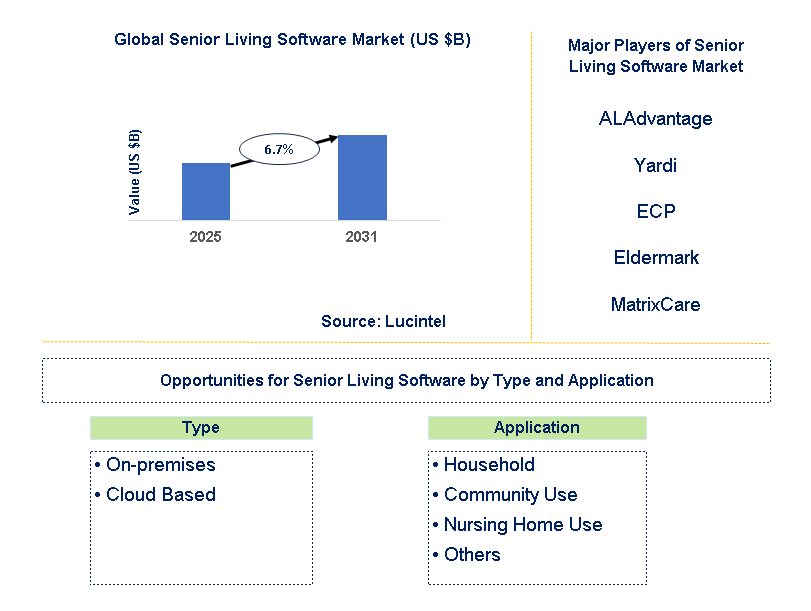
Key data points: The growth forecast = 6.7% annually for the next 7 years. Scroll below to get more insights. This market report covers Trends, opportunities and forecasts in senior living software market to 2031 by type (on-premises and cloud based), application (household, community use, nursing home use, and others), and region (North America, Europe, Asia Pacific, and the Rest of the World)
We'll send your sample report shortly.
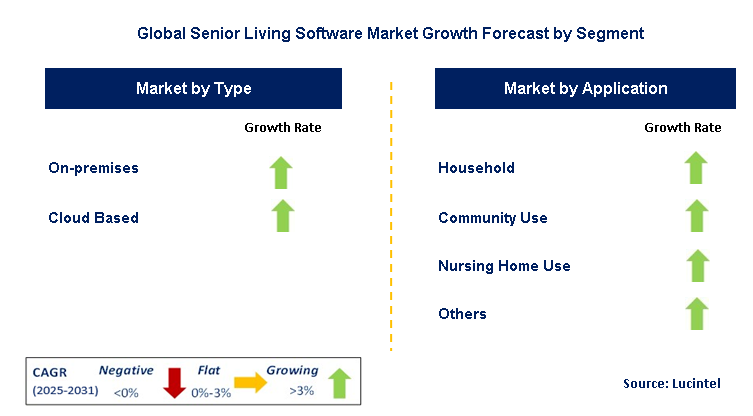
• Lucintel forecasts that, within the type category, on-premise is expected to witness higher growth over the forecast period.
• Within the application category, nursing home use is expected to witness the highest growth.
• In terms of region, North America is expected to witness the highest growth over the forecast period.
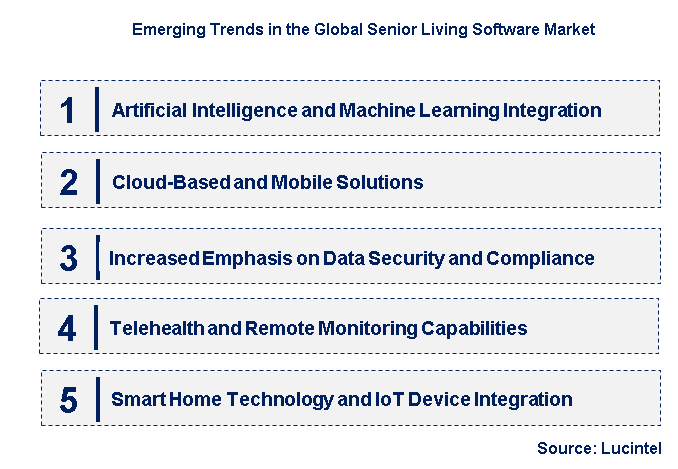
• Artificial Intelligence and Machine Learning Integration: AI and ML are becoming more prevalent integrations within senior living software as a way of improving various operations and care dimensions. AI-powered analytics help foresee possible health risk, recognize warning signs for dementia, and individualize care planning using unique resident data. ML algorithms will also optimize employee schedules, anticipate resource requirements, and recognize behavior patterns among residents to enhance safety and well-being. This supports more proactive, personalized delivery of care, producing improved health results and enhanced operation efficiency within the senior living environment.
• Cloud-Based and Mobile Solutions: Moving towards cloud-based solutions and mobile applications is redefining senior living software availability and useability. Cloud-based solutions provide scalability, affordability, and remote access to critical resident information, facilitating seamless communication among care teams and families. Mobile apps give caregivers the ability to complete tasks anywhere, instantly access resident data, and communicate more easily. Mobile portals are also available for residents and families for updates, communication, and connection to the community, creating transparency and peace of mind.
• Increased Emphasis on Data Security and Compliance: As resident health information becomes more digitized, data security and regulatory compliance with the likes of HIPAA (in the US) and GDPR (in Europe) are becoming ever more critical. Senior living software is integrating sophisticated security measures, such as data encryption, access controls, and audit trails, to safeguard sensitive resident data from unauthorized access and breaches. Vendors are also concentrating on making their platforms regulatory compliant with changing requirements, giving senior living communities the comfort of data privacy and security.
• Telehealth and Remote Monitoring Capabilities: The inclusion of telehealth and remote monitoring functionalities in senior living software is widening access to healthcare services for residents. Telehealth allows virtual consultations with physicians and specialists, reducing the need for travel and enhancing timely access to medical advice. Remote monitoring tools, such as wearable sensors and smart devices, continuously monitor residents' vital signs and activity levels and enable early detection of health issues and proactive intervention. The trend improves the quality of care, enhances resident safety, and promotes aging in place.
• Smart Home Technology and IoT Device Integration: Integration of smart home technologies and Internet of Things (IoT) devices into elderly living spaces is making living for seniors more comfortable, secure, and connected. Senior living software is adapting to integrate with such devices, including smart thermostats, lighting controls, fall detection sensors, and medication dispensers. This integration enables automated environmental controls, enhanced safety monitoring, and customized care, improving residents' independence and well-being while delivering caregivers insightful data and alerts. These emerging trends collectively redefined the senior living software market by pushing innovation, enhancing efficiency, promoting enhanced resident care, and promoting enhanced connectivity. Emphasis on AI, cloud and mobile technologies, data protection, telemedicine, and home integration is paving the way to a future where technology has a greater role to play in ensuring seniors' well-being and independence within living communities.
• Advancements in Electronic Health Records Systems: Recent advances in EHR systems for senior living are focused on developing more user-friendly interfaces, improving data interoperability, and incorporating features specific to the needs of long-term care. This encompasses enhanced medication management, care planning tools integrated into the system, and improved support for regulatory reporting obligations. The objective is to create a complete and readily accessible digital record for every resident, simplifying care staff workflows and enhancing care coordination.
• Data Analytics and Reporting Integration: Increasing focus is being placed on integrating strong data analytics and reporting tools into senior living software platforms. These capabilities enable communities to monitor key performance indicators, detect trends in resident behavior and health, and make informed decisions to enhance care quality and operational effectiveness. Reportable dashboards and customizable reporting enable administrators and care teams to derive insightful information about a range of areas in their operations, from care outcomes to occupancy levels.
• Development of Advanced Communication and Engagement Platforms: The latest developments involve the establishment of more sophisticated communication and engagement platforms that link residents, families, and personnel. These platforms frequently have capabilities including secure messaging, video calls, family portals to track resident wellness, and means to plan community events and activities. Better communication facilitates transparency, drives higher resident and family satisfaction, and supports a sense of greater community within senior living communities.
• Emphasis on Regulatory Compliance and Risk Management Capabilities: Senior living software is now including capabilities that will assist communities in dealing with the intricacies of regulatory compliance and risk management. These include mechanisms for monitoring state and federal regulation compliance, handling incident reports, performing audits, and maintaining compliance with safety protocols. These new developments are meant to minimize administrative compliance burdens and lower the potential for penalties or legal problems for senior living providers.
• Mobile Accessibility and Point-of-Care Solution Expansion: Realizing the necessity for flexibility and immediate access to information, recent trends have emphasized mobile accessibility expansion and offering point-of-care solutions to caregivers. Staff can access resident data, document care tasks, and exchange messages with the team from their smartphone or tablet through mobile applications. This enhances efficiency, reduces paperwork, and ensures that caregivers have the information they need at their fingertips to offer timely and effective care. These primary advancements are affecting the senior living software market greatly by integrating technology more deeply into the daily functioning and delivery of care in senior living communities. The progress of EHR systems, data analytics, communication systems, regulatory compliance software, and mobile availability are all helping to lead towards a more effective, safer, and person-directed approach to elderly care.
• Increased Resident Engagement and Experience Solutions: One of the largest areas of growth is creating software that improves resident engagement and overall experience in senior living communities. This encompasses platforms for supporting social interactions, activity and event management, personalized content and entertainment, and simple communication with family and friends. By addressing the social and emotional health of residents, software companies can build valuable solutions that enhance resident satisfaction and retention.
• Predictive and Personalized Care Management: There is increasingly a chance of software solutions which use data analysis and AI in order to provide predictive and personalized care management. This consists of tools used in evaluating unique individual resident requirements, creating personalized care plans, health trend tracking, forecasting probable threats to health, and notification to care workers in regard to pre-emptive interventions. Such applications have the potential to enhance resident health status and emergency room avoidance through empowering more accurate and timely care.
• Efficient Operational Workflow and Automation: Software that automates workflows and improves operational efficiency presents a large growth opportunity. This encompasses solutions for staff management and scheduling, billing and financial management, inventory management, and maintenance tracking. Through minimizing administrative tasks and maximizing resource allocation, these applications can enable senior living communities to enhance their bottom line and enable staff to spend more time on direct resident care.
• Telehealth and Remote Monitoring Integration: The growing use of telehealth and remote monitoring is a huge growth potential for senior living software companies. By integrating these features into their platforms, they enable virtual visits, remote health monitoring through wearable technology, and timely interventions from real-time data. This increases access to healthcare services for residents, enhances care coordination, and enables aging in place.
• Risk and Compliance Management Solutions: As the senior living industry is so heavily regulated, software solutions with strong risk and compliance management capabilities are increasingly in demand. These solutions involve features for monitoring regulatory compliance, managing documents, auditing, incident reporting, and compliance with safety procedures. Through these types of comprehensive solutions, software vendors are able to assist senior living communities in reducing risk and ensuring regulatory compliance, both of which are critical to their long-term viability. These strategic expansion prospects identify the possibility of the senior living software market growing through fulfilling essential requirements within the market. By addressing resident engagement, customized care, efficiency in operations, telemedicine integration, and compliance management, software vendors can build useful solutions that enhance seniors' quality of life and senior living community performance.
• ALAdvantage
• Yardi
• ECP
• Eldermark
• MatrixCare
• Carepatron
• PointClickCare
• Aline
• Netsmart
• LifeLoop
• On-premises
• Cloud Based
• Household
• Community Use
• Nursing Home Use
• Others
• North America
• Europe
• Asia Pacific
• The Rest of the World
• United States: The US market remains a pacesetter in senior living software uptake, with a strong focus on integrated Electronic Health Records (EHRs), comprehensive medication management systems, and sophisticated analytics for individualized care. Recent trends include more focus on interoperability across disparate software platforms and improved cybersecurity initiatives to safeguard sensitive resident information. Cloud-based offerings are picking up even more momentum because they are cost-effective and scalable, and demand for software that enables remote monitoring and telehealth services is on the rise.
• China: China's senior living software market is in a fairly nascent stage of development but is growing very fast, fueled by a huge aging population and government encouragement of technology adoption in healthcare and eldercare. Recent developments consist of the design of localized software solutions that can address the local cultural and regulatory needs of the Chinese senior care system. Growing interest exists for the integration of AI-based technologies for health tracking and predictive insights, as well as platforms enabling communication and activation for seniors among their communities.
• Germany: The German senior living software market is driven by concerns of data privacy, regulatory compliance, and quality care management. Latest trends highlight integration of software into existing healthcare infrastructure and a keen demand for solutions that enable in-depth documentation and reporting. Demand for assistive technologies and home automation integrations within senior living communities is also on the rise, necessitating software that can manage and integrate these varied systems.
• India: India's senior living software industry is in its early stages but is highly poised for growth based on the size and growth rate of the country's elderly population, as well as rising awareness about the value proposition of professional elder care. Emerging trends have seen the arrival of cost-effective, localized solutions with capabilities for dealing with the local market's particular requirements, e.g., language support and ability to deal with a geographically distributed network of care. Telehealth integration and core EHR capabilities are gaining momentum as the market matures.
• Japan: Japan, with its extremely aged population, has an increasing demand for sophisticated senior living software solutions. Current trends emphasize the integration of technology to enable independent living, handle complicated care requirements, and respond to the caregiver shortage. Robotics and artificial intelligence are being investigated for resident monitoring and support, necessitating advanced software for control and data analysis. User-friendly interfaces and transparent communication tools for residents and care staff are also a high priority.


• ALAdvantage
• Yardi
• ECP
• Eldermark
• MatrixCare
• Carepatron
• PointClickCare
• Aline
• Netsmart
• LifeLoop Q5. Which senior living software market segment will be the largest in future? Answer: Lucintel forecasts that, within the type category, on-premise is expected to witness higher growth over the forecast period. Q6. In senior living software market, which region is expected to be the largest in next 5 years? Answer: In terms of region, North America is expected to witness the highest growth over the forecast period. Q7. Do we receive customization in this report? Answer: Yes, Lucintel provides 10% customization without any additional cost.


Choose a license that fits your team. Instant PDF delivery.
Prices exclude taxes. Instant delivery. Custom licensing available on request.
Market Report · July 15, 2026
Market Report · June 26, 2026
Market Report · June 24, 2026
Trusted partner for strategic intelligence and business growth


Receive a complimentary market analysis tailored to your industry. Our analysts will identify key growth opportunities and competitive dynamics specific to your business.

Market size, growth rate, and key trend analysis for your specific sector.

Top competitor positioning and market share analysis.

Strategic recommendations backed by data-driven insights.
Get curated market intelligence and competitive moves straight to your inbox.
By subscribing, you agree to receive our monthly insights. Unsubscribe anytime.
Receive a complimentary market analysis tailored to your industry. Our analysts will identify key growth opportunities and competitive dynamics specific to your business.
Market size, growth rate, and key trend analysis for your specific sector.
Top competitor positioning and market share analysis.
Strategic recommendations backed by data-driven insights.
Get curated market intelligence, emerging trends, and competitive moves straight to your inbox each month.
By subscribing, you agree to receive our monthly insights. Unsubscribe anytime.
We'll send your sample report shortly.