
Market Report · July 24, 2026

Key data points: The growth forecast = 7.8% annually for the next 7 years. Scroll below to get more insights. This market report covers trends, opportunities and forecasts in semiconductor grade solvent market to 2031 by type (functional chemicals and ultra high purity reagents), application (home appliances, communication industry, aerospace, manufacturing, and others), and region (North America, Europe, Asia Pacific, and the Rest of the World)
We'll send your sample report shortly.
• Lucintel forecasts that, within the type category, ultra high purity reagent is expected to witness higher growth over the forecast period.
• Within the application category, communication industry is expected to witness the highest growth.
• In terms of region, APAC is expected to witness the highest growth over the forecast period. Gain valuable insights for your business decisions with our comprehensive 150+ page report. Sample figures with some insights are shown below.

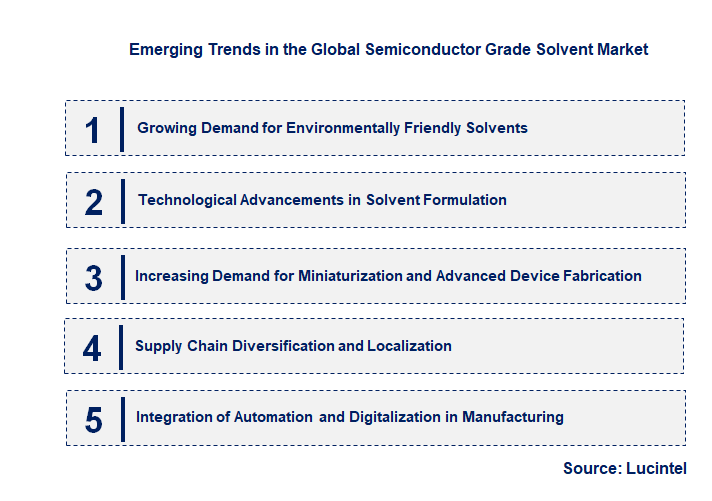
• Growing demand for environmentally friendly solvents: The industry is shifting towards eco-friendly solvents due to stricter environmental regulations and increasing consumer awareness. Companies like samsung and intel are investing in green chemistry to reduce hazardous waste and emissions. This trend promotes sustainable manufacturing practices, reduces regulatory risks, and appeals to environmentally conscious consumers. The adoption of biodegradable and low-toxicity solvents is expected to enhance brand reputation and compliance, while also driving innovation in solvent formulation. Overall, this shift supports a more sustainable and responsible semiconductor manufacturing ecosystem.
• Technological advancements in solvent formulation: Innovations in chemical engineering are leading to the development of high-purity, specialized solvents tailored for advanced semiconductor fabrication processes. Companies such as taiwan semiconductor manufacturing company (tsmc) and samsung are investing in R&D to improve solvent performance, stability, and compatibility with new materials. These advancements enable finer patterning, higher yields, and reduced defect rates in chip production. The evolution of solvent technology directly impacts process efficiency and product quality, facilitating the production of next-generation semiconductors with enhanced performance. This trend underscores the importance of continuous innovation in solvent chemistry.
• Increasing demand for miniaturization and advanced device fabrication: As consumer electronics and IoT devices become more compact and powerful, the need for precise and reliable solvents in manufacturing processes intensifies. Companies like apple and tsmc are adopting advanced solvents to meet the demands of smaller, more complex chips. These solvents enable finer etching, cleaning, and deposition processes essential for miniaturized components. The trend accelerates the development of high-performance, energy-efficient devices, driving growth in the semiconductor solvent market. It also prompts manufacturers to develop specialized solvents that can handle increasingly complex fabrication requirements.
• Supply chain diversification and localization: Geopolitical tensions and global disruptions have prompted companies to diversify and localize their supply chains for semiconductor solvents. Firms such as samsung and intel are establishing regional manufacturing facilities to reduce dependency on single sources and mitigate risks. This trend enhances supply security, reduces lead times, and supports regional economic development. It also encourages innovation in local production techniques and sustainable sourcing. As a result, the market becomes more resilient, with a focus on regional customization and supply chain agility, ensuring steady supply for critical semiconductor manufacturing needs.
• Integration of automation and digitalization in manufacturing: The adoption of Industry 4.0 technologies is transforming how semiconductor solvents are produced and managed. Companies like samsung and tsmc are implementing automation, IoT, and data analytics to optimize solvent usage, quality control, and process efficiency. Digital twin models and real-time monitoring improve operational precision and reduce waste. This trend enhances productivity, reduces costs, and ensures consistent quality in solvent supply. It also facilitates predictive maintenance and rapid response to process deviations, supporting the overall advancement of semiconductor manufacturing capabilities in a highly competitive market. In summary, these emerging trends are collectively reshaping the semiconductor grade solvent market by fostering sustainability, technological innovation, supply chain resilience, and operational efficiency. They enable manufacturers to meet the evolving demands of the semiconductor industry, ensuring continued growth and competitiveness in a rapidly advancing technological landscape.
• technological innovations: Companies like Dow and merck are developing advanced purification techniques to produce higher purity solvents, which enhance semiconductor manufacturing precision and yield, thereby reducing defect rates and increasing overall efficiency.
• sustainability initiatives: Firms such as samsung and taiwan semiconductor manufacturing company are adopting eco-friendly solvents and recycling methods to minimize environmental impact, aligning with global sustainability goals and regulatory requirements.
• supply chain diversification: Major players like linde and air liquide are expanding their supplier networks and establishing regional manufacturing hubs to mitigate risks associated with geopolitical tensions and supply disruptions.
• regulatory compliance: Companies are investing in compliance with evolving environmental and safety standards, such as REACH and OSHA regulations, which influence solvent formulation, handling, and disposal practices, ensuring market access and reducing legal risks.
• technological collaborations: Industry leaders are forming strategic alliances with research institutions and technology providers to co-develop innovative solvent formulations and application techniques, accelerating product development and market penetration. These developments are collectively transforming the semiconductor grade solvent market by enhancing product quality, promoting sustainability, ensuring supply chain resilience, and fostering innovation. As a result, the market is becoming more competitive, reliable, and aligned with environmental standards, supporting the growth of the global electronics industry.
• Expansion in Semiconductor Manufacturing: The increasing demand for smaller, more powerful chips is driving the need for advanced solvents in fabrication processes. This growth enhances production efficiency and yields, supporting the miniaturization trend in electronics.
• Advanced Cleaning Applications: As device complexity increases, the need for ultra-pure cleaning solvents grows. These solvents improve device reliability and performance, reducing defect rates and ensuring compliance with stringent industry standards.
• Etching Process Optimization: The development of specialized solvents for etching enables finer patterning and higher precision in semiconductor devices. This advancement accelerates innovation in device architecture and performance.
• Environmental and Safety Regulations: Stricter regulations are prompting companies to develop eco-friendly and safer solvents. This shift not only reduces environmental impact but also enhances brand reputation and compliance.
• Customization and Specialty Solvents: Growing demand for tailored solutions leads to the development of specialty solvents designed for specific applications, improving process efficiency and product quality. In summary, these growth opportunities are significantly impacting the semiconductor grade solvent market by fostering innovation, improving process efficiencies, and aligning with regulatory standards. This dynamic environment is attracting new investments and encouraging companies to develop sustainable, high-performance solutions, ultimately driving market expansion and technological progress.
• Technological Innovation: The continuous development of advanced semiconductor manufacturing techniques necessitates high-purity solvents, which are critical for ensuring product quality and process efficiency. As chip designs become more complex, the demand for specialized solvents with superior purity and performance increases, fueling market growth. Innovations in cleaning and etching processes further boost the need for advanced solvents, making technological progress a key driver.
• Growing Electronics Industry: The expanding consumer electronics, automotive, and industrial sectors are significantly increasing the demand for semiconductors. This surge directly impacts the need for high-quality solvents used in manufacturing and cleaning processes, thereby propelling market expansion. The rise of IoT, AI, and 5G technologies amplifies this effect, creating a robust demand pipeline.
• Stringent Regulatory Standards: Governments and environmental agencies impose strict regulations concerning the handling, disposal, and composition of chemicals used in semiconductor manufacturing. These regulations drive the industry to develop and adopt safer, environmentally friendly solvents, which in turn stimulates innovation and market growth. Compliance costs and the need for sustainable solutions also influence market dynamics.
• Supply Chain Optimization: The global supply chain disruptions, especially during recent years, have prompted manufacturers to seek reliable sources of high-purity solvents. Investments in local production facilities and strategic partnerships help ensure consistent supply, reduce costs, and mitigate risks, thereby supporting market stability and growth. Supply chain resilience remains a critical factor for industry players. The challenges in the semiconductor grade solvent market are:
• Environmental and Safety Concerns: The use of certain solvents poses environmental risks and safety hazards, including toxicity and flammability. Strict regulations and increasing environmental awareness compel companies to invest in safer alternatives and waste management solutions, which can increase costs and complicate manufacturing processes. Balancing performance with safety and sustainability remains a significant challenge.
• High Production Costs: Manufacturing high-purity solvents involves complex processes, advanced purification techniques, and stringent quality controls, leading to elevated production costs. These costs can impact profit margins and pricing strategies, especially amid competitive pressures. Additionally, fluctuations in raw material prices can further strain profitability.
• Market Volatility and Supply Disruptions: The semiconductor industry is highly cyclical and sensitive to global economic conditions. Fluctuations in demand, geopolitical tensions, and supply chain disruptions can lead to oversupply or shortages of solvents, affecting market stability. Managing inventory and maintaining consistent quality amid such volatility is a persistent challenge for market participants. In summary, the semiconductor grade solvent market is driven by technological advancements, expanding electronics demand, regulatory pressures, and supply chain improvements. However, it faces challenges related to environmental safety, high production costs, and market volatility. These factors collectively shape the market landscape, requiring companies to innovate continuously, adapt to regulatory changes, and optimize supply chains. Success in this sector hinges on balancing growth opportunities with the mitigation of operational and compliance risks, ultimately influencing the markets long-term trajectory.
• Mitsubishi Chemical
• Stella Chemifa
• Entegris
• Chang Chun Group
• Jianghua Micro-Electronic Materials
• Crystal Clear Electronic Material
• Honeywell
• BASF
• Avantor
• TOKYO OHKA KOGYO
• Functional Chemicals
• Ultra High Purity Reagents
• Home Appliances
• Communication Industry
• Aerospace
• Manufacturing
• Others
• North America
• Europe
• Asia Pacific
• The Rest of the World
• United States, the market is characterized by innovation and high R&D investment, with companies like ams and entegris leading advancements in sustainable and high-purity solvents, alongside expanding manufacturing capacities to support domestic chip production initiatives.
• China is rapidly increasing its market share through government-backed projects and local companies such as kingfa and jinzhou, focusing on developing domestically produced, environmentally friendly solvents to reduce reliance on imports and enhance supply chain security.
• Germany remains a key player in the European semiconductor ecosystem, with firms like merck and basf innovating in high-performance solvents, emphasizing quality, regulatory compliance, and sustainable production practices to serve both regional and global markets.
• India is witnessing significant growth driven by government initiatives like "Make in India," with local companies such as sudarshan and pcc expanding their capabilities in manufacturing semiconductor-grade solvents, aiming to establish a self-reliant supply chain.
• Japan continues to advance through technological innovation and strict quality standards, with companies like tokuyama and mitsubishi chemical investing in developing next-generation solvents that meet the evolving needs of the semiconductor industry, emphasizing environmental sustainability and high purity.


• Mitsubishi Chemical
• Stella Chemifa
• Entegris
• Chang Chun Group
• Jianghua Micro-Electronic Materials
• Crystal Clear Electronic Material
• Honeywell
• BASF
• Avantor
• TOKYO OHKA KOGYO Q5. Which semiconductor grade solvent market segment will be the largest in future? Answer: Lucintel forecasts that, within the type category, ultra high purity reagent is expected to witness higher growth over the forecast period. Q6. In semiconductor grade solvent market, which region is expected to be the largest in next 5 years? Answer: In terms of region, APAC is expected to witness the highest growth over the forecast period. Q7. Do we receive customization in this report? Answer: Yes, Lucintel provides 10% customization without any additional cost.


Choose a license that fits your team. Instant PDF delivery.
Prices exclude taxes. Instant delivery. Custom licensing available on request.
Market Report · July 24, 2026
Market Report · July 20, 2026
Market Report · July 20, 2026
Trusted partner for strategic intelligence and business growth


Receive a complimentary market analysis tailored to your industry. Our analysts will identify key growth opportunities and competitive dynamics specific to your business.

Market size, growth rate, and key trend analysis for your specific sector.

Top competitor positioning and market share analysis.

Strategic recommendations backed by data-driven insights.
Get curated market intelligence and competitive moves straight to your inbox.
By subscribing, you agree to receive our monthly insights. Unsubscribe anytime.
Receive a complimentary market analysis tailored to your industry. Our analysts will identify key growth opportunities and competitive dynamics specific to your business.
Market size, growth rate, and key trend analysis for your specific sector.
Top competitor positioning and market share analysis.
Strategic recommendations backed by data-driven insights.
Get curated market intelligence, emerging trends, and competitive moves straight to your inbox each month.
By subscribing, you agree to receive our monthly insights. Unsubscribe anytime.
We'll send your sample report shortly.