
Market Report · July 24, 2026

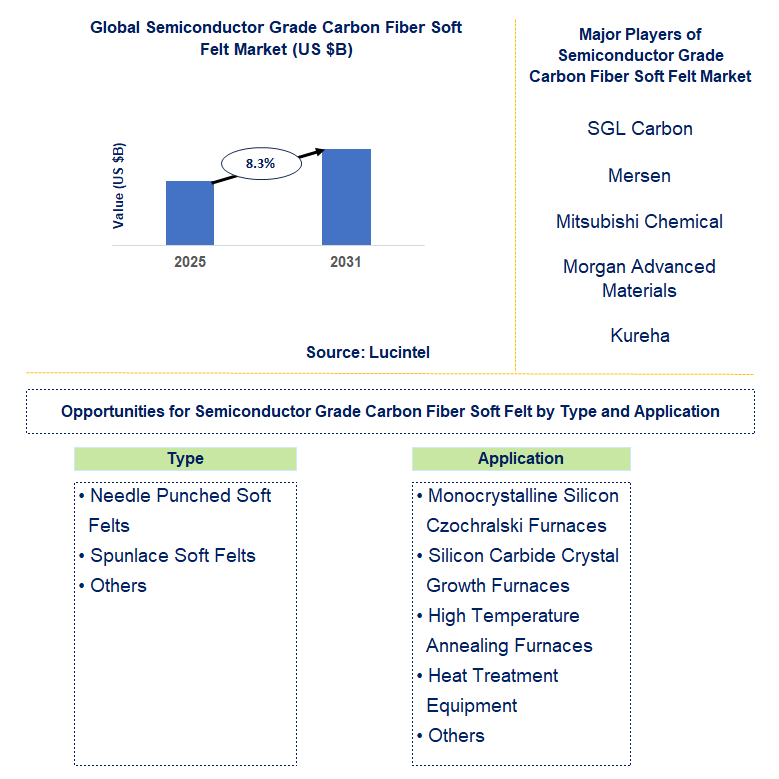
Key data points: The growth forecast = 8.3% annually for the next 7 years. Scroll below to get more insights. This market report covers trends, opportunities and forecasts in semiconductor grade carbon fiber soft felt market to 2031 by type (needle punched soft felts, spunlace soft felts, and others), application (monocrystalline silicon czochralski furnaces, silicon carbide crystal growth furnaces, high temperature annealing furnaces, heat treatment equipment, and others), and region (North America, Europe, Asia Pacific, and the Rest of the World)
We'll send your sample report shortly.
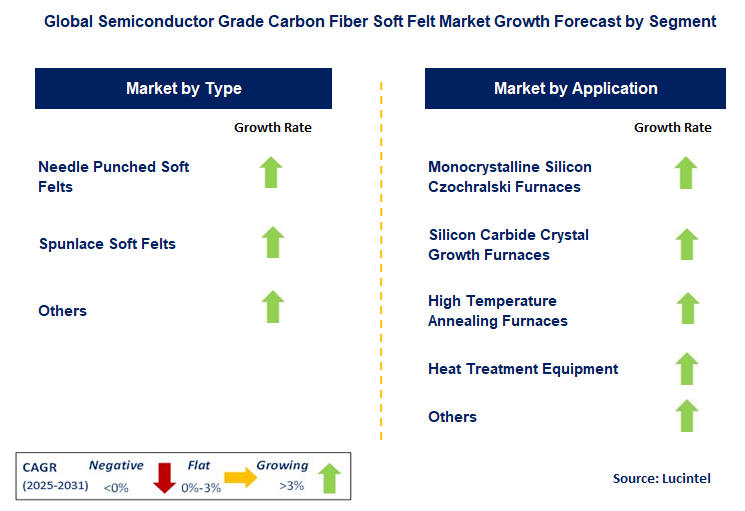
• Lucintel forecasts that, within the type category, needle punched soft felt is expected to witness higher growth over the forecast period.
• Within the application category, monocrystalline silicon czochralski furnace is expected to witness the highest growth.
• In terms of region, APAC is expected to witness the highest growth over the forecast period. Gain valuable insights for your business decisions with our comprehensive 150+ page report. Sample figures with some insights are shown below.
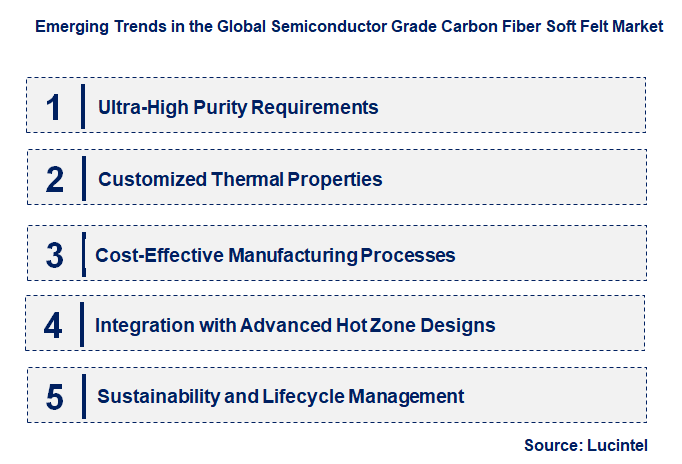
• Ultra-High Purity Requirements: This trend further calls for the requirement of semiconductor grade carbon fiber soft felt with impurity as low as possible. Producers are investing big money in developing advanced purification techniques, including halogen purification and high temperature graphitization that would drop metals, sulfur, and boron to lower values acceptable without contaminating semiconductor wafers. The impact is critical to prevent defects and enhance yield in semiconductor devices, mainly logic and memory chips. Ultra-high purity attainment is a requirement for reproducible electrical characteristics and performance and plays a direct role in the reliability and integrity of integrated circuits and other critical electronic components.
• Customized Thermal Properties: This trend is to tailor carbon fiber soft felt’s thermal conductivity and specific heat capacity to achieve optimal thermal management in semiconductor processing tools, such as crystal growth furnaces. Manufacturers design felts of specific density and fiber orientation to yield desired insulation performance. This is critically reflected in more accurate temperature gradient control during sensitive points in the manufacturing process. This yields larger high-quality semiconductor crystals and, consequently leads to better process efficiency. Much of this customization will lead to saving in energy usage as well as ensuring that high-temperature components are long-lived, reducing operational costs in the fab.
• Cost-Effective Manufacturing Processes: This trend focuses on innovations that reduce the production cost of semiconductor grade carbon fiber soft felt without compromising performance or purity. This includes optimizing precursor materials, refining carbonization and graphitization steps, and exploring new manufacturing techniques. The impact is a more accessible and economically viable supply of these critical materials, which can lower the overall manufacturing cost of semiconductors. Reducing material costs helps semiconductor companies maintain competitive pricing for their end products, especially as chip demand continues to grow and cost pressures intensify across the global electronics industry.
• Integration with Advanced Hot Zone Designs: This trend involves designing semiconductor grade carbon fiber soft felt in conjunction with advanced hot zone configurations for crystal growth furnaces and other high-temperature processing equipment. The felt is increasingly being tailored to fit complex geometries and integrated as part of a holistic thermal management system. The impact is an improvement in the uniformity of temperature distribution within the furnace, leading to higher quality single crystals and more efficient energy utilization. This collaborative approach between felt manufacturers and equipment designers ensures optimal thermal performance, supporting the production of larger and more perfect semiconductor wafers.
• Sustainability and Lifecycle Management: The trend includes an increasing emphasis on the carbon footprint of semiconductor grade carbon fiber soft felt and the need for a lifecycle approach-from the sourcing of raw materials to end-of-life disposal. Manufacturers are focused on precursor materials having lower environmental impact and developing recycling and reclamation processes for spent felt. The resultant is reduced environmental footprint, directed towards global sustainability goals and corporate social responsibility. This also addresses potential regulatory pressures regarding waste management and resource consumption, contributing to a greener semiconductor industry and enhancing the reputation of material suppliers. These emerging trends are collectively reshaping the semiconductor grade carbon fiber soft felt market by driving advancements towards materials with higher purity, optimized thermal performance, and improved cost-effectiveness. The focus on integration with advanced manufacturing processes and a growing emphasis on sustainability are transforming the market into one that is more responsive to the evolving needs of the semiconductor industry. This dynamic evolution ensures that these specialized felts continue to play a critical role in enabling the development of next-generation electronic devices.
• Enhanced Purification Techniques: A key recent development is the widespread adoption of more advanced purification techniques for carbon fiber soft felt, such as vacuum graphitization and halogen treatments. These processes reduce impurity levels to parts per million (ppm) or even parts per billion (ppb). The impact is critical for the semiconductor industry, where even trace impurities can compromise wafer quality and device performance. Ultra-high purity soft felt ensures minimal contamination during crystal growth and other high-temperature processes, leading to higher yields of defect-free semiconductor devices and contributing directly to the reliability of integrated circuits.
• Development of High-Density and Low-Density Variants: Recent developments include the introduction of semiconductor grade carbon fiber soft felt in a wider range of densities, including both ultra-low density options for lightweight insulation and higher-density versions for structural support and enhanced thermal management. The impact is increased versatility in meeting diverse application requirements within semiconductor furnaces and equipment. Low-density felt offers superior insulation properties with minimal thermal mass, allowing for faster heating and cooling cycles, while higher-density variants provide better structural stability and localized heat management, optimizing the performance of complex hot zones.
• Improved Mechanical Properties for Longer Lifespan: Manufacturers have recently focused on enhancing the mechanical strength and durability of semiconductor grade carbon fiber soft felt through optimized fiber entanglement and bonding processes. This leads to a material that is more resistant to wear, tear, and deformation under high-temperature cycling. The impact is a significantly extended service life for filter bags in demanding semiconductor processing environments, reducing the frequency of replacement and associated downtime. This improvement translates to lower operational costs for semiconductor manufacturers and improved overall equipment reliability, enhancing the efficiency of production lines.
• Customization for Specific Furnace Geometries: One of the emerging trends is the growing focus on offering highly specialized semiconductor grade carbon fiber soft felt solutions suited to a particular furnace design and hot zone geometry. This involves pre-formed shapes, custom thickness, and accurate cutting. The effect is maximum thermal insulation performance and a flawless fit in intricate semiconductor manufacturing equipment, reducing heat loss to zero and providing an even temperature spread. Customization helps minimize installation time and material waste, thereby enabling semiconductor companies to optimize the efficiency of their specialized furnaces. And consistency in their crystal growth processes can be improved.
• New Precursor Materials Research: Research and development work is underway to seek new precursor materials beyond the usual PAN (polyacrylonitrile) and pitch precursors. This would allow for better performance properties or lower manufacturing costs. This includes investigations into alternative polymers or even bio-based precursors. The impact is the potential for next-generation carbon fiber soft felts with enhanced properties such as improved thermal stability, higher purity, or better mechanical performance. This long-term development aims to innovate beyond current material limitations, supporting future advancements in semiconductor technology and potentially diversifying the supply chain for these critical materials. These recent developments are collectively impacting the semiconductor grade carbon fiber soft felt market by driving advancements towards materials that are more precise, durable, and tailored to the exacting requirements of modern semiconductor manufacturing. The emphasis on higher purity, varied densities, improved mechanical properties, and customization, alongside research into novel precursors, is crucial for supporting the production of increasingly sophisticated electronic devices. This continuous innovation ensures that these specialized felt materials remain indispensable for the efficiency and quality of semiconductor fabrication processes.
• Silicon Crystal Growth Furnaces: This application represents a cornerstone growth opportunity. Semiconductor-grade carbon fiber soft felt is of utmost importance to thermal insulation in silicon crystal growth furnaces, CZ and FZ particularly. Strategic growth demands bettering the thermal uniformity and minimizing particle shedding of the developed felt to improve the quality and yield of crystals. Thus, the support is to the production of high-quality silicon wafers, which constitute the backbone for nearly all the devices in the modern electronics world. With increasing demand for larger and perfect silicon crystals, the demand for high-quality soft felt insulation increases similarly, creating a stable and growing market segment.
• Silicon Carbide Crystal Growth: The tremendous growth of the Silicon Carbide (Sic) power electronics market, spurred by electric vehicles and renewable energy, represents a high-growth opportunity. Sic crystal growth is done at very high temperatures (above 2400 °C) with highly specialized thermal insulation. Strategic growth lies in developing ultra-high purity, high-temperature resistant soft felts specifically designed for Sic furnaces. The impact is crucial for enabling the mass production of Sic wafers, which offer superior efficiency in power conversion compared to silicon. This niche but rapidly growing segment demands the most advanced and robust carbon fiber soft felt solutions.
• High-Temperature Vacuum and Inert Gas Furnaces: Beyond crystal growth, general high-temperature vacuum and inert gas furnaces used in various semiconductor processes like annealing, sintering, and deposition also present significant opportunities. These furnaces require robust thermal insulation that can withstand extreme temperatures and inert atmospheres. Strategic growth involves offering versatile soft felt products with excellent thermal stability and chemical compatibility for a broad range of high-temperature treatments. The impact is enhanced efficiency and reliability of these critical thermal processing steps, ensuring optimal material properties and structural integrity for semiconductor components, supporting diverse manufacturing needs.
• Epitaxy and MOCVD Reactors: Applications in epitaxy and Metal-Organic Chemical Vapor Deposition (MOCVD) reactors, crucial for manufacturing compound semiconductors like gallium nitride (Gan) and gallium arsenide (GaAs), offer another promising growth area. These reactors operate at elevated temperatures and involve corrosive gases, requiring highly inert and thermally stable insulation. Strategic growth focuses on developing soft felts that minimize contamination from trace elements and withstand aggressive chemical environments. The impact is critical for producing high-performance LEDs, power devices, and high-frequency communication components, where material purity and process control are paramount for device functionality.
• Semiconductor Equipment Components and Sealing: The use of semiconductor grade carbon fiber soft felt as specialized components, gaskets, and sealing materials within various semiconductor manufacturing equipment extends beyond the primary hot zone insulation. Strategic growth involves innovating felt forms that offer excellent sealing properties, chemical inertness, and thermal stability in diverse equipment parts. The impact is improved overall equipment performance, reduced vacuum leaks, and enhanced process control within various chambers and modules. This opportunity leverages the flexibility and specific properties of soft felt for critical sealing and structural applications within the intricate machinery of a semiconductor fab. These strategic growth opportunities are profoundly impacting the semiconductor grade carbon fiber soft felt market by focusing innovation and investment on the most critical and rapidly expanding areas of semiconductor manufacturing. By providing highly specialized and performance-optimized materials for silicon and Sic crystal growth, high-temperature furnaces, epitaxy reactors, and equipment components, manufacturers are directly enabling advancements in chip technology. This targeted approach ensures the market’s continued expansion and its integral role in the global electronics industry.
• SGL Carbon
• Mersen
• Mitsubishi Chemical
• Morgan Advanced Materials
• Kureha
• Nippon Carbon
• Carbosystem
• Semixlab Technology
• Aoyida Advanced Materials
• Sinotek Materials
• Needle Punched Soft Felts
• Spunlace Soft Felts
• Others
• Monocrystalline Silicon Czochralski Furnaces
• Silicon Carbide Crystal Growth Furnaces
• High Temperature Annealing Furnaces
• Heat Treatment Equipment
• Others
• North America
• Europe
• Asia Pacific
• The Rest of the World
• United States: The United States semiconductor grade carbon fiber soft felt market is driven by the country’s strong semiconductor production sector and continued attempts to strengthen local supply chains. Recent trends are marked by investments in the latest graphitization furnaces and precursor conversion plants to minimize import dependence and counter the effects of tariffs. There is a strong emphasis on producing ultra-high purity felts for critical applications like silicon carbide crystal growth and other advanced semiconductor processes. Research and development focus on innovative felt formulations and lower-temperature processing to enhance cost-effectiveness and performance, supporting the growth of high-tech manufacturing.
• China: China’s semiconductor grade carbon fiber soft felt market is undergoing rapid expansion, driven by massive government investment in its domestic semiconductor industry and a push for technological self-sufficiency. Recent developments include significant advancements in local manufacturing capabilities for high-purity graphite felt and carbon felt, crucial for crystal growth furnaces and semiconductor equipment. Chinese manufacturers are focusing on improving material purity and production efficiency to meet the surging demand from their booming electronics sector. The goal is to reduce reliance on imported materials and establish a strong domestic supply chain for critical semiconductor components, ensuring consistent supply.
• Germany: In Germany, the semiconductor grade carbon fiber soft felt market is defined by a strong emphasis on high-quality, precision-engineered materials and sustainable production practices. The more recent expansions include SGL Carbon’s recent expansion and upgrading of soft felt production facilities, which are designed to meet the increasing demand from the semiconductor industry. German manufacturers are now targeting specific soft felts that serve to provide high-level thermal management and chemical stability for advanced crystal growth and high-temperature processes. The market prioritizes consistent product performance and reliability, aligning with the stringent quality standards of European semiconductor manufacturers and research institutions.
• India: The Indian market for semiconductor grade carbon fiber soft felt is experiencing emerging growth, albeit from a smaller base, driven by increasing government initiatives to establish a robust domestic semiconductor manufacturing ecosystem. Recent developments include growing interest in local production capabilities for carbon fiber and related materials, although the specific market for semiconductor grade soft felt is still nascent. The focus is on attracting foreign investment and technology transfer to build out the necessary infrastructure for high-purity material production. As India’s electronics and manufacturing sectors expand, the demand for specialized materials like semiconductor grade carbon fiber soft felt is expected to increase.
• Japan: Japan’s semiconductor grade carbon fiber soft felt market is characterized by a demand for ultra-high purity and high-performance materials, reflecting its advanced semiconductor manufacturing capabilities. Recent trends involve ongoing innovation on the part of industry leaders such as Nippon Carbon, aimed at creating soft felts with high heat resistance, low thermal conductivity, and consistent structures for application in high-temperature furnaces and electronic device manufacturing. The Japanese industry leads the way in optimizing purification processes to a very low level of impurities, necessary for delicate semiconductor use. The country’s high-performance semiconductor industry will be addressed by long-term reliability and accurate material properties.


• SGL Carbon
• Mersen
• Mitsubishi Chemical
• Morgan Advanced Materials
• Kureha
• Nippon Carbon
• Carbosystem
• Semixlab Technology
• Aoyida Advanced Materials
• Sinotek Materials Q5. Which semiconductor grade carbon fiber soft felt market segment will be the largest in future? Answer: Lucintel forecasts that, within the type category, needle punched soft felt is expected to witness higher growth over the forecast period. Q6. In semiconductor grade carbon fiber soft felt market, which region is expected to be the largest in next 5 years? Answer: In terms of region, APAC is expected to witness the highest growth over the forecast period. Q7. Do we receive customization in this report? Answer: Yes, Lucintel provides 10% customization without any additional cost.


Choose a license that fits your team. Instant PDF delivery.
Prices exclude taxes. Instant delivery. Custom licensing available on request.
Market Report · July 24, 2026
Market Report · July 20, 2026
Market Report · July 20, 2026
Trusted partner for strategic intelligence and business growth


Receive a complimentary market analysis tailored to your industry. Our analysts will identify key growth opportunities and competitive dynamics specific to your business.

Market size, growth rate, and key trend analysis for your specific sector.

Top competitor positioning and market share analysis.

Strategic recommendations backed by data-driven insights.
Get curated market intelligence and competitive moves straight to your inbox.
By subscribing, you agree to receive our monthly insights. Unsubscribe anytime.
Receive a complimentary market analysis tailored to your industry. Our analysts will identify key growth opportunities and competitive dynamics specific to your business.
Market size, growth rate, and key trend analysis for your specific sector.
Top competitor positioning and market share analysis.
Strategic recommendations backed by data-driven insights.
Get curated market intelligence, emerging trends, and competitive moves straight to your inbox each month.
By subscribing, you agree to receive our monthly insights. Unsubscribe anytime.
We'll send your sample report shortly.