
Market Report · July 15, 2026

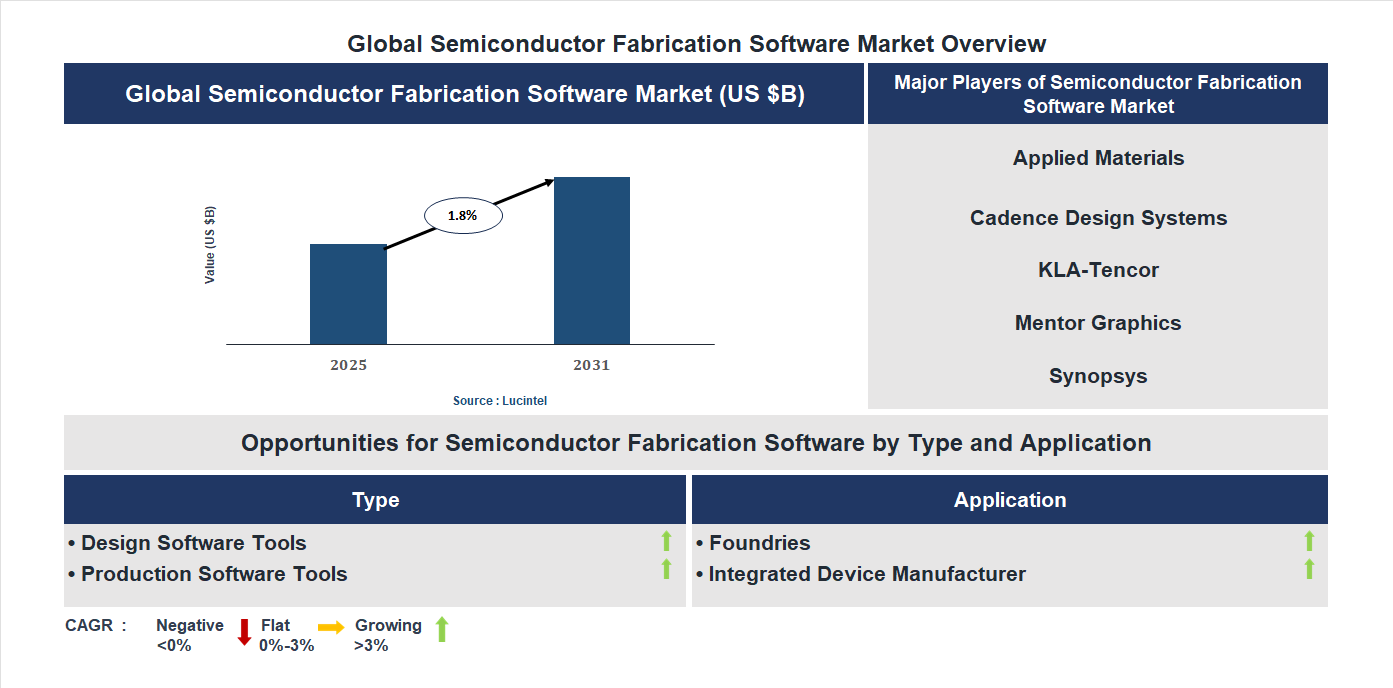
Key data points: The growth forecast = 1.8% annually for the next 7 years. Scroll below to get more insights. This market report covers trends, opportunities and forecasts in semiconductor fabrication software market to 2031 by type (design software tools and production software tools), application (foundries and integrated device manufacturer), and region (North America, Europe, Asia Pacific, and the Rest of the World)
We'll send your sample report shortly.
• Lucintel forecasts that, within the type category, design software tool is expected to witness higher growth over the forecast period.
• Within the application category, foundry is expected to witness higher growth.
• In terms of region, APAC is expected to witness the highest growth over the forecast period. Gain valuable insights for your business decisions with our comprehensive 150+ page report. Sample figures with some insights are shown below.
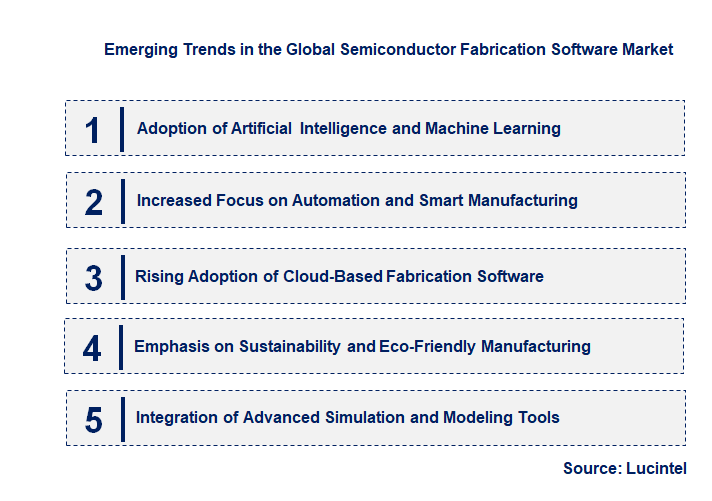
• adoption of artificial intelligence and machine learning: Companies like cadence and synopsys are integrating AI and ML into fabrication software to enhance process optimization, defect detection, and predictive maintenance. This trend improves yield rates, reduces downtime, and accelerates development cycles, making manufacturing more efficient and cost-effective. AI-driven analytics enable real-time decision-making, which is crucial for managing complex fabrication processes and maintaining competitive advantage in a rapidly evolving industry.
• increased focus on automation and smart manufacturing: Firms such as mentor graphics are deploying automation tools to streamline fabrication workflows, minimize human error, and increase throughput. Smart manufacturing solutions incorporate robotics, IoT, and real-time data analytics to create more flexible and responsive fabrication environments. This trend leads to higher productivity, better resource utilization, and faster time-to-market, ultimately transforming traditional fabrication plants into highly automated, intelligent facilities.
• rising adoption of cloud-based fabrication software: Companies like ansys and siemens are offering cloud-enabled solutions that facilitate collaboration, scalability, and remote access. Cloud platforms reduce infrastructure costs and enable seamless updates and integration with other enterprise systems. This trend supports a more agile manufacturing process, allowing fabs to quickly adapt to changing demands, share data across global teams, and implement continuous improvements with minimal disruption.
• emphasis on sustainability and eco-friendly manufacturing: Industry players are developing software that optimizes energy consumption, reduces waste, and supports environmentally sustainable practices. Companies such as ansys are incorporating eco-design principles into their tools, helping fabs meet regulatory standards and corporate social responsibility goals. This trend not only benefits the environment but also reduces operational costs and enhances brand reputation, aligning manufacturing practices with global sustainability initiatives.
• integration of advanced simulation and modeling tools: Firms like synopsys are enhancing their software with sophisticated simulation capabilities to predict fabrication outcomes and troubleshoot issues before physical production. These tools enable more accurate process control, reduce trial-and-error, and shorten development cycles. The impact is a significant reduction in time-to-market, improved product quality, and lower overall manufacturing costs, giving companies a competitive edge in the fast-paced semiconductor industry. In summary, these emerging trends are fundamentally reshaping the semiconductor fabrication software market by fostering greater efficiency, sustainability, and innovation. The integration of AI, automation, cloud computing, sustainability practices, and advanced simulation tools is driving a new era of smarter, more agile manufacturing processes. As these trends continue to evolve, they will enable semiconductor companies to meet increasing global demand, reduce costs, and accelerate technological breakthroughs, ensuring sustained growth and competitiveness in the industry.
• Adoption of AI-driven optimization tools: Companies like cadence and synopsys are integrating AI to enhance process accuracy and reduce defect rates, leading to higher yields and lower costs.
• Expansion of cloud-based fabrication software: Firms such as mentor graphics are offering cloud solutions that enable real-time collaboration, scalability, and remote monitoring, improving operational efficiency.
• Increased focus on sustainability: Semiconductor companies are adopting eco-friendly software solutions to minimize energy consumption and waste, aligning with global sustainability goals.
• Development of integrated design and manufacturing platforms: Companies like ansys are creating unified platforms that streamline the transition from design to fabrication, reducing time-to-market and improving product quality.
• Growth of automation and robotics in fabrication processes: Firms such as kLA are deploying automation software to enhance precision, reduce human error, and increase throughput in fabrication plants. These developments are significantly impacting the semiconductor fabrication software market by increasing efficiency, reducing costs, and enabling faster innovation cycles. The integration of advanced technologies is fostering a more agile, sustainable, and competitive industry landscape, positioning companies to better meet the demands of the evolving semiconductor market.
• Device Design Optimization: This opportunity involves leveraging advanced simulation and AI-driven tools to improve device performance and reduce time-to-market. Companies like cadence and synopsys are developing integrated platforms that streamline design workflows, leading to faster innovation cycles and cost savings.
• Process Control Enhancement: Implementing real-time monitoring and automation solutions allows fabs to maintain tighter process controls. firms such as mentor graphics are providing software that enhances yield and reduces defects, significantly impacting manufacturing efficiency and product quality.
• Manufacturing Execution Systems (MES): Upgrading MES with IoT and cloud capabilities enables better tracking, scheduling, and resource management. this results in increased throughput, reduced downtime, and improved supply chain coordination, giving companies a competitive edge.
• Quality Management and Inspection: Advanced software solutions utilizing AI and machine learning facilitate early defect detection and quality assurance. companies like aegis and kLA are innovating in this space, leading to higher yields and reduced scrap rates.
• Equipment Maintenance and Predictive Analytics: Predictive maintenance software helps forecast equipment failures before they occur, minimizing downtime. firms such as siemens and fanuc are integrating these tools, which extend equipment lifespan and lower maintenance costs. In summary, these growth opportunities are transforming the semiconductor fabrication software market by enhancing efficiency, reducing costs, and accelerating innovation. Companies adopting these advanced solutions are better positioned to meet the increasing global demand for semiconductors, ensuring sustained market growth and technological leadership.
• Technological Innovation: The continuous evolution of semiconductor technology necessitates advanced fabrication software capable of supporting complex chip designs, process optimization, and automation. As device miniaturization progresses, software tools must adapt to handle intricate manufacturing processes, leading to increased adoption of cutting-edge solutions. Companies like cadence design systems and synopsys are investing heavily in R&D to develop software that meets these demands, thereby fueling market growth.
• Rising Demand for Consumer Electronics: The proliferation of smartphones, tablets, wearables, and IoT devices has significantly increased the demand for semiconductors. This surge compels manufacturers to adopt sophisticated fabrication software to improve yield, reduce time-to-market, and ensure high-quality production. The expanding consumer electronics market directly correlates with increased investments in fabrication software, creating a robust growth trajectory.
• Industry 4.0 and Automation: The integration of Industry 4.0 principles, including IoT, AI, and machine learning, into semiconductor manufacturing processes is transforming fabrication facilities. Software solutions that enable real-time monitoring, predictive maintenance, and process automation are in high demand. This technological shift enhances efficiency, reduces costs, and improves product quality, thereby driving the adoption of advanced fabrication software across fabs worldwide.
• Increasing R&D Investments: Semiconductor companies and foundries are investing heavily in research and development to stay competitive. These investments often focus on developing new fabrication techniques and process nodes, which require sophisticated software tools for simulation, design, and process control. The growing R&D expenditure accelerates the development and deployment of innovative fabrication software solutions, propelling market expansion.
• Growing Focus on Sustainability and Energy Efficiency: Environmental regulations and the push for sustainable manufacturing practices are influencing software development. Fabrication software that optimizes resource utilization, reduces waste, and minimizes energy consumption is increasingly sought after. Companies adopting such solutions can meet regulatory standards and improve their environmental footprint, further stimulating market growth. The challenges facing this semiconductor fabrication software market include:
• High Development and Implementation Costs: Developing advanced semiconductor fabrication software involves significant R&D expenditure, specialized expertise, and complex integration processes. For manufacturers and fabs, the high costs associated with software acquisition, customization, and training can be prohibitive, especially for smaller players. This financial barrier may slow down adoption rates and limit market expansion in certain regions.
• Rapid Technological Changes: The semiconductor industry is characterized by rapid technological advancements and frequent process node shrinks. Keeping software up-to-date with these fast-changing requirements is challenging, requiring continuous updates and innovations. Companies may face difficulties in maintaining compatibility, ensuring stability, and managing obsolescence, which can hinder software deployment and operational efficiency.
• Regulatory and Security Concerns: Stringent regulations related to data security, intellectual property protection, and environmental standards pose compliance challenges for software providers. Additionally, increasing cyber threats necessitate robust security measures within fabrication software. Ensuring compliance and security can increase complexity and costs, potentially delaying deployment and affecting overall market growth. In summary, the semiconductor fabrication software market is driven by technological innovation, rising demand from consumer electronics, Industry 4.0 integration, increased R&D investments, and sustainability initiatives. However, high costs, rapid technological changes, and regulatory challenges pose significant hurdles. These factors collectively shape a dynamic landscape where continuous innovation and strategic adaptation are essential for market players to thrive. The overall impact is a market poised for growth, but one that requires careful navigation of evolving technological and regulatory environments to sustain competitive advantage.
• Applied Materials
• Cadence Design Systems
• KLA-Tencor
• Mentor Graphics
• Synopsys
• Agnisys
• Aldec
• Ansoft
• ATopTech
• JEDA Technologies
• Design Software Tools
• Production Software Tools
• Foundries
• Integrated Device Manufacturer
• North America
• Europe
• Asia Pacific
• The Rest of the World
• United States: The US continues to lead in semiconductor software innovation, with companies like cadence and synopsys launching advanced design tools. There is a strong focus on AI-driven automation and cloud-based solutions to enhance efficiency. Government initiatives such as the CHIPS Act aim to boost domestic manufacturing and R&D. US firms are also collaborating with international partners to expand capabilities and secure supply chains. The market sees increased investment in software that supports complex chip design and verification processes, maintaining the USs competitive edge in the industry.
• China: China is rapidly expanding its semiconductor software capabilities through companies like naura and huahong. The government’s "Made in China 2025" plan emphasizes self-sufficiency, leading to increased investment in domestic software development. Focus areas include AI, EDA tools, and process simulation to reduce reliance on foreign technology. Several startups are emerging, supported by national policies, to develop innovative solutions. China’s market is also characterized by strategic partnerships with global firms to acquire advanced technologies and accelerate local innovation, aiming to become a major player in semiconductor fabrication software.
• Germany: Germany remains a key player in the European semiconductor ecosystem, with companies like mentor graphics and siemens advancing software solutions. The focus is on integrating Industry 4.0 principles with semiconductor manufacturing, emphasizing automation and digital twin technologies. Germany benefits from strong research institutions and collaborations with industry leaders to develop cutting-edge EDA tools. The government supports innovation through funding programs and partnerships, aiming to enhance Europes independence in semiconductor manufacturing. The market is also witnessing increased adoption of AI and machine learning to optimize fabrication processes and improve yield.
• India: India is emerging as a significant hub for semiconductor software development, with companies like tsmc india and local startups focusing on EDA tools and process simulation. The government’s "Make in India" initiative encourages domestic innovation and manufacturing. Investments are directed toward building a skilled workforce and establishing research centers for semiconductor R&D. India is also fostering collaborations with global technology firms to access advanced software and expertise. The market is characterized by a focus on developing cost-effective solutions to support the growing demand for semiconductors in consumer electronics and automotive sectors.
• Japan: Japan continues to innovate in semiconductor fabrication software, with companies like tokyo electron and renesas developing advanced design and process control tools. The focus is on improving precision, yield, and reliability through AI and data analytics. Japan’s strong industrial base and research institutions contribute to ongoing advancements in EDA and process simulation software. The government promotes innovation through strategic funding and international collaborations. Japan is also investing in next-generation semiconductor technologies, including 3D integration and advanced lithography, to maintain its competitive position in the global market.


• Applied Materials
• Cadence Design Systems
• KLA-Tencor
• Mentor Graphics
• Synopsys
• Agnisys
• Aldec
• Ansoft
• ATopTech
• JEDA Technologies Q5. Which semiconductor fabrication software market segment will be the largest in future? Answer: Lucintel forecasts that, within the type category, design software tool is expected to witness higher growth over the forecast period. Q6. In semiconductor fabrication software market, which region is expected to be the largest in next 5 years? Answer: In terms of region, APAC is expected to witness the highest growth over the forecast period. Q7. Do we receive customization in this report? Answer: Yes, Lucintel provides 10% customization without any additional cost.


Choose a license that fits your team. Instant PDF delivery.
Prices exclude taxes. Instant delivery. Custom licensing available on request.
Market Report · July 15, 2026
Market Report · June 26, 2026
Market Report · June 24, 2026
Trusted partner for strategic intelligence and business growth


Receive a complimentary market analysis tailored to your industry. Our analysts will identify key growth opportunities and competitive dynamics specific to your business.

Market size, growth rate, and key trend analysis for your specific sector.

Top competitor positioning and market share analysis.

Strategic recommendations backed by data-driven insights.
Get curated market intelligence and competitive moves straight to your inbox.
By subscribing, you agree to receive our monthly insights. Unsubscribe anytime.
Receive a complimentary market analysis tailored to your industry. Our analysts will identify key growth opportunities and competitive dynamics specific to your business.
Market size, growth rate, and key trend analysis for your specific sector.
Top competitor positioning and market share analysis.
Strategic recommendations backed by data-driven insights.
Get curated market intelligence, emerging trends, and competitive moves straight to your inbox each month.
By subscribing, you agree to receive our monthly insights. Unsubscribe anytime.
We'll send your sample report shortly.