
Scrap Metal Recycling Market
The future of the global scrap metal recycling market looks promising with opportunities in the automotive, aerospace & defense, building & construction, electrical & electronics, manufacturing & industrial sectors and consumer appliances markets. The global scrap metal recycling market is expected to reach an estimated $659.2 billion by 2035 with a CAGR of 4.1% from 2026 to 2035. The major drivers for this market are the rising demand for recycled metals, the increasing industrial activities driving scrap generation and the growing sustainability initiatives boosting recycling adoption.
• Lucintel forecasts that, within the type category, ferrous (Iron and Steel) will remain the largest segment over the forecast period as the rising construction activities boosting steel recycling.
• Within the end use category, building & construction will remain the largest segment due to the the increasing infrastructure projects boosting scrap utilization.
• In terms of regions, APAC will remain the largest region over the forecast period due to the the growing steel production boosting scrap metal demand.
Gain valuable insights for your business decisions with our comprehensive 150+ page report.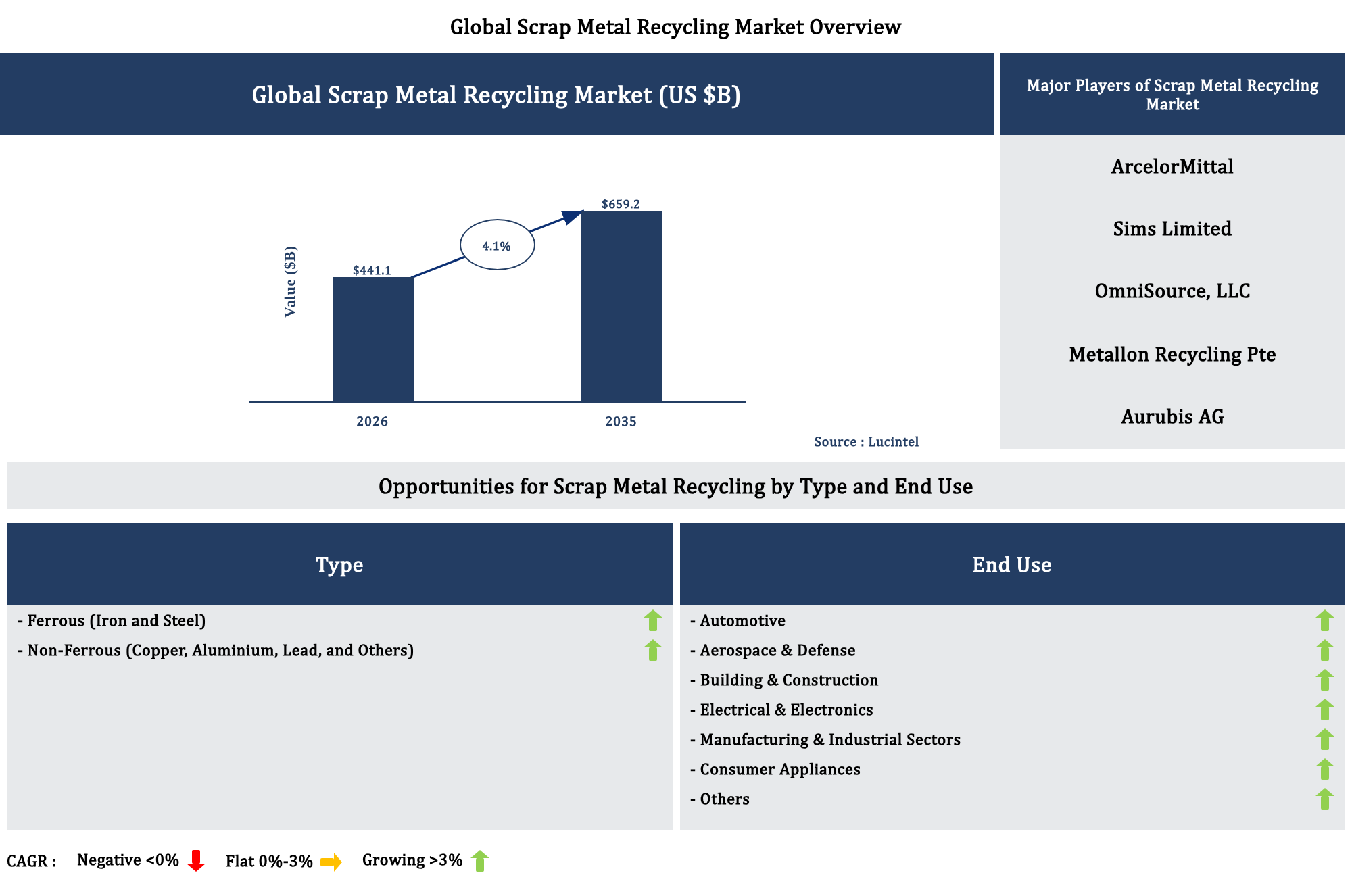
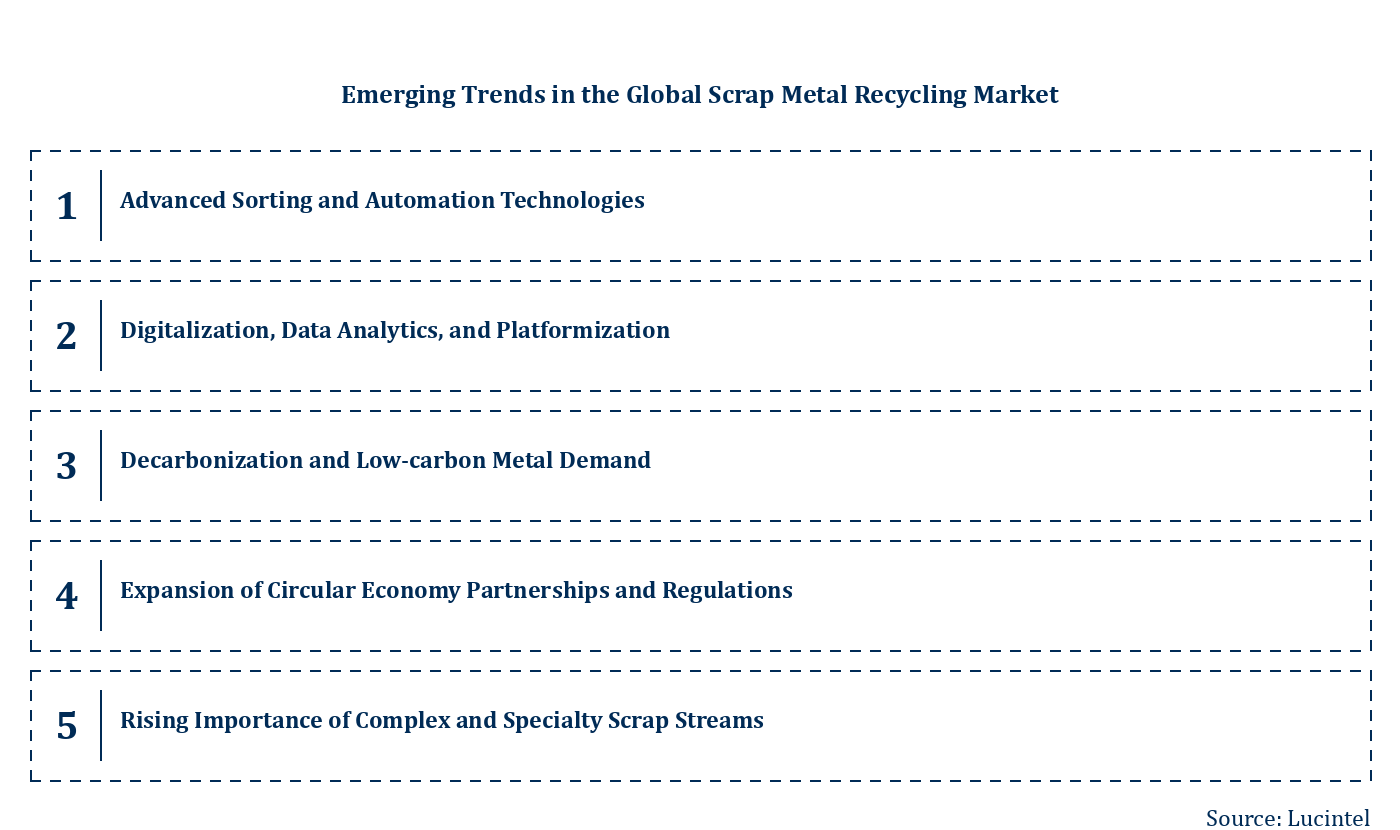
Emerging Trends in the Scrap Metal Recycling Market
The scrap metal recycling market is undergoing significant transformation as industries, regulators, and consumers place greater emphasis on resource efficiency and decarbonization. Rising metal demand, volatile primary commodity prices, and tightening emissions targets are accelerating investment in advanced recycling technologies and digital operating models. At the same time, circular economy policies and extended producer responsibility schemes are reshaping value chains and partnerships across manufacturing, construction, automotive, and electronics. These dynamics are driving innovation in collection, sorting, and processing while opening new revenue streams from data, traceability, and low-carbon materials, redefining how the scrap metal recycling market competes and grows globally.
Recent Developments in the Scrap Metal Recycling Market
The scrap metal recycling market is undergoing significant transformation as circular economy policies, industrial decarbonization, and resource security concerns intensify worldwide. Market participants are investing in advanced processing technologies, digital platforms, and traceability tools to boost recovery rates and enhance material quality. At the same time, fluctuations in commodity prices and geopolitical supply risks for primary metals are increasing the strategic importance of recycled inputs for steel, aluminum, copper, and specialty alloys. These recent developments are reshaping supply chains, influencing capital allocation, and redefining competitive dynamics across the global scrap metal recycling market.
Strategic Growth Opportunities in the Scrap Metal Recycling Market
The scrap metal recycling market is entering a phase of strategic expansion as circular economy policies, decarbonization targets, and supply-chain resilience reshape global raw materials sourcing. Demand for lower-carbon metals is accelerating across construction, automotive, machinery, and consumer goods, creating strong pull for high-quality recycled inputs. At the same time, digitalization and advanced processing technologies are improving recovery rates and margins. Growth opportunities are emerging around specialized application segments where recycled metals can displace primary production without compromising performance. Companies that align processing, logistics, and certification capabilities with these applications can unlock premium pricing, secure long-term contracts, and strengthen competitiveness.
Scrap Metal Recycling Market Drivers and Challenges
The scrap metal recycling market is shaped by a mix of technological, economic, and regulatory dynamics that influence both supply and demand. Advancements in sorting and processing technologies, fluctuating commodity prices, and increasingly stringent environmental regulations all play critical roles in determining market performance. At the same time, global industrialization, circular economy targets, and corporate sustainability commitments boost demand for recycled metals. However, the market also faces obstacles such as volatile feedstock availability, quality variability, and compliance burdens. Understanding these drivers and challenges is essential for recyclers, manufacturers, investors, and policymakers seeking to optimize value in this evolving sector.
The factors responsible for driving the scrap metal recycling market include:
The challenges facing this scrap metal recycling market include:
Overall, the scrap metal recycling market reflects a dynamic balance between strong structural drivers and persistent systemic challenges. Industrialization, cost and energy advantages, regulatory support for sustainability, and technological progress collectively promote deeper integration of recycled metals into global supply chains. At the same time, price volatility, quality variability, and regulatory complexity constrain profitability and discourage some investment. Market participants that effectively manage these risks through diversification, technology adoption, and strategic partnerships are better positioned to capture growth opportunities. As circular economy principles gain traction, resolving these challenges will be critical for unlocking the full potential of scrap metal recycling worldwide.
List of Scrap Metal Recycling Market Companies
Companies in the market compete on the basis of product quality offered. Major players in this market focus on expanding their manufacturing facilities, R&D investments, infrastructural development, and leverage integration opportunities across the value chain. Through these strategies scrap metal recycling market companies cater increasing demand, ensure competitive effectiveness, develop innovative products & technologies, reduce production costs, and expand their customer base. Some of the scrap metal recycling market companies profiled in this report include-
Scrap Metal Recycling Market by Segment
The study includes a forecast for the global scrap metal recycling market by type, end use, and region.
Country Wise Outlook for the Scrap Metal Recycling Market
The global scrap metal recycling market is evolving rapidly as countries seek to cut carbon emissions, secure raw material supply, and stabilize costs in energy-intensive industries. Technological upgrades in sorting, shredding, and metal recovery, along with stricter regulatory frameworks, are reshaping how ferrous and nonferrous scrap is collected, processed, and traded. Digitization, traceability, and circular economy commitments from automakers, construction firms, and electronics manufacturers are creating new demand for high-quality recycled feedstock. The following country summaries outline key recent developments in the United States, China, Germany, India, and Japan, emphasizing policy shifts, capacity expansions, and innovation trends.
Features of the Scrap Metal Recycling Market
Article
Scrap Metal Recycling Market: Which Strategic Shifts Will Redefine the Next Decade?
Dallas, June 5, 2026 – The scrap metal recycling market is entering a pivotal phase as decarbonization, digitalization, and circular-economy policies converge. Tightening emissions targets, volatile primary metal prices, and supply chain risk are pushing manufacturers, technology companies, and governments to treat scrap not as waste but as a strategic raw material. This transformation is reshaping business models from steel mills and smelters to electronics OEMs and cloud data center operators, creating fresh opportunities alongside new operational and regulatory pressures.
What Structural Trends Are Rewiring the scrap metal recycling market?
The scrap metal recycling market is being reshaped by a combination of policy, technology, and shifting customer expectations. Several intertwined trends are becoming foundational to how value will be created and captured across the supply chain.
A key implication of these dynamics is that competitive advantage will no longer be defined solely by scale of collection and processing, but by data-rich, low-carbon, and highly traceable scrap ecosystems that are tightly integrated with manufacturing and technology demand centers.
How Are Automation and AI Transforming Scrap Metal Sorting and Quality?
Automation and AI-enabled sensing are emerging as central levers for driving both margin expansion and quality assurance in the scrap metal recycling market. Traditional manual and low-tech methods struggle to keep up with rising volumes, complex material mixes, and stringent quality specifications demanded by high-end steel, aluminum, and electronics applications.
These improvements directly benefit markets that depend on consistent, high-quality recycled inputs, including flat steel for automotive bodies, high-conductivity copper for power and data applications, and clean aluminum scrap for packaging and transportation. As AI systems learn from operational data, leading facilities are moving toward near-continuous optimization, creating a widening performance gap versus lagging players that remain dependent on manual sorting.
Which End Markets Will See the Strongest Impact from Emerging Scrap Innovations?
Innovations in scrap metal recycling are not spread evenly across demand centers; some downstream markets stand to experience far-reaching disruption as recycled feedstock quality and reliability improve.
As these sectors reconfigure procurement criteria around emissions, traceability, and circularity, recyclers that can supply certified low-carbon, high-purity scrap with digital documentation stand to move closer to the strategic core of major OEM supply chains rather than operating at the periphery.
Why Is the Technology Industry Emerging as a Strategic Anchor for Scrap Metal Recycling?
The technology industry is both a major consumer of metal-intensive components and a significant source of valuable end-of-life material, especially from electronics, batteries, network hardware, and data center infrastructure. This dual role is turning tech companies into critical nodes in the scrap metal recycling market.
Used cases in the technology industry increasingly revolve around closed-loop models where OEMs or service providers contract directly with recyclers to secure predictable scrap flows, protect data-bearing equipment throughout the dismantling process, and certify the recycled content that re-enters new devices and infrastructure. Partnerships that combine physical recycling capabilities with secure data destruction and granular reporting are becoming differentiators in enterprise procurement decisions.
Which Challenges Could Limit the Pace of Market Transformation?
Despite clear momentum, the scrap metal recycling market faces several structural and operational challenges that could slow the full realization of its potential. Stakeholders need to understand these constraints to design viable strategies.
Addressing these issues will require closer coordination among recyclers, metals producers, technology OEMs, and policymakers, together with targeted financing mechanisms to help mid-sized facilities modernize equipment and digital infrastructure.
Where Do the Most Attractive Opportunities Emerge for Innovators and Investors?
While the challenge set is nontrivial, the opportunity landscape in the scrap metal recycling market is expanding for players that can bridge operational excellence with digital intelligence and ecosystem partnerships.
As customers and regulators attach tangible value to emissions reductions, traceability, and resource efficiency, differentiated offerings in scrap collection, processing, and certification are likely to command premium pricing and more stable contract relationships.
What Recent Developments Signal the Next Phase of Market Disruption?
A series of recent developments across technology, policy, and corporate strategy suggests the scrap metal recycling market is moving into a more structured, data-driven, and partnership-based phase.
These shifts indicate a transition from opportunistic scrap trading toward integrated circular supply chains in which data, carbon performance, and long-term relationships carry as much strategic weight as tonnage and spot prices. Companies that anticipate this new configuration and invest accordingly will be better positioned to shape industry standards, capture premium demand, and mitigate exposure to resource and regulatory shocks.
Top 5 Companies
1. ArcelorMittal
ArcelorMittal is one of the world’s largest steel producers and a major participant in the global scrap metal recycling market through its extensive use of ferrous scrap as a key input for electric arc furnace and basic oxygen furnace operations. Headquartered in Luxembourg City and formed in 2006, the company employs tens of thousands of people across Europe, the Americas, Asia, and Africa. ArcelorMittal operates steelmaking and downstream facilities that integrate scrap collection, processing, and melting, thereby creating a closed-loop ecosystem that reduces raw material and energy intensity. Its scrap-related activities include sourcing obsolete and prompt scrap from industrial, automotive, and construction sectors and processing this material into high-quality feedstock for flat and long steel products. The company’s geographic presence spans more than 60 countries, with recycling and raw-material procurement hubs located close to major steel plants in Europe and North America. In recent years, ArcelorMittal has invested in expanding scrap-based steelmaking capacity, particularly in Europe and the United States, as part of its decarbonization strategy that emphasizes higher scrap usage rates. The company has also executed targeted acquisitions of scrap processing facilities and yards in strategic markets to secure supply and enhance its circular-economy profile, although many individual deals are relatively small and often undisclosed. ArcelorMittal’s scrap recycling initiatives are linked to its low-carbon steel brands, which leverage high scrap content and renewable electricity to reduce lifecycle emissions for automotive, construction, and engineering customers.
2. Sims Limited
Sims Limited is a global leader in metal recycling and a prominent player in the scrap metal recycling market, with its headquarters in Sydney and operations spanning North America, Australasia, and the United Kingdom and Europe. Founded in 1917, the company employs several thousand people across a network of collection yards, processing facilities, and deep-sea export terminals. Sims Limited’s core business focuses on ferrous and non-ferrous scrap recycling, including the collection of end-of-life vehicles, demolition scrap, industrial offcuts, and consumer metal waste. The company processes scrap through shredding, shearing, baling, and separation technologies to produce high-grade recycled feedstock for steel mills, foundries, and non-ferrous refiners worldwide. Its product portfolio includes shredded steel scrap, heavy melt, busheling, stainless and alloy scrap, as well as aluminum, copper, and other non-ferrous metal packages. Sims has expanded geographically in North America through additional yards and processing capacity, improving access to both domestic mills and export markets in Asia. The company has also invested in technology-driven metal recovery from waste streams, supporting circular-economy goals. Mergers and acquisitions have historically been part of Sims’ growth strategy, including past combinations with regional recyclers that strengthened its presence in the United States and the United Kingdom. Recent strategic moves emphasize optimization of its footprint, digital systems for scrap sourcing, and increased processing of higher-quality scrap grades tailored to low-emission steel and aluminum production. Sims positions itself as a sustainability-focused recycler, highlighting the carbon benefits of using recycled metals in place of virgin ore-based materials.
3. OmniSource, LLC
OmniSource, LLC is one of the largest scrap metal recyclers in North America and a key contributor to the regional scrap metal recycling market. Headquartered in Fort Wayne, Indiana and founded in 1943, the company has grown into a broad network of collection and processing facilities across the Midwestern and Eastern United States. OmniSource employs thousands of workers across scrap yards, shredders, and downstream separation plants. Its product portfolio covers ferrous scrap grades such as shredded, heavy melt, plate and structural, and prime industrial busheling, as well as non-ferrous products including aluminum, copper, brass, and stainless steel scrap. The company serves electric arc furnace steelmakers, integrated mills, foundries, and non-ferrous refiners, including its parent company Steel Dynamics. OmniSource maintains a strong geographic presence in states such as Indiana, Ohio, Michigan, and neighboring regions, while also operating brokerage and logistics capabilities to move scrap to domestic and export markets. Over the years, OmniSource has expanded through a series of acquisitions of regional recyclers and scrap processors, integrating these operations into a coordinated supply chain. These deals have enhanced its access to industrial generators and automotive stamping plants, as well as to municipal and dealer scrap flows. In recent periods, OmniSource has focused on advanced shredding and metal recovery technologies that increase non-ferrous recovery from shred residue, boosting yield and environmental performance. Being part of Steel Dynamics allows the company to align closely with mill demand, enabling more stable flows of high-quality recycled metal and supporting the growth of scrap-based steel production across the United States.
4. Aurubis AG
Aurubis AG, headquartered in Hamburg and founded in 1866, is one of the world’s leading suppliers of non-ferrous metals and one of the largest copper recyclers globally. The company employs several thousand people across production sites in Germany, Belgium, Bulgaria, the Netherlands, the United States, and other locations. Aurubis plays a crucial role in the scrap metal recycling market through its extensive processing of copper and multi-metal scrap, including electronic scrap, industrial residues, and complex recycling materials. Its portfolio includes high-purity copper cathodes, copper shapes, wire rod, and specialty products, together with recovered precious metals, tin, nickel, and minor metals obtained from recycling streams. The company’s geographic presence is strongly European, with growing activities in North America, including the construction of new recycling facilities that focus on multi-metal recycling and e-scrap. Aurubis has pursued a strategic expansion of its recycling business through organic investments and selective acquisitions of scrap processing assets and technology companies, allowing it to handle increasingly complex input materials while achieving high recovery rates. Recent expansion projects in the United States and Europe are aimed at increasing capacity to process electronics and industrial scrap, supporting stricter environmental regulations and the shift to a circular economy. Aurubis’ M&A activity has included stakes in recycling and refining companies that complement its smelting and refining network, thereby integrating more of the value chain from scrap sourcing to refined metal products. Through continuous process innovation and its multi-metal recovery model, Aurubis positions itself as a central European hub for recycling valuable metals from a wide array of scrap sources.
5. Nucor Corporation
Nucor Corporation is the largest steel producer in the United States and a major force in the scrap metal recycling market through its extensive network of scrap-based electric arc furnace mills and dedicated recycling operations. Headquartered in Charlotte, North Carolina, the company employs more than 30,000 people across steel mills, downstream fabrication facilities, and scrap processing plants. Nucor’s steel production model is heavily reliant on ferrous scrap, sourced and processed primarily through its recycling subsidiary, The David J. Joseph Company and associated scrap yards. The company’s scrap-related portfolio includes collection, processing, brokering, and logistics services covering obsolete scrap, industrial prime scrap, and end-of-life vehicles. Nucor maintains a broad geographic footprint across the United States with mills, recycling locations, and distribution facilities strategically positioned near major manufacturing and construction markets. In recent years, Nucor has invested in new EAF mills and sheet and plate expansions that further increase its demand for high-quality scrap, while also supporting low-carbon steel initiatives. The company has engaged in a steady stream of acquisitions and joint ventures involving scrap processors, recycling yards, and related logistics operations, improving its access to raw materials and enhancing vertical integration. These transactions have reinforced Nucor’s ability to manage scrap flows from collection to melt, providing resilience against commodity price volatility. Nucor continues to explore geographic and product expansions, including specialized steel products with high recycled content for automotive, construction, and energy sectors, leveraging its strong position in the North American scrap metal recycling ecosystem.
Table of Contents
List of Figures
List of Tables
Methodology
Lucintel has been in the business of market research and management consulting since 2000 and has published over 1000 market intelligence reports in various markets / applications and served over 1,000 clients worldwide. This study is a culmination of four months of full-time effort performed by Lucintel's analyst team. The analysts used the following sources for the creation and completion of this valuable report:
- In-depth interviews of the major players in this market
- Detailed secondary research from competitors' financial statements and published data
- Extensive searches of published works, market, and database information pertaining to industry news, company press releases, and customer intentions
- A compilation of the experiences, judgments, and insights of Lucintel's professionals, who have analyzed and tracked this market over the years.
Extensive research and interviews are conducted across the supply chain of this market to estimate market share, market size, trends, drivers, challenges, and forecasts. Below is a brief summary of the primary interviews that were conducted by job function for this report.

Thus, Lucintel compiles vast amounts of data from numerous sources, validates the integrity of that data, and performs a comprehensive analysis. Lucintel then organizes the data, its findings, and insights into a concise report designed to support the strategic decision-making process. The figure below is a graphical representation of Lucintel's research process.

Buy Now
Choose a license that fits your team. Instant PDF delivery.
Prices exclude taxes. Instant delivery. Custom licensing available on request.
Frequently Asked Questions
What is the Scrap Metal Recycling Market size?
What is the growth forecast for Scrap Metal Recycling Market?
What are the major drivers influencing the growth of the Scrap Metal Recycling Market?
What are the major segments for Scrap Metal Recycling Market?
Who are the key Scrap Metal Recycling Market companies?
Which Scrap Metal Recycling Market segment will be the largest in future?
In Scrap Metal Recycling Market, which region is expected to be the largest in next 9 years?
Do we receive customization in this report?
Key Questions
- • What are some of the most promising, high-growth opportunities for the Scrap Metal Recycling Market by Type (Ferrous (Iron and Steel) and Non-Ferrous (Copper, Aluminium, Lead, and Others)), End Use (Automotive, Aerospace & Defense, Building & Construction, Electrical & Electronics, Manufacturing & Industrial Sectors, Consumer Appliances, and Others), and region (North America, Europe, Asia Pacific, and the Rest of the World)?
- • Which segments will grow at a faster pace and why?
- • Which region will grow at a faster pace and why?
- • What are the key factors affecting market dynamics? What are the key challenges and business risks in this market?
- • What are the business risks and competitive threats in this market?
- • What are the emerging trends in this market and the reasons behind them?
- • What are some of the changing demands of customers in the market?
- • What are the new developments in the market? Which companies are leading these developments?
- • Who are the major players in this market? What strategic initiatives are key players pursuing for business growth?
- • What are some of the competing products in this market and how big of a threat do they pose for loss of market share by material or product substitution?
- • What M&A activity has occurred in the last 9 years, and what has its impact been on the industry?


