
Market Report · May 18, 2026

This market report covers trends, opportunities, and forecasts in the global satellite payloads market to 2031 by technology (communication, navigation, radar, software-defined payloads, automatic identification system (ais), and others), end use industry (commercial, government & military, and others), and region (North America, Europe, Asia Pacific, and the Rest of the World)
We'll send your sample report shortly.
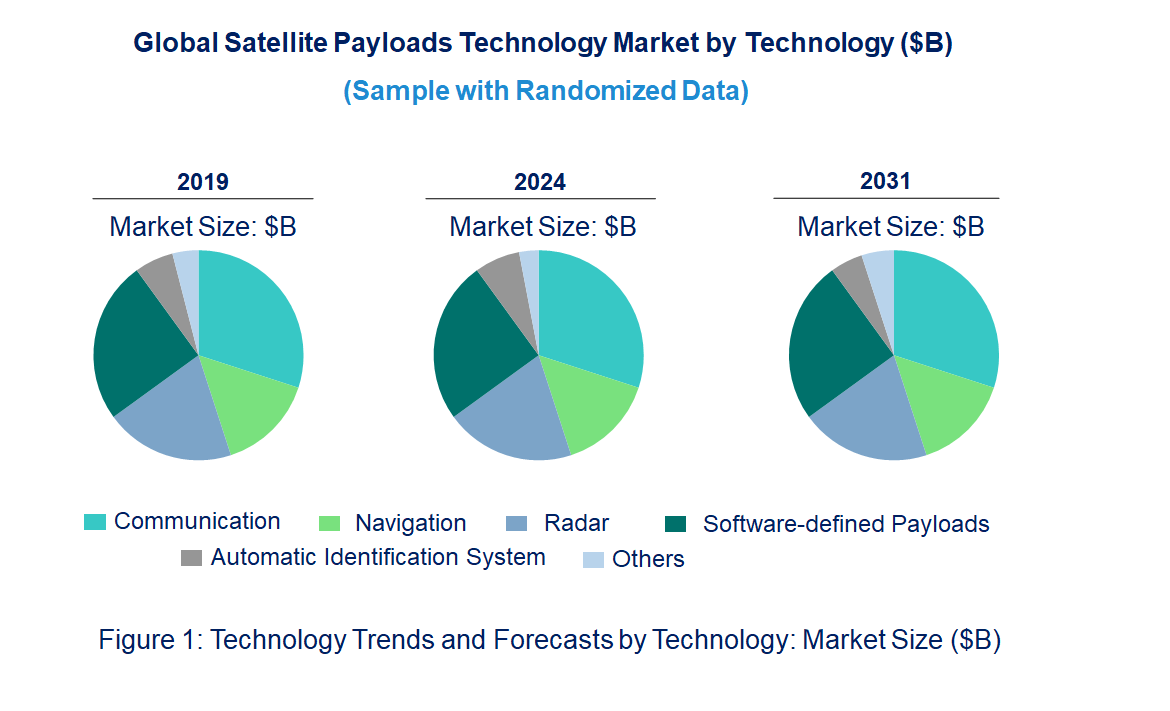
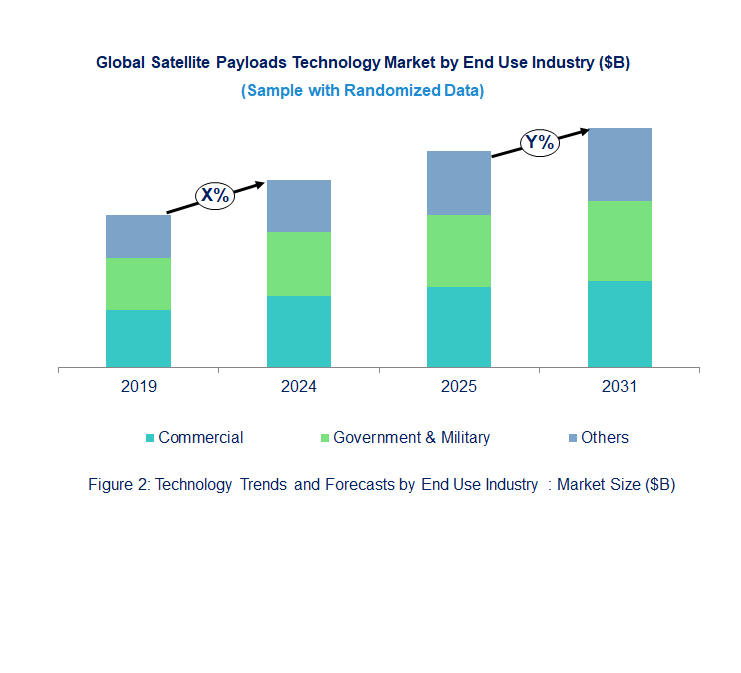
• Shift to Software-Defined Payloads (SDPs): This is one of the fastest-growing trends through the adoption of SDPs. Satellite payloads can be rearranged in orbit. Its flexible use of resources makes it more efficient, reduces operational costs, and accommodates changing mission requirements, as requested by governments and the military.
• Higher AI and Machine Learning Utilization: Satellite payloads are increasingly integrated with AI and machine learning for autonomous decision-making and real-time data processing. This enhances the efficiency and precision of satellite systems, particularly in communication and Earth observation payloads.
• Miniaturization and Integration of Payloads: With advancements in satellite technology, miniaturization and integration of payloads into smaller, lighter units are increasingly used. Combining multiple functions into a single compact payload reduces launch costs, increases the number of satellites in orbit, and expands service capabilities.
• Growth of Commercial Applications: Commercial applications, particularly in communication, Earth observation, and remote sensing, are driving demand for more sophisticated and cost-effective satellite payloads. Companies are seeking payloads that provide high-quality, reliable data for industries such as agriculture, energy, and telecommunications.
• High Throughput Satellites (HTS): HTS payloads are under development for faster data transmission and higher bandwidth. HTS payloads help the global communication network support industries like broadband, mobile services, and military communications. These technology trends are changing the shape of the satellite payloads market, enhancing flexibility, improving performance, and opening new markets for both commercial and government sectors. The quest for greater efficiency, reconfigurability, and processing power is changing how satellites are used for various applications.
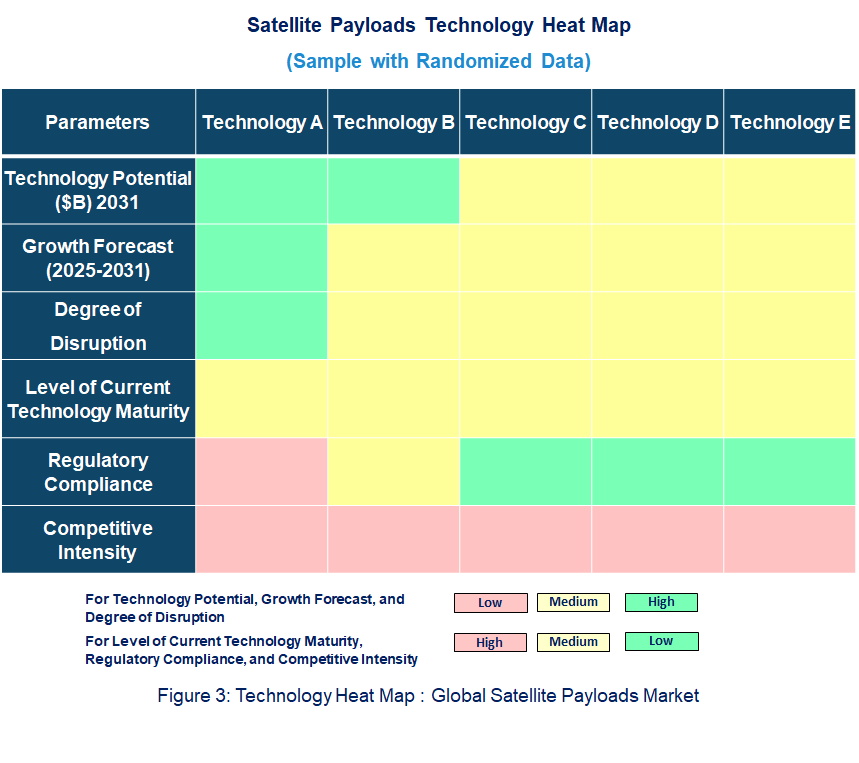
• Technological Potential: Satellite payload technology has vast potential to transform areas such as telecommunications, Earth observation, and national defense. Miniaturized payloads, high-throughput communication systems, advanced sensors, and onboard AI for data processing promise to improve the capabilities of satellites while reducing launch and operational costs. The ability to increase satellite efficiency, data throughput, and coverage will enable more precise and real-time services across industries.
• Degree of Disruption: The technology is highly disruptive, particularly with the rise of small satellite constellations (e.g., SpaceX’s Starlink) that leverage compact, cost-effective payloads to provide global coverage. This disruption challenges traditional large satellite systems and opens up new opportunities for more flexible, scalable, and affordable space-based services.
• Technology Maturity: Satellite payload technology is mature but still evolving. Although well-established technologies such as communication payloads are widely used, miniaturization, advanced sensors, and AI processing are still in development.
• Regulatory Compliance: Satellite payloads must adhere to international regulations, including ITU for frequency allocation and space debris mitigation guidelines to ensure responsible deployment and operation of satellites.
• Airbus has focused on integrating advanced software-defined payloads in their satellites, enhancing the adaptability and efficiency of their systems. This allows their satellites to provide more tailored services for both commercial and defense sectors with improved on-orbit performance.
• Gomspace is expanding in the small satellite payload domain, focusing on the cost-effective miniaturization of payload solutions. Through innovation in integrated communication and Earth observation payloads, the company finds itself ahead in the commercial space sector.
• Honeywell has developed advanced payload solutions for satellite communication and navigation systems, incorporating AI-powered systems for better signal processing and data accuracy. Their contributions enhance the operational efficiency of commercial satellites in areas like geospatial data and real-time communications.
• L3 Harris Technologies is currently dominating the market with advanced radar and communication payloads. They focus on high-precision, high-frequency radar systems and integrated communications payloads that support military and commercial satellite applications for intelligence and surveillance.
• Lockheed Martin is pushing the boundaries of satellite payload technology with multi-functional, high-throughput payloads for commercial and military applications. Its innovations in software-defined payloads enable more flexible and efficient satellite operations.
• Maxar Technologies is expanding its Earth observation payload offerings by using high-resolution imaging systems for applications ranging from environmental monitoring to defense intelligence. Its satellite payloads provide greater clarity and precision in remote sensing.
• Mitsubishi Electric has developed next-generation satellite payloads focusing on communication and Earth observation technologies, primarily aiming to increase signal strength and data transmission power capabilities. Their latest innovations also point toward compact, reliable payload solutions for small satellite platforms. These developments show how leading players are advancing satellite payload technology through innovations in software-defined payloads, miniaturization, and AI-powered systems, significantly enhancing the capabilities and adaptability of their satellite offerings.
• Demand for Advanced Communication Systems: With the increasing demand for global communication needs, there is a growing need for high-throughput satellite payloads that can deliver faster and more reliable data transmission. This is especially crucial in under- and overserved regions.
• Growing Commercialization of Space: The increasing interest of private companies in space exploration and satellite communications is driving demand for satellite payloads. Commercial sectors such as telecommunications, remote sensing, and geospatial data are significant drivers for innovation in payload technologies.
• Technological Advancements in AI and Automation: AI, machine learning, and automation enhance satellite payload capabilities, including autonomous operations and data processing. This improves mission efficiency and allows satellites to perform more complex tasks in real time, adding greater value.
• Government and Military Demand: Military and defense applications have always been drivers of advanced payload development for surveillance, reconnaissance, and communications. The demand for secure, high-performance payloads is high, especially for national security and defense applications. Challenges in the satellite payloads market include:
• High Development and Launch Costs: The development of advanced satellite payloads, especially high-throughput or software-defined technologies, is expensive. This cost can act as a bottleneck for the wider adoption of newer payloads, particularly by small companies or organizations with limited budgets.
• Regulatory and Licensing Challenges: The increasing complexity of satellite payloads, with involvement from more private companies, has made regulatory and licensing processes more stringent. Such procedures can cause delays in the launching of satellites, thereby restraining market growth.
• Space Debris Issues: The growing population of satellites and payloads orbiting the Earth raises concerns about space debris, the sustainability of satellite operations, and the need for companies to design their payloads to avoid generating debris and follow guidelines on safe satellite operations. The satellite payloads market is driven by advanced communications, AI integration, and the growing commercialization of space. However, high costs, regulatory challenges, and space debris concerns are significant barriers to market expansion. These are the factors shaping the development and deployment of satellite payload technologies.
• Airbus
• Gomspace
• Honeywell
• L3Harris Technologies
• Lockheed Martin
• Maxar Technologies
• Technology Readiness and Competitive Level for Satellite Payloads Market: Communication and navigation payloads are highly mature and ready for large-scale deployment, with well-established systems like GPS and satellite broadband services already in operation. Radar payloads are advanced, especially for remote sensing and surveillance, but there is continual improvement in resolution and signal processing. Software-defined payloads are rapidly maturing, offering flexibility in space mission functionality and holding the potential for future space missions. AIS technology is valid for maritime tracking, but it is still developing in terms of integrating global satellite systems. The competitive level in the satellite payload market is intense, as numerous space agencies and private companies work on cutting-edge innovations to improve payload efficiency, reduce costs, and meet regulatory requirements. Regulatory compliance for these technologies includes adherence to spectrum management, orbital regulations, and space debris mitigation strategies. Key applications for communication and navigation payloads include telecommunications, GPS services, and global internet access, while radar and AIS are integral to defense, weather forecasting, and maritime safety. Software-defined payloads offer versatility for future satellite constellations and space exploration missions.
• Competitive Intensity and Regulatory Compliance in Satellite Payloads Market: The competitive intensity in the satellite payloads market is high, with leading players constantly innovating to provide more advanced and cost-efficient technologies like communication, navigation, radar, software-defined payloads, and AIS. Communication payloads are fiercely contested by companies aiming to deploy low Earth orbit (LEO) constellations to deliver global connectivity, while radar and navigation systems face competition in military, commercial, and space exploration sectors. Software-defined payloads are increasingly in demand due to their flexibility and cost-effectiveness, leading to increased competition for more adaptable satellite architectures. Regulation is highly stringent, especially concerning global standards on radio frequencies, orbital slots, and spectrum management. The regulatory landscape for AIS and communication payloads is complex and requires coordination with international agencies such as the ITU and national space authorities. Safety, cybersecurity, and environmental impact regulations also drive competitive dynamics, particularly in defense and surveillance payloads.
• Disruption Potential of Different Technologies for Satellite Payloads Market: Technologies such as communication, navigation, radar, software-defined payloads (SDPs), and the Automatic Identification System (AIS) are causing significant disruption in the satellite payloads market. Communication payloads are essential for data transmission, and high-throughput satellites (HTS) are becoming more efficient with increased speeds in connectivity, particularly for remote areas. Navigation payloads, especially in GNSS systems, are becoming more accurate and will support a wide range of applications from defense to autonomous vehicles. Radar payloads for Earth observation and defense applications are evolving with higher resolutions and frequency capabilities. Software-defined payloads provide flexibility for satellite operators to change payload configurations remotely, optimizing performance and cost. AIS improves maritime tracking, while other specialized payloads enable better monitoring of environmental and atmospheric conditions. These technologies are disrupting the satellite market by offering more versatile, cost-effective, and scalable solutions to meet growing demands for global connectivity, security, and real-time data.
• Communication
• Navigation
• Radar
• Software-defined Payloads
• Automatic Identification System (AIS)
• Others
• Commercial
• Government & Military
• Others
• North America
• Europe
• Asia Pacific
• The Rest of the World
• Latest Developments and Innovations in the Satellite Payloads Technologies
• Companies / Ecosystems
• Strategic Opportunities by Technology Type


Choose a license that fits your team. Instant PDF delivery.
Prices exclude taxes. Instant delivery. Custom licensing available on request.
Market Report · May 18, 2026
Market Report · May 18, 2026
Market Report · May 18, 2026
Trusted partner for strategic intelligence and business growth


Receive a complimentary market analysis tailored to your industry. Our analysts will identify key growth opportunities and competitive dynamics specific to your business.

Market size, growth rate, and key trend analysis for your specific sector.

Top competitor positioning and market share analysis.

Strategic recommendations backed by data-driven insights.
Get curated market intelligence and competitive moves straight to your inbox.
By subscribing, you agree to receive our monthly insights. Unsubscribe anytime.
Receive a complimentary market analysis tailored to your industry. Our analysts will identify key growth opportunities and competitive dynamics specific to your business.
Market size, growth rate, and key trend analysis for your specific sector.
Top competitor positioning and market share analysis.
Strategic recommendations backed by data-driven insights.
Get curated market intelligence, emerging trends, and competitive moves straight to your inbox each month.
By subscribing, you agree to receive our monthly insights. Unsubscribe anytime.
We'll send your sample report shortly.