
Market Report · July 16, 2026

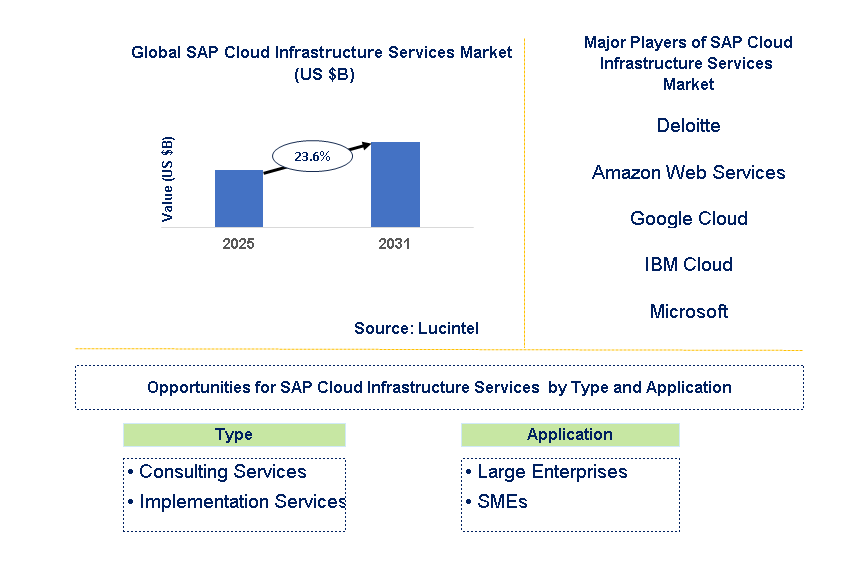
Key data points: The growth forecast = 23.6% annually for the next 7 years. Scroll below to get more insights. This market report covers Trends, opportunity and forecast in SAP cloud infrastructure services market to 2031 by type (consulting services and implementation services), application (large enterprises and SMEs), and region (North America, Europe, Asia Pacific, and the Rest of the World)
We'll send your sample report shortly.
• Adoption of Hybrid Cloud Environments: Hybrid cloud environments adoption has been high because many firms prefer using their infrastructure and at the same time applying public and private clouds. Thus, there has been the need for cloud service providers, especially SAP, to combine these three forms into different platforms where organizations can adopt for the various uses. These forms are enabling them to manage specific legacy applications, which still contribute significantly in operations, yet be flexible in attaining full digital transformation for increased scalability and agility.
• Higher Emphasis on Artificial Intelligence: Automation artificial intelligence and automation will be considered key components in the cloud infrastructure services of SAP. Businesses today rely on insights delivered by AI for better decisions, enhanced customer experiences, and operations. These can be used with SAP solutions in the power of AI-driven and cloud services. More intelligent automation and AI-based cloud-based services are therefore to be found as more firms shift towards AI and automation-driven operations.
• Expansion of Industry-Specific Solutions: The SAP Cloud Infrastructure Services market is shifting with the focus on providing more industry-specific cloud solutions that cater to the specific requirements of certain sectors such as healthcare, manufacturing, and retail. By cloud services tailored to specific industries, SAP provides businesses with a greater opportunity to exploit cloud technology. Increasingly, this trend is reinventing the SAP Cloud Infrastructure Services market as it results in a demand for solutions tailored to the operation, regulatory requirements, and the business's condition.
• Greater Emphasis on Data Privacy And Security: As data privacy and security concerns continue to grow, secure cloud solutions are at the top of businesses' lists. SAP is responding to this trend in the form of enhanced security features within its cloud infrastructure services, which comply with regulations set forth for global data protection such as the GDPR in Europe and CCPA in the United States. This focus on security allows businesses to make strides in gaining customer trust as they transition to cloud technologies with confidence.
• Integration with Emerging Technologies (IOT, Blockchain): SAP is increasingly integrating its cloud infrastructure services with emerging technologies like the Internet of Things (IoT) and blockchain. This trend is enabling businesses to gather real-time data from connected devices, improve supply chain transparency, and automate contract management processes. SAP’s cloud solutions, combined with IoT and blockchain, offer businesses the ability to optimize operations and enhance visibility across their ecosystems.
These trends are redefining the SAP Cloud Infrastructure Services market, leading to innovations that help organizations in achieving higher operational efficiency and in keeping up with the emerging business requirements across all sectors.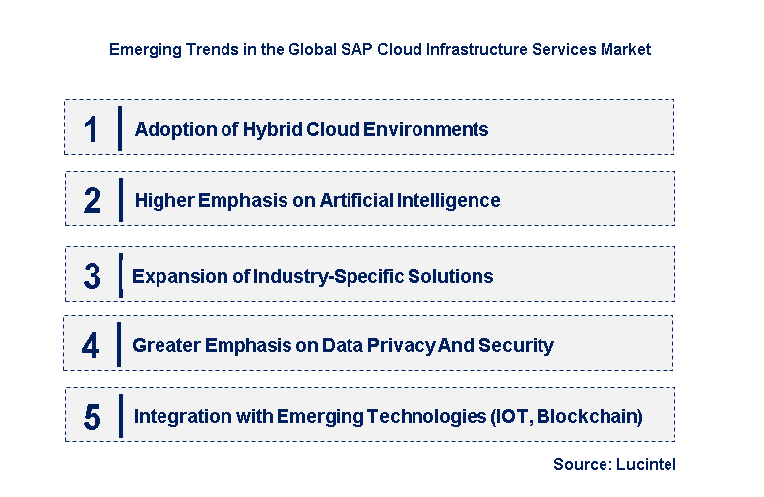
• Collaboration with Hyperscalers; A partnership that SAP has delved into with major cloud providers includes Microsoft Azure, AWS, and Google Cloud to offer the business more cloud solutions. Partnerships from these hyperscalers give SAP access to hyperscalers' strengths, including global scalability, speed, and security. Businesses can optimize their digital transformation journeys, become more efficient, and innovate faster by integrating SAP's cloud infrastructure services with the platforms.
• Launch Industry-Specific Cloud Solutions: Industry-specific cloud solutions have been announced by SAP that provide specific businesses in sectors, such as manufacturing, healthcare, and retail with tailored cloud infrastructure services. Designed to address each industry's uniqueness, the feature addresses regulatory compliance, specific operations, and issues related to its market. Through this development, businesses can exploit SAP's cloud technologies to solve their unique business needs.
• Cloud Integration with AI and Machine Learning: SAP has integrated AI and machine learning capabilities into its cloud infrastructure services, enabling businesses to harness advanced analytics and automation tools. These integrations allow organizations to use real-time data for predictive analytics, optimize operations, and improve decision-making processes. The increased use of AI and machine learning is enhancing SAP’s cloud solutions and making them more intelligent and efficient.
• Improving security and compliance: Since data privacy issues are ever-rising, SAP has looked for ways of ensuring that it boosts the cloud service's security and compliance. Some of these have included encryption features, two-factor authentication, and more complex forms of protection on data. Thus, while strengthening security for data, it's helping customers in compliance, be it in regards to GDPR and CCPA.
• Expansion of Cloud Footprint in Emerging Markets: SAP is expanding its cloud infrastructure services in emerging markets like India, Southeast Asia, and Africa. This expansion allows SAP to cater to the growing demand for cloud-based solutions in these regions, where businesses are increasingly adopting cloud technologies to drive digital transformation. SAP’s focus on these markets reflects its strategy to capture a larger share of the global cloud infrastructure services market.
These developments indicate how SAP is committed to helping businesses around the world by fulfilling all of their growing needs with scalable, secure, and innovative cloud infrastructure services.• Enterprise Resource Planning (ERP) Systems: The increasing demand for efficient, integrated business management systems is a huge growth opportunity for SAP Cloud Infrastructure Services. With cloud-based ERP solutions, businesses can streamline their operations, reduce costs, and improve decision-making. SAP's ERP offerings, combined with its cloud infrastructure, provide businesses with scalable and flexible solutions that can be customized to meet specific industry requirements.
• Supply Chain Management (SCM): Cloud-based supply chain management solutions are in high demand as businesses look for ways to improve efficiency, reduce costs, and enhance visibility. SAP’s cloud infrastructure services enable companies to optimize their supply chains by providing real-time insights, improving demand forecasting, and enhancing collaboration across the supply chain. This growth opportunity is especially significant in industries like manufacturing, retail, and logistics.
• Customer Relationship Management (CRM): Cloud-based CRM solutions are essential for businesses looking to enhance customer engagement and improve sales processes. SAP’s cloud services can be leveraged to provide a unified platform for managing customer interactions, analyzing customer data, and delivering personalized experiences. This growth opportunity is particularly valuable in industries like retail, banking, and telecommunications.
• Human Capital Management (HCM): The need for cloud-based human resource solutions is growing as businesses seek to optimize talent management, recruitment, and employee engagement. SAP’s cloud-based HCM solutions allow organizations to manage their workforce more effectively, improve employee satisfaction, and reduce HR costs. The shift to cloud-based HCM is particularly strong in industries with large, distributed workforces, such as healthcare and retail.
• Data Analytics and Business Intelligence (BI): As businesses generate more data than ever before, there is an increasing need for cloud-based data analytics and BI solutions. SAP’s cloud infrastructure services provide businesses with the tools they need to analyze large volumes of data, gain actionable insights, and make informed decisions. This growth opportunity is especially important in sectors like finance, healthcare, and manufacturing, where data-driven decisions are critical for success.
These strategic growth opportunities indicate the significant potential for SAP Cloud Infrastructure Services to expand across various industries and applications, further strengthening its position in the global market.• Deloitte
• Amazon Web Services
• Google Cloud
• Ibm Cloud
• Microsoft
• Accenture
• Pcg
• Techtarget
• Fujitsu
• Yash Technologies
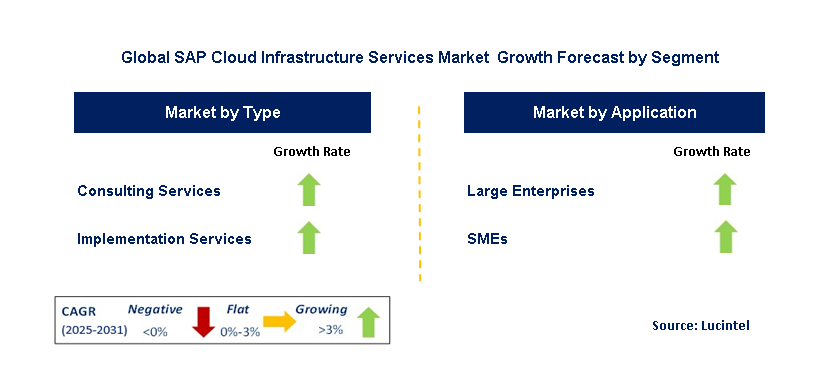
• Consulting Services
• Implementation Services
• Large Enterprises
• SMEs
• North America
• Europe
• Asia Pacific
• The Rest of the World
• United States: The SAP Cloud Infrastructure Services market in the United States is mainly driven by business adoption of enterprise solutions based on cloud. SAP’s partnership with hyperscalers such as Microsoft Azure, Google Cloud, and Amazon Web Services (AWS) has significantly expanded the market’s reach. U.S. companies are increasingly integrating SAP’s solutions with cloud platforms for enhanced scalability and flexibility. Additionally, the rise of AI and machine learning applications in SAP’s cloud services is reshaping how businesses manage operations. Increased investment in the areas of data security and compliance will be backed by regulations including GDPR and CCPA. Hence, this goes even further.
• China: Accelerating its agenda on digital transformation, SAP cloud infrastructure services grow significantly in importance for China, especially in countries such as with the support being extended from cloud service providers. Local Alibaba cloud helps SAP find opportunities for these Chinese businesses with respect to including ERP-based ERP in their services. The Chinese government's thrust on the growth of the digital economy and smart manufacturing is fueling demand for SAP Cloud Infrastructure Services. Moreover, the focus on data sovereignty and local cloud services means that SAP is aligning its offerings with the country's regulations, thereby further entrenching its position in the region's rapidly expanding digital ecosystem.
• Germany: SAP's home country, Germany, continues to see strong growth in SAP Cloud Infrastructure Services. The country is emphasizing digital transformation across industries, especially in the automotive, manufacturing, and logistics sectors. SAP's cloud solutions are increasingly being integrated with Industry 4.0 technologies such as IoT and big data analytics to optimize production and supply chain processes. The German market is characterized by a high demand for secure cloud solutions that comply with stringent data protection laws, such as the General Data Protection Regulation (GDPR). This has driven SAP to offer enhanced security features within its cloud infrastructure services.
• India: The SAP Cloud Infrastructure Services market in India is growing rapidly, fueled by the country's expanding IT sector and increasing digitalization of businesses. Indian companies have begun to embrace SAP cloud solutions so that they can transform and automation-based efficiency. The government led Digital India is kindling more interest in cloud technology, which is encouraging local businesses to use the infrastructure services of SAP. SAP is also focusing on providing solutions that cater to India’s diverse industries, including manufacturing, retail, and services, with an emphasis on cost-effectiveness and scalability to meet the needs of the growing market.
• Japan: Japan’s demand for SAP Cloud Infrastructure Services is on the rise as the country seeks to modernize its enterprises through digital transformation. Japanese businesses are increasingly turning to SAP’s cloud-based solutions to streamline their operations and enhance data-driven decision-making. The government’s focus on innovation, such as its Society 5.0 initiative, is pushing industries like automotive, robotics, and manufacturing to adopt cloud solutions. Furthermore, Japan’s emphasis on data privacy and security has led SAP to offer tailored solutions to meet the country’s specific regulatory requirements. Advanced technologies like AI and robotics are also fueling adoption.


• Deloitte
• Amazon Web Services
• Google Cloud
• Ibm Cloud
• Microsoft
• Accenture
• Pcg
• Techtarget
• Fujitsu
• Yash Technologies
Q5. Which SAP cloud infrastructure services market segment will be the largest in future?

Choose a license that fits your team. Instant PDF delivery.
Prices exclude taxes. Instant delivery. Custom licensing available on request.
Market Report · July 16, 2026
Market Report · May 18, 2026
Market Report · May 18, 2026
Trusted partner for strategic intelligence and business growth


Receive a complimentary market analysis tailored to your industry. Our analysts will identify key growth opportunities and competitive dynamics specific to your business.

Market size, growth rate, and key trend analysis for your specific sector.

Top competitor positioning and market share analysis.

Strategic recommendations backed by data-driven insights.
Get curated market intelligence and competitive moves straight to your inbox.
By subscribing, you agree to receive our monthly insights. Unsubscribe anytime.
Receive a complimentary market analysis tailored to your industry. Our analysts will identify key growth opportunities and competitive dynamics specific to your business.
Market size, growth rate, and key trend analysis for your specific sector.
Top competitor positioning and market share analysis.
Strategic recommendations backed by data-driven insights.
Get curated market intelligence, emerging trends, and competitive moves straight to your inbox each month.
By subscribing, you agree to receive our monthly insights. Unsubscribe anytime.
We'll send your sample report shortly.