
Market Report · July 15, 2026

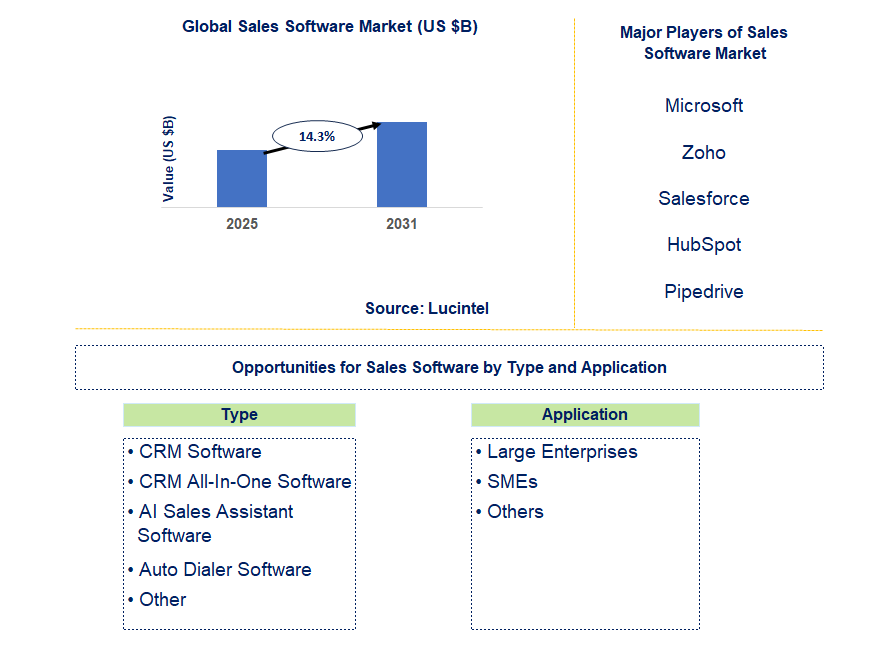
Key data points: The growth forecast = 14.3% annually for the next 7 years. Scroll below to get more insights. This market report covers trends, opportunities and forecasts in sales software market to 2031 by type (crm software, crm all-in-one software, ai sales assistant software, auto dialer software, and other), application (large enterprises, smes, and others), and region (North America, Europe, Asia Pacific, and the Rest of the World)
We'll send your sample report shortly.
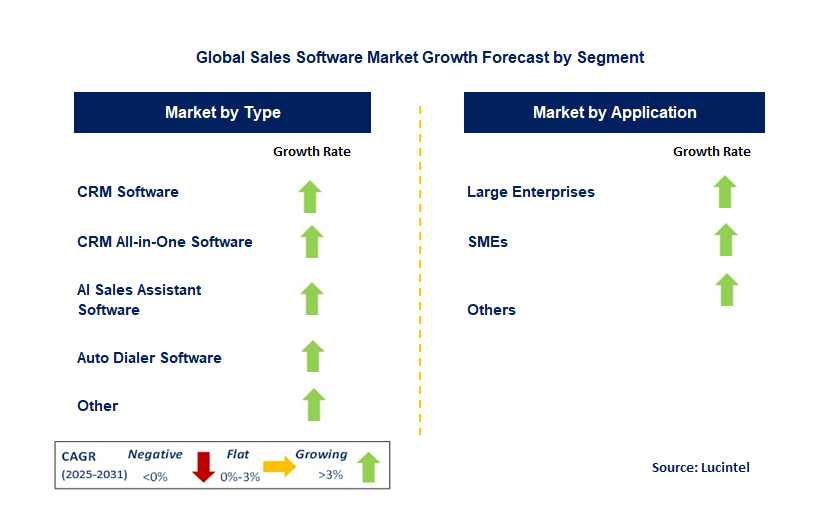
• Lucintel forecasts that, within the type category, is expected to witness higher growth over the forecast period.
• Within the application category, is expected to witness the highest growth.
• In terms of region, APAC is expected to witness the highest growth over the forecast period. Gain valuable insights for your business decisions with our comprehensive 150+ page report. Sample figures with some insights are shown below.
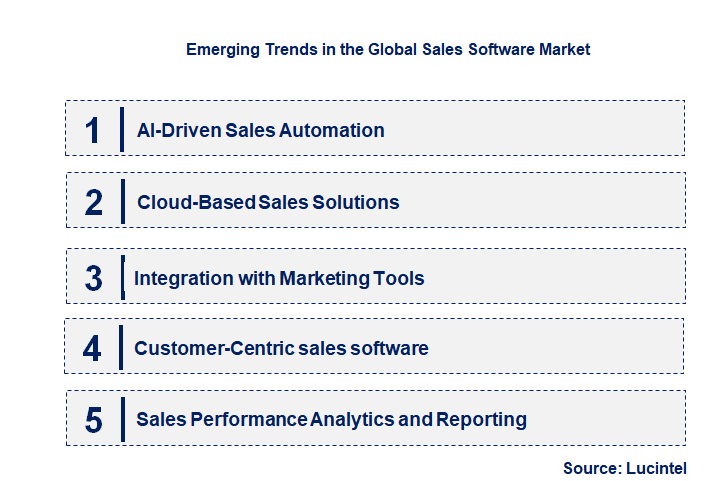
• AI-Driven Sales Automation: Artificial intelligence is revolutionizing the sales process, making routine activities such as lead qualification, follow-ups, and content creation based on personal preferences. AI-powered sales software can analyze huge amounts of customer data to predict buyer behavior, personalize sales pitches, and optimize workflows. This allows sales teams to focus on high-value activities while increasing efficiency and reducing human error. As AI continues to evolve, businesses will increasingly rely on these tools to improve sales forecasting, identify trends, and make more informed decisions.
• Cloud-Based Sales Solutions: Cloud sales software allows scalable flexibility and access from any corner of the world to ensure seamless working of teams with collaboration. It is because remote work has taken center stage with businesses focusing more on digitization, thus requiring the flexibility that comes along with it. Better data storage and security capabilities through cloud-based solutions allow large customer data and, thus help scale the organizations in handling enormous operations. The cost-effectiveness of cloud-based solutions also appeals to small and medium-sized enterprises (SMEs) looking to leverage sophisticated sales tools without significant upfront investment.
• Integration with Marketing Tools: The integration of sales software with marketing tools is becoming increasingly important as businesses aim to align their sales and marketing strategies. Integrating CRM and sales management tools with marketing automation platforms can allow for more personalized customer journeys and improvements in lead nurturing processes. Better tracking of customer touchpoints, cross-channel marketing, and a better relationship between marketing and sales teams can be achieved through such integration. Optimizing conversion rates will be at the forefront of business interests in the near future, which is going to impact the sales software market.
• Customer-Centric sales software: Customer-centric sales software is aimed at providing more profound insights into the needs and preferences of customers. This enables businesses to tailor their sales efforts and, in the process, be more effective in their approach. Advanced analytics and data-driven insights enable sales teams to create unique solutions for every client, leading to better customer satisfaction and loyalty. Improved customer retention is driving this shift toward a more customer-centric approach because customer experience has become increasingly crucial in driving revenue. More and more, businesses are investing in sales software that enhances customer engagement and deepens long-term relationships.
• Sales Performance Analytics and Reporting: Sales performance analytics and reporting are becoming more complex and sophisticated to allow businesses to track and measure sales performance in real-time. The tools can give insights on sales activities, team performance, and customer behavior, which enable businesses to determine areas for improvement and optimize sales strategies. The advanced data visualization and reporting features can help sales managers make better decisions and develop strategies that yield better outcomes. This trend is forcing businesses to become more data-driven in their approaches to sales management and performance tracking. The emerging trends in the sales software market include AI-powered automation, cloud-based solutions, integration with marketing tools, customer-centric features, and performance analytics. All these factors are redesigning the entire mechanism of sales for businesses, as they are changing the way efficiency, personalization, and data-driven decision-making can improve the success odds of companies in an increasing competition.
• AI/Machine Learning Integration: With AI and machine learning, sales software increasingly sits at the center of things. These technologies enable predictive analytics, lead scoring, and personal communication to help a sales team make better decisions and convert more deals. Through AI, the work of automated tasks like follow-up emails, lead management, and sales forecasting helps free up sales reps to focus on higher-leverage activities. The integration of these technologies into sales software is one of the most important developments reshaping the market.
• Cloud-Based CRM Solutions: Cloud-based CRM systems are becoming increasingly popular as businesses look for more flexibility and accessibility. These solutions allow sales teams to collaborate in real-time, track customer interactions, and manage sales pipelines from anywhere. The rise of remote work and the need for scalable solutions that can grow with businesses have accelerated the shift to cloud-based systems. Cloud CRM systems are also more cost-effective and offer better integration with other business tools, making them an attractive option for organizations of all sizes.
• Sales Automation Tools: Sales automation tools are changing the sales team's nature and how sales teams work. Automating tasks related to scheduling, reporting, and follow-ups allows more time on more valuable activities for sales representatives, including closing deals. This advancement has expanded the growth of sales software because companies look for ways to enhance productivity and cut down on operational costs. Today, most sales software platforms have sales automation as a critical component
• Integration with Third-Party Platforms: Integration of sales software with third-party platforms, such as marketing automation tools, ERP systems, and e-commerce platforms, is enhancing the functionality and value of sales solutions. Connecting different systems allows businesses to create a unified view of customer data, improve collaboration between teams, and streamline workflows. This trend is making it easier for companies to manage all aspects of their sales operations from a single platform, leading to better insights and more effective strategies.
• Focus on Data Security and Compliance: Nowadays, data privacy is growing as an increasing concern as well as strict rules such as GDPR, which compels sales software vendors to upgrade the security of data at their end as well as complying with compliance features. The innovations range from stronger encryption methods, secure data storage, and tools that help businesses comply with privacy laws. Given that organizations are dealing with increasingly sensitive customer data, meeting these requirements in sales software has been a critical focus for developers and users. The latest trends in the sales software market, such as AI integration, cloud-based CRM solutions, sales automation, third-party platform integration, and a focus on data security, are significantly influencing how businesses manage their sales processes. These advancements are driving growth in the market, as companies increasingly adopt innovative solutions to optimize efficiency, improve customer relationships, and boost sales performance.
• Sales automation solutions: With growing interest in sales process streamlining and efficiency improvement, the demand for sales automation tools is on the rise. Sales automation solutions help companies reduce manual tasks, improve lead management, and accelerate sales cycles. Automation of repetitive tasks, such as follow-ups and data entry, enables sales teams to focus on more strategic activities, like building relationships with clients. This trend is opening up significant growth opportunities for sales software providers.
• Data Analytics and Reporting Tools: As companies continue to depend more on data in their sales strategy, there is a need for more advanced analytics and reporting tools. These help businesses analyze the performance of their sales, behavior of customers, and market trends, thereby streamlining their strategy. Sales software companies can cash in on this trend by providing more complex analytics capabilities that can help businesses make data-driven decisions and enhance their overall sales performance.
• Mobile sales software: With the growing trend of remote work and mobile devices, demand for mobile-friendly sales software is increasing. Mobile sales software enables sales teams to access customer data, update pipelines, and manage communications while on the go. This growth opportunity is particularly important for businesses with field sales teams or a large remote workforce. By offering mobile-compatible solutions, sales software providers can cater to a broader audience.
• AI-driven personalization: AI-powered personalization is becoming a key feature of sales software as businesses seek to deliver more targeted, personalized sales experiences. AI tools can help sales teams tailor their approach based on customer preferences, behavior, and past interactions. By offering personalized solutions, businesses can improve customer engagement, increase conversion rates, and enhance customer loyalty. This presents a significant growth opportunity for sales software companies that integrate AI-driven personalization into their platforms
• Integration with marketing and customer service platforms: Sales software integrating marketing automation and customer service applications has become more vital for business companies looking to integrate their sales, marketing, and customer services. Businesses are integrating these systems to achieve a common view of the interactions customers have with their companies, thus increasing interdepartmental collaboration, as well as the overall quality of customer service. This is a growth opportunity that can make sales software vendors offer additional and comprehensive solutions to their customers. The sales software market is experiencing a number of strategic growth opportunities in the form of sales automation, data analytics, mobile solutions, AI-driven personalization, and platform integration. These opportunities allow businesses to become more efficient, improve customer relationships, and drive sales performance. By capitalizing on these trends, sales software providers can remain competitive and meet the evolving needs of businesses.
• Microsoft
• Zoho
• Salesforce
• HubSpot
• Pipedrive
• Nimble
• ActiveCampaign
• Infusion Software
• Vtiger
• Swiftpage ACT
• CRM Software
• CRM All-In-One Software
• AI Sales Assistant Software
• Auto Dialer Software
• Other
• Large Enterprises
• SMEs
• Others
• North America
• Europe
• Asia Pacific
• The Rest of the World
• United States: In the United States, the sales software market has seen an uptrend in cloud-based CRM systems and automation tools adoption. Sales software usage in leading retail, finance, and technology companies will continue on an upward trajectory as companies track customer interactions, personalize sales, and automate simple tasks. AI-driven data tools will enable most businesses to have a better idea of sales trends, thereby streamlining their strategies. The demand for sales software solutions as remote work gains traction has also increased the demand for the same.
• China: The sales software market in China is growing rapidly as businesses are adopting digital tools to keep up with the changing landscape. With the increased usage of mobile technology and the dominance of e-commerce platforms, sales software designed to enhance online sales performance and customer engagement has been widely adopted. In addition, the integration of AI and machine learning capabilities in sales software has allowed businesses in China to automate their sales processes and gain insights from large datasets. Companies are also focusing more on improving customer service and satisfaction through personalized sales strategies.
• Germany: The German sales software market is driven by a strong focus on efficiency, data privacy, and regulatory compliance, especially with the implementation of GDPR. Many German companies in industries like manufacturing, automotive, and logistics are adopting advanced sales software tools to streamline their sales workflows and enhance customer interactions. The integration of CRM solutions with ERP systems is becoming more common, as businesses seek to better align sales efforts with overall business operations. Further, the booming tech environment in Germany is driving innovation in sales software, with homegrown companies building solutions that respond to specific regional needs and compliance standards.
• India: The sales software market is growing rapidly in India as more businesses, especially in e-commerce, IT services, and telecom, realize the value of digital transformation. The increasing adoption of cloud-based solutions and the availability of affordable sales software have democratized access to these tools for small and medium-sized enterprises (SMEs). Indian companies are increasingly adopting AI-based sales solutions to personalize their sales processes and improve customer acquisition. In addition, the demand for sales software that integrates seamlessly with mobile platforms is growing, as mobile commerce continues to expand across the country.
• Japan: Japan's sales software market is changing, taking the route of innovation and integration. Sales automation tools have become significantly popular lately, allowing many businesses to improve efficiency and the accuracy of sales forecasts. When it comes to CRM and sales management software, demand is increasing in the technology, retail, and manufacturing sectors. It is also gaining traction in the Japanese market, with companies interested in using AI-powered sales tools to review customer information and judge appropriate sales strategies. Also, this country has an ageing population, and there is a strong pressure toward the automation of digital solutions for maintaining productivity and optimizing sales efforts.


• Microsoft
• Zoho
• Salesforce
• HubSpot
• Pipedrive
• Nimble
• ActiveCampaign
• Infusion Software
• Vtiger
• Swiftpage ACT Q5. Which sales software market segment will be the largest in future? Answer: Lucintel forecasts that, within the type category, is expected to witness higher growth over the forecast period. Q6. In sales software market, which region is expected to be the largest in next 5 years? Answer: In terms of region, APAC is expected to witness the highest growth over the forecast period. Q7. Do we receive customization in this report? Answer: Yes, Lucintel provides 10% customization without any additional cost.


Choose a license that fits your team. Instant PDF delivery.
Prices exclude taxes. Instant delivery. Custom licensing available on request.
Market Report · July 15, 2026
Market Report · June 26, 2026
Market Report · June 24, 2026
Trusted partner for strategic intelligence and business growth


Receive a complimentary market analysis tailored to your industry. Our analysts will identify key growth opportunities and competitive dynamics specific to your business.

Market size, growth rate, and key trend analysis for your specific sector.

Top competitor positioning and market share analysis.

Strategic recommendations backed by data-driven insights.
Get curated market intelligence and competitive moves straight to your inbox.
By subscribing, you agree to receive our monthly insights. Unsubscribe anytime.
Receive a complimentary market analysis tailored to your industry. Our analysts will identify key growth opportunities and competitive dynamics specific to your business.
Market size, growth rate, and key trend analysis for your specific sector.
Top competitor positioning and market share analysis.
Strategic recommendations backed by data-driven insights.
Get curated market intelligence, emerging trends, and competitive moves straight to your inbox each month.
By subscribing, you agree to receive our monthly insights. Unsubscribe anytime.
We'll send your sample report shortly.