
Market Report · July 15, 2026

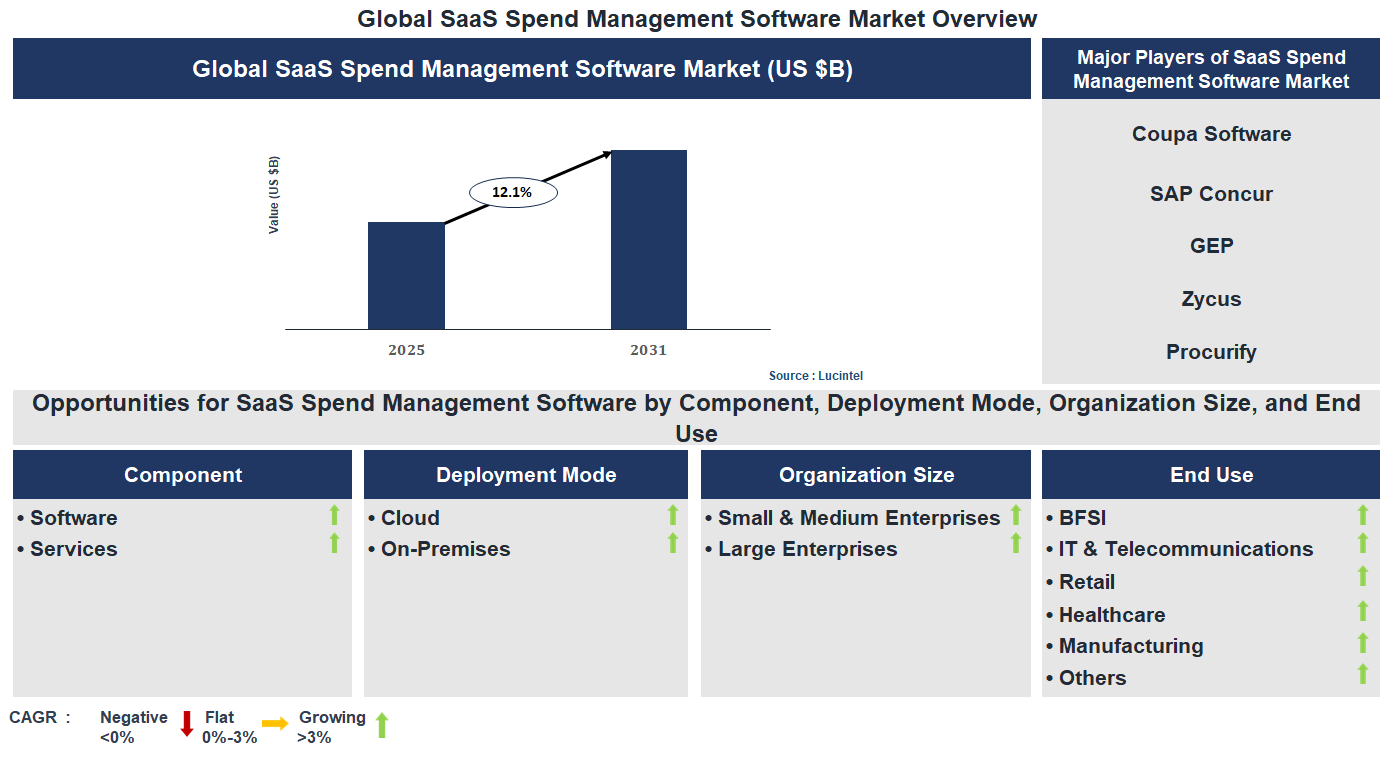
Key data points: The growth forecast = 12.1% annually for the next 7 years. Scroll below to get more insights. This market report covers trends, opportunities and forecasts in SaaS spend management software market to 2031 by component (software and services), deployment mode (cloud and on-premises), organization size (small & medium enterprises and large enterprises), end use (BFSI, IT & telecommunications, retail, healthcare, manufacturing, and others), and region (North America, Europe, Asia Pacific, and the Rest of the World)
We'll send your sample report shortly.
• Lucintel forecasts that, within the component category, software is expected to witness higher growth over the forecast period.
• Within the end use category, BFSI is expected to witness the highest growth.
• In terms of region, North America is expected to witness the highest growth over the forecast period. Gain valuable insights for your business decisions with our comprehensive 150+ page report. Sample figures with some insights are shown below.
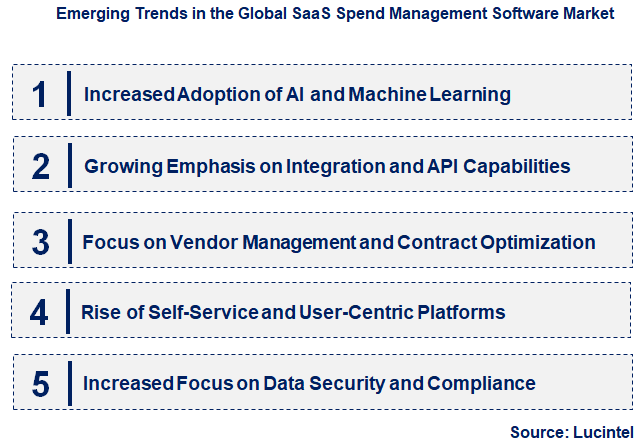
• Increased Adoption of AI and Machine Learning: AI and machine learning are being integrated into SaaS spend management tools to automate expense tracking, detect anomalies, and forecast future costs. These technologies enable real-time insights and predictive analytics, helping organizations optimize their SaaS portfolios more effectively. The automation reduces manual effort, minimizes errors, and enhances decision-making accuracy, leading to significant cost savings and improved operational efficiency.
• Growing Emphasis on Integration and API Capabilities: Modern SaaS spend management solutions are increasingly designed to seamlessly integrate with existing enterprise systems such as ERP, procurement, and financial software. Robust API capabilities facilitate data sharing and process automation across platforms, providing a unified view of SaaS expenses. This integration enhances transparency, simplifies workflows, and enables comprehensive spend analysis, empowering organizations to make more informed and strategic financial decisions.
• Focus on Vendor Management and Contract Optimization: As SaaS usage proliferates, companies are prioritizing vendor management and contract optimization to control costs and mitigate risks. Advanced tools now offer features like contract lifecycle management, renewal alerts, and vendor performance analytics. These capabilities help organizations negotiate better terms, avoid unnecessary renewals, and ensure compliance, ultimately reducing expenses and strengthening vendor relationships.
• Rise of Self-Service and User-Centric Platforms: User-friendly, self-service SaaS spend management platforms are gaining popularity, allowing non-technical users to access and analyze spend data independently. These platforms often feature intuitive dashboards, customizable reports, and collaborative tools, fostering greater transparency and accountability across departments. This trend democratizes financial oversight, accelerates decision-making, and encourages proactive cost management at all organizational levels.
• Increased Focus on Data Security and Compliance: With the growing reliance on cloud-based spend management solutions, data security and regulatory compliance have become critical priorities. Vendors are investing in advanced security protocols, encryption, and compliance certifications to protect sensitive financial data. Ensuring data privacy and meeting regulatory standards not only builds customer trust but also mitigates legal and financial risks, making security a key differentiator in the market. In summary, these trends are transforming the SaaS spend management software market by fostering greater automation, integration, and security. They enable organizations to gain deeper insights, optimize costs more effectively, and adapt swiftly to changing technological and regulatory landscapes. As a result, the market is becoming more sophisticated, customer-centric, and aligned with broader digital transformation goals.
• Adoption of AI and Machine Learning: Integration of AI and ML technologies into SaaS spend management tools has improved expense forecasting, anomaly detection, and automated decision-making. This enhances accuracy and efficiency, enabling organizations to identify cost-saving opportunities proactively. The impact is a more intelligent, responsive platform that reduces manual oversight and optimizes SaaS investments.
• Expansion of Integration Capabilities: Vendors are increasingly offering seamless integration with existing enterprise systems such as ERP, CRM, and procurement platforms. This interoperability streamlines workflows, consolidates data, and provides a unified view of SaaS spending. The result is improved data accuracy and better strategic decision-making, fostering broader adoption across various organizational functions.
• Focus on User Experience and Interface Design: Companies are prioritizing intuitive, user-friendly interfaces to facilitate easier adoption and daily use. Enhanced dashboards, customizable reports, and simplified onboarding processes improve user engagement and reduce training costs. This focus on UX drives higher customer satisfaction and retention, making these tools more accessible to non-technical users.
• Rise of Subscription Management and Optimization Features: Advanced subscription management capabilities, including renewal alerts, usage tracking, and cost optimization suggestions, are becoming standard. These features help organizations avoid overspending and underutilization of SaaS resources. The impact is significant cost savings and better alignment of SaaS usage with business needs.
• Strategic Partnerships and Market Consolidation: Major players are forming alliances and acquiring smaller firms to expand their product offerings and market reach. This consolidation accelerates innovation, enhances service portfolios, and increases competitive pressure. It benefits customers through more comprehensive solutions and improved support, fostering overall market growth. In summary, these developments are significantly transforming the SaaS spend management software market by enhancing technological capabilities, improving user experience, and fostering strategic collaborations. These changes are driving increased adoption, better cost control, and more sophisticated management of SaaS expenditures, positioning the market for sustained growth and innovation.
• Enhanced Budgeting and Forecasting Tools : These tools enable organizations to gain real-time insights into SaaS spending, improve budget accuracy, and forecast future expenses, leading to better financial planning and cost control.
• Automated Vendor Management : Automation streamlines vendor onboarding, contract management, and renewal processes, reducing manual effort, minimizing errors, and strengthening vendor relationships.
• Centralized SaaS Governance Platforms : These platforms facilitate comprehensive oversight of SaaS applications, ensuring compliance, security, and optimal usage, which reduces risks and enhances IT efficiency.
• Employee SaaS Usage Analytics : Analytics tools help HR departments monitor SaaS application usage, optimize licenses, and control costs associated with employee subscriptions, improving overall workforce management.
• Integration with Business Workflows : Seamless integration of SaaS spend management with existing operational workflows enhances process automation, data accuracy, and decision-making speed, boosting organizational agility. In summary, these growth opportunities are significantly impacting the SaaS spend management software market by driving innovation, improving cost efficiency, and enabling organizations to better manage their SaaS investments. As businesses increasingly prioritize digital transformation, these developments are expected to foster sustained market expansion and competitive advantage.
• Technological Innovation: The rapid evolution of cloud computing, artificial intelligence, and automation technologies has revolutionized spend management. These innovations enable real-time tracking, predictive analytics, and automated workflows, significantly improving efficiency and accuracy. As organizations seek to optimize their SaaS expenditures, the demand for advanced, user-friendly solutions increases. Vendors investing in cutting-edge technology can differentiate themselves, leading to increased market adoption. Moreover, integration capabilities with existing enterprise systems facilitate seamless deployment, further fueling growth. The continuous technological advancements ensure that SaaS spend management remains relevant and capable of addressing complex organizational needs, thus driving market expansion.
• Growing SaaS Adoption Across Industries: The widespread adoption of SaaS solutions across various sectors such as healthcare, finance, retail, and manufacturing is a major growth driver. Organizations are shifting from traditional on-premises systems to cloud-based platforms to enhance agility, scalability, and cost-efficiency. This transition necessitates effective spend management to control SaaS subscriptions and prevent overspending. As SaaS usage proliferates, the need for specialized spend management tools becomes critical. The increasing reliance on SaaS applications amplifies the demand for solutions that provide visibility, control, and optimization of SaaS expenses, thereby propelling market growth.
• Cost Optimization and Budget Control: Organizations are under constant pressure to optimize operational costs and improve budget management. SaaS spend management software offers detailed insights into subscription usage, expenditure patterns, and potential savings opportunities. By identifying redundant or underutilized subscriptions, companies can eliminate unnecessary costs, leading to significant savings. This focus on cost control is especially pertinent in economic downturns or budget-constrained environments. As businesses seek to maximize ROI on their SaaS investments, the adoption of spend management tools becomes a strategic priority, fueling market expansion and innovation in cost-saving features.
• Increasing Focus on Data Security and Compliance: Data security and regulatory compliance are critical concerns for organizations managing SaaS expenditures. As data breaches and cyber threats become more sophisticated, vendors are compelled to enhance security protocols within their spend management solutions. Compliance with standards such as GDPR, HIPAA, and SOC 2 is essential to maintain customer trust and avoid penalties. This focus on security and compliance drives vendors to develop more robust, transparent, and auditable solutions. Consequently, the market benefits from increased trust and wider adoption among risk-averse organizations, further stimulating growth.
• Rising Demand for Integrated Financial Management Solutions: The integration of SaaS spend management with broader financial and enterprise resource planning (ERP) systems is a key driver. Organizations prefer unified platforms that provide comprehensive financial oversight, reducing manual efforts and improving data accuracy. Integrated solutions facilitate better decision-making, streamlined workflows, and real-time reporting. As digital transformation accelerates, the demand for seamless, end-to-end financial management tools increases. Vendors offering integrated SaaS spend management solutions can capture larger market shares, making this a significant growth factor. The challenges facing this SaaS spend management software market include:
• Integration Complexities: Integrating SaaS spend management software with existing enterprise systems can be complex and resource-intensive. Organizations often operate with heterogeneous IT environments, making seamless integration difficult. Compatibility issues, data silos, and legacy system limitations can hinder deployment and reduce the effectiveness of spend management solutions. Additionally, integration requires technical expertise and ongoing maintenance, which can increase costs and implementation timeframes. These challenges may slow adoption rates and limit the market’s growth potential, especially among small and medium-sized enterprises lacking extensive IT resources.
• Data Security and Privacy Concerns: Despite advancements, data security remains a significant challenge. SaaS spend management solutions handle sensitive financial and organizational data, making them attractive targets for cyberattacks. Ensuring data privacy, secure access, and compliance with evolving regulations demands continuous investment in security measures. Any breach or non-compliance can lead to legal penalties, reputational damage, and loss of customer trust. These concerns may cause organizations to hesitate in fully adopting or expanding SaaS spend management solutions, thereby constraining market growth.
• Rapid Technological Changes and Vendor Lock-in: The fast pace of technological change can pose challenges for vendors and users alike. Vendors must continuously innovate to stay competitive, which can lead to frequent updates and potential disruptions. Additionally, organizations may face vendor lock-in due to proprietary platforms or high switching costs, limiting flexibility and negotiating power. This dependency can hinder customization and integration with other tools, reducing overall value. Managing technological obsolescence and avoiding vendor lock-in are critical challenges that can impact market stability and growth. In summary, the SaaS spend management software market is driven by technological advancements, increasing SaaS adoption, cost optimization needs, security and compliance focus, and integration demands. However, integration complexities, security concerns, and rapid technological changes pose significant challenges. These drivers and challenges collectively shape the market landscape, influencing innovation, adoption rates, and competitive dynamics. While opportunities for growth are substantial, addressing these challenges is essential for sustained market expansion and value creation for stakeholders.
• Coupa Software
• SAP Concur
• GEP
• Zycus
• Procurify
• Expensify
• SutiSoft
• Kissflow Procurement Cloud
• Emburse
• Xpenditure
• Software
• Services
• Cloud
• On-Premises
• Small & Medium Enterprises
• Large Enterprises
• North America
• Europe
• Asia Pacific
• The Rest of the World
• United States: The US market has seen significant advancements with major SaaS providers launching AI-powered spend management tools, enhancing automation and predictive analytics. Increased adoption among Fortune 500 companies is driven by a focus on cost control and compliance. Cloud security improvements and integration with existing ERP systems are key trends. The government’s push for digital transformation has also accelerated SaaS adoption in public sector procurement processes.
• China: China’s SaaS spend management market is rapidly expanding, supported by government initiatives promoting digital economy growth. Local companies are developing tailored solutions to meet unique regulatory and business needs, emphasizing data localization and security. The integration of AI and big data analytics is improving procurement efficiency. E-commerce and manufacturing sectors are primary drivers, with increased investments in cloud infrastructure and partnerships with global SaaS providers.
• Germany: Germany’s market is characterized by a strong emphasis on data privacy and regulatory compliance, influencing SaaS spend management solutions. Companies are adopting more sophisticated tools that offer detailed spend analysis and supplier management. There is a growing trend toward integrating sustainability metrics into procurement processes. The adoption of cloud-based solutions is supported by robust digital infrastructure and a focus on Industry 4.0 initiatives.
• India: The Indian SaaS spend management market is witnessing rapid growth due to digital transformation efforts and increased SME adoption. Local startups are innovating with affordable, scalable solutions tailored for small and medium enterprises. The government’s Digital India initiative is fostering a conducive environment for SaaS growth. AI and automation features are becoming more prevalent, helping businesses optimize costs and improve procurement transparency.
• Japan: Japan’s market is evolving with a focus on integrating SaaS spend management tools into existing enterprise systems. There is a strong emphasis on security, compliance, and data privacy, driven by strict regulations. Companies are adopting solutions that support multi-language and multi-currency operations, reflecting global business needs. The market is also seeing increased interest in AI-driven analytics and real-time spend tracking to enhance decision-making processes.


• Coupa Software
• SAP Concur
• GEP
• Zycus
• Procurify
• Expensify
• SutiSoft
• Kissflow Procurement Cloud
• Emburse
• Xpenditure Q5. Which SaaS spend management software market segment will be the largest in future? Answer: Lucintel forecasts that, within the component category, software is expected to witness higher growth over the forecast period. Q6. In SaaS spend management software market, which region is expected to be the largest in next 5 years? Answer: In terms of region, North America is expected to witness the highest growth over the forecast period. Q7. Do we receive customization in this report? Answer: Yes, Lucintel provides 10% customization without any additional cost.


Choose a license that fits your team. Instant PDF delivery.
Prices exclude taxes. Instant delivery. Custom licensing available on request.
Market Report · July 15, 2026
Market Report · June 26, 2026
Market Report · June 24, 2026
Trusted partner for strategic intelligence and business growth


Receive a complimentary market analysis tailored to your industry. Our analysts will identify key growth opportunities and competitive dynamics specific to your business.

Market size, growth rate, and key trend analysis for your specific sector.

Top competitor positioning and market share analysis.

Strategic recommendations backed by data-driven insights.
Get curated market intelligence and competitive moves straight to your inbox.
By subscribing, you agree to receive our monthly insights. Unsubscribe anytime.
Receive a complimentary market analysis tailored to your industry. Our analysts will identify key growth opportunities and competitive dynamics specific to your business.
Market size, growth rate, and key trend analysis for your specific sector.
Top competitor positioning and market share analysis.
Strategic recommendations backed by data-driven insights.
Get curated market intelligence, emerging trends, and competitive moves straight to your inbox each month.
By subscribing, you agree to receive our monthly insights. Unsubscribe anytime.
We'll send your sample report shortly.