
Market Report · July 13, 2026

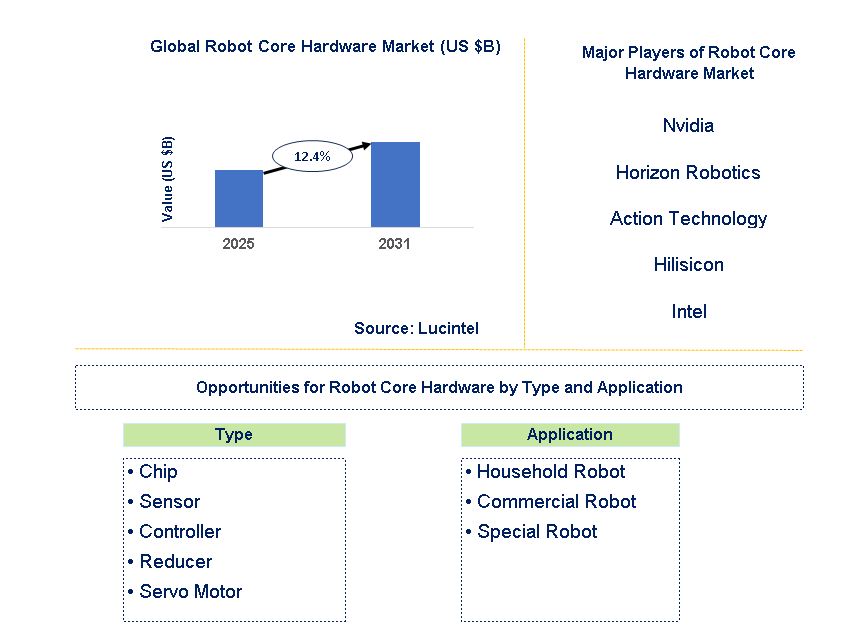
Key data points: The growth forecast = 12.4% annually for the next 7 years. Scroll below to get more insights. This market report covers Trends, opportunity and forecast in robot core hardware market to 2031 by type (chip, sensor, controller, reducer, and servo motor), application (household robot, commercial robot, and special robot), and region (North America, Europe, Asia Pacific, and the Rest of the World)
We'll send your sample report shortly.
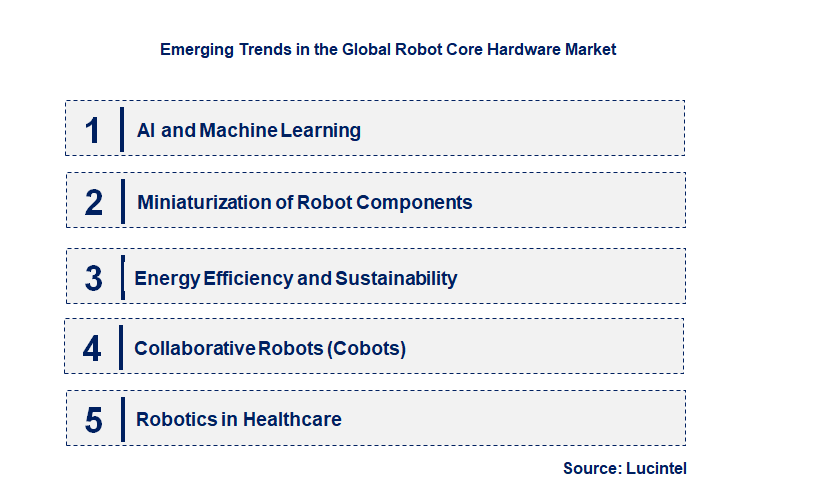
• AI and Machine Learning: Driven Robots become more intelligent, adaptive, and efficient. Through integration of the algorithms into the robots, by using machine learning, they would be able to perform complex tasks better, optimize their movements, and improve performance over time. The whole process is changing directions of manufacturing, healthcare, and logistic industries. Robots are becoming more autonomous and able to work in any dynamic environment.
• Miniaturization of Robot Components: The miniaturization trend for robot components makes robots versatile and adaptable to wide ranges of applications. Smaller and more compact core hardware permits increased mobility, as well as allows usage in space-limited environments, like warehouses and hospitals. This reduces the cost of production and offers a more flexible robot design.
• Energy Efficiency and Sustainability: There is increasing demand for energy-efficient robot core hardware as industries seek to reduce operational costs and environmental impact. Robots with low energy consumption, longer battery life, and efficient power management systems are becoming more sought after. This trend is particularly relevant for mobile robots, which are increasingly used in industries like logistics and healthcare.
• Collaborative Robots (Cobots): The most important trend in the robot core hardware market is the rise of collaborative robots, or cobots. Cobots are designed to work safely with humans in a variety of settings, such as factories or hospitals. Their hardware must be flexible and robust, with advanced sensors and safety features, for seamless human-robot collaboration.
• Robotics in Healthcare: With the world's population aging, the need for robotics in healthcare is on the rise. Robot core hardware is being developed with improved surgical robots, rehabilitation robots, and elderly care robots. Robotic solutions are becoming more specialized as hardware advances enhance precision, safety, and functionality in medical applications, making robots integral to modern healthcare. Emerging trends in the robot core hardware market illustrate the pursuit for greater intelligence, efficiency, and versatility in robotics. The updates on AI, miniaturization, energy efficiency, and collaborative robots are taking the industry into a new wave of revolution in the markets. The market is now enhancing its evolution toward the development of more integrated, flexible, and sustainable robotic solutions. This would lead to changing future robotic hardware components and applications.
• AI and Machine Learning in Core Hardware: One of the most important developments is the integration of AI and machine learning into robot core hardware. This will enable robots to learn from data, adapt to new tasks, and optimize their performance, thus making them more autonomous and capable of handling complex environments. It creates tremendous demand for advanced robot components that support these technologies.
• Miniaturization and Lightweight Materials: The miniaturization of robot core hardware is making robots more compact and lightweight, thus opening up new applications. This trend is most visible in mobile robots and cobots, where space and weight are critical factors. With the use of lightweight materials such as carbon fiber and advanced polymers, robots are becoming more agile and efficient.
• Energy-Efficient Robotics: Energy efficiency is increasingly an important emphasis in the robot core hardware market. Growing demand for cost savings and sustainability make companies develop robots with optimized power management systems, longer battery life, and low energy consumption. In logistics, mobile robots, in particular, are affected strongly by efficient power usage since it reduces operation costs much.
• Growth in Collaborative Robotics: Cobots are increasingly gaining popularity in the market. The new developments focus on the improvement of safety, adaptability, and ease of use. Cobots are designed to work alongside humans in various environments, transforming industries such as manufacturing, healthcare, and logistics with advanced sensors, AI integration, and human-robot interaction capabilities.
• Advancements in Healthcare Robotics: Healthcare robotics is growing at a fast pace. Robot core hardware is being advanced for better medical care. It ranges from enhanced precision surgical robots to rehabilitation robots that can help the patient regain lost capabilities after surgery, and to robots that provide elderly care. The growing age of the world's population is going to increasingly require such technologies in health care across the globe. Recent developments in the robot core hardware market are transforming the capabilities of robots across various industries. AI integration, miniaturization, energy efficiency, collaborative robotics, and healthcare advancements are driving the next phase of innovation. These developments are paving the way for more intelligent, adaptable, and efficient robots, allowing for broader applications and growth in the robotics sector.
• Industrial Automation: The industrial automation sector is an area of huge growth for robot core hardware. As industries are investing in automation to increase efficiency and reduce labor costs, there is a growing demand for advanced robot hardware, such as AI and precision components. Companies can capitalize on this trend by developing specialized robots for different manufacturing applications.
• Healthcare Robotics: With growing demand for healthcare solutions, this is a massive opportunity to further expand the usage of robotics in surgery, rehabilitation, and elderly care. Improvements in robot core hardware are the necessity for bettering medical procedures and outcomes. As healthcare robotics gains momentum, companies can seek new applications and develop products customized to the emerging needs of the healthcare sector.
• Logistics and Warehousing: The industry of logistics has recently started adopting robotics solutions for handling, sorting, and inventorying materials. Some of the significant developments in robotic core hardware that help increase energy efficiency and precision sensing are driving growth in this market. Companies have opportunities to be developed in line with logistics-specific needs; these can primarily be in warehouse automation and operations for the supply chain.
• Service Robots: The market in service robots that are applied for hospitality, retail, and customer care is on the upsurge. Given the increased need for automation by consumers in these service industries, there is the potential for hardware development for optimizing robots in interactions with humans, mobility, and efficiency. The scope of this market is growing, both in design as well as functionality innovation.
• Agriculture and Farming Robotics: Another space where robotics solutions are gradually gaining momentum is agriculture. Robots are being used in farming for the purposes of harvesting, planting, and crop monitoring. Strong core hardware for farming robotics can meet the growing demand for automation in one of the most critical industries. The robot core hardware market provides broad growth opportunities within the industrial automation, healthcare, logistics, service robots, and agriculture sectors. As companies move towards developing advanced hardware solutions tailored to such applications, the market is expected to shift with technological development and growing demands for robotic solutions within each industry. The opportunities are paving the way to the future of robotics in all parts of the world.
• Nvidia
• Horizon Robotics
• Action Technology
• Hilisicon
• Intel
• Qualcomm
• Rockchip
• Chip
• Sensor
• Controller
• Reducer
• Servo Motor
• Household Robot
• Commercial Robot
• Special Robot
• North America
• Europe
• Asia Pacific
• The Rest of the World
• United States: In the United States, the core hardware market of robots is rapidly growing, and the demand for automation in industries like manufacturing, logistics, and healthcare is increasing. Companies are concentrating on developing high-performance robot hardware, incorporating AI and machine learning capabilities. The rise of smart manufacturing and cost-push are driving innovations in core robot components.
• China: China is investing heavily in robot core hardware as part of its quest to become a global leader in robotics. The government's support for automation, especially in manufacturing and industrial applications, is fostering a surge in demand. Companies are developing advanced robots with integrated AI, enabling better precision, efficiency, and adaptability in industries such as electronics, automotive, and healthcare.
• Germany: Precision engineering and industrial automation, dominated by the traditional leader in robotics hardware, Germany, seem to be next on its agenda. Advanced robotic systems have been in demand as Germany has its strong manufacturing sector. Cobots and robot component innovations are among the key investment areas for most German players. The goal is to ensure that robots can share a safe space with humans at factories.
• India: India's robot core hardware market is also growing as a result of increasing adoption of automation in industries like automotive, electronics, and logistics. The market is still developing; however, with the push towards Industry 4.0, the expansion of robotics research is creating demand for advanced robot hardware in India. Manufacturers are focusing on cost-effective solutions to cater to both domestic and international markets.
• Japan: Japan is one of the most advanced markets for robot core hardware, with strong demand across industrial, medical, and service robotics. Japanese companies are leading innovations in humanoid robotics and precision manufacturing. The aging population in Japan is also driving the development of healthcare robots, pushing further advancements in robot core hardware to address the needs of an aging society.


• Nvidia
• Horizon Robotics
• Action Technology
• Hilisicon
• Intel
• Qualcomm
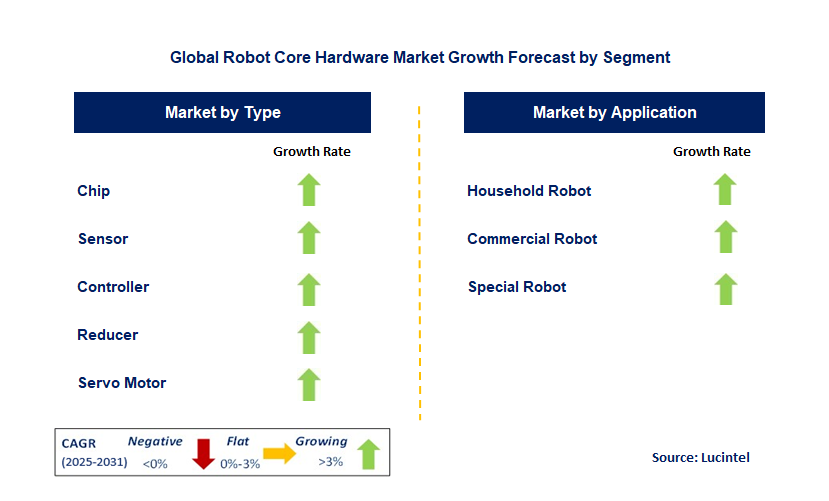
• Rockchip Q5. Which robot core hardware market segment will be the largest in future? Answer: Lucintel forecasts that servo motor is expected to witness higher growth over the forecast period. Q6. In robot core hardware market, which region is expected to be the largest in next 5 years? Answer: APAC is expected to witness the highest growth over the forecast period. Q7. Do we receive customization in this report? Answer: Yes, Lucintel provides 10% customization without any additional cost.


Choose a license that fits your team. Instant PDF delivery.
Prices exclude taxes. Instant delivery. Custom licensing available on request.
Market Report · July 13, 2026
Market Report · July 13, 2026
Market Report · July 2, 2026
Trusted partner for strategic intelligence and business growth


Receive a complimentary market analysis tailored to your industry. Our analysts will identify key growth opportunities and competitive dynamics specific to your business.

Market size, growth rate, and key trend analysis for your specific sector.

Top competitor positioning and market share analysis.

Strategic recommendations backed by data-driven insights.
Get curated market intelligence and competitive moves straight to your inbox.
By subscribing, you agree to receive our monthly insights. Unsubscribe anytime.
Receive a complimentary market analysis tailored to your industry. Our analysts will identify key growth opportunities and competitive dynamics specific to your business.
Market size, growth rate, and key trend analysis for your specific sector.
Top competitor positioning and market share analysis.
Strategic recommendations backed by data-driven insights.
Get curated market intelligence, emerging trends, and competitive moves straight to your inbox each month.
By subscribing, you agree to receive our monthly insights. Unsubscribe anytime.
We'll send your sample report shortly.