
Market Report · July 15, 2026

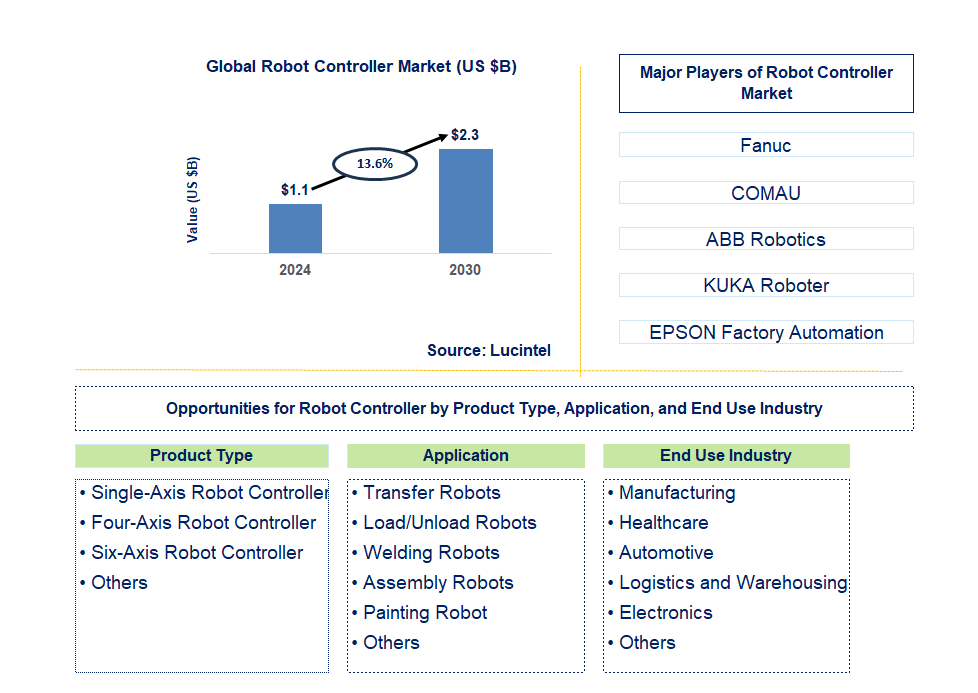
Key data points: The market size in 2030 = $2.3 billion, growth forecast = 13.6% annually for the next 6 years. Scroll below to get more insights. This market report covers trends, opportunities, and forecasts in the global robot controller market to 2030 by product type (single-axis robot controller, four-axis robot controller, six-axis robot controller, and others), application (transfer robots, load/unload robots, welding robots, assembly robots, painting robot, and others), end use industry (manufacturing, healthcare, automotive, logistics and warehousing, electronics, and others), and region (North America, Europe, Asia Pacific, and the Rest of the World)
We'll send your sample report shortly.
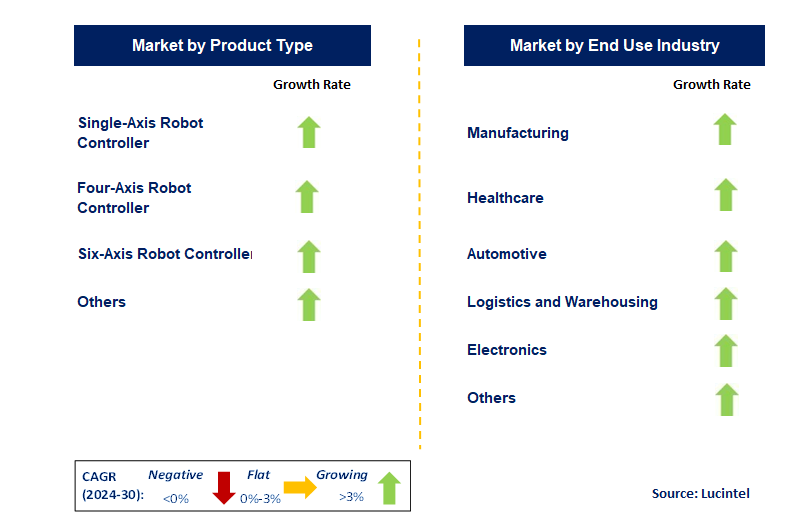
• Lucintel forecasts that, within the product type category, the six-axis is expected to witness the highest growth over the forecast period.
• Within the end use category, manufacturing is expected to witness the highest growth.
• In terms of regions, APAC is expected to witness the highest growth over the forecast period due to rising demand for robot controllers from various end use industries, such as the automotive, electrical, and chemical sectors of the region. Gain valuable insight for your business decisions with our comprehensive 150+ page report.
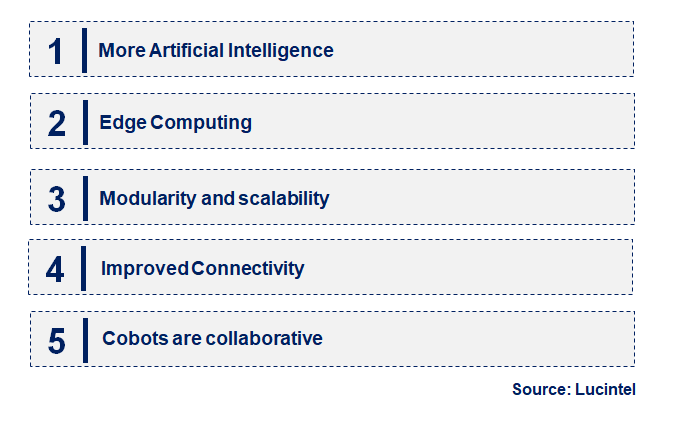
• More Artificial Intelligence: Controllers today boast increased integration of artificial intelligence, allowing for adaptability in learning and decision-making. This trend is improving performance and efficiency in robots, as the controller can optimize operations and interact more effectively with dynamic environments.
• Edge Computing: Edge computing is becoming essential for handling data in real-time for robot controllers. Controllers process data locally rather than relying on central servers, resulting in less latency, improved processing speeds, and generally enhanced responsiveness.
• Modularity and Scalability: These represent current market trends in robot controllers. Such systems are easily scalable and flexible; their maintenance and upgrades can be efficiently managed by manufacturers to meet the particular needs of customers, enhancing efficiency and reducing costs.
• Improved Connectivity: The increased demand for IoT and 5G connectivity is another driver for the development of robot controllers. Better connectivity allows for higher integration with other devices and systems; thus, more sophisticated automation solutions with real-time monitoring are enabled.
• Collaborative Robots: These robots have controllers developed to include enhanced safety features and ease of use. Such advanced controllers can work safely and intuitively alongside human operators, facilitating more effective collaboration between humans and robots across various industries. These trends drive innovation within the Robot Controller market, making operations more efficient and robotic systems more adaptable to diverse industrial needs.
• Integration of AI: Recent advancements in AI have further enhanced robot controllers, making them more intelligent and adaptive. This enables robots to execute complex tasks in dynamic environments, increasing their versatility and capability.
• Advanced Sensors: The introduction of new sensor technology enhances the accuracy and capability of robot controllers. Improved sensors provide better awareness of the environment and more effective control, thereby improving performance and reliability.
• Enhanced Software Platforms: Advancements in software afford more sophisticated capabilities for programming and controlling robots. Newer platforms are user-friendly and support more complex algorithms, enhancing the speed and versatility of operations across various applications.
• Safety Features: Enhanced safety features in robot controllers, such as improved collision detection and better emergency stop functions, are critical for ensuring safe human-robot interaction in collaborative environments.
• Cost Reduction Initiatives: Cost-reduction initiatives in robot controllers are making automation feasible for more industries. Innovations in manufacturing processes and component sourcing provide economic solutions without compromising performance. These developments drive the evolution of the Robot Controller market by enhancing capabilities, improving safety, and making advanced automation solutions more accessible.
• Manufacturing Automation: The wider adoption of automation across industries increases the demand for sophisticated robot controllers. There is a possibility of developing controllers that promise better precision and flexibility, leading to greater efficiency and productivity gains in processes.
• Logistics and Warehousing: The rise of e-commerce creates an end-to-end need for efficient logistics solutions, fostering new opportunities for robot controllers. Solutions that excel in automated sorting, packing, and inventory management contribute to high demand and growth in this segment.
• Health Robotics: The use of robotic systems for surgery, rehabilitation, and assistance is rapidly gaining momentum in the healthcare industry. There is enormous scope for custom-designed controllers for medical robots to execute tasks with high precision, reliability, and safety concerning patients.
• Agriculture: This is one of the largest markets for robotics, automating farmwork such as planting, harvesting, and monitoring crops. Controllers that operate in various and challenging environmental conditions create new possibilities for usage in this segment.
• Consumer Robotics: Emerging consumer robots for home automation and personal assistance significantly increase the demand for economically viable and user-friendly controllers. This market offers a wide field for innovative work to create cost-effective and intuitively operable solutions. These emerging growth opportunities are consolidating in the Robot Controller market, resulting in an extension of applications and an increasing demand for specialized high-performance solutions.
• Technological Advancements: The rapid advancement in robotics and AI improves controller capabilities and makes robots more productive and versatile. Such technologies spur innovation and raise demand for advanced controllers.
• Industrial Automation: This is a key driver pushing for increased automation within industries regarding robot controllers. Automation leads to higher productivity levels and increased efficiency, fueling the need for sophisticated control systems.
• Cost Reduction: Reducing costs increases the viability of automation across more industries. Lower costs drive adoption and expansion into new markets.
• Increased Demand for Customization: More industries are seeking customized automation solutions. Consequently, there is an increased demand for customized controllers for robots, driving development and innovation in controller technology.
• Regulatory Standards: Stringent regulatory standards regarding safety and performance pose challenges for many manufacturers. Compliance with regulatory requirements necessitates ongoing changes and investments in the design and testing of controllers. Challenges in the robot controller market include:
• Integration Complexity: Integrating high-end controllers with existing systems is complex and costly. Compatibility and interoperability may hinder adoption and further integration.
• Market Saturation: Increased competition within the market compels companies to differentiate their offerings, helping customers achieve unique value. Saturation may impact profitability and market share. The aforementioned drivers and challenges are critical factors for assessing the Robot Controller market, influencing technological development, the pace of adoption, and competitive terms.
• Fanuc
• COMAU
• ABB Robotics
• KUKA Roboter
• EPSON Factory Automation
• Yasukawa
• NACHI-FUJIKOSHI
• Stubli Robotics
• Kawasaki Robotics
• OTC
• Single-Axis Robot Controller
• Four-Axis Robot Controller
• Six-Axis Robot Controller
• Others
• Transfer Robots
• Load/Unload Robots
• Welding Robots
• Assembly Robots
• Painting Robot
• Others
• Manufacturing
• Healthcare
• Automotive
• Logistics and Warehousing
• Electronics
• Others
• North America
• Europe
• Asia Pacific
• The Rest of the World
• United States: Advanced robot controllers are in high demand in the U.S. market due to increased automation in manufacturing and logistics. Companies are investing heavily in AI-integrated controllers to enhance precision and efficiency in their processes, aligning with the broader trend toward smart manufacturing.
• China: China continues to lead in adopting robot controllers due to extensive automation in industries such as electronics and automotive. The focus is on developing cost-effective, high-performance controllers to maintain a competitive advantage and cater to domestic demand.
• Germany is focusing on Industry 4.0, driving innovations in controllers to connect with IoT for real-time data and predictive maintenance. The German market is concentrating on high-precision and modular controllers to support its advanced manufacturing industry.
• India: The country is experiencing growth in the robot controller segment by investing in the automation of industries such as automotive and electronics. Recent introductions include low-cost and easy-to-operate controllers aimed at increasing automation levels in SMEs.
• Japan has consistently been at the forefront of robotics technology, particularly in developing advanced and multifunctional controllers for high-tech applications in manufacturing and healthcare industries. Developments focus on increasing the dexterity and adaptability of robot controllers.


• Fanuc
• COMAU
• ABB Robotics
• KUKA Roboter
• EPSON Factory Automation
• Yasukawa
• NACHI-FUJIKOSHI
• Stubli Robotics
• Kawasaki Robotics
• OTC Q6. Which robot controller market segment will be the largest in future? Answer: Lucintel forecasts that six-axis is expected to witness the highest growth over the forecast period. Q7. In robot controller market, which region is expected to be the largest in next 5 years? Answer: In terms of regions, APAC is expected to witness highest growth over the forecast period due to rising demand for robot controller from various end use industries, such as automotive, electrical, and chemical sector of the region. Q.8 Do we receive customization in this report? Answer: Yes, Lucintel provides 10% customization without any additional cost.


Choose a license that fits your team. Instant PDF delivery.
Prices exclude taxes. Instant delivery. Custom licensing available on request.
Market Report · July 15, 2026
Market Report · July 13, 2026
Market Report · July 13, 2026
Trusted partner for strategic intelligence and business growth


Receive a complimentary market analysis tailored to your industry. Our analysts will identify key growth opportunities and competitive dynamics specific to your business.

Market size, growth rate, and key trend analysis for your specific sector.

Top competitor positioning and market share analysis.

Strategic recommendations backed by data-driven insights.
Get curated market intelligence and competitive moves straight to your inbox.
By subscribing, you agree to receive our monthly insights. Unsubscribe anytime.
Receive a complimentary market analysis tailored to your industry. Our analysts will identify key growth opportunities and competitive dynamics specific to your business.
Market size, growth rate, and key trend analysis for your specific sector.
Top competitor positioning and market share analysis.
Strategic recommendations backed by data-driven insights.
Get curated market intelligence, emerging trends, and competitive moves straight to your inbox each month.
By subscribing, you agree to receive our monthly insights. Unsubscribe anytime.
We'll send your sample report shortly.